Walk into a good boutique and the person who helps you isn't reading you a returns policy. They're sizing you up in the friendliest way: the occasion, the budget you'll admit to, the colours you keep drifting toward and forty minutes later you're leaving with a full look you didn't plan to buy. That's a personal shopper. It's also the single hardest thing to reproduce online, and it's exactly what the current wave of AI is finally getting right.
An AI personal shopper for fashion is a conversational stylist that lives inside your store. It takes a vague, human request" something for a rooftop wedding in July, nothing too fussy" asks the one or two questions a real stylist would, and comes back with a complete, shoppable outfit from your live catalogue. Not 47 filtered results. A look, with a reason.
The brands doing this aren't running experiments for the press release. Victoria Beckham saw a 20% lift in average order value and 10% revenue growth after deploying Alhena's shopping assistant. Fashion is leading adoption of AI shopping agents, and it's not hard to see why clothing is the category where "help me decide" is worth the most.
This is a breakdown of the six agents that make an AI personal shopper actually work for a fashion store, what each one does, the results brands are seeing, and how to pick a platform without getting sold a support bot in a stylist's clothing.
What is an AI personal shopper (and how is it different from a chatbot)?
An AI personal shopper you'll also see it called an AI stylist or AI shopping assistant is a conversational agent embedded in your store that guides a shopper from "I'm just looking" to checkout through natural back-and-forth. It reads an open request, asks smart follow-ups, and recommends complete outfits from what you actually have in stock.
The difference from a generic chatbot is specialization, and it's a big one. A chatbot answers "where's my order?" and "what's your return policy?" useful, ticket-shaped work. An AI personal shopper does that and builds outfits, advises on fit, runs visual search, coordinates colour, and turns the conversation into a sale. One closes tickets. The other closes carts.
The way Alhena's fashion solution pulls this off is worth understanding, because it explains why it works: instead of one AI trying to be good at everything, it runs a team of specialist agents. A Style Assistant runs the conversation. An Outfit Builder assembles the looks. A Fit and Size Advisor handles sizing off real body data. Each one is a specialist, which is how you get advice that feels considered instead of generic.
The 6 agents behind an AI personal shopper for fashion
A strong AI stylist isn't a single clever bot. It's a set of agents, each owning a piece of the journey. Here's how each one works.
How does an AI stylist build outfits and complete-the-look suggestions?
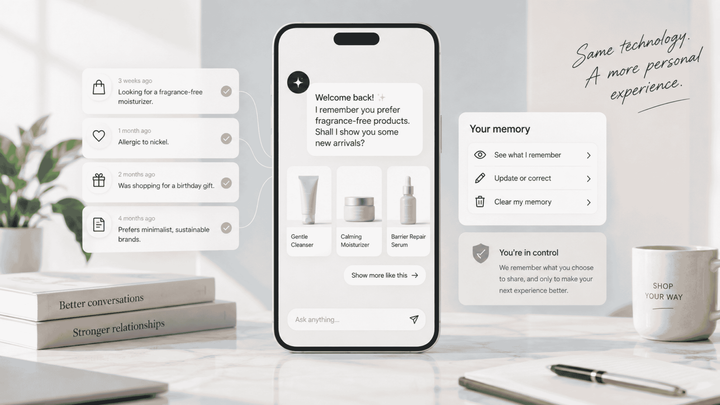
Start with the front of house. The Style Assistant is the agent the shopper talks to — it reads intent and chats like someone who actually knows clothes, across web and mobile. It picks up the context a good stylist would: occasion, budget, colours, body type, the vibe someone's going for.
Say a shopper types, "I need something casual but put-together for a weekend away." The Style Assistant doesn't bury them in results. It asks one sharpening question, then offers two or three curated looks with a line on why each works. Every reply nudges the conversation toward a decision instead of away from one.
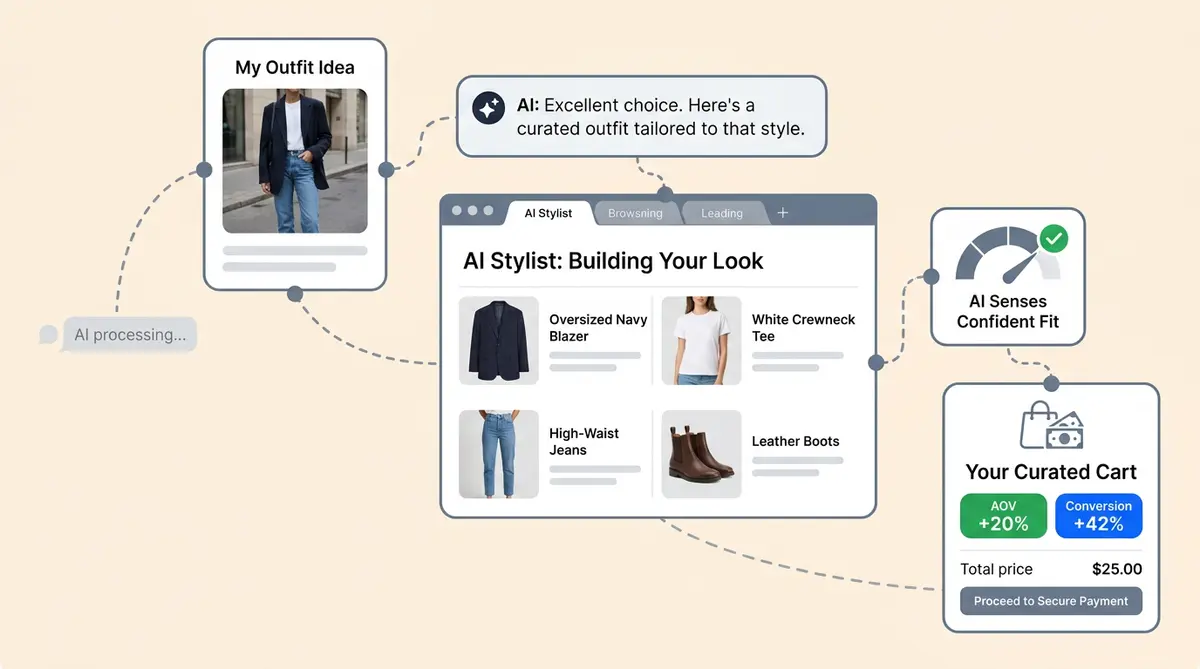
Then the Outfit Builder Agent does the part shoppers find hardest — assembling a full look on request. On Shopify (and WooCommerce, Magento, and Salesforce Commerce Cloud), it layers pieces together, balances colour and silhouette, and explains why the set works. Specifically it:
- Assembles complete outfits from your live product catalogue
- Factors in occasion, season, price range, and fabric preferences
- Suggests the shoes and accessories that finish the look — and grow the cart
- Honours your merchandising rules, so it pushes the SKUs you actually want moved
- Leads with a short summary, then lets the shopper expand for the full styling rationale
This is Alhena's Complete the Look in practice: contextual bundles and accessory pairings that lift average order value because they're genuinely useful, not bolted-on upsells.
How does the Fit and Size Advisor reduce returns?
Sizing doubt is the quiet killer in fashion ecommerce. It's the top reason shoppers hesitate and the leading reason they send things back. The Fit and Size Advisor combines a shopper's body data with SKU-level dimensions to recommend the right size for that garment — not a generic chart.
When someone's between an 8 and a 10, the advisor knows whether that particular brand runs large or small and adjusts. It's reading product-level sizing, fabric stretch, and fit notes, not sending people off to a one-size-fits-all guide.
That matters to the P&L. Fashion return rates run well above the ecommerce average — a meaningful share of it driven by fit — so anything that gets size right before checkout protects margin directly. (Worth measuring against your own baseline: return reduction varies a lot by category and how much fit data you feed the advisor.)
How does virtual try-on work — and does it actually reduce returns?
Virtual try-on is the confidence step. Instead of guessing from a flat product photo, the AI uses body data, purchase history, and product dimensions to show a shopper how a garment is likely to sit on their frame before they buy.
Does it reduce returns? Directionally, yes — reducing fit uncertainty before checkout is one of the more reliable levers on both returns and conversion, which is why the big players keep investing in it. The honest caveat: the size of the effect depends on your category (structured tailoring behaves differently from knitwear), your imagery, and how much fit data the tool has. Treat vendor averages as a starting hypothesis and measure your own.
A few of the try-on questions I hear most from fashion brands, answered plainly:
- Best virtual try-on that works from a single selfie? Look for tools that generate a fit visualisation from one uploaded photo plus body inputs, rather than requiring a 3D scan — that's the difference between shoppers using it and ignoring it.
- Can I get try-on and fit/size in one platform? Yes — and you want that. Try-on that shows the look, paired with a Fit and Size Advisor that recommends the number, is far stronger than either alone. In Alhena, both live on the product page via Embeddable Agents.
- Try-on for jewelry and accessories? The same visual approach extends to accessories, though execution quality varies more here than with apparel — test it on your actual SKUs before committing.
- How accurate is it across body types and skin tones? This is the right question to ask any vendor, and the answer should be specific, not reassuring. Ask to see it on a range of body types and tones on your products, not a demo reel.
- Does it slow down my Shopify store? A well-built embed loads asynchronously and shouldn't drag your page speed. Ask how the snippet loads before you install it.
How does visual search turn inspiration into a purchase?
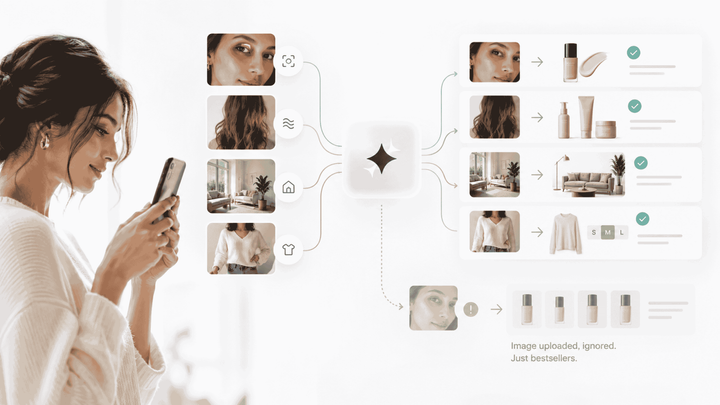
Shoppers find clothes everywhere — a screenshot from Instagram, a Pinterest board, a stranger's outfit. The Upload and Match agent lets them snap or upload a photo and find the closest pieces in your catalogue in seconds.
It reads the image for colour and palette, pattern and print, silhouette and cut, and style category, then surfaces the nearest matches from live inventory. It turns "I want that" into "here's what we have that's close" without the shopper needing the words for it — which is where a lot of fashion intent quietly dies on a normal search bar.
How does colour analysis make recommendations feel personal?
Colour is the most personal part of getting dressed, and the easiest for generic tools to butcher. The Color Analyzer suggests palettes and prints that flatter, based on the shopper's stated preferences and the thread of the conversation.
If someone says they lean warm, or asks what goes with the navy blazer already in their cart, the analyzer factors it in. Paired with the Outfit Builder, it's the reason a suggested look reads as cohesive rather than "three things that were in stock." It also keeps people browsing longer, because coordinated exploration is more fun than scrolling a grid.
What results are fashion brands actually getting?
Fashion is the vertical showing the strongest AI-driven conversion gains, and the case studies bear it out. Verified results from brands running Alhena:
- Victoria Beckham: 20% higher average order value, 10% increase in total online revenue
- Tatcha: 3x conversion rate, 38% AOV uplift, 11.4% of total site revenue attributed to AI
- Puffy: 63% of inquiries resolved automatically, 90% CSAT
- Crocus: 86% deflection rate, 84% CSAT
The reason these hold up is measurement. Alhena's revenue attribution tracks which conversations lead to purchases, what the AI-assisted average order value is, and how much revenue the assistant actually influences — so this isn't "engagement went up," it's dollars you can point at.
AI personal shopper vs. a generic chatbot: the honest comparison
Most chatbot platforms grew up as support tools. They're built to answer questions and close tickets, and they're fine at it. They just weren't built to sell clothes. Here's the difference where it counts:
- Outfit building: An AI personal shopper builds complete, shoppable looks. A support chatbot recommends single products from a basic feed.
- Fit guidance: A Fit and Size Advisor uses body data and SKU dimensions. A support chatbot links to a static size chart.
- Visual search: Upload and Match finds items from a photo. Most support bots don't do image search at all.
- Colour matching: A Color Analyzer coordinates palettes and prints. Support bots don't touch colour.
- Checkout: Agentic checkout fills the cart, pre-fills fields, and applies eligible discounts inside the chat. Most bots hand off to the standard checkout page.
- Revenue tracking: A purpose-built assistant reports revenue attribution. Support bots report deflection.
To be fair to the support tools: Zendesk deflects tickets well, and Fin AI (now part of Salesforce) is strong on support automation. They're good at what they were built for. They just don't ship a Fit and Size Advisor or visual search, because that was never the job. Tidio and Gorgias sit in the same bucket — solid for service, thin on the fashion-specific agents that move revenue.
For a fashion, apparel, or clothing brand, the real question isn't AI or no AI. It's whether your AI understands fashion or treats your store like any other help desk.
We run a mid-sized fashion store and want AI assistants to recommend our items. What should we do?
This is one of the smartest questions a fashion brand can ask right now, because shoppers increasingly ask ChatGPT, Gemini, and Perplexity for outfit ideas and product picks — and you want to be in that answer. Two moves, in order:
- Put a real AI personal shopper on your own store. When your site can build outfits, nail fit, and answer styling questions in natural language, you're generating the structured, useful, conversion-ready experience that keeps shoppers on-site instead of bouncing to a marketplace. That's the foundation.
- Make your catalogue legible to AI. Clean product data, clear structured markup, genuine reviews, and content that answers real buyer questions ("what to wear to X," "what pairs with Y") are what AI engines pull from when they recommend products. If you sell an outcome — "an outfit for a summer wedding" — write and structure your site around that outcome, not just the SKU.
The brands that win the AI-recommendation game are the ones whose own experience is already stylist-grade. It's the same investment, working twice.
How to deploy an AI personal shopper on your fashion store
Standing this up takes under 48 hours, no developers required. The path:
- Connect your catalogue. Alhena integrates with Shopify, WooCommerce, Magento, and Salesforce Commerce Cloud. Product data, inventory, pricing, and sizing sync automatically.
- Train it on your brand voice. Upload your voice guidelines, knowledge base, and policies so it sounds like your team, not a stock bot.
- Configure the agents. Set Outfit Builder rules, Fit Analyzer parameters, Color Analyzer preferences, and product-boost priorities from the dashboard.
- Go live across channels. Start on web chat, then extend to Instagram DMs, WhatsApp, email, and voice. Context follows the shopper from channel to channel.
- Measure and tune. Track conversion, AOV impact, and revenue attribution, and A/B test agent configurations to see what actually performs.
It also runs alongside your existing helpdesk. If you're on Zendesk or Gorgias, the AI handles discovery and sales conversations while your humans take the hard support cases, with Agent Assist drafting suggested replies your team can send in a click.
Why a fashion-specific AI beats a horizontal tool
Fashion has needs a general-purpose bot doesn't meet. Shoppers browse by occasion, mood, and aesthetic — not just category and price. They need fit advice tuned to specific brands and bodies. They want to see the whole outfit, not an isolated product card.
A horizontal chatbot can answer "where's my order?" all day. It can't layer a knit over a silk cami, choose trousers that balance the line, and add the right accessories — all while respecting your merchandising priorities. That's the gap a purpose-built AI shopping assistant fills: fashion-specific agents that carry a shopper from "I need something for a friend's wedding" to a finished checkout.
Personalisation is worth real money here — brands that personalise the shopping experience consistently see meaningful revenue uplift, and fashion is one of the categories where it pays off most, because so much of the purchase is taste and confidence.
Conclusion
An AI personal shopper for fashion runs on specialist agents — a Style Assistant, an Outfit Builder, a Fit and Size Advisor, virtual try-on, Upload and Match visual search, and a Color Analyzer — that together walk a shopper from a vague idea to a full, confident purchase. The Outfit Builder grows carts. The Fit Advisor protects margin. Visual search catches intent that keyword search misses. And it's all measurable, down to the revenue each conversation drives.
Pick the tool that actually understands clothes, and give your shoppers the kind of help that feels like walking into their favourite store — the version that never closes.
Book a demo with Alhena AI or start free with 25 conversations.
Frequently Asked Questions
What is an AI personal shopper for fashion ecommerce?
An AI personal shopper (also called an AI stylist or AI shopping assistant) is a conversational agent embedded in your store that guides shoppers through discovery, outfit building, fit advice, and checkout using natural dialogue. Unlike a generic chatbot that only handles support queries, it uses specialist agents for styling, sizing, visual search, and colour. Alhena's version runs six purpose-built agents across web chat, email, Instagram DMs, WhatsApp, and voice.
How does an AI stylist build outfits and complete-the-look suggestions on Shopify?
Alhena's Outfit Builder Agent assembles full outfits from your live Shopify catalogue by combining pieces that work together on occasion, season, colour, and silhouette. It respects your merchandising rules and the shopper's stated preferences, leads with a short summary, and lets shoppers expand for the full styling rationale then add the whole look to cart in one click, which lifts average order value.
What's the best AI virtual try-on app for a Shopify fashion store?
The best fit for most fashion brands is virtual try-on bundled into a full AI shopping assistant rather than a standalone app — so try-on works alongside fit/size advice, outfit building, and checkout in one place. Look for try-on that works from a single customer selfie plus body inputs, loads without slowing your store, and can show results across a range of body types and skin tones on your actual products.
Can I get virtual try-on plus fit and size recommendations in one platform?
Yes, and you should want both together. Try-on shows how a garment looks; a Fit and Size Advisor recommends the right number using body data and SKU-level dimensions. Alhena runs both on the product page via Embeddable Agents, so a shopper can see the look and get the size in the same flow.
How much does an AI virtual try-on tool cost per month for a small clothing brand?
It varies by vendor and volume. Standalone try-on apps price separately, while an all-in-one AI shopping assistant folds try-on into one platform — often better value for a small brand than stitching point tools together. Alhena starts free with 25 conversations, then moves to custom pricing based on your store's volume.
How accurate is AI virtual try-on across different body types and skin tones?
Accuracy varies by vendor, so treat this as a due diligence question, not a given. Ask any provider to demonstrate try-on on a genuine range of body types and skin tones using your own products, not a curated demo reel. The strongest tools pair visualisation with real fit data rather than relying on a single idealised model.
Can an AI personal shopper reduce fashion return rates?
Yes. Sizing uncertainty is the top driver of fashion returns, and a Fit and Size Advisor tackles it by combining shopper body data with SKU-level dimensions and brand-specific fit patterns to recommend the right size before purchase. Return reduction varies by category and how much fit data you provide, so track it against your own baseline.
How does visual search work for fashion brands?
Alhena's Upload and Match lets a shopper upload a photo from Instagram, Pinterest, or their camera roll. The AI reads it for colour, pattern, silhouette, and style, then surfaces the closest matches from your live inventory turning "I want that" into a purchase without the shopper needing to describe it in words.
We run a mid-sized fashion store and want AI assistants to recommend our items what should we do?
Two things. First, put a real AI personal shopper on your own store so your experience is stylist-grade and keeps shoppers on-site. Second, make your catalogue legible to AI engines with clean product data, structured markup, genuine reviews, and content built around outcomes ("what to wear to X"). The brands that get recommended by AI are usually the ones whose own experience is already excellent.
How is an AI personal shopper different from Zendesk or a support chatbot for fashion brands?
Zendesk and support-first tools are built for ticket deflection and FAQs — good at service, but they don't include fashion-specific agents like the Outfit Builder, Fit and Size Advisor, Color Analyzer, or visual search. An AI personal shopper is built for ecommerce sales: it guides discovery, builds outfits, and closes sales in chat, and it reports revenue attribution rather than just tickets resolved.