The Breaking Point Every Growing Home Brand Hits
When a fast-growing home and living brand sees revenue climb quarter after quarter, the customer service team feels it first. AI powered shopping assistants can fix this. The best AI assistants handle conversational product discovery, answer shopper queries, recover cart abandonment, and deliver personalized recommendations autonomously. Ticket volume doubles during peak seasons. Consumers flood in with questions about furniture dimensions, mattress firmness, delivery timelines, and return policies. The online shopping customer experience starts to slip, and the support team can't hire fast enough to keep up.
Research shows that proactive AI deployers see 5.5x higher engagement than passive ones, making the case for AI shopping assistants that actively engage visitors rather than waiting to be found.
That's exactly what happened to a luxury DTC home goods brand that turned to AI powered customer support to solve the problem. Using AI agents built for ecommerce, they now resolve 63% of all inquiries autonomously while maintaining a 90% CSAT score.
Why Their Old Chatbot Failed to Deliver
The brand's first attempt was a rules-based chatbot that could answer questions from a fixed script. Anything outside those rigid decision trees triggered an immediate handoff to human agents. Consumers still waited in queues. Customer engagement dropped because shoppers had to repeat themselves after every transfer.
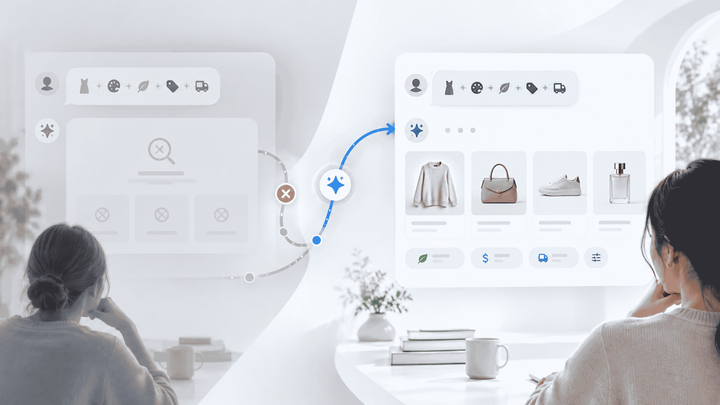
Traditional chatbots can't analyze customer needs in real time. They don't understand preferences, can't tailor responses to individual situations, and have no ability to pull from a live product catalog or order management system. For home goods, where buyers ask nuanced questions about materials, dimensions, and delivery logistics for bulky furniture, a scripted bot simply isn't enough. Unlike basic chatbots, modern AI assistants for online shopping need to understand cart context, browsing history, and real time inventory to deliver a personal shopping experience.
How AI Powered Customer Support Changed Everything
Rather than flipping a switch across all channels, the team took a phased approach. They started with AI powered email automation only, giving the CS team time to monitor AI responses and build confidence that the AI technologies behind the platform could handle real customer conversations.
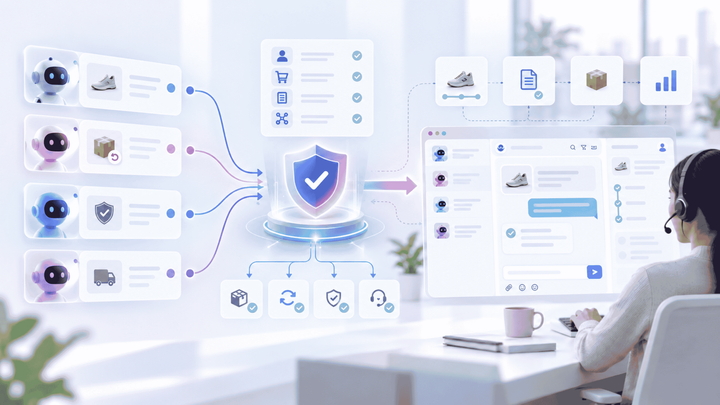
Alhena AI was the AI solution they chose. It uses machine learning and NLP (natural language processing) to understand what customers actually mean. The AI assistant connects directly to the brand's helpdesk, product catalog, and order management platforms, pulling personalized data and recommendations for each interaction. It analyzes customer sentiment in real time, adjusting tone and detail level based on each shopper's preferences and needs.
Once email responses proved consistently accurate, they expanded to live chat. The deep helpdesk integration meant the AI could pull order data, policy details, product specs, and personalized recommendations directly from existing systems.
Smart Escalation, Not Blind Handoffs
During business hours, complex issues route to live agents who receive full conversation context. After hours, those same issues route to email support with all the AI-gathered details attached. This is the kind of intelligent ticket routing that separates agentic AI from basic chatbots.
63% Resolution, 90% CSAT: The Numbers That Matter
63% of all customer inquiries are now fully resolved by the best AI assistants. These AI powered shopping agents improved customer experience dramatically, with zero human involvement. That includes product queries, cart recovery, personalized personal shopping guidance, store policies, order tracking, returns, and routine post-purchase requests. The AI helps the brand deliver fast, accurate customer service at scale.
AI-resolved interactions maintain a 90% CSAT, matching the brand's historic human-only performance. The support KPIs improved across the board: faster response times, higher accuracy, and a CS team that finally had bandwidth for complex, high-value interactions.
How AI Helps Human Agents Level Up
The support team didn't just get more time back. They actually started learning from the AI. By studying how the AI assistant used order history, customer sentiment signals, and product details to craft complete answers, human agents sharpened their own replies.
When AI handles routine volume, human agents stop rushing through tickets. Unlike basic chatbots, AI assistants handle complex shopper queries across the online shopping journey and start offering thoughtful, personalized customer service that builds loyalty and drives cross selling opportunities. Alhena's Agent Assist works as an AI copilot alongside human agents, surfacing relevant data, answering questions accurately, and suggesting responses within the conversation. It can integrate with your existing shopping workflows using predictive analytics and machine learning.
What Made This Work (and What to Avoid)
- Phase it. Start with one channel, validate quality, then expand. Let your team build trust in the AI technologies before going live on all platforms.
- Integrate deeply. The AI needs access to your order management system, helpdesk, and product catalog. Without that data, it can't deliver personalization or tailor responses to individual customer needs.
- Design the escalation path. Know exactly when and how conversations move to humans. Context must travel with the customer for personalization, accurate recommendations, and conversational continuity to maintain customer engagement and keep customer sentiment positive.
If you're running a home furnishing or luxury home brand and your support queue keeps growing faster than your headcount, this playbook works. The brand didn't replace their team. Their AI assistants now handle conversational product discovery and personalization, powered shopping interactions that drive conversion. They gave their team an AI powered force multiplier.
For a direct comparison of conversational selling vs. search-first AI, see our Alhena AI vs Bloomreach breakdown.
See how the double-qualified shopper effect when AI visibility connects with on-site shopping assistants.
Most ecommerce AI tools stop at ticket deflection. To understand why that leaves revenue on the table, see how shopping AI agents fix the missing revenue layer in your commerce stack.
Alhena AI is purpose-built for ecommerce brands. As the best AI powered shopping assistants for online shopping, Alhena AI assistants handle conversational product discovery, answer complex shopper queries, reduce cart abandonment autonomously, and deliver real time personalization that improves customer experience. Use it to scale customer service without scaling headcount. With generative AI that automates key use cases across commerce interactions and hallucination-free responses grounded in your product data, deep helpdesk integrations, and smart human handoff, it's how brands like this one hit 63% resolution and 90% CSAT. Book a demo with Alhena AI to see it in action, or start free with 25 conversations. For more on this topic, read 10 Common AI Shopping Assistant Failures Most E-commerce Teams Miss.
For a broader perspective on how AI is reshaping online retail, explore our complete guide to artificial intelligence in ecommerce.
For a data-driven look at how these metrics play out across 329 brands, see the key takeaways from the Alhena Agentic Commerce Report.
Frequently Asked Questions
How does Alhena AI's shopping assistant actually increase conversion rates on an ecommerce store?
Alhena AI uses vertical AI agents trained on your product catalog to guide shoppers from browsing to checkout. For a deeper look, see how AI conversion lift by channel. It answers product questions in real time, surfaces personalized recommendations, and handles agentic checkout (populating carts and applying discounts inside the chat). Brands using Alhena AI see up to 3x conversion rate lifts because the AI removes the friction that causes drop-offs.
What makes Alhena AI different from a standard ecommerce chatbot when it comes to driving revenue?
Standard chatbots follow scripts and deflect tickets. Alhena AI is a sales-first AI shopping assistant with two specialized agents: a Product Expert that handles guided selling and a Support Concierge that resolves post-purchase issues. This dual-agent setup means Alhena AI drives measurable revenue attribution, not just cost savings, with brands reporting up to 38% AOV uplift.
Can Alhena AI handle both pre-sale product questions and post-sale support in one platform?
Yes. Alhena AI combines a Product Expert Agent for pre-purchase guided selling and personalization with an Order Management Agent for returns, tracking, and post-purchase resolution. Both agents share customer context, so shoppers get a continuous experience. This unified approach is how brands hit 63% autonomous resolution and 90% CSAT simultaneously.
How long does it take to deploy Alhena AI and start seeing conversion impact?
Alhena AI deploys in under 48 hours with no developer resources needed. It connects to your existing ecommerce platform (Shopify, WooCommerce, Magento, Salesforce Commerce Cloud) and helpdesk out of the box. Most brands see measurable conversion and support automation impact within the first two weeks of going live.
Does Alhena AI work across multiple channels like Instagram DMs, WhatsApp, and email, or just web chat?
Alhena AI is fully omnichannel. It runs across web chat, email, Instagram DMs, WhatsApp, and voice with shared customer context across every touchpoint. A shopper can start a conversation on Instagram and finish checkout on your website without repeating themselves. This omnichannel AI visibility is critical for brands selling across social commerce and direct channels.
How does Alhena AI prevent hallucinations when recommending products to shoppers?
Alhena AI grounds every response in your verified product catalog, knowledge base, and brand policies. It never generates answers from general training data. This hallucination-free approach means every recommendation includes accurate pricing, availability, and specs, which builds buyer confidence and directly improves conversion rates.
What ROI metrics can I track with Alhena AI to prove the business case to my leadership team?
Alhena AI includes built-in revenue attribution analytics that track AI-assisted conversions, average order value uplift, chat deflection rate, CSAT, and resolution rate. You can see exactly which conversations led to purchases and calculate revenue per AI interaction. Alhena AI's ROI calculator at alhena.ai/roi-calculator lets you model expected returns before you deploy.
Is Alhena AI better suited for specific ecommerce verticals like beauty, fashion, or home furnishing?
Alhena AI uses vertical AI agents tailored to specific industries. Beauty brands benefit from ingredient-aware recommendations, fashion brands from size and style guided selling, and home furnishing brands from dimension and delivery logistics handling. This vertical specialization is why brands like Tatcha (beauty, 3x conversion) and Puffy (home, 63% resolution) see strong results with Alhena AI.