Why Ticket Routing Is Still Broken in Ecommerce
Every misrouted support ticket costs time, money, and customer trust. A shopper writes in about a damaged shipment, and the ticket lands with the wrong team. By the time it reaches the right agent, the customer is already frustrated. Multiply that across hundreds of daily tickets, and the problem compounds fast.
Under manual systems, 30 to 40 percent of support tickets are misrouted on the first assignment. Each wrong handoff eats into SLA deadlines and pushes resolution times well beyond what customers expect. For ecommerce brands juggling seasonal surges and multichannel inquiries, manual ticket management does not scale.
AI ticket routing fixes this by using natural language processing, sentiment analysis, and skill-based matching to send every ticket to the right agent with the right context. This guide covers how an AI-powered ticket system works, why ecommerce brands should use AI for routing, and how Alhena AI goes further by resolving tickets before they ever need routing.
What Is AI Ticket Routing?
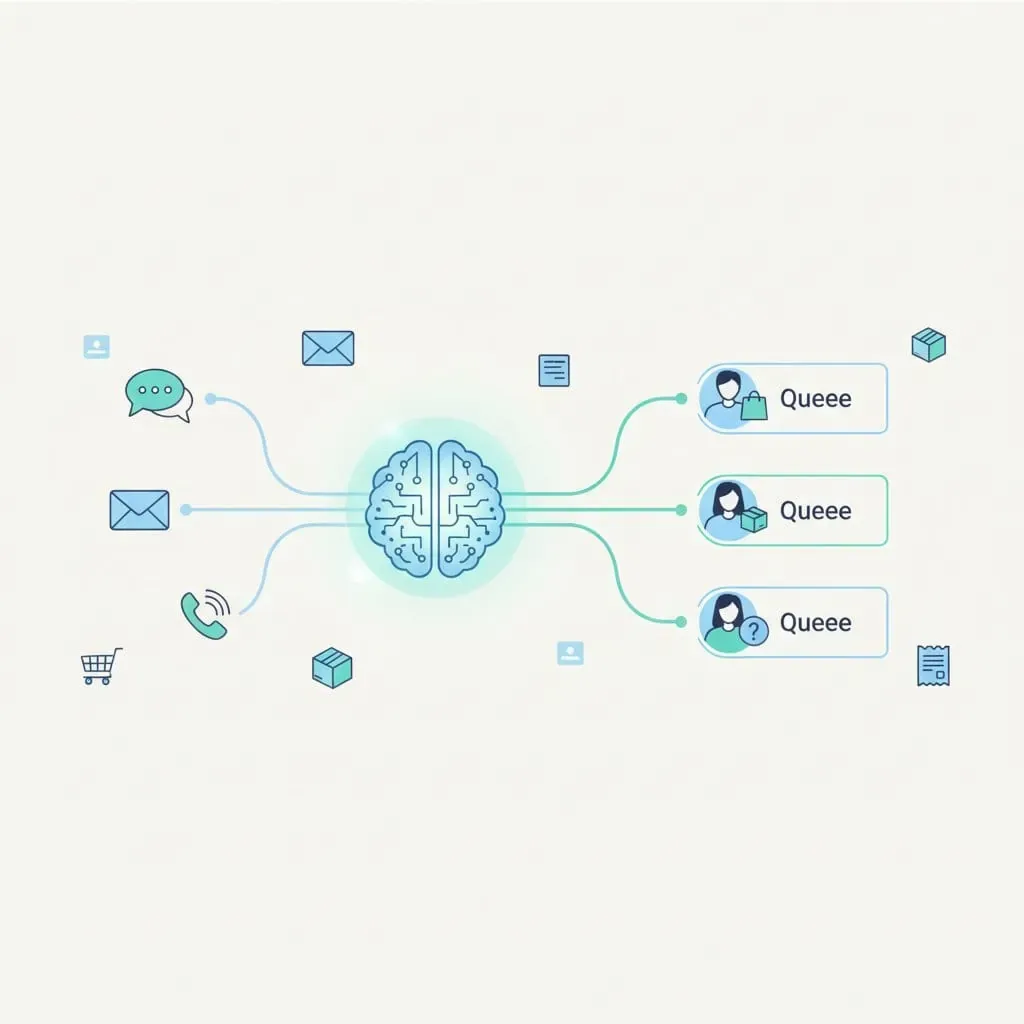
AI ticket routing uses machine learning and NLP to automatically classify, prioritize, and direct incoming support tickets to the best-suited agent or support team. Unlike rule-based ticket systems that match keywords to queues, an AI-driven ticket system understands what the customer actually means.
A customer typing "I want my money back" and another typing "this product doesn't work, what are my options?" both express a returns intent. A keyword-based ticket system catches the first but misses the second. AI classification handles both because it reads intent, not just words.
Rule-based systems use static conditions and break the moment customers phrase issues differently. AI routing learns from historical tickets instead. It adapts to new phrasings, detects urgency through sentiment, and factors in agent workload. The ticket system becomes more effective with every resolved interaction, no manual rule-writing required.
How AI Ticket Routing Works
AI ticket routing follows a multi-step pipeline that transforms raw customer messages into precise assignments.
Ingestion and preprocessing: When a new ticket arrives from any channel, email, live chat, WhatsApp, or phone, the ticket system normalizes the text. Named entity recognition extracts key details like order numbers and product names to feed downstream steps.
Intent classification: NLP models categorize each ticket into predefined categories: order status, returns, product questions, shipping issues, and pre-sale inquiries. The ticket system trains on thousands of historically labeled tickets, so it can categorize "where's my package?" and "tracking says delivered but I don't have it" as different intents — even though both mention a package.
Sentiment and priority scoring: The AI scores customer emotion alongside ticket severity, customer lifetime value, SLA windows, and complexity. High-urgency complaints get elevated automatically. Low-urgency inquiries during volume spikes may be deferred. This multi-factor scoring ensures the most impactful tickets get attention first.
Skill-based assignment: The classified ticket gets matched to the best available agent based on expertise, workload, and resolution history. For a beauty brand, a skincare question goes to a specialist, not a generalist.
Escalation and continuous learning: When confidence is low, the ticket system will escalate to a senior agent. If sentiment deteriorates mid-conversation, it re-routes automatically. Every resolved ticket feeds back into the model, improving categorization accuracy without manual updates.
Why Ecommerce Brands Need AI Ticket Routing
Ecommerce faces customer support challenges other industries do not face at the same scale.
Seasonal volume spikes: Customer support inquiries spike 200 to 300 percent during peak shopping seasons. You cannot triple your support team for a two-week window. AI routing deflects repetitive queries, order tracking, return policies, and streamlines complex issues to human agents, delivering real efficiency gains.
Product expertise matching: A fashion brand needs agents who understand sizing. A beauty brand needs agents who know ingredients. AI detects the product category and routes to the agent with matching expertise, cutting the back-and-forth that slows resolution.
Pre-sale vs. post-sale routing: These workflows require fundamentally different skills. Pre-sale questions need product knowledge. Post-sale tasks need service management access and process knowledge. Misrouting between them costs time and potential sales.
Omnichannel consistency: Customers start on WhatsApp, continue on web chat, and expect resolution over email, without repeating themselves. AI ticket routing unifies context across channels so the ticket follows the customer, not the inbox.
The financial impact: Manual ticket handling costs upwards of $20 per interaction. AI-powered automation brings ecommerce support costs down dramatically — contributing to a 30 percent reduction in cost per ticket. When most consumers will switch brands after just one bad customer experience, slow routing damages customer satisfaction directly. Pairing routing logic with <a href="https://alhena.ai/blog/ai-sentiment-analysis-ecommerce/">real-time sentiment analysis</a> adds an emotional intelligence layer that catches frustrated customers before they escalate.
Where Most AI Ticket Systems Fall Short
Most support platforms treat routing as a cost-reduction function only. They sort tickets and direct them to agents, but do not connect the ticket system to revenue outcomes. A pre-sale question about a $300 jacket gets the same triage priority as a password reset. They also struggle with omnichannel context — customer data sits across chatbots and backend platforms with limited interoperability. For brands that view customer support as a revenue channel, basic ticket system logic is not enough. You need agentic AI solutions built for commercial context.
How Alhena AI Handles Ticket Routing for Ecommerce
Alhena AI takes a fundamentally different approach to ticket system design. Instead of sorting tickets into queues, Alhena's agentic multi-agent ticket system resolves most inquiries automatically before a human ever sees them. Tickets that do require a person arrive with full context, correct classification, and the right priority.
Multi-agent orchestration: Alhena uses specialized agentic AI agents that work together within a unified ticket system. The Product Expert Agent handles pre-sale questions with deep product knowledge, recommending items, comparing options, and populating carts. The Order Management Agent tackles post-purchase issues like tracking, returns, and cancellations by connecting directly to your order system. Conversations transfer between agents without losing context, and the entire workflow runs seamlessly across your support team.
Intelligent routing beyond triage: Alhena's ticket system automatically directs conversations to the right agent, AI or human, based on intent, sentiment, and complexity. Simple inquiries resolve instantly through self-service automation. Complex cases escalate to your support team through Agent Assist, which provides a full conversation summary and suggested responses. This streamlines the entire workflow, Manawa saw response time drop from 40 minutes to 1 minute after deployment.
Hallucination-free accuracy: Unlike generative AI tools that can fabricate answers, Alhena grounds every response in its knowledge base of verified product data, order records, and approved company policies. Every answer is traceable. Puffy achieved 90 percent customer satisfaction with 63 percent automated inquiry resolution, while Crocus hit an 86 percent deflection rate at 84 percent CSAT.
Revenue-aware routing: Alhena recognizes when a "support" ticket is actually a sales opportunity. A customer asking "does this come in blue?" is one answer away from buying. Alhena's AI Shopping Assistant identifies these moments proactively and guides the conversation toward conversion. Tatcha saw a 3x conversion rate and 38 percent average order value uplift, with 11.4 percent of total site revenue attributed to AI-assisted conversations.
Omnichannel with unified memory: Alhena operates across web chat, email, Instagram DMs, WhatsApp, and voice, maintaining full conversation context regardless of channel. Whether through self-service or agent-assisted resolution, a customer who starts on Instagram and follows up via email never repeats themselves. peak season support challenges see our full guide.
The Future of AI Ticket Routing in Ecommerce
AI ticket routing is evolving fast. Gartner predicts that agentic AI will autonomously resolve 80 percent of common customer service issues by 2029, reducing operational costs by 30 percent. The trajectory is clear: AI won't just route tickets faster; it will eliminate the need for tickets altogether.
Three trends are shaping this shift:
- Proactive ticket prevention: AI monitors order pipelines, payment systems, and shipping data to identify and resolve issues before customers even notice them. A delayed shipment triggers an automatic notification with updated tracking, before the customer writes in.
- Voice AI integration: Voice-based AI support is advancing rapidly. 74 percent of consumers say AI that understands and responds to their voice would improve their experience, according to the Zendesk CX Trends 2025 report.
- Unified AI channels: Gartner predicts 30 percent of Fortune 500 companies will offer service through only a single AI-enabled channel by 2028, collapsing omnichannel complexity into one intelligent interface.
For ecommerce brands, the question isn't whether to adopt AI ticket routing. A Gartner survey of 321 customer service leaders found that 91 percent are under executive pressure to implement AI in 2026. The real question is whether your AI just routes tickets or actually resolves them.
Related: Learn how AI creates richer ticket artifacts before routing even begins.
Ready to move beyond basic ticket routing and turn your support into a revenue channel? Book a demo with Alhena AI or start for free with 25 conversations.
Frequently Asked Questions
What happens when an AI ticket system cannot handle a customer issue on its own?
Alhena AI's agentic ticket system recognizes when an issue requires human judgment. It hands the conversation to your team through its Assist feature, delivering the full interaction history, customer profile, and a suggested reply. The person picking up continues mid-conversation without the customer repeating anything. This streamlined handoff keeps response time low and customer satisfaction high, while the AI logs the interaction to improve future ticket management accuracy.
Can AI-powered ticket routing work alongside my existing Zendesk or helpdesk?
Yes. Alhena AI layers on top of your current helpdesk, Zendesk, Freshdesk, Gorgias, or others, through pre-built integrations. The AI ticket system adds AI-powered classification, service management, and revenue attribution without disrupting your existing workflow. Your support team keeps using the same tools while Alhena streamlines the triage, prioritization, and ticket management behind the scenes. Most brands go live in under 48 hours.
How does an AI ticket system improve efficiency during Black Friday and seasonal surges?
AI-powered automation absorbs the surge. Alhena AI's ticket system handles repetitive inquiries, order tracking, return policy questions, shipping updates, through self-service resolution, so your team only sees complex cases. The agentic AI can triage, prioritize, and address thousands of requests per hour without degrading the customer experience. Brands using Alhena report handling 3 to 4x volume spikes without extra headcount and with no drop in efficiency.
What should ecommerce leaders look for when choosing an AI ticket routing solution?
Prioritize five things: does the AI ticket system use machine learning to learn from your data, or just follow static rules? Does it connect to your knowledge base and product catalog for real-time answers? Does it offer agentic capabilities, meaning it takes action, not just answers questions? Can it streamline workflows across your ecommerce platform? And does it measure revenue impact, not just deflection? Alhena AI checks all five. Use AI that drives outcomes, not just automation.
Does Alhena AI use machine learning to get more accurate at routing over time?
Yes. Alhena's agentic AI continuously learns from every interaction. Its models refine how they classify intent, detect sentiment, and prioritize inquiries based on real customer data from your store. Every new request that passes through the AI ticket system makes the classification and triage more precise, without your team writing rules or updating workflows.
Can AI ticket routing handle pre-sale product questions or only post-sale customer support?
Both, and this is where Alhena AI differs from most AI ticket systems. Its Product Expert capability answers pre-sale questions with deep product knowledge, recommends items, compares options, and populates carts through agentic checkout. Its Order Management capability handles post-sale use cases like tracking, returns, and cancellations. Both streamline the workflow and reduce repetitive work across your team. Whether it is a pre-sale or post-sale inquiry, Alhena's AI-powered ticket system assigns it through the right path automatically.
How does Alhena AI prevent hallucinated or wrong answers in automated customer support?
Every response Alhena generates is grounded in your verified knowledge base, product data, order records, and approved company policies. Unlike generative AI tools that fabricate responses, Alhena's AI-powered system only speaks when it has confirmed data to reference. If confidence is low, the agentic system hands off to your team instead of guessing. This approach delivered 90 percent customer satisfaction at Puffy while handling 63 percent of their volume through AI, proving you can use AI without sacrificing accuracy or customer experience.
What is the difference between basic chatbot automation and Alhena AI's agentic AI ticket system?
Standard chatbots follow scripted decision trees and break when customers phrase things unexpectedly. Alhena AI's agentic ticket system understands natural language processing, takes real actions in your ecommerce platforms, learns from each interaction through machine learning, and drives revenue, not just deflection. It can streamline service management, handle repetitive tasks, and proactively address issues. It is the difference between a static FAQ page and an AI-powered ticket system that sells and improves the customer experience on its own.