Why Email Is Ecommerce's Hardest Support Channel to Automate
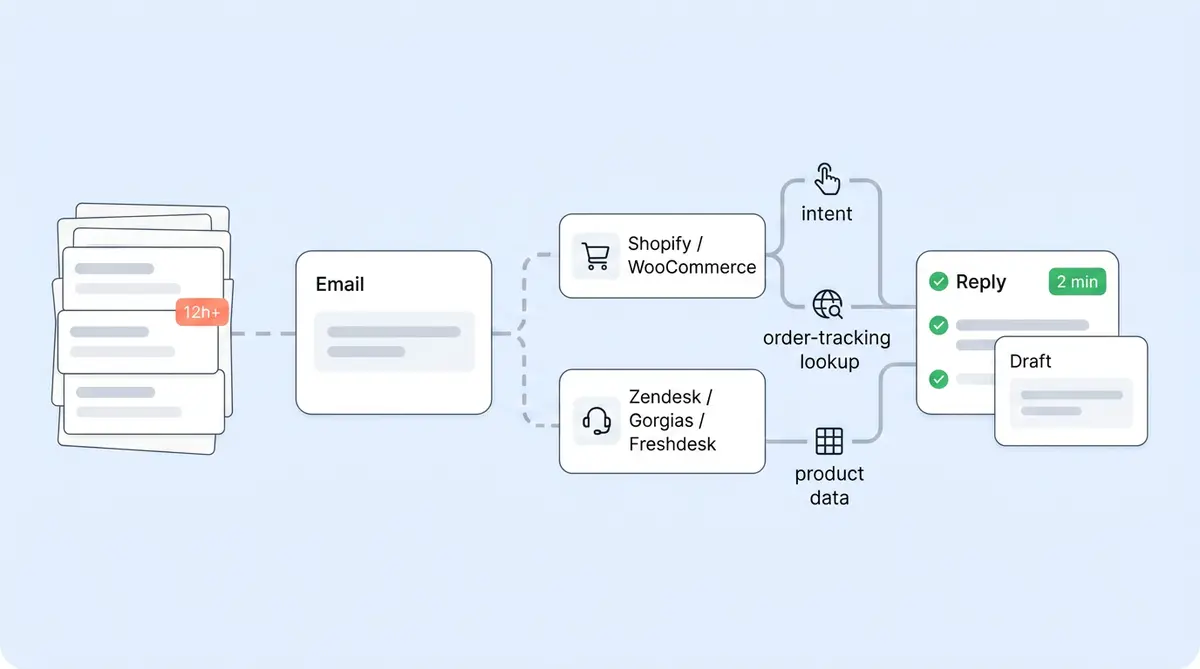
The average ecommerce email takes 12 hours and 10 minutes to get a first response, according to Timetoreply research. In retail, that number climbs to 17 hours. Meanwhile, 60% of users define "immediate" as 10 minutes or less.
That gap is where revenue disappears. A user asking "Does this jacket come in petite?" at 9 PM won't wait until tomorrow. They'll buy from the brand that answers first.
Email is fundamentally different from live chat. Messages are longer, often containing two or three questions in a single thread. Customers forward old order confirmations, attach photos of damaged items, and reference conversations from weeks ago. A chat widget handles quick, one-turn questions well. Email requires the AI to parse multi-part requests, maintain threading context, and take real action that drives engagement (not just reply with a link to the FAQ page).
That's why generic chatbot tools struggle with email. They were built for short, synchronous exchanges. AI email assistant and automation software for e-commerce needs a different architecture: one that reads complex messages, pulls live store data, and resolves issues end-to-end.
How AI Email Automation Works in Ecommerce
AI email automation connects three systems: your store platform, your helpdesk (or shared inbox), and an AI email assistant trained on your brand's data. When a customer email arrives, the AI uses three core features to process it.
Step 1: Intent Detection and Order Matching
The AI reads the full email, including forwarded threads and attachments. It identifies the customer's intent (return request, product question, shipping inquiry) and extracts key data points like order numbers, SKUs, or tracking IDs. Modern AI email automation software detects intent with over 95% accuracy on routine e-commerce queries.
Step 2: Live Data Retrieval from Your Store
Once intent is clear, the AI connects to your ecommerce backend through API features and integrations. On Shopify, it pulls order status, shipping carrier updates, and product availability in real time. On WooCommerce, it accesses customer purchase history and inventory data. On Salesforce Commerce Cloud, it reads account details and fulfilment records. No guessing, no hallucinated tracking numbers. Data security is built in with encrypted connections and scoped access controls.
Step 3: Response Generation with Brand Voice
The AI can write a response grounded in verified data and matched to your brand's tone. If the customer asked about a return, the reply includes their specific order details, your return window, and a prepaid label link. If they asked about sizing, the response pulls from your actual product catalog, not a generic guess.
The best AI email automation systems offer a draft-and-review mode where AI drafts are checked where your team approves drafts before they send. Once confidence is high, you can switch specific automations to full auto-resolve for each ticket category.
Five Ecommerce Email Workflows AI Handles Best
Not every email needs a human. These five categories represent the features most support teams need automated, making up 60 to 70% of most online store support inboxes, and AI handles all of them well.
1. Order tracking and shipping updates. "Where is my order?" accounts for 30 to 40% of all online support tickets. AI pulls the tracking number, uses predictive tracking and checks the carrier API, and replies with the current status and estimated delivery date. Cost per resolution drops from $8 to $15 (human email) to $0.50 to $2 (AI), based on 2026 industry benchmarks.
2. Returns and exchanges. The AI checks if the item falls within your return plan and policy, confirms eligibility, generates a return label, and sends instructions. For brands processing hundreds of returns monthly, this alone can improve the customer experience and cut return handling time by over 60%.
3. Product questions before purchase. Sizing guides, material details, compatibility checks, "will this fit my space?" questions. AI pulls answers directly from your product catalog data, so responses are accurate and specific. This is where email automation drives revenue, not just deflection. A fast, helpful answer to a pre-sale question converts browsers into buyers and turns inquiries into qualified leads. This is one of the most valuable features of AI email automation.
4. Subscription and account management. Pause, cancel, swap, update payment method. AI reads the request, verifies the customer's identity, and executes the change through your subscription platform. No back-and-forth emails asking for account details the customer already provided.
5. Post-purchase follow-ups. Review requests, cross-sell recommendations based on purchase history, and proactive delivery delay notifications. AI automates these at scale while keeping the messaging personalized to each customer for maximum engagement's order.
What Generic Email Tools Get Wrong About Ecommerce
Most AI email automation software was built for SaaS help desks or general business email. They can summarize a thread and suggest a reply. But they don't know what an SKU is, can't look up an order, and have no concept of a return policy.
Here's where the gaps show up:
- ChatGPT and Copilot plugins generate fluent responses but have no connection to your store data. They'll confidently tell a customer their order shipped when it hasn't.
- Zendesk AI and Freshdesk Freddy handle ticket routing and suggested replies well, but they weren't designed to execute transactions. They can't process a return, check inventory, or populate a cart.
- Email marketing tools like Klaviyo and Mailchimp automate outbound campaigns, not inbound support. Different problem entirely.
- Generic automation platforms require extensive custom workflow building. You're essentially coding the AI's behavior from scratch for every ticket type.
Email automation for online stores needs an AI that's grounded in your product catalog, connected to your order system, with features capable of taking action, not just drafting text. That's the difference between a reply tool and an AI agent.
How Alhena AI Automates Ecommerce Email Support
Alhena AI was purpose-built for ecommerce, not retrofitted from a general-purpose helpdesk software. Its features are designed specifically for online retail. Its Product Expert Agent and Order Management module work together across email, web chat, Instagram DMs, WhatsApp, and voice to handle the full customer journey with smart automations.
For email specifically, Alhena connects directly to your store platform and helpdesk. On Shopify, it reads order data, inventory levels, and customer profiles through native integration. On the helpdesk side, it works with Zendesk, Gorgias, Freshdesk, and Intercom to pull tickets, respond, and resolve.
Key features that set Alhena apart from generic email software:
- Hallucination-free answers. Every answer is grounded in your verified product data, order records, and knowledge base. Alhena won't invent a tracking number or make up a return policy.
- Agentic actions, not just replies. Alhena can process returns, populate carts, pre-fill checkout, and update subscriptions through email, not just suggest what a human rep should do.
- Revenue attribution features. Built-in analytics show exactly how much revenue AI-powered email conversations generate, not just how many tickets were deflected.
- 48-hour deployment is one of the standout features. No dev resources needed. Alhena ingests your product catalog, past tickets, and knowledge base automatically and goes live in days.
The results speak for themselves. Manawa cut response times from 40 minutes to 1 minute and automated 80% of inquiries. Crocus hit an 86% deflection rate with 84% customer satisfaction. Puffy automated 63% of inquiries while maintaining 90% customer satisfaction. These aren't chat-only numbers; they include email automation across the full support stack.
Setting Up AI Email Automation on Your E-commerce Stack
Getting started with AI email automation doesn't require a months-long implementation. Here's what the setup looks like for the two most common store platforms.
Shopify + Helpdesk Setup
Connect your Shopify store to your helpdesk (Zendesk, Gorgias, or Freshdesk). Then connect Alhena to both. Alhena pulls your product catalog, order history, and existing knowledge base articles automatically. Set email as an active channel, configure your automations, configure your brand voice and tone, and start in draft mode where AI drafts go to your team so they can review AI replies before they reach customers. Most Shopify brands plan to move to full automation within two weeks once confidence scores stabilize above 95%.
WooCommerce + Helpdesk Setup
The process is similar for WooCommerce stores. Connect your WooCommerce instance, sync your product data and customer records, and link your helpdesk. WooCommerce's open-source flexibility means you can also build custom automations connecting subscription plugins and third-party fulfilment tools through Alhena's API. For brands running WooCommerce with Freshdesk, Alhena bridges the gap between your store data and your support inbox so the AI has full context for every email.
What You Need Before Going Live
- A product catalog synced with your e-commerce platform
- At least 30 days of past support tickets (email and chat) for training
- Return, shipping, and exchange policies documented in your knowledge base
- Brand voice guidelines (tone, language, escalation rules)
- Data security and compliance requirements documented
With these in place, Alhena's AI can be handling email tickets within 48 hours. You can check estimated savings before you start with the ROI calculator.
Measuring ROI from AI Email Automation
The business case for AI email automation in ecommerce is straightforward. Here are the metrics that matter and the benchmarks to aim for.
Cost per resolution. Human email support costs $8 to $15 per contact, and most email issues need three to four exchanges to resolve, pushing actual cost per interaction and resolution to $24 to $60. AI email automation brings that down to $0.50 to $2 per resolution for routine queries. For a brand handling 5,000 email tickets per month, automating 60% of them saves $36,000 to $87,000 annually.
First response time. The industry average is 12+ hours. AI responds in under 2 minutes. Speed, efficiency, and team productivity matter: 90% of customers rate an immediate response as essential when they have a support question.
Deflection rate. The percentage of tickets fully resolved by AI without human intervention, increasing overall productivity. Top businesses using Alhena hit 60 to 86% deflection, with Tatcha seeing a 3x conversion rate increase alongside 82% chat deflection.
CSAT score. AI doesn't hurt satisfaction when it's done right. Puffy maintains 90% CSAT with 63% automation. Crocus holds 84% CSAT at 86% deflection. The key: hallucination-free responses grounded in real data, not generic canned templates.
Revenue per AI conversation. This is where retail-focused AI email automation pulls ahead of generic support tools. Alhena's built-in revenue attribution tracks when an AI email interaction leads to a purchase. Tatcha attributes 11.4% of total site revenue to AI-assisted conversations, and Victoria Beckham saw a 20% increase in average order value.
Companies investing in AI customer service see an average return of $3.50 for every $1 spent, with top performers hitting 8x ROI. The pricing page and ROI calculator can help you model your specific numbers.
Start Automating Ecommerce Email Support Today
AI email automation isn't experimental anymore. Online businesses that automate their email support cut costs by 50%+, respond faster, in minutes instead of hours, and boost customer engagement and turn support conversations into revenue. The brands that wait will keep losing customers to faster competitors.
Ready to see how AI email automation works on your store's real data? Book a demo with Alhena AI or start free with 25 conversations to test it on your own tickets.
Frequently Asked Questions
What is AI email automation for ecommerce?
AI email automation for ecommerce uses artificial intelligence to read, understand, and respond to customer support emails automatically. The AI connects to your ecommerce platform (Shopify, WooCommerce, Magento) and their apps to pull real order data, product details, and customer history, then can write accurate answers in your brand voice. It handles routine queries like order tracking, returns, and product questions without human intervention.
How much does AI email automation save online retailers?
Human email support costs $8 to $15 per contact, with most issues needing 3-4 exchanges ($24-$60 per resolution). AI email automation reduces this to $0.50-$2 per resolution. For a brand handling 5,000 email tickets monthly and automating 60%, that translates to $36,000 to $87,000 in annual savings. Companies see an average return of $3.50 for every $1 invested in AI customer service.
How fast can AI respond to ecommerce support emails?
AI email automation responds to customer emails in under 2 minutes, compared to the industry average of 12 hours and 10 minutes for human agents. In retail specifically, human email response times average 17 hours. Alhena AI customer Manawa cut their response time from 40 minutes to 1 minute across all support channels including email.
Can AI email automation handle returns and refund requests?
Yes. AI email automation can verify return eligibility against your store's return policy, check the order date and item condition requirements, generate prepaid return labels, and send step-by-step instructions. Alhena AI's Order Management module processes returns end-to-end without human intervention for straightforward cases, while escalating complex situations to your support team with full context.
How does AI email automation differ from email marketing automation?
Email marketing automation (Klaviyo, Mailchimp) handles outbound campaigns like abandoned cart reminders and promotional emails. AI email automation handles inbound customer support, reading and responding to individual customer questions about orders, products, returns, and account issues. They solve completely different problems and work best when used together.
Does AI email automation work with Shopify and WooCommerce?
Yes. Alhena AI integrates natively with Shopify and WooCommerce, pulling product catalogs, order data, customer profiles, and inventory levels in real time. It also connects to helpdesks like Zendesk, Gorgias, Freshdesk, and Intercom where your email tickets live. Setup takes under 48 hours with no developer resources required.
Will AI email responses hurt my customer satisfaction scores?
Not when the AI is grounded in real data. Puffy maintains 90% CSAT while automating 63% of inquiries. Crocus holds 84% CSAT at 86% deflection. The key is using AI that pulls from verified product and order data rather than generating generic responses. Hallucination-free AI like Alhena ensures every answer is accurate and specific to the customer's situation.
How is Alhena AI different from Zendesk AI or Freshdesk Freddy for email?
Zendesk AI and Freshdesk Freddy were built for ticket routing and agent assistance. They suggest replies but can't execute transactions like processing returns, populating carts, or updating subscriptions. Alhena AI is purpose-built for ecommerce with agentic capabilities, meaning it takes action on behalf of the customer. It also includes revenue attribution analytics that track when AI email conversations lead to purchases.
What do I need to set up AI email automation for my online store?
You need four things: a synced product catalog from your ecommerce platform, at least 30 days of past support tickets for training, documented return/shipping/exchange policies in your knowledge base, and brand voice guidelines. With these in place, Alhena AI can be handling email tickets within 48 hours. Start in draft mode so agents review AI responses before switching to full automation.