The Real Question: Do You Need Better Search or a Better Salesperson?
Bloomreach has spent over a decade building one of the strongest site search and merchandising engines in e-commerce. Its Loomi AI powers site search, product recommendations, personalization, and search recommendations, AI-powered product recommendations, personalized product recommendations, and real time product personalization for 850+ retailers, earning a Leader spot (alongside Yext and other search vendors like Yext). Yext in Gartner's 2025 Magic Quadrant for Personalization Engines. Its product recommendations engine is well-established, with deep analytics for search performance and site analytics. That's a track record worth respecting.
But the way shoppers find products is changing fast. Gartner predicted that traditional search volume would drop 25% by 2026 as AI chatbots and virtual agents take over. Meanwhile, AI-powered chat delivers 4x higher conversion rates than traditional search (12.3% vs. 3.1%), and 76% of online buyers now say they want AI shopping assistants to improve the customer experience on the sites they visit.
So the Alhena AI vs Bloomreach question isn't really about which tool is "better." It's about which approach fits where commerce is heading: search-first discovery or conversational selling. This guide breaks down both platforms, feature by feature, so you can decide which one matches your growth strategy.
Alhena AI vs Bloomreach: At a Glance
Before digging into the details (and if you’re also comparing Klaviyo, Voyado, Klevu, or Algolia, we’ll touch on those too), here's a side-by-side snapshot of how the two platforms compare across the capabilities that matter most for commerce retailers.
| Alhena AI | Bloomreach | |
|---|---|---|
| Core Focus | Conversational selling + support | Site search + merchandising |
| AI Approach | Dialogue-first product discovery | Search-first with Clarity add-on |
| Channels | Web, email, Instagram, WhatsApp, voice | Web only (Clarity); SMS/WhatsApp for marketing |
| Post-Purchase Support | Built-in (orders, returns, cancellations) | Requires separate helpdesk |
| Checkout Assistance | Agentic: populates carts, pre-fills forms | No checkout assistance |
| Deployment | Under 48 hours, no dev resources | 3-6 months, $4K+ setup |
| Pricing | Free tier + usage-based plans | $19K+/yr per module, enterprise retailers and large retailers only |
| Revenue Attribution | Built-in: tracks AI-generated revenue | Search analytics only, limited chat analytics and attribution |
Two Different Starting Points for Product Discovery
Bloomreach was built around site search. Formerly known as the Bloomreach digital experience Cloud (now Bloomreach digital experience and Commerce Cloud or Bloomreach Experience Cloud). The experience cloud concept defines their approach. Its core product, Bloomreach Discovery, combines the cloud-based Loomi AI engine with merchandising rules for marketing teams to process search queries, rank results, and apply personalization to what visitors see on category and product pages. It supports semantic search in 33+ languages, visual search, visual merchandising tools, visual product displays, visual AI search results, and AI-powered merchandising rules that let marketing teamss, visual merchandisers, and marketing teams, e-commerce and digital marketing teams and marketing teams at enterprise retailers jointly control which products surface for specific queries.
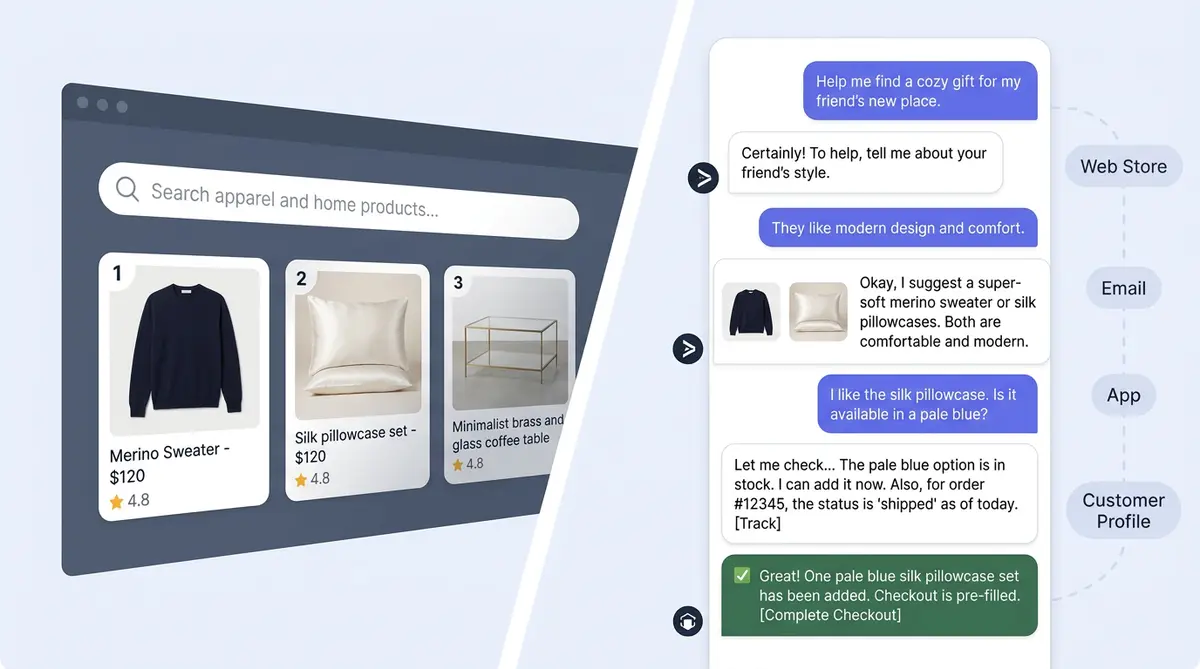
This approach works well when shoppers know what they're looking for. Type "blue running shoes size 10" into a Bloomreach-powered search bar, and you'll get accurate, well-ranked results. The problem? Only 14% of consumers rate retailers' search and discovery experiences as excellent. And 63% of zero-result queries use subjective or use-case language ("something for a beach wedding" or "gift for a picky teenager") that keyword-based search can't handle. We explored this gap in depth in our analysis of the e-commerce discovery gap.
Alhena AI starts from the opposite end. Instead of waiting for a search query, Alhena's Product Expert Agent, Alhena’s standout feature. Alhena’s standout capability (and standout differentiator), opens a conversation. It asks clarifying questions, understands context ("I have oily skin and I'm looking for a lightweight moisturizer under $40"), and guides customers to the right product through dialogue, similar to an online sales associate. Every recommendation is grounded in verified product data, so the AI never invents features or suggests items that don't match.
The difference shows up in the numbers. Brands using Alhena's conversational approach report 3x conversion rates and up to 50% higher average order values. Tatcha, for instance, saw a 38% AOV uplift after deploying Alhena, with 11.4% of total site revenue flowing through the AI shopping assistant, transforming the customer experience.
What About Bloomreach Clarity?
To its credit, Bloomreach recognized the conversational shift. In March 2025, it launched Clarity, an AI conversational shopping agent built on top of the Engagement platform. Early results from The Foschini Group (TFG) during Black Friday were promising: 39.8% higher revenue per visit, 35.2% higher conversion, and 28.1% lower exit rate.
Those numbers are real. But Clarity has some important constraints to consider.
Web-only (for now). Clarity lives on your website. App support is expected in H1 2026, but it doesn't operate natively on WhatsApp, Instagram DMs, SMS, or voice. If your customers reach out on social channels or prefer phone calls, Clarity can't help them.
Sales only, not support. Bloomreach explicitly designed Clarity for shopping conversations. Less than 1% of interactions involve customer service. That means you still need a separate helpdesk (Zendesk, Gorgias, Freshdesk) to handle order tracking, returns, cancellations, and post-purchase question automation and self-service resolution.
Requires Bloomreach Engagement, which operates as a marketing automation and CMS content management and marketing automation system. Clarity isn't a standalone product. It creates a new project within Bloomreach Engagement (which includes a customer data platform (CDP), orchestration hub, and customer data platform for enterprise retailers), meaning you need the broader marketing automation and customer data platform to use it. Bloomreach positions this customer data platform as a unified orchestration layer for enterprise retailers. That adds cost and complexity if you're not already a Bloomreach customer.
No checkout assistance. Clarity helps shoppers find products, but it doesn't populate carts or pre-fill checkout forms. The handoff from conversation to purchase still requires the shopper to navigate your website's standard checkout flow.
Where Alhena AI Goes Further
Alhena was purpose-built as a conversational selling platform for e-commerce, not a search engine that added chat. That architectural difference shows up in several ways.
Unified Sales and Support in One Agent
Alhena doesn't split the customer experience into separate shopping and support tools. The same AI handles product discovery, guided selling across the full customer journey, order tracking, returns, cancellations, and post-purchase questions. When a shopper asks "where's my order?" mid-conversation, Alhena's Order Management Agent pulls real time real time order status from Shopify, WooCommerce, Magento, or SAP Commerce Cloud (SAP) without switching commerce platforms. Puffy, the mattress brand, uses this unified, omnichannel approach (covering web, email, social, and voice channels) to resolve 63% of inquiries automatically while maintaining 90% CSAT through a single Alhena deployment.
True Omnichannel Conversations
Alhena provides true omnichannel coverage (not just omnichannel marketing automation workflows) across web chat, email, Instagram DMs, WhatsApp, and voice. A shopper can start a conversation on Instagram ("love this dress, do you have it in green?"), continue on your website, and follow up by email, all without repeating themselves. Every touchpoint stays connected, unlike listing tools such as Yext that only handle directory presence. Bloomreach handles WhatsApp and SMS through its Engagement platform, but those are marketing automation and orchestration and campaign channels (campaigns, broadcasts, SMS marketing and Klaviyo-style push notifications, triggered push notifications, scheduled push notifications, and product recommendations), not real time conversational selling. Alhena’s real time approach or real time product guidance.
Agentic Checkout
When a shopper says "add all three to my cart," Alhena doesn't just recommend. It populates the cart and pre-fills checkout on Shopify and other commerce platforms. This removes friction at the most critical moment in the customer journey, as our cart-to-checkout conversion analysis showed. Bloomreach Clarity surfaces product recommendations, but the shopper still has to manually add items and complete checkout through your standard flow.
Hallucination-Free AI
Both platforms use AI to generate responses, but Alhena takes a different approach to accuracy. Every response is grounded in your verified product catalog, knowledge base, and brand policies. Built-in analytics track every conversation’s revenue impact, giving you real time analytics and real time reporting on what drives sales. The AI doesn't make up product features, invent promotions that don't exist, or recommend out-of-stock items. For brands in regulated categories like beauty, health, or food (with GDPR, GDPR and data privacy, and GDPR compliance built in. GDPR readiness and GDPR compliance matter for retailers and online retailers selling across the EU), this matters. Victoria Beckham uses Alhena precisely because it can trust the AI to represent its products correctly, resulting in a 20% AOV increase without any accuracy concerns.
48-Hour Deployment vs. 3-6 Months
Bloomreach reviewers consistently note that full implementation takes 3 to 6 months. Setup costs start at $4,000+, and you'll need dedicated developers, front-end developers, API developers, platform developers, and technical resources. Alhena deploys in under 48 hours with no dev work or SAP consultants. Its API connects to your commerce platform (Shopify, WooCommerce, Magento, or Salesforce Commerce Cloud). Whether you run Shopify, Shopify Plus, or WooCommerce, it helpdesk, and CRM in minutes. No custom API development needed. The Alhena API handles product sync, order data, and conversation history automatically. Compare that to Bloomreach’s API, which requires custom integration work. The AI uses pre built, no-code API connectors (all pre built and tested) to train on your product catalog and knowledge base automatically, so you can go live while Bloomreach is still in the onboarding phase.
Pricing: Enterprise-Only vs. Accessible
Bloomreach doesn't publish pricing, but industry data puts the starting cost at $19,020/year per module for Shopify stores, with enterprise customers paying $50,000 to $430,000+ annually (per Insider, Business Insider, and industry reports) depending on modules and usage. Some retailers also layer on retail media and retail media networks capabilities, which adds another cost line. Clarity requires the Engagement platform, so you're paying for both. Setup fees start at $4,000, and reviewers on G2 have noted that Bloomreach sometimes underestimates required usage tiers during negotiations, leading to surprise cost increases at renewal.
Alhena AI offers transparent pricing with a free tier (25 conversations) and plans that scale with your actual usage. There are no setup fees, no module fees, and Alhena is GDPR compliant. Unlike Klaviyo or Bloomreach Engagement, you don’t pay per contact or per event, and no multi-month implementation budgets. You can estimate your return before committing using Alhena's ROI calculator.
For mid market brands and enterprise retailers doing $5M to $50M in annual revenue, this gap matters. Bloomreach's pricing makes sense for enterprise retailers with large teams and complex merchandising needs (or b2b catalogs). But if you’re a mid market, growth-stage, or enterprise retailer looking for AI that drives revenue through conversations without a six-figure annual commitment, Alhena is the more practical option.
When to Choose Bloomreach
Bloomreach is the right pick if your primary need is AI search and merchandising at enterprise scale. Specifically:
- You have a catalog with 50,000+ SKUs and need sophisticated search ranking (where tools like Voyado and Bloomreach shine), faceting, and merchandising rules (similar to Klevu). Klevu and Algolia and Yext focus heavily on site search API integrations, while Bloomreach bundles search into a larger commerce platform. Meanwhile, Klaviyo handles marketing automation across email and SMS marketing for many of these same retailers
- You already use Bloomreach Engagement for email (competing with Klaviyo), SMS marketing automation, and want to add Clarity to your existing stack
- Your marketing teams and merchandising teams and e-commerce developers and engineers and a 3-6 month implementation timeline isn't a blocker
- You need a headless CMS for content management alongside search (Bloomreach Content). Bloomreach positions content management, headless CMS, enterprise CMS, headless CMS integration, and CMS capabilities as part of its broader Bloomreach experience cloud offering. Content management is central to their personalization strategy
- Your budget supports $50K+ annually for the combined platform (comparable to Algolia’s enterprise tier)
Bloomreach's site search capabilities are genuinely best-in-class for large catalogs, competing with Algolia, Voyado, Klevu, Yext, and Insider. If your online customers primarily use keyword search and you want to improve result relevance (where Algolia, Yext, and Voyado also compete), it's a strong choice.
When to Choose Alhena AI
Alhena AI is the right pick if you want AI that actively sells, not just helps shoppers search. Specifically:
- You want conversational product discovery that guides shoppers through complex buying decisions (skincare routines, furniture sets, fashion styling)
- You need sales and support in one platform, not two separate tools with two separate budgets
- Your customers reach you on Instagram, WhatsApp, or phone, not just your website
- You want to go live in days, not months, and you don't have dev resources to spare
- You care about unified revenue attribution analytics: knowing exactly how much revenue AI generated, not just how many tickets it deflected. (Our 3-bucket vendor evaluation framework explains why this matters.)
- You're on Shopify, WooCommerce, or Salesforce Commerce Cloud and want agentic checkout (cart population, pre-filled forms)
Alhena also integrates with the helpdesks Bloomreach doesn't replace. If you're on Zendesk, Gorgias, Freshdesk, or Intercom, Alhena sits on top as the AI layer, so your agents get AI-powered assist while the AI handles routine queries, product recommendations, and AI recommendations end-to-end. Crocus, a mid market garden retailer using Alhena’s analytics analytics dashboard, hit an 86% deflection rate with 84% CSAT using this setup.
The Bottom Line
Bloomreach and Alhena AI aren't really competing for the same job. Bloomreach is a search-first platform expanding into conversations. Alhena is a conversation-first platform built to sell.
If your shoppers type keywords into a search bar and you need better results, Bloomreach Discovery (along with similar alternatives like Algolia, Klevu, and similar Bloomreach alternatives and comparable Bloomreach alternatives in the market. As you evaluate alternatives) is hard to beat. But the data suggests that's a shrinking use case. 76% of consumers want AI assistants, 54% already use chatbots for product discovery, and conversational commerce, social commerce, voice commerce, AI recommendations, and conversational commerce are growing at 13-16% CAGR toward a $39B market by 2034. Gartner also predicts AI agents will mediate over $15 trillion in B2B transactions by 2028.
For brands that want to meet customers where they are (on chat, on social, on the phone) and turn every interaction into a potential sale, Alhena AI was built for that e-commerce use case from day one. It combines guided product discovery, post-purchase support, and revenue attribution in one platform that goes live in 48 hours.
The question isn't which platform is better. It's which approach matches where your customers are heading. If you're weighing other options too, our Alhena AI vs Intercom Fin AI breakdown and Alhena AI vs Tidio comparison cover additional alternatives worth considering.
Ready to see how conversational selling works for your website? Book a demo with Alhena AI or start for free with 25 conversations.
Frequently Asked Questions
What is the main difference between Alhena AI and Bloomreach?
Bloomreach is a search-first platform built around site search, merchandising, and personalization. Alhena AI is a conversation-first platform built for guided product discovery and post-purchase support. Bloomreach helps shoppers who type keywords; Alhena guides shoppers who don't know exactly what they want through AI-powered dialogue.
Does Bloomreach Clarity work on WhatsApp, Instagram, or voice?
No. Bloomreach Clarity currently works on web only, with app support expected in H1 2026. Bloomreach's Engagement platform supports WhatsApp and SMS for marketing campaigns, but those aren't real-time conversational selling channels. Alhena AI operates natively on web chat, email, Instagram DMs, WhatsApp, and voice.
How does Alhena AI pricing compare to Bloomreach?
Bloomreach starts at 9,020/year per module for Shopify stores, with enterprise customers paying 0,000 to 30,000+ annually. Setup fees start at ,000. Alhena AI offers a free tier with 25 conversations and usage-based plans with no setup fees, no module fees, and deployment in under 48 hours.
Can Alhena AI handle customer engagement and support, or is it sales only?
Alhena handles both sales and support in one unified platform with real time data syncing. It also syncs with Klaviyo and HubSpot for email follow-ups. Unlike Yext or similar listing tools, Alhena is built for real time sales conversations and real time shopper engagement. The Product Expert Agent guides product discovery, surfaces product recommendations, and drives conversational selling, while the Order Management Agent handles order tracking, returns, cancellations, and post-purchase questions. Bloomreach Clarity is sales-only, with less than 1% of interactions involving customer service.
Does Bloomreach Clarity offer agentic checkout?
No. Bloomreach Clarity helps customers find products through conversation, but it doesn't populate carts or pre-fill checkout forms. Alhena AI's agentic checkout can add items to carts and pre-fill checkout on Shopify and other platforms, removing friction at the moment of purchase. This unified, omnichannel, pre built approach means retailers can go live fast.
How long does it take to set up Bloomreach vs Alhena AI?
Bloomreach reviewers report full implementation takes 3 to 6 months with dedicated developers and technical resources and setup fees starting at ,000+. Alhena AI deploys in under 48 hours with no API and developer resources needed. The AI uses pre built training pipelines on your product catalog and knowledge base.
Which platform is better for large product catalogs?
For keyword-based site search with deep personalization across 50,000+ SKUs (where Algolia, Klevu, and Bloomreach Discovery all excel). Klevu stands out for its AI-native site search and AI search personalization, though its API approach differs from Bloomreach’s bundled commerce platform with sophisticated faceting and merchandising rules, Bloomreach Discovery is best-in-class. Voyado is also strong for Nordic retailers and mid market brands. Voyado’s strength in loyalty and personalization makes it popular. Industry insider reports confirm this trend. For conversational product discovery that handles subjective queries ("something for a beach wedding") and guides shoppers through complex buying decisions, Alhena AI is the stronger solution.