The Five Steps Every Sales Associate Follows (and Ecommerce Only Replicates One)
Walk into a good apparel store, a beauty counter, a jewelry showroom, and something happens before you touch a single product. Someone approaches you. They don't pitch. They ask a question.
"What brings you in today?"
That prompt kicks off a five-step workflow that every trained sales associate follows to convert customers: qualify, diagnose, recommend, handle objections, close. This trend in physical retail has been refined for decades, and it's why in-store conversion rates sit between 20% and 40% while online stores hover at 2% to 3%.
Ecommerce has spent 15 years trying to replicate this workflow with algorithms. Filters, recommendation engines, "customers also bought" widgets, dynamic merchandising. After all that investment, online retail has only replicated step three. The other four steps require conversation, and that's the gap most brands and their customers are still living with. This post maps each step of the associate model against what online retail actually provides today, names the specific gaps, and shows where AI shopping assistants fit in.
Step 1: Qualify
What the associate does
"What brings you in today?" A sales associate at a furniture showroom doesn't point you to Aisle 12. They ask whether you're furnishing a new apartment, replacing one piece, or browsing for a gift. That single question narrows 500 products to maybe 15. A beauty associate at a skincare counter asks about your skin type, your routine, whether you've tried retinol before. Within 30 seconds, a quick conversation rules out half the shelf.
Product discovery starts with qualification, the highest-leverage moment in the entire sales process. It determines everything that follows. Get it right, and every product you show feels relevant. Skip it, and customers drown in options.
What ecommerce provides instead
A search bar and 47 filters. No AI assistant that qualifies. No conversation at all. The ecommerce discovery gap starts here. Customers type "moisturizer" and gets 238 results. They can filter by price, brand, and skin type, or try visual search, but nobody asks what they need. 69% of shoppers run search queries, and 80% leave frustrated. Not because the products aren't there. Because nothing qualified them first.
Think about a jewelry shopper looking for an anniversary gift. In store, the associate asks: "What's the occasion? Does she prefer gold or silver? Any stones she gravitates toward? What's your budget range?" Online, that same shopper lands on a page with 400 necklaces sorted by "Most Popular." The store has every product she'd love. It just can't figure out which ones.
The gap
Nobody asks the shopper what they actually need. Filters require users to already know what they want. But for considered purchases in apparel, beauty, jewelry, furniture, footwear, and even grocery, most shoppers don't know yet. They need someone to help them find what they need and figure it out.
Step 2: Diagnose
What the associate does
"Is this for you or a gift? What's the occasion? Where will this live in your home?" Diagnosis adds layers of context that clicks and browse history can't capture. A footwear associate doesn't just ask your size. They ask whether you overpronate, what surface you'll run on, how many miles a week you log. A beauty associate asks whether your skin gets oily by noon or stays dry all day, whether you want coverage or just evening out tone.
Product discovery depends on this step, where selling separates from sorting. A filter can sort by "running shoes, size 10, men's." Only a conversation can sort by "overpronation, trail running, 30 miles a week, wide toe box, under $150."
What ecommerce provides instead
Recommendation engines that guess from browse history. "You viewed Product A, so you might like Product B." That's pattern matching, not diagnosis. It can tell you what other shoppers clicked. It can't tell you why this particular shopper is here today.
Some brands offer a personal shopper service, personal shopping concierges, or product quizzes, and those help. But a quiz is a one-time data capture at the top of the funnel. A sales associate diagnoses continuously throughout the conversation, adapting as they learn more. When the customer winces at a price or hesitates over a color, the associate is helpful because they recalibrate to what customers need instantly. A quiz can't do that.
The gap
Recommendation engines infer from behavior. Associates ask directly. Inference misses intent, occasion, recipient, urgency, and personal constraints that only surface through conversation. For a considered purchase in beauty, apparel, or furniture, the difference between "she browsed sofas" and "she's furnishing a small apartment, needs a sleeper sofa, has a dog, budget is $1,200" is the difference between a 2% conversion rate and a 30% conversion rate.
Step 3: Recommend
What the associate does
"Based on what you've told me, I'd try these three." The associate pulls a personalized shortlist, explains why each one fits and can highlight key differences, and gives an honest, personalized opinion about which they'd pick. The selection feels considered because it is. It's grounded in everything learned during steps one and two.
What ecommerce provides
This is the one step retailers have replicated well. Product carousels, Google Shopping feeds, personalized homepage modules, collaborative filtering algorithms. From Amazon to niche DTC brands, recommendation engines generate 26% of ecommerce revenue from just 7% of traffic. The technology works.
The problem isn't the recommendations themselves. It's that they fire without steps one and two. A recommendation engine that surfaces suggestions based on browsing history is guessing. A recommendation that follows a genuine qualification and diagnosis conversation is advising. Same format, completely different value. The psychology behind why conversational recommendations convert at 4x comes down to trust: shoppers believe the suggestion because it followed questions that demonstrated understanding.
The gap
Online shopping has the mechanics right (show relevant products) but the context wrong (no conversation preceded the recommendation). Recommendations without qualification are educated guesses. Recommendations after qualification feel like expert advice.
Step 4: Handle Objections
What the associate does
"That one's above your budget? Here's a similar style at your price point." "Not sure about the color? We have it in three other shades." "Worried about sizing? Let me check if we have this in a 6." Objection handling is the step that saves sales from dying on the shelf. The shopper has a concern. The associate addresses it in real time, with alternatives, reassurance, or information that resolves the hesitation.
In furniture, the associate might say: "This sofa runs firm, but it softens after a few weeks. If you want something soft out of the box, try the one at the end of the row." In beauty: "The full-size is $85, but we have the travel size for $28 so you can test it first." In jewelry: "If the price is a stretch, we do layaway, and this stone holds its value better than that one."
What ecommerce provides instead
The price. And hope. When an online shopper stalls on a product page, retail has almost no mechanism for addressing the hesitation. The page shows the price, the reviews, the photos, and then waits. Some brands add exit-intent popups, chatbots with canned responses, or a discount code, but a 10% off popup isn't objection handling. It's a blunt instrument applied blindly to all customers regardless of what their actual objection was.
Was the shopper worried about fit? A coupon doesn't help. Were they comparing two products and couldn't decide? A discount on one doesn't resolve the comparison. Were they buying a gift and unsure if the recipient would like it? Nothing on the page even acknowledges that scenario. No return policy highlight. No gift receipt offer.
The gap
Ecommerce shows the price and hopes for the best. No negotiation. No personalized alternatives surfaced in context. No acknowledgment that the shopper has a specific, addressable concern. 70% of online carts are abandoned, and while UX friction accounts for some of that, a meaningful share is users with unhandled objections that a conversation could have resolved.
Step 5: Close
What the associate does
"Should I add the matching earrings?" "I'll wrap this up for you while you keep browsing." "This goes perfectly with the cleanser you picked out." Closing isn't a hard sell. In the best retail environments, it's a natural extension of the conversation. The associate suggests a complement, offers to hold each item, or simply walks the customer to the register. The interaction from deciding to buying feels seamless because the associate manages each interaction.
Cross-selling in person works because it's contextual. The apparel associate who watched you try on a blazer and suggests a pocket square isn't reciting a script. They saw which items you liked, understood your style, and made a relevant suggestion at exactly the right moment.
What ecommerce provides instead
A "Frequently Bought Together" widget at the bottom of the product page. Or a shopping cart drawer that says "You might also like" with four products pulled from a collaborative filter. These aren't bad features. But they're cold. They lack the timing, the context, and the conversational framing that makes an associate's cross-sell feel helpful rather than promotional.
The checkout flow itself is another problem. In store, the associate walks you through payment, bags each item, and thanks you personally. Online, you navigate a multi-step form, enter shipping details, hunt for a promo code field, and click "Place Order" alone. Nobody guided the shopping experience. Nobody confirmed you got everything you needed.
The gap
Ecommerce relies on a cold "frequently bought together" widget instead of a smart, contextual, conversational close. The cross-sell has no relationship to the conversation (because there was no conversation). And the path from "I want this" to "I bought this" is unassisted.
The Scorecard: Ecommerce Is 1 for 5
Map the five steps against what online retail actually provides, and the picture is clear:
- Qualify: ❌ Search bar and filters. Nobody asks.
- Diagnose: ❌ Browse history inference. Nobody asks.
- Recommend: ✅ Carousels, widgets, algorithms. This works.
- Handle objections: ❌ Static page. No conversation.
- Close: ❌ Cold widgets and unassisted checkout.
One out of five. Not because of bad AI tools or missing features. That's the real reason for the conversion gap between physical retail and online. It's not page speed. It's not photography. It's not checkout UX. Four out of five steps in the sales process require conversation, and ecommerce has spent 15 years trying to replace conversation with algorithms. For considered purchases in apparel, beauty, jewelry, furniture, and footwear, personal shopping services help but don’t scale, and the online shopping algorithm-only approach tops out at 2-3% conversion. The associate model gets 20-40%. The math tells you what's missing.
AI Shopping Assistants: The First Technology That Covers All Five Steps
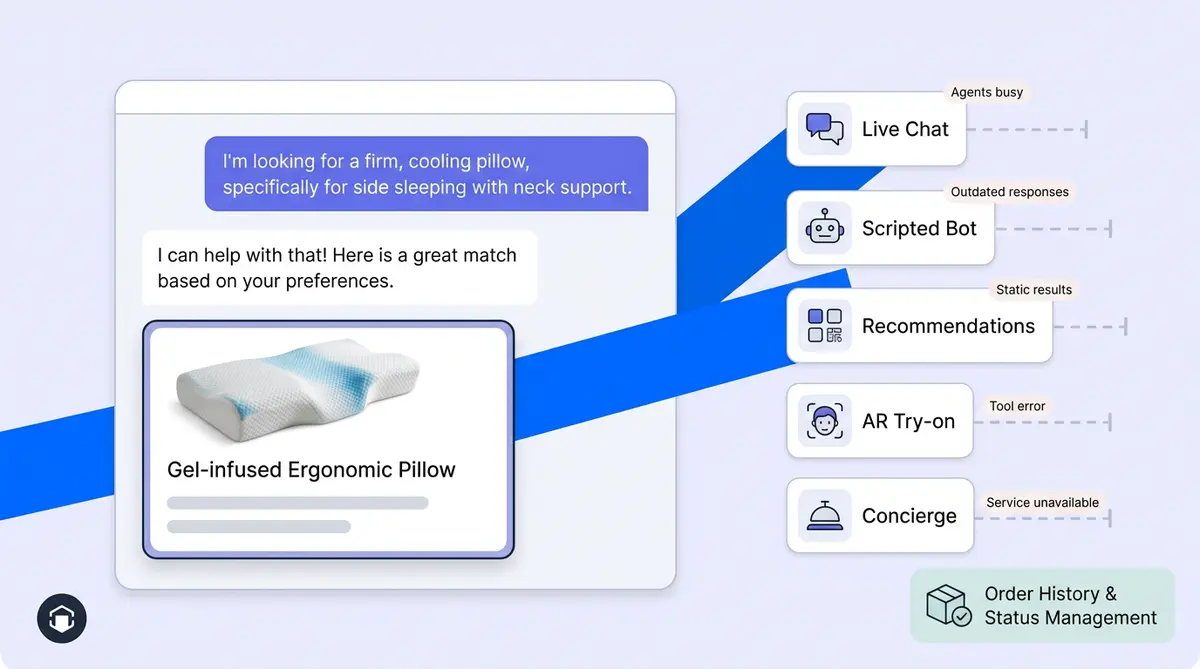
Every previous digital commerce attempt to close this gap addressed one step at a time. Live chat handled some objections but wasn’t an AI shopping assistant but was purely reactive, not proactive enough to qualify. Recommendation engines nailed step three but skipped one, two, four, and five. Early shopping assistants and chatbots tried to qualify but broke the moment a question went off-script. Conversational commerce as a concept identified the right problem, but early tools weren't sophisticated enough to execute the full workflow.
AI-powered shopping agents built on large language models are the first. Each smart AI assistant is the first technology that can replicate all five steps. Not sequentially. Simultaneously. In a single conversation.
Alhena AI's Product Expert Agent runs the complete associate workflow in real time:
- Qualifies by asking what the shopper needs before surfacing any products. "What's the occasion?" "What skin concerns are you trying to address?" "What room is this for?"
- Diagnoses through follow-up questions that add context no algorithm can infer. Budget constraints, gift recipients, style and appearance preferences, compatibility requirements.
- Recommends from the live product catalog with explanations grounded in the diagnosis. Not "people also bought" but "based on your dry skin and preference for fragrance-free products, here are three options and why each one fits."
- Handles objections in real time. Price concern? It surfaces alternatives at the customer’s target price. Sizing worry? It pulls fit data and reviews. Comparing two products? It explains the personalized differences based on what the shopper said they needed.
- Closes with personalized cross-sells and agentic checkout that populates the cart, automatically applies the best deals and can offer the shopper ways to save money, and automatically pre-fills checkout details. The transition from conversation to purchase is one click.
The proof is in the results. Tatcha saw a 3x conversion rate after deploying Alhena, with 38% higher average order values and 11.4% of total site revenue coming from AI-assisted conversations. That's what happens when you stop replicating one step and start replicating all five. A luxury fashion brand using Alhena's AI stylist drove 10% revenue growth and 20% higher AOV by running the full qualify-diagnose-recommend-close workflow in every conversation.
These results come from the core use case where the associate model matters most: beauty, apparel, jewelry, furniture, footwear. Brands selling $8 phone cases don't need a sales associate. Brands selling $85 serums, $250 shoes, $300 headphones, $120 pet supplies, or $1,200 sofas do. And for those brands, the difference between replicating one step and replicating five is the difference between a chatbot and an AI shopping assistant that functions as a revenue channel.
Key Takeaways
- In-store sales associates follow a five-step workflow: qualify, diagnose, recommend, handle objections, close. Ecommerce has only replicated step three (recommend) with algorithms.
- The other four steps require conversation. Filters, recommendation engines, and "customers also bought" widgets can't qualify, diagnose, handle objections, or close because they can't ask questions or respond to hesitation.
- This is the real source of the 10x conversion gap between physical retail (20-40%) and online (2-3%), especially in considered-purchase verticals like apparel, beauty, jewelry, furniture, and footwear.
- The best AI shopping assistants are the first technology that can execute all five steps in a single conversation, not just surface recommendations.
- Alhena AI's Product Expert Agent runs the full associate workflow and delivers measurable results: 3x conversion at Tatcha, 20% AOV lift, 11.4% of total site revenue from AI conversations.
Ready to use AI to give your online store the complete sales associate workflow? Book a demo with Alhena AI or start for free with 25 conversations.
Frequently Asked Questions
What are the five steps a sales associate follows in-store?
Qualify (ask what brings the shopper in), diagnose (uncover context like occasion, budget, and preferences), recommend (suggest a personalized shortlist), handle objections (address hesitations around price, fit, or alternatives), and close (suggest complementary items and guide to checkout). Ecommerce has only replicated the recommend step with algorithms.
Why is in-store conversion so much higher than online?
In-store conversion rates reach 20-40% because sales associates run a complete five-step selling workflow. Online stores convert at 2-3% because they rely on filters and recommendation engines that only handle one step (recommend) and skip the other four. The gap isn't UX or page speed. It's the absence of conversation.
Can an AI shopping assistant really replicate a sales associate?
Yes, for the first time. Right now, this technology exists. AI shopping assistants built on large language models can qualify through questions, diagnose needs through follow-up conversation, recommend from live product catalogs, handle objections in real time, and close with personalized cross-sells and agentic checkout. Alhena AI customers like Tatcha have seen 3x conversion rates with this full-workflow approach.
What's wrong with product recommendation engines?
Nothing, for what they do. Recommendation engines replicate step three of the sales associate workflow well, generating 26% of ecommerce revenue from 7% of traffic. The problem is they fire without qualification or diagnosis. A recommendation after a conversation feels like expert advice. A recommendation without one feels like a guess.
Which product categories benefit most from an AI sales associate?
Considered-purchase verticals where shoppers need guidance: apparel, beauty, jewelry, furniture, and footwear. Brands selling $85 serums, $250 shoes, $300 headphones, $120 pet supplies, or $1,200 sofas benefit most (whether on Amazon, Shopify, or their own store) because these purchases involve questions, comparisons, and objections that filters and widgets can't address.
How does Alhena AI handle objections during a shopping conversation?
Alhena's Product Expert Agent detects hesitation signals and responds contextually. Price concern? It surfaces alternatives at the customer’s target price. Sizing worry? It pulls fit data and product reviews. Comparing two products? It explains differences based on what the shopper said they need, not generic specs.
How long does it take to deploy Alhena AI as an online sales associate?
Under 48 hours. Alhena connects to any merchant’s ecommerce platform (Shopify, WooCommerce, Magento, or Salesforce Commerce Cloud) and trains on your product catalog and brand voice. No engineering team or custom development needed. The setup is flexible enough to fit any catalog. It starts running the full five-step sales workflow from day one.
How do I measure if my AI is selling or just answering support tickets?
Track conversion rate from AI conversations, AI-attributed revenue, and average order value for AI-assisted purchases. If your current AI only measures ticket deflection or resolution rate, it's a support tool, not a sales tool. Alhena AI includes built-in revenue attribution that ties specific conversations to completed orders.