Luxury fashion conversion rates online hover around 0.3% to 0.9%. That's a fraction of the 3% average in general fashion e-commerce. The gap exists because luxury shoppers expect the kind of personalized guidance they get in a flagship boutique: fit advice, fabric expertise, and curated styling. Scaling that personal stylist experience across time zones and regions is the top challenge every premium brand faces. This post gives you an overview of how one luxury fashion brand deployed an AI stylist to close that gap, lifting AOV by 20% and total online revenue by 10%.
The Challenge: Expert Style Guidance That Doesn't Scale
The brand's customers weren't abandoning carts because of price. They were leaving the site because they couldn't get answers about what to wear. "Will this silk blouse drape the same way on my frame?" "Can I pair these clothes with clothes and pieces already in my closet?" "What size should I order if I'm between a UK 10 and 12?"
These aren't simple FAQ questions. They require product knowledge, personal styling taste, and context about the customer's purchase history. In a physical store, a trained fashion stylist handles this naturally, pulling outfit ideas, creating outfit combinations from the rack and offering suggestions based on body type (no selfie upload needed), occasion, color analysis, seasonal color analysis, and matching, and personal color preferences. Online, the brand had two options: live chat staffed by a small team with limited hours, or generic chatbot responses that felt nothing like the brand.
Size and fit uncertainty alone accounts for 40% to 60% of all fashion returns. For luxury price points, every return is expensive and damaging to the customer relationship. Shoppers wanted a personal stylist online, the same personal stylist experience they get in store. The brand needed a way to bring the in-store personal stylist experience online, available around the clock for closet guidance, without compromising its premium voice.
The Solution: A Multi-Agent AI Stylist Built for Luxury Fashion
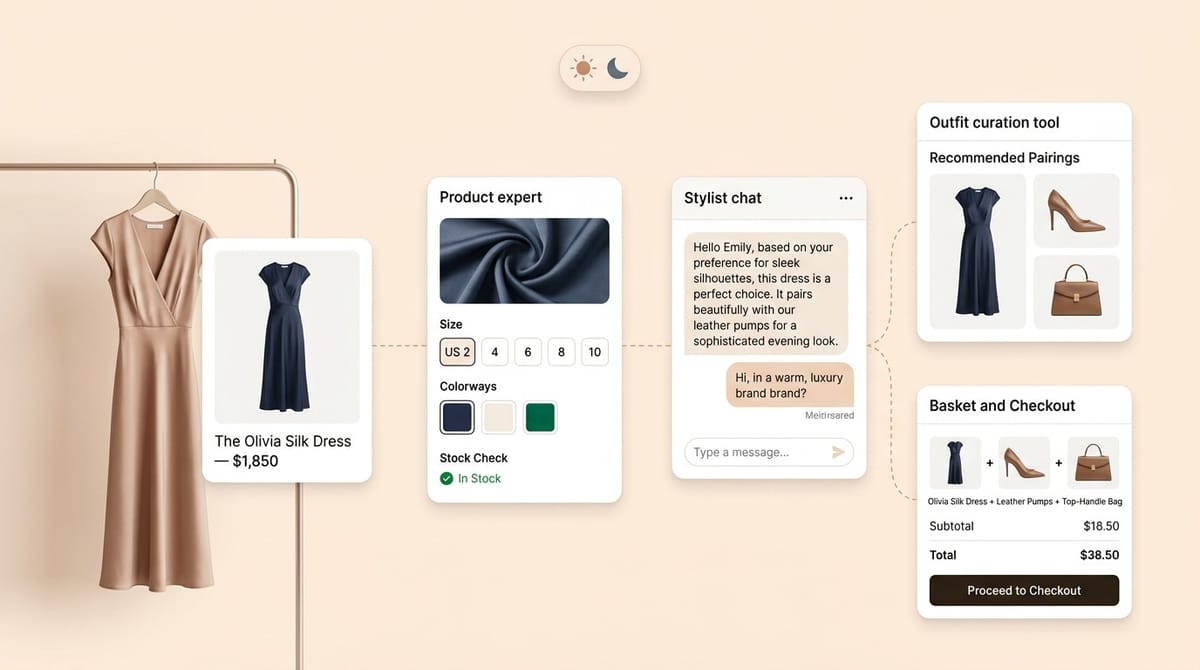
The brand chose Alhena AI to deploy a multi-agent system purpose-built for fashion ecommerce. Rather than a single chatbot answering everything, Alhena's architecture uses specialized agents that each handle a distinct part of the customer journey.
The Product Expert Agent connects directly to the brand's product catalog and pulls real-time information on fabrics, sizing charts, product images you upload, available colorways, and stock levels. When a customer asks about the weight of a cashmere knit or whether a dress or blouse runs small, the AI responds with verified product data, not guesses. This hallucination-free approach is critical for a brand where accuracy protects trust.
The AI Fashion Stylist Agent goes beyond answering questions. It proactively curates clothing and outfit recommendations and styled outfits based on the item a customer is browsing, their style preferences, purchase history, and current inventory. If someone is looking at a tailored blazer, the stylist keeps creating outfit after outfit with expert suggestions, like a complementary silk cami and wide-leg trousers, complete outfits and styled outfits the shopper can add to cart with one click. It's the virtual, digital version of a personal stylist pulling looks from the closet and saying, "Try these together." You can see how this works in our breakdown of AI-driven outfit discovery in fashion.
The Order Management Agent integrates with the brand's backend systems, handling post-purchase questions like shipping updates, returns, and exchanges without routing to a human agent. This frees the support team from repetitive tickets so they can focus on high-value interactions.
Brand Voice Calibration: Why Tone Matters for Luxury
For luxury fashion, tone is everything. A customer browsing a $2,000 coat expects to feel the same care and expertise online that they'd get walking into a boutique. The entire AI system was fine-tuned to match the brand's voice: knowledgeable, warm, never pushy.
The AI doesn't sound like a generic bot. It mirrors the tone of an in-store associate who understands style. As the brand's Head of Ecommerce put it, "The flexibility to shape the assistant has been valuable." That calibration covers vocabulary, response length, how the stylist introduces outfit ideas, and when to recommend accessories versus letting the customer browse on their own.
How the AI Stylist Curates Outfits and Drives Revenue
Most AI tools in ecommerce focus on ticket deflection. They're support tools that save costs. Alhena is different because it's built for sales and support together.
The AI stylist's outfit curation directly increases basket size. When a customer engages with a personalized and personalised styling recommendation, they're far more likely to wear a complete look and wear a complete look rather than buy a single piece. Cross-selling within a styling conversation generates significantly more revenue per session. The brand saw its average order value climb 20% after deploying Alhena's AI stylist.
That AOV lift, combined with higher conversion from confident, well-guided shoppers, translated to a 10% increase in total online revenue. Alhena's built-in revenue attribution analytics tracked these results directly, showing which conversations led to purchases and how much revenue the AI influenced.
24/7 Wardrobe and Closet Styling Coverage Around the Clock
Before the AI deployment, the brand's customer service team worked fixed hours. Customers in different time zones, especially in Asia and the Middle East, often had no access to real-time styling guidance during their browsing sessions.
Alhena's AI stylist now covers every hour, always available. During off-hours, it handles questions about what to wear for specific occasions, wardrobe planning and wardrobe curation, fit concerns, wardrobe pairing suggestions, and order inquiries autonomously. During business hours, it runs alongside the human team in a hybrid model where Agent Assist gives associates AI-generated suggestions and suggested responses they can review and send with one click.
Human associates now spend less time on "what size should I get?" and more time on VIP relationship-building, personal shopping appointments, and high-value clienteling. This is the model fashion brands are adopting as agentic commerce matures.
What Made This Fashion Stylist AI Deployment Work
Three things set this deployment apart from a typical chatbot rollout:
- Deep catalog integration. The AI doesn't work from a static FAQ sheet. It pulls live wardrobe data, product data, inventory levels, and sizing details from the Shopify store in real time, so every wardrobe suggestion and style suggestion reflects what's actually available.
- Proactive closet-to-outfit personal styling, not reactive answering. The AI stylist suggests complete outfits and outfit ideas, not just single products. It works as a planner and cross-sells and upsells naturally within the chat conversation, turning a browsing session into a full wardrobe and closet organization consultation.
- Brand voice calibration. The AI was trained to speak like the brand's own stylists. Customers feel like they're getting advice from someone who understands fashion and their personal style, not talking to a bot.
The pros are clear and the cons are minimal. Setup took less than 48 hours with no developer resources required. The brand's team managed voice calibration and catalog mapping through Alhena's app dashboard. Alhena connects to Shopify, WooCommerce, Magento, and Salesforce Commerce Cloud out of the box.
The Bottom Line
Luxury fashion ecommerce has a structural problem: customers want expert personal styling guidance, and most online experiences don't deliver it. This brand solved it by deploying an AI stylist that acts like a digital in-store associate, offering outfit ideas, wardrobe suggestions, and fit expertise and virtual try ons at scale. The result: a 20% AOV increase and 10% revenue growth while giving the human team room to focus on what they do best. For more on this topic, read How a Luxury Skincare Brand Used AI to Drive 3X Conversions and 38% Higher AOV.
If you're running a fashion or luxury brand and your online experience doesn't match what customers get in your stores, an AI stylist closes that gap. Book a demo with Alhena AI to see how it works for your catalog, or start free with 25 conversations to test it yourself.
Enterprise AI Stylist vs Consumer Styling Apps
A consumer styling app is designed for individual use. Each styling app like Combyne (a popular styling app), Combyne alternatives, and other styling apps like Wishi and Style DNA (another styling app) each focus on personal wardrobe management. Users upload a selfie, take a style quiz, get color analysis results, personal color palette recommendations, then organize their closet with smart closet management features. These apps are useful for consumers creating outfit collages, building capsule wardrobe plans, and making packing lists for every trip, building packing lists and travel wardrobes and wardrobe capsules for trips. Some even offer virtual try ons and background removal and photo background removal tools for creating outfit photos and lookbook collages.
An enterprise AI fashion stylist like Alhena works differently. Instead of helping one person organize their closet, it helps a brand serve thousands of shoppers at once with personalized styling. The AI creates outfits from the brand's live product catalog, not from clothes a user uploads. It drives revenue by turning every chat into a personal stylist session that leads to a purchase. The pros of an enterprise solution outweigh the cons of relying on generic consumer tools that weren't designed for ecommerce conversion. Read the full case study.
Curious which tools are leading the charge? Our AI in fashion buying guide ranks the 10 best options for 2026.

Frequently Asked Questions
What is an AI stylist for fashion ecommerce?
An AI stylist is a specialized shopping assistant that provides personalized outfit recommendations, wardrobe styling, fit guidance, and fabric expertise in real time. Unlike generic chatbots, it uses product catalog data, closet organization insights, and customer history to curate looks from a smart closet of product data the way a trained fashion stylist or in-store associate would. Alhena AI's stylist agent handles this within a multi-agent architecture purpose-built for fashion brands.
How does an AI stylist increase average order value?
AI stylists increase AOV by proactively suggesting complementary items during a shopping session. When a customer browses a blazer, the outfit planner recommends a matching blouse and trousers, making it easy to add multiple items in one click. Creating outfit after outfit and cross-selling within a styling conversation drives 10% to 30% of total ecommerce revenue, and one luxury brand saw a 20% AOV lift after deploying Alhena's AI stylist.
Can an AI stylist match a luxury brand's tone and voice?
Yes. Alhena AI allows brands to fine-tune the AI's personality, vocabulary, and response style to match their in-store associate experience. The system avoids generic or overly casual language and can be calibrated to sound knowledgeable, elegant, and on-brand for luxury audiences.
How does the AI stylist handle fit and sizing questions?
The Product Expert Agent pulls real-time sizing charts, fabric composition, and fit notes directly from the product catalog. It gives specific answers rather than pointing customers to a generic size guide. Size and fit issues cause 40% to 60% of fashion returns, so accurate guidance at the point of decision has a direct impact on profitability.
How long does it take to deploy an AI stylist like Alhena?
Alhena AI deploys in under 48 hours with no developer resources needed. The brand's team manages catalog integration, voice calibration, and agent configuration through a self-service dashboard with a built-in style quiz for shoppers. Alhena connects to Shopify, WooCommerce, Magento, and Salesforce Commerce Cloud out of the box.
Does the AI stylist replace human customer service agents?
No. The best results come from a hybrid model. The AI stylist handles routine styling questions, fit inquiries, and order status requests 24/7. Human associates focus on VIP relationship-building, personal shopping appointments, and high-value clienteling. Alhena's Agent Assist tool also gives human agents AI-generated response suggestions they can edit and send.
What results can fashion brands expect from an AI stylist?
Results vary by brand, but verified outcomes include a 20% AOV increase and 10% revenue growth for a luxury fashion brand using Alhena AI. Alhena's built-in revenue attribution analytics track exactly which conversations drive purchases.