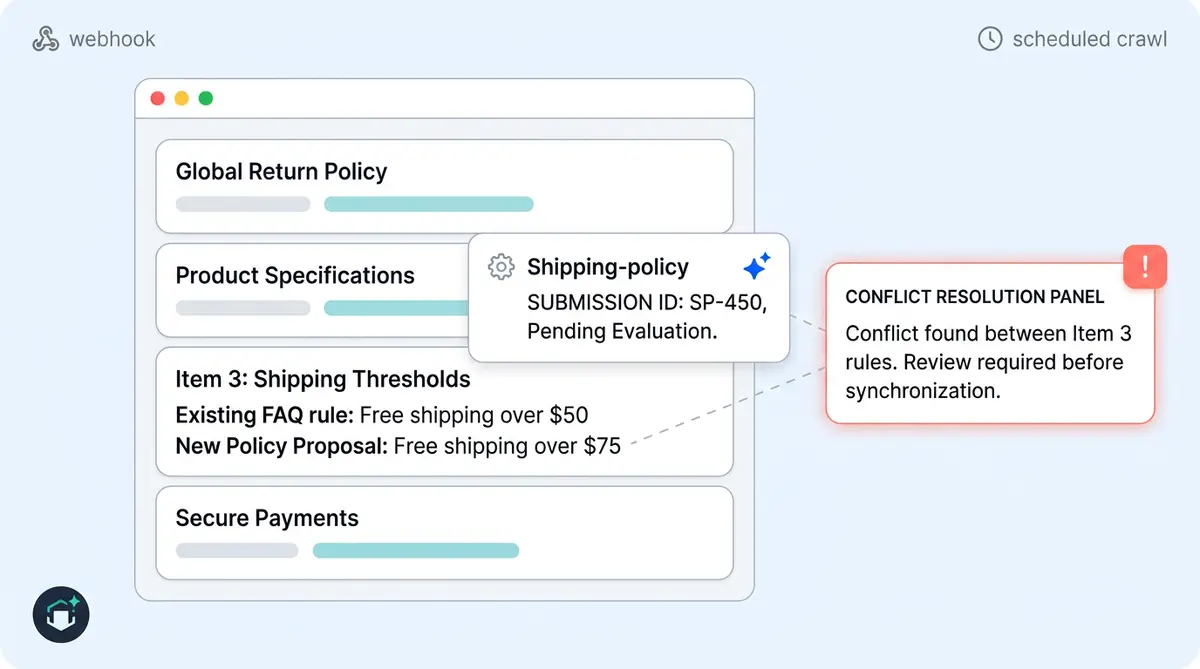
When your AI has two answers to the same question, the problem isn't the model. It's the ai knowledge base behind it. One FAQ says returns are accepted within 30 days. Another says 14 days. The AI retrieves whichever one matches the query first, and the customer gets an answer that may be flat-out wrong.
This isn't a hypothetical. Air Canada learned it the hard way when its chatbot told a passenger he could retroactively claim a bereavement discount, contradicting the airline's actual policy. A Canadian tribunal held Air Canada liable, ruling the company "did not take reasonable care to ensure its chatbot was accurate." The root cause wasn't a bad AI model. It was conflicting information in the knowledge base. Better artificial intelligence solutions and technologies alone won’t fix contradictory sources of truth.
Alhena AI built FAQ Conflict Detection to catch these contradictions before customers do. This post walks through how the feature works, what it looks like in practice, and its performance impact, and why it matters for any team running AI knowledge base software in e-commerce.
The Hidden Problem with Every AI Knowledge Base
Most teams focus on adding more content to their knowledge base. More FAQs, more product descriptions, more policy pages. Few teams spend equal time checking whether the content they already have is consistent with current processes.
That's a problem, because 54% of organizations struggle to maintain current and accurate customer service knowledge repositories. And according to Zendesk's 2025 KB health report, 30% of a typical enterprise help center contains articles over 12 months old. Old content doesn't just sit there quietly. It actively competes with new content for retrieval.
Here's what happens in a standard RAG (retrieval-augmented generation) database setup. When a customer asks about your return policy, the AI searches your knowledge base for the most relevant passages. If two FAQs cover the same topic with different answers, the system has no built-in way to know which one is correct. Academic research on the MADAM-RAG framework shows that large language models exhibit "frequency bias", favouring answers supported by more documents, regardless of which answer is actually right.
The result? Inconsistent customer experiences. A customer who interacts with your chat hears one thing from your AI Shopping Assistant and something different from a human agent who checks the updated policy. A 2025 Forrester study found that 48% of customers who received conflicting information from an AI agent and then a human rep rated the company "unreliable" and were 3x more likely to churn within 90 days.
The fix isn't a better model. It's cleaner data. When AI systems are constrained to RAG with well-curated, verified knowledge bases, hallucination rates drop from 15-27% to just 0.7-1.5%. Knowledge base curation alone reduces and keeps on reducing grounded-but-wrong answers by 20-30%.
What FAQ Conflict Detection Is (and What It Isn't)
Alhena's FAQ Conflict Detection is an intelligence layer and quality-control system for your AI knowledge base. It automatically checks whether a new or edited FAQ contradicts any existing FAQ before that contradiction can affect customer support answers.
The system uses NLP-driven analysis to understand the actual meaning of each question-and-answer pair, not just surface-level wording. Two FAQs can use completely different phrasing and still conflict if they produce contradictory responses about the same policy. Alhena catches that.
What it flags:
- Different return windows for the same product category
- Conflicting shipping timelines or delivery estimates
- Contradictory refund eligibility rules
- Opposite instructions for cancellations, exchanges, or subscriptions
- Discount policies that don't align across FAQs
What it doesn't flag: repetition. If two FAQs say the same thing in different words, that's fine. Alhena only raises a flag when it detects a logical inconsistency, where two FAQs give genuinely different responses to the same question.
It’s a distinction that matters. Some knowledge base software tools flag duplicates, which creates noise. Alhena focuses on contradictions, which creates clarity.
How Alhena Detects Contradictions in Your AI Knowledge Base
The detection happens automatically during the FAQ management workflow, fitting into your existing support workflows. Every time an admin creates or edits an FAQ inside Alhena's Support Concierge, the system runs a comparison against all existing active FAQs for that company.
Alhena's comparison goes beyond keyword matching. It uses natural language processing (NLP) to evaluate semantic meaning, looking at what each FAQ actually says rather than how it says it. If FAQ #1 says "free shipping on orders over $50" and FAQ #2 says "free shipping starts at $75", the system recognizes these as conflicting even though they share similar vocabulary.
When a conflict is detected, Alhena stores three things:
- The FAQ that appears to conflict
- The related conflicting FAQ IDs
- A concise conflict reason explaining the inconsistency
This happens in real time. You don't need to run a manual audit or schedule a review cycle. The check runs every time content changes. This turns knowledge management and maintenance from a periodic chore into a continuous process, catching conflicts the moment they're introduced, not weeks later when a customer opens a ticket about a wrong answer.
For teams that also use Alhena's continuous learning system, which auto-generates FAQs from real customer conversations, conflict detection acts as a safety net. When the system proposes a new FAQ based on customer feedback, it gets checked against the existing knowledge base before going live.
The Resolution Workflow: From Flag to Fix
Detection alone isn't enough. Alhena pairs every conflict flag with a practical resolution workflow so admins can act on it immediately.
In the FAQ list, conflicting entries are prioritized and displayed with a warning indicator. Admins don't have to hunt for problems. The dashboard surfaces them.
When an admin opens a flagged FAQ, Alhena shows:
- A conflict summary explaining what looks inconsistent
- The recently added or edited FAQ
- The existing FAQ with the conflicting answer
- Editable fields for both FAQs side by side
- Options to update or delete either FAQ
This side-by-side layout turns conflict resolution into a two-minute task instead of a research project. The admin can see exactly what conflicts, understand why, and fix it in place.
One important design choice: Alhena does not silently suppress or overwrite flagged FAQs. All content stays available to the AI, machine learning, and training systems even when marked as conflicting. The flag is there to help humans improve the knowledge base, not to hide content or create security concerns. Alhena identifies the risk, explains it, and lets your team decide which answer is correct.
This matters for teams managing large catalogs. Sometimes what looks like a conflict is actually an intentional exception. "30-day returns for full-price items, 14-day returns for final-sale items" isn't a contradiction once you understand the scope. Alhena gives you the information to make that judgment call.
Five Conflict Patterns That Trip Up Ecommerce Teams
After working with brands like Tatcha (3x conversion rate, 82% chat deflection) and Crocus (86% deflection, 84% CSAT), Alhena has seen the same conflict patterns repeat across ecommerce knowledge bases.
1. Policy updates that don't retire old FAQs
A support manager updates the return policy from 30 days to 14 days but forgets that three other FAQs still reference the old window. The AI now has four answers to the same question, and only one is current.
2. Auto-generated FAQs that clash with manual ones
Alhena's system generates FAQs from real customer conversations. If a human agent gave a slightly different answer during a chat (maybe a one-time exception), the auto-generated FAQ might conflict with the official policy FAQ. Conflict detection catches this before the exception becomes the rule.
3. Seasonal and promotional changes
Holiday shipping deadlines, Black Friday return extensions, limited-time free shipping thresholds. They’re temporary policies that create FAQs that conflict with year-round defaults. When the promotion ends, teams forget to remove the seasonal content. Then tickets start coming in with confused customers quoting outdated terms.
4. Multi-team knowledge contributions
When marketing, operations, and support all add FAQs and respond to tickets independently, assumptions diverge. Marketing writes "ships in 2-3 business days" based on the average. Operations writes "ships in 3-5 business days" based on the SLA. Both are active. Both get retrieved.
5. Product-specific exceptions mixed with general policies
A general FAQ says, "All items are eligible for exchange." A product-specific FAQ says "custom-engraved items cannot be exchanged." Without proper scoping in your product data, the AI might apply the general policy to a custom order.
Why Automated Detection Beats Manual Knowledge Base Management
Most support platforms still rely on manual approaches to knowledge base management. Zendesk flags stale articles based on age and engagement metrics. Intercom surfaces content that hasn't been updated recently. These are useful signals, but they miss the core problem: two articles can both be recently updated and still contradict each other.
Manual KB reviews face real challenges and limitations. As one industry analysis put it, identifying outdated or conflicting content is still "a very manual, reactive job" at most companies, with teams "usually waiting for an agent to flag an article or a customer to complain before realizing something needs to be fixed."
Alhena's approach is different in three ways:
It's semantic, not age-based. The system checks meaning, not timestamps. A one-day-old FAQ can conflict with a one-hour-old FAQ if they say different things about the same topic.
It's proactive, not reactive. Conflicts are caught at the point of creation or editing, before they reach the AI Shopping Assistant or Support Concierge. You don't wait for a wrong answer to surface the problem.
It's continuous, not periodic. Every FAQ change triggers a check. There's no quarterly audit to schedule, no manual review to remember. The system watches for contradictions around the clock.
This matters more as your ai knowledge base grows. A 50-FAQ knowledge base is manageable by hand. A 500-FAQ knowledge base with weekly product launches, seasonal promotions, and policy updates across multiple brands on Shopify, Salesforce Commerce Cloud, or WooCommerce? That's where automated conflict detection capabilities become essential.
Building a Contradiction-Free AI Knowledge Base
Conflict detection is one piece of Alhena's broader approach to building an AI-powered knowledge management, freshness, and accuracy. Here's how the pieces fit together for ecommerce teams.
Dual ingestion keeps content current. Alhena uses push paths (webhooks for real-time pricing and inventory changes) and pull paths (scheduled crawling for documentation and policy pages). This means the AI always works with the latest product data and knowledge content, not yesterday's snapshot.
Smart flagging catches more than conflicts. Beyond contradictions, Alhena's quality control system flags low-confidence answers, knowledge gaps, support tickets with recurring issues, and out-of-scope queries automatically. The conversation debugger traces incorrect answers back to the specific knowledge sources that caused the error.
A 30-minute weekly cadence keeps everything tight. Alhena recommends a simple maintenance rhythm to improve performance: review flagged conversations (10 minutes), approve or edit auto-generated FAQs (10 minutes), sync with merchandising teams (5 minutes), and spot-check random conversations (5 minutes). Conflict detection feeds directly into this workflow by prioritizing the FAQs that need attention most.
Forrester's 2026 predictions for customer service put it plainly: this year "won't be the year that AI transforms customer service operations." Instead, it will be the year of hard work, of simplifying, restructuring, and preparing." Conflict detection is exactly that kind of work. It's not glamorous. But it's the foundation that makes everything else, from social commerce to voice AI, actually reliable.
Companies that invest in AI knowledge base software quality now are building the infrastructure that separates accurate AI from unreliable AI. With 91% of customer service leaders facing executive pressure to deploy AI in 2026. As we move through 2026 (Gartner), getting the knowledge base right isn't optional. It's the starting line.
Ready to stop contradictory FAQs from reaching your customers? Book a demo with Alhena AI to see conflict detection in action, or start for free with 25 conversations.
For teams that store SOPs and product guides in the cloud, you can also train your AI directly from Google Drive using Docs, Sheets, and Slides as knowledge sources.
Teams that keep product knowledge in Atlassian wikis can also train their AI chatbot directly from Confluence using Alhena's integration.
Frequently Asked Questions
What is FAQ Conflict Detection in Alhena AI?
FAQ Conflict Detection is an ai-powered layer inside Alhena's knowledge base software that checks every new or edited FAQ against all existing entries for your company. It runs semantic search and natural language processing on each question-and-answer pair to find logical contradictions, not just similar wording. Think of it as a built-in knowledge management system audit that happens automatically every time content changes. The goal is to catch conflicts before your AI retrieval pipeline serves a wrong answer to a customer query, keeping self-service accurate without manual review.
How does Alhena detect contradictions in an AI knowledge base?
When an FAQ is created or edited, Alhena's NLP engine compares it against every active FAQ using embeddings and semantic search rather than simple keyword matching. The system evaluates what each document actually says, so it catches conflicts even when the wording is completely different. In a retrieval augmented generation setup, the AI agent will retrieve whichever passages are most relevant to a customer's query. If two of those passages contradict each other, the AI has no way to pick the right one. Alhena's detection layer flags those contradictions at the source, before they enter the retrieval pipeline, whether the content is structured FAQs or unstructured docs.
Does Alhena remove or suppress FAQs that are flagged as conflicting?
No. Flagged FAQs stay active and available to the AI agent until a human agent or admin resolves them. Alhena doesn't silently overwrite or hide content. The conflict flag is a knowledge management signal that helps your internal team organize the knowledge base and decide which answer is accurate. This design matters because some apparent conflicts are actually intentional exceptions, like different return windows for different product categories. Alhena surfaces the issue and lets your team make the call.
What types of FAQ conflicts does the system catch?
Alhena catches contradictions across return policies, shipping timelines, refund eligibility, discount terms, cancellation instructions, exchange rules, and warranty documentation. Common triggers include outdated FAQs that weren't retired after a policy change, customer support answers that conflict with official customer service pages, and product-specific exceptions mixed with general policies. Any FAQ that gives a different answer to the same question gets flagged. Teams that centralize their knowledge in Alhena can resolve these conflicts before they generate confused support tickets.
How does FAQ Conflict Detection work with auto-generated FAQs?
Alhena's machine learning system generates FAQs from real customer conversations, essentially turning chat patterns into ai-powered knowledge entries. Every auto-generated FAQ runs through the same conflict check before it goes live. If a chatbot conversation produced an answer that contradicts an existing manual FAQ, the system flags it. This is especially useful during onboarding, when teams import large volumes of existing documentation and need to ensure new power knowledge entries don't clash with what's already in the base.
Do other AI customer service tools offer automatic conflict detection?
Most knowledge base software platforms, including Zendesk, Intercom, Freshdesk, and Gorgias, flag content based on age or engagement metrics. If an article hasn't been viewed recently, they'll suggest reviewing it. But none of these base tools run NLP-driven semantic analysis to detect when two active articles contradict each other. The same applies to general knowledge platforms like Confluence or Slack-based knowledge bots. They index content and enable ai search, but they don't check whether the content they're serving is internally consistent. Alhena's conflict detection fills that gap.
How long does it take to resolve a flagged conflict in the knowledge base?
Most conflicts take under two minutes. Alhena's interface shows both FAQs side by side with editable fields and a plain-language summary of what's inconsistent. An agent or admin can search the dashboard for flagged entries, update either FAQ, delete the outdated one, or refine both to clarify scope. You don't need to dig through PDFs or external docs. The assistant organizes everything in one view so you can fix the conflict and move on.
Can FAQ Conflict Detection improve AI answer accuracy?
Yes, and the data is clear. Knowledge base curation alone reduces wrong AI answers by 20-30%. When ai-powered retrieval systems pull from clean, conflict-free sources, hallucination rates drop from 15-27% to just 0.7-1.5%. Every contradiction you resolve makes your knowledge management system more accurate, which directly improves self-service resolution rates and reduces the volume of support tickets that reach your human team. Conflict detection also helps unify answers across channels, so customers get the same relevant response whether they ask via chat, email, or social.