The five e-commerce conversion mistakes that quietly cost online stores the most revenue are cluttering pages with competing CTAs, hiding AI assistants behind generic chat bubbles, assuming shoppers already know what they want, ignoring the social nature of buying decisions, and failing to show what modern AI can actually do. Each one erodes your add-to-cart rate without showing up in standard reports.
Before the list, one mental model that reframes everything below. Most of the battle in e-commerce conversion is add to cart. Once a shopper adds something, the cart-to-checkout ratio is fairly stable, 30 to 40 per cent for most brands. You don't win or lose there. You win or lose upstream, at the moment a browsing visitor decides this is the thing. So the goal is never "more checkouts". It's helping more of the right people add to cart with confidence.
With that lens, here are the five mistakes I see costing brands conversions every day and the fix for each.
#Mistake 1: Making Every CTA Scream
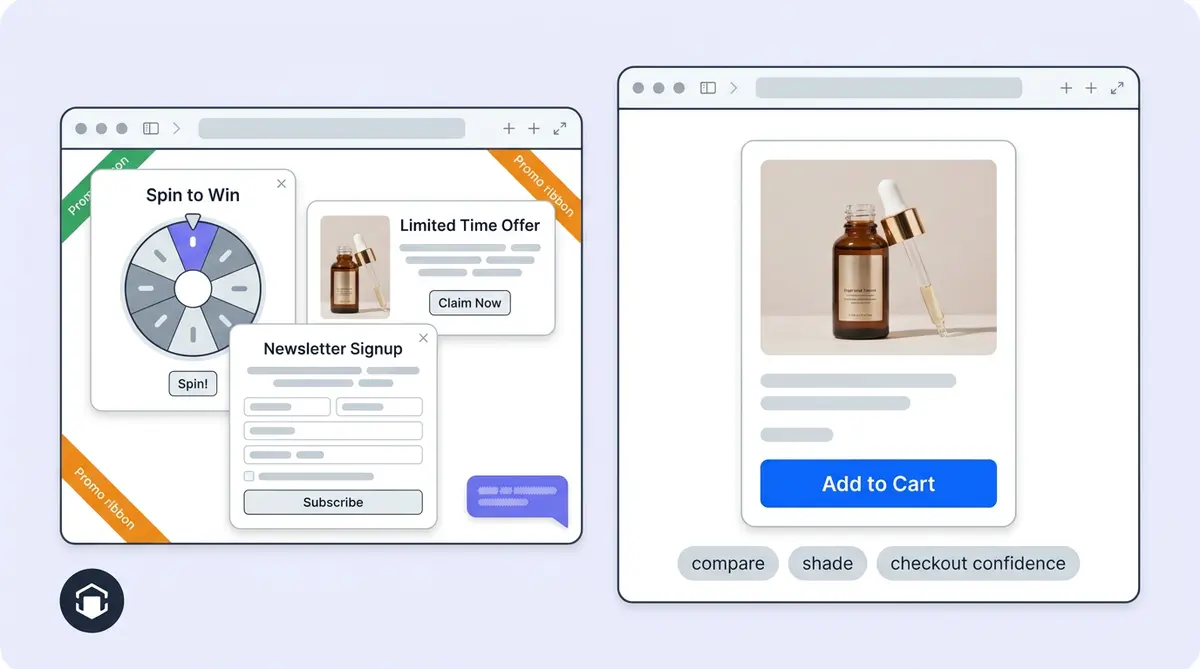
Brands keep piling on flashy buttons, banners, popups, widgets, and promos. But attention is zero-sum. When everything is loud, the shopper doesn't know what matters, and the noise quietly competes with the only two actions that drive revenue: add to cart and checkout.
I watch this happen constantly. A brand adds a loud new CTA, engagement with that element goes up, everyone celebrates, and the core add-to-cart rate dips. You didn't create new buyers. You redistributed the attention of people who were already going to buy. Engagement is not incrementality.
Fix: Protect the buying path. Make the primary purchase action unmistakable. Use secondary CTAs sparingly. Don't let "Take the quiz", "Chat with us", "Join SMS", or "Unlock the offer" elbow the core buying motion out of the way. Ecommerce conversion improves when the next step feels obvious, not when the page feels busier.
What does a distraction-free buying path look like?
The best online retailers limit their product pages to one primary action: add to cart. Everything else (newsletter signups, quiz prompts, chat invitations) sits below the fold or appears only after the visitor has scrolled past the buy button. In the digital market, where attention spans keep shrinking, confusion about what to click next is one of the most expensive problems an online shop can have. If a first-time visitor can't figure out the next step in under three seconds, you've already lost them.
#Mistake 2: Hiding Your Best Sales Associate Behind a Chat Bubble
Most AI assistants sit in the bottom corner of the site and wait. That creates a cold-start problem. The shopper has to notice it, click it, and then know what to ask. Most don't, so the assistant gets ignored. (Small thing that isn't small: when that bubble sits on the left or has no label, engagement craters. Placement is not a detail.)
Fix: Put AI entry points where hesitation actually happens. You want far more ways in than one icon, and each should be contextual to where the shopper is:
- On product pages (PDPs): "Is this right for my skin type?" · "Find my size" · "Build a routine with this product"
- On collection pages: "Help me find the right one" · "Compare bestsellers" · "Create an outfit"
- On the cart: "Am I missing anything?" · "Will these work together?"
More entry points, more engagement, and more engagement is more conversion. The future of AI shopping is not a chat bubble. It's contextual guidance across the whole journey.
Where should e-commerce marketers place AI entry points?
Start with your highest-traffic pages. Most e-commerce marketers struggle with low chat engagement because they rely on a single widget across the entire site. Instead, look at where website traffic concentrates (usually a handful of collection pages and top-selling PDPs) and add contextual prompts specific to those products. A skincare retailer might place "Build my routine" on its moisturizer page. A fashion brand might add "Style this with..." on dress listings. Match the prompt to the decision the shopper is trying to make on that specific page.
#Mistake 3: Treating Shoppers Like They Already Know What They Want
Most sites are built for the shopper who knows exactly what they're looking for. Real shoppers are often uncertain. They don't always know the right product, shade, size, routine, fit, or bundle. Search helps only when you know the words to type. Filters help only when you know how to narrow. PDPs help only when you can interpret the details.
Fix: Guide the shopper the way a great store associate would. Picture walking into a good store: someone greets you, asks a couple of questions to understand what you're after, recommends the right thing, explains why, and helps you compare. That's the job. Ask questions, understand intent, recommend, and remove doubt. The job is not to display inventory. It's to help the shopper decide.
#Mistake 4: Forgetting That Shopping Is Social
Offline, shopping has always been social. People ask their partner, a friend, the group chat: "Does this look good?" "Which shade should I get?" "Can I wear this to the event?" "Is this worth it?" Online shopping too often makes that decision lonely, and a lonely decision is a hesitant one.
Fix: Make products and recommendations easy to share. Let a shopper share an outfit, a makeup shade, a built routine, a comparison, or a cart, and pull the people they trust into the decision. The more confidence a shopper borrows from people they trust, the more likely they are to buy. Social isn't a nice-to-have feature. It reduces purchase anxiety, and purchase anxiety is what kills carts.
Brands that connect AI across social storefronts like Instagram and WhatsApp see higher engagement precisely because they meet shoppers where sharing already happens.
#Mistake 5: Assuming Shoppers Understand What Modern AI Can Do
Here's the obstacle most brands underestimate. When a shopper sees a chat bubble, they don't think "helpful assistant". They think, "Old support bot, probably useless". That memory is doing damage before a single message is exchanged.
And the skepticism is earned. Most of what's deployed today is still two-year-old decision-tree technology. A scripted bot answers. A modern agent reasons about your catalogue, the shopper's behaviour, their history, and your brand voice. Chatbots answer. Agents move. But shoppers won't know that unless you show them.
Fix: Show capability before you ask for engagement. Don't say "Chat with us". Say what it can actually do:
"Find my shade." · "Style this dress" · "Build my hair care routine." · "Compare these two products." · "Help me choose a gift." · "Find products for my trip"
Specific invitations beat generic chat prompts every time.
What This Looks Like in Numbers
This isn't theory. When brands trade a passive chat icon for contextual, agent-led guidance, the funnel moves:
- A prestige skincare brand now attributes roughly 11.5% of site revenue to its AI agent, resolves 82% of customer questions without a human, and sees about 38% higher average order value from assisted shoppers. Read the full Tatcha case study.
- A global fashion brand: 10% revenue increase, 20% higher AOV. See the Victoria Beckham results.
- A bedding brand: 12% higher AOV, 4% revenue lift, and live in under a day. See the Puffy case study.
Different categories, same pattern. Shoppers who engage with a capable agent add to cart more, reach checkout more, and spend more.
The Bigger Shift Hiding Behind All of This
There's one more reason to fix these now. A new, high-intent traffic source just arrived: shoppers coming from AI answer engines. Over the last year, LLM-referred traffic to the brands we see grew more than 6x, and it now converts better than both Google Ads and Meta Ads, at effectively zero acquisition cost. These are people who already asked an AI "what's the best X for me" and clicked through with intent.
If your on-site experience is a cold chat icon buried in a wall of competing CTAs, you're squandering the most valuable visitors you've ever had. If it's a set of contextual, agent-led entry points that pick up where the AI left off, you're converting them.
The New Ecommerce Conversion Playbook
The new playbook is not more pressure. It's more guidance.
Reduce hesitation. Make the next step obvious. Help the shopper feel confident. Treat every touchpoint, discovery, question, objection, and support as a moment that either moves revenue or doesn't.
So before you add your next flashy banner, ask the harder question. Not "How do I get more clicks?" but "How do I help more shoppers decide?" That's where the battle is actually won.
Ready to see how contextual AI agents can move your add-to-cart rate? Book a demo with Alhena AI or start for free with 25 conversations.
Frequently Asked Questions
What is ecommerce conversion rate optimization?
Ecommerce conversion rate optimization is the practice of increasing the percentage of website visitors who complete a desired action on your online store, whether that's adding a product to cart, completing checkout, or signing up for an account. Good conversion rate optimization starts by identifying where visitors drop off in the buying process, then fixing those friction points. Most ecommerce brands focus too heavily on the checkout step when the real opportunity is upstream, at the moment someone decides to add to cart.
How can I optimize my conversion funnel without a full site redesign?
You don't need to overhaul everything. Start by mapping your conversion funnel from landing page to checkout, then look for the biggest drop-off point. Often the fix is simpler than you'd expect: simplify your product page layout, reduce competing CTAs, or add contextual entry points that guide uncertain buyers. A targeted strategy that improves the user experience at one stage of the customer journey usually moves the needle more than a broad redesign. Test one change at a time so you can measure what actually works.
What role does personalization play in boosting ecommerce conversion rates?
Personalization directly helps boost conversion by matching product recommendations to what a specific buyer actually needs. When you personalize the shopping experience based on browsing behavior, past purchases, or stated preferences, you reduce the effort it takes to find the right product. Brands that pair personalization with guided AI recommendations consistently see higher conversion rates and average order values. The key is making it feel helpful, not intrusive.
Why do online shoppers abandon their carts before checkout?
Cart abandonment happens for a handful of predictable reasons. Unexpected shipping costs top the list, followed by forced account creation, limited payment methods, and checkout flows that confuse first-time buyers. Many online shoppers also abandon because they're simply not confident in their choice yet. The fix isn't always about the checkout page itself. Often it's about giving the shopper enough guidance and information earlier in the journey so they arrive at checkout already sure they want to buy.
Which analytics should I track to find conversion rate problems?
Focus on a few core metrics first: add-to-cart rate, cart-to-checkout rate, and checkout completion rate. These three numbers tell you exactly where your funnel leaks. Use analytics tools like Google Analytics or your platform's built-in reports to analyze drop-off by device, traffic source, and product category. Customer feedback through post-purchase surveys and chat transcripts can reveal issues that data alone won't show. Once you have a clear picture, build your optimization strategy around the biggest gap.
Does page speed actually affect ecommerce conversion rates?
Yes, and the impact is bigger than most ecommerce marketers realize. Research shows that every extra second of load time can cut your conversion rate measurably. A slow site frustrates website visitors before they even see your products, which means fewer people enter the funnel in the first place. Improving page speed is one of the lowest-effort, highest-return optimizations you can make for your online store, especially on mobile where most traffic now comes from.
How does AI help convert more browsers into buyers on ecommerce sites?
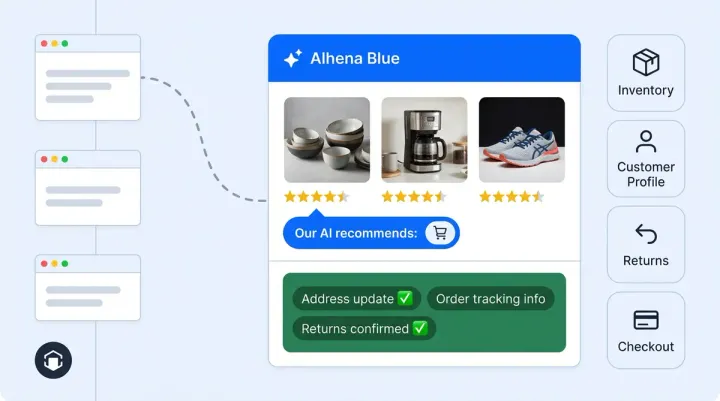
AI shopping assistants work by guiding visitors who aren't sure what to buy. Instead of leaving those uncertain browsers to figure it out alone, an AI agent asks a few questions, narrows down the catalog, and recommends the right product with context. This mirrors what a great in-store sales associate does. Brands using this approach see measurable lifts in add-to-cart rates because the AI removes doubt at the decision point. It's not about pushing a sale. It's about helping a buyer feel confident enough to commit.
How does social sharing reduce purchase hesitation and boost conversion?
When a shopper can share an outfit, a shade match, or a curated cart with a friend or partner, they borrow confidence from people they trust. That social validation directly reduces the anxiety that causes someone to close the tab instead of completing the purchase. Making recommendations and products easy to share turns a lonely online decision into a collaborative one. Brands that build sharing into the shopping experience often see higher conversion rates and fewer abandoned carts, even without offering an extra discount or promotion.
What's the fastest way to boost conversion rates for an ecommerce store?
The fastest wins usually come from fixing what's already broken rather than adding something new. Audit your product pages for competing CTAs that pull attention away from the add-to-cart button. Check whether your checkout flow asks for unnecessary information. Look at your mobile user experience, since that's where most traffic lands. If you want to boost conversion with a single change, adding contextual AI entry points on your highest-traffic pages tends to deliver the biggest improvement. Target the pages with the most visitors and optimize from there.
Can small ecommerce businesses benefit from AI shopping assistants?
Yes. Small ecommerce businesses often benefit the most because they rarely have the staff to provide live customer support around the clock. An AI agent handles product questions, guides uncertain buyers through the catalog, and helps close sales at any hour without added headcount. Modern tools like Alhena AI deploy in under 48 hours and start with free conversations, so there's no heavy upfront investment. The value shows up quickly in higher conversion rates and revenue per visitor, which matters even more when every sale counts. A well-guided shopping experience also helps your SEO by keeping visitors on site longer and reducing bounce rates.