It's 10:02 AM on drop day. Your limited-edition collab went live two minutes ago. Already, 4,300 people are on site. Chat volume just passed 200 concurrent conversations. The first angry DM hits Instagram: "It says sold out but I had it in my cart???"
Your support team has six people on shift. They're drowning.
This is the part of product launches nobody puts in the marketing brief. The part where customer demand and customer confusion arrive at exactly the same moment, and you have minutes (not hours) to convert one without losing the other.
AI changes the math. It answers the repetitive questions instantly, across every channel, while your team handles the edge cases that actually need a human. Brands using AI for e-commerce product launch support see 10x fewer escalations, sub-second response times, and measurably higher conversion rates during the moments when intent is at its peak.
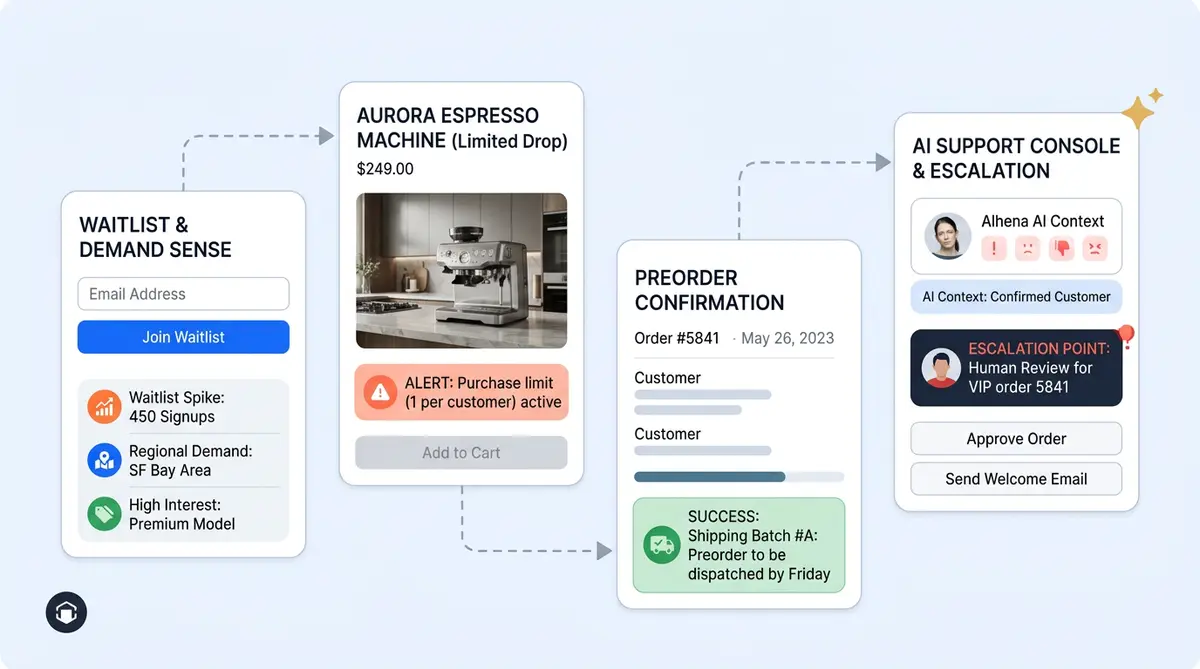
This playbook covers the four hardest parts of any product launch: waitlists, limited drops, preorders, and launch-day support surges. Each section breaks down what goes wrong, what AI handles, and what you should set up before your next launch.
Why Do Ecommerce Product Launches Break Support Teams?
A brand handling 62 support tickets on a normal Tuesday might see 700 tickets during a launch event. That's not a gradual ramp. It's a wall.
The pattern is predictable. Marketing builds anticipation for weeks. Then, on launch day, thousands of high-intent shoppers show up at once, each with a specific question they need answered before they'll buy. Most of those questions are identical:
- "When does it drop?"
- "Am I on the waitlist?"
- "Is my size still available?"
- "Why won't my promo code work?"
- "Did my order go through?"
Six agents can't answer 600 of those in the window that matters. By the time they get to ticket #47, the product might already be sold out. The customer who waited 20 minutes for a reply about checkout isn't buying anymore. They've left.
Brands that respond to live chat within one minute convert 15% higher than those that take five minutes. During a launch, that gap compounds across thousands of simultaneous conversations. Speed isn't a nice-to-have. It's the conversion lever.
How Does AI Handle Waitlists for Product Launches?
AI turns a waitlist from a passive email form into an active guidance system that answers questions, captures preferences, and segments demand before the product even goes live.
Here's the scenario most brands get wrong. You set up a waitlist page. Thousands sign up. Then silence. Customers start asking questions your site doesn't answer, and your inbox fills up with the same five messages.
What Waitlist Questions Can AI Answer Automatically?
- "Am I on the waitlist?" AI checks the customer's email or account and confirms instantly.
- "When does it launch?" AI shares the product's confirmed date and time or explains it hasn't been announced yet.
- "Do I get early access?" AI explains the product's access rules: VIP windows, early access codes, and first-come, first-served timing.
- "I never got a confirmation." AI walks through spam folders, resubmissions, or email updates.
- "Can I change my preference to size L?" AI captures the update and routes it to the right system.
- "What if it sells out before my turn?" AI explains restock plans, alternatives, or next-drop timing.
How Do Waitlist Conversations Become Demand Intelligence?
This is the part most e-commerce teams miss. Every waitlist conversation is a data point.
When 300 people ask about the black colorway in size M, that's a demand signal your inventory team can act on before launching product availability. When customers keep asking about international shipping to the UK, that's a logistics gap you can close. When someone says, "I want the bundle but not the case," that tells you something about your packaging strategy.
Alhena AI's Shopping Assistant captures these signals during natural conversations and structures them for your team. You don't just get a signup count. You get a demand breakdown by variant, region, and price sensitivity, all before you've shipped a single unit.
Waitlist reveal emails already generate 40 to 60% open rates and 15 to 25% click rates, far above normal e-commerce benchmarks. AI makes sure the customers who click through can get answers the second they land on your site.
How Does AI Support Limited Product Drops?
A limited drop compresses an entire sales cycle into minutes. Sometimes seconds. The Adidas Yeezy Boost 350 V2 sold out in 10 minutes. Supreme Box Logo Hoodies sell out in under 30 seconds.
In that window, customers don't browse. They act. And they need answers at the speed they're buying.
What Questions Hit During a Live Drop?
- Timing: "When does it go live?" AI shares the exact time, timezone, and countdown details. It can also respond to questions triggered by teasers, social teasers, and preview content.
- Eligibility: "Is this members-only?" AI explains access rules and any early-access conditions.
- Stock: "Is size M still available?" AI checks real-time inventory data.
- Limits: "Can I buy two?" AI states the purchase policy clearly.
- Checkout issues: "My cart says unavailable." AI identifies common problems (browser cache, sold-out variant, payment method) and walks the customer through a fix.
- Alternatives: "This is gone. What's similar?" AI recommends comparable products or a restock waitlist.
62% of consumers are more likely to buy when a product is labeled "limited edition," and limited drops generate 35% higher social media engagement than standard launches. That intent is real. But it evaporates the moment a customer can't get an answer.
What Happens When the Drop Sells Out?
Sellouts are great for your brand story. They're terrible for the customer who missed it by three minutes.
That customer is standing at a fork. They either become a frustrated detractor who tweets about your broken site or a loyal future buyer who signs up for the restock. The difference is what happens in the next 30 seconds.
AI handles sellout recovery by:
- Explaining confirmed restock timelines (and only confirmed ones)
- Guiding the customer to a restock notification or waitlist
- Recommending similar in-stock products that match the same style or need
- Capturing which variants had the most missed demand and building loyalty through proactive follow-up
Alhena's AI Support Concierge doesn't just say "sold out". It moves the customer forward. Join a waitlist. Try this alternative. Get notified. That's the difference between losing a customer and keeping their loyalty through a sellout.
How Does AI Manage Preorder Questions and Customer Anxiety?
Preorders flip the normal buying equation. The customer has already paid. They don't have the product yet. And the longer that gap stretches, the more anxious they get.
According to Fulfil's preorder management research, clear communication about shipping dates and potential delays is the single biggest factor in preorder satisfaction. Not the product itself. The communication about when it's coming.
AI makes that communication instant and consistent.
What Preorder Questions Does AI Handle?
- "When does my preorder ship?" AI shows the estimated window based on the customer's specific order batch.
- "Was I already charged?" AI explains the payment model: charged at checkout or charged at shipment.
- "Can I cancel?" AI walks through cancellation policies and processes the request or escalates.
- "Can I change my shipping address?" AI checks if the order is still editable. If yes, it makes the change. If not, it escalates with full context.
- "Will my other items ship separately?" AI explains split-shipment policies for pre-orders and standard items.
- "It's delayed. What's going on?" AI provides the latest status update with a revised timeline.
Why Does Preorder Anxiety Create So Many Support Tickets?
Because the same repeat questions get asked by hundreds of different customers. "Where's my order?" and "When does it ship?" aren't complex. They're just relentless.
Without AI, each one sits in a queue until an agent pulls it up, looks up the order, types the same answer they've typed 80 times that day, and moves on. With AI, the customer gets an immediate response: "Your order is confirmed. This item ships in the late August batch. You'll get tracking once it leaves the warehouse."
Alhena's Product Expert Agent pulls from verified product and order data for every answer. It won't guess a shipping date. It won't promise a timeline the brand hasn't confirmed. For preorders, where a wrong answer about timing can trigger a cancellation or chargeback, that accuracy isn't optional.
How Should You Prepare AI Before an Ecommerce Product Launch?
AI that performs well on launch day gets set up one to two weeks before. You're not configuring a tool. You're building a launch checklist for your AI the same way you'd build one for your marketing teams.
Pre-Launch Checklist: What to Set Up
- Build your launch FAQ. Write clear answers to the 15 to 20 most likely questions: pricing, availability, shipping, returns, sizing, access rules, and payment terms.
- Document waitlist and preorder policies. How does the waitlist work? Who gets early access? Is payment collected at preorder or at shipment? What's the cancellation policy?
- Connect your product and order data. Ensure your AI can pull real-time inventory, order status, and shipping information. Alhena connects to Shopify, WooCommerce, Magento, and Salesforce Commerce Cloud natively.
- Set escalation paths. Define the setting for which questions AI handles and which go to a human. Checkout failures and payment issues should always have a fast escalation route.
- Write approved responses for edge cases. Sellout messaging, delay updates, refund policies, and international availability should be pre-approved by your team.
- Test before you launch. Run testing on the top 20 expected questions and ensure the AI gives accurate, on-brand answers. Alhena's Guideline Studio lets you rehearse and refine before a single customer sees it.
During the Launch: What to Monitor
- Watch your top questions in real time. If a question you didn't anticipate starts spiking, add the answer immediately.
- Track AI confidence scores. A drop means the AI is hitting content gaps you need to fill on the fly.
- Monitor checkout escalations specifically. A surge in checkout errors usually signals a site issue, not a support issue. Your dev team needs to know.
- Cover social channels. Instagram DMs and WhatsApp messages spike during drops just as fast as web chat. Alhena's Social Commerce module handles all of them.
After the Launch: What to Capture
- Follow up with waitlisted customers who didn't convert. Offer restock alerts or alternatives.
- Send proactive shipping updates as preorders move through fulfillment.
- Run your launch analytics: most-asked questions, top checkout blockers, demand by variant, hesitation patterns.
- Feed those insights back into your AI's knowledge base. Every launch should improve your performance and future launch performance for the next one.
Why Does AI-Powered Launch Support Actually Drive Revenue?
Here's the thing about launch-day support that's easy to overlook: it's not a cost center. It's a conversion event.
Every customer who asks "Is this still in stock?" is telling you they want to buy. Every person who messages "My promo code doesn't work" is one answer away from a completed purchase. The question isn't whether to invest in launch support. It's whether you're converting the demand you already generated.
The Speed-to-Conversion Connection
Tatcha, a luxury skincare brand, is a good example of what happens when AI handles the speed problem. Using Alhena AI, Tatcha saw a 3x conversion rate from AI-assisted conversations, a 38% increase in average order value, and 11.4% of total site revenue coming from AI interactions. Those aren't hypothetical numbers. They're production results, measured with Alhena's built-in revenue attribution analytics.
Deflection That Protects Agent Focus
Deflection gets a bad reputation because it sounds like ignoring customers. It's not. It's giving customers instant answers so your agents can spend their time on the tasks that actually need human judgement: order exceptions, VIP problems, and technical escalations.
Crocus, a UK garden retailer, hit an 86% deflection rate with Alhena while keeping 84% CSAT. That's 86% of questions answered without a human, and customers were happier because they got answers faster.
Consistency That Prevents Costly Mistakes
During a chaotic launch, different agents sometimes give different answers about return windows, discount rules, active promotions, or restock timing. One agent says the promo applies. Another says it doesn't. Now you have a chargeback and a one-star review.
AI gives every customer the same policy-aligned answer. That consistency builds loyalty and prevents the small mistakes that compound into real revenue loss.
Sellout Recovery That Keeps Demand Alive
When a product sells out, AI can immediately guide the customer to a restock waitlist, an alternative product, or a next-drop notification. That keeps momentum going instead of letting high-intent traffic bounce to a competitor. You don't lose the customer. You redirect them.
What Guardrails Does AI Need During an Ecommerce Product Launch?
This is the section that matters more than any other. AI should never guess during a product launch. A wrong answer about inventory, restock timing, or shipping dates doesn't just lose a sale. It creates chargebacks, angry tickets, and social media damage.
Here are the non-negotiable guardrails every e-commerce brand and online business should set:
- Inventory: Only share stock information the AI can verify in real time. If the feed is delayed, say "checking availability" instead of confirming something that might be wrong.
- Shipping dates: Share confirmed timelines only. "Estimated late August" is honest. "It will arrive by August 15th" is a promise you might break.
- Restock promises: Never say "this will restock next week" unless it's confirmed. The safe answer is always "Sign up for restock notifications, and we'll let you know."
- Promo codes: Check whether a code applies to the specific launch product. Don't assume all promotional codes work sitewide.
- Cancellation policies: Preorder cancellation rules often differ from standard orders. State the exact policy, not a general one.
- International availability: Check shipping zone eligibility before confirming international orders.
Alhena AI is built with hallucination-free guardrails. Every answer comes from verified product data, order records, and brand-approved content. If it doesn't know, it says so and escalates. No fabricated dates. No phantom restock promises. For a launch, that accuracy is the difference between building trust and breaking it.
How Does Alhena AI Fit Into Your Ecommerce Product Launch Strategy?
Most AI tools in e-commerce started as support ticket deflectors and bolted on sales features later. Alhena started from the other direction: it was built to sell, and it handles support because great selling requires great support.
That difference shows up during launches, when you need an AI that understands products, inventory, checkout, and customer intent, not just FAQ matching.
What Alhena Brings to a Product Launch
- Two specialized agents: The Product Expert Agent handles product questions, recommendations, and comparisons. The Order Management Agent handles order status, cancellations, returns, and shipping. Both bring specialized features to every launch.
- Omnichannel coverage: Web chat, email, SMS, Instagram DMs, WhatsApp, and voice. Launch questions come from every channel. Alhena handles them all with the same product knowledge, building customer loyalty across every touchpoint.
- Agentic checkout: Alhena populates carts and pre-fills checkout within the conversation. During a time-sensitive drop, that frictionless path from question to purchase isn't a feature. It's revenue.
- 48-hour deployment: No dev team. No six-week implementation. Set it up and stress-test it before your next launch.
- Revenue attribution: Alhena tracks which conversations led to purchases with built-in analytics, so you can measure exactly how much revenue AI generated during a launch. See how attribution works.
Key Takeaways
- A successful product launch is a support event, not just a marketing event. Traffic and questions spike together. Speed of response is one of your most important KPIs and directly impacts conversion.
- AI handles the repetitive 80%. Waitlist confirmations, inventory checks, preorder status, shipping questions. None of these need a human.
- Preparation is your launch strategy. Build your FAQ, connect your data, set escalation paths, run testing. Do it one to two weeks before, not launch morning.
- Sellouts aren't the end. AI turns sold-out moments into waitlist signups, alternative sales, and future demand capture.
- Guardrails are non-negotiable. AI that guesses on inventory or shipping creates chargebacks and trust damage. Hallucination-free AI protects your brand during high-stakes moments.
- Cover every channel. Chat, email, SMS, Instagram, WhatsApp, voice. Customers don't pick one. Your AI shouldn't either.
- Every launch improves the next one. AI captures patterns, top questions, and checkout blockers that help your teams improve launch performance over time.
Ready to make your next e-commerce product launch the smoothest one yet? Book a demo with Alhena AI to see how it handles waitlists, drops, preorders, and launch-day surges. Or start free with 25 conversations and calculate your ROI before your next launch.
Frequently Asked Questions
How does AI help during a product launch?
AI handles the surge of repetitive customer questions that hit during launches, including waitlist status, inventory availability, checkout troubleshooting, and shipping timelines. It responds in seconds across chat, email, social, and voice, keeping conversion rates high while freeing human agents for complex issues.
Can AI manage waitlists and preorder questions automatically?
Yes. AI can confirm waitlist signups, explain early access rules, share launch dates, and capture customer preferences like size and color. For preorders, it handles shipping estimates, payment timing, cancellation policies, and proactive status updates, all without human involvement.
What happens when a product sells out during a drop?
AI turns sellout moments into future revenue. It can guide customers to join a restock waitlist, recommend similar in-stock alternatives, sign them up for next-drop notifications, and capture demand data by variant. Brands using Alhena AI recover demand that would otherwise walk away.
How much does launch-day support volume typically spike?
Support volume can spike 10x or more during a product launch. A brand handling 62 tickets on a normal day might see 600 during a launch event. AI absorbs this surge by answering the repetitive questions instantly, so human agents only handle the exceptions.
Does Alhena AI work across all channels during a launch?
Yes. Alhena AI covers web chat, email, Instagram DMs, WhatsApp, and voice from a single platform. Launch-day questions come from every channel, and Alhena handles them all with the same product knowledge and brand voice. There's no need to staff each channel separately.
How fast can I set up AI before a product launch?
Alhena AI deploys in under 48 hours with no dev resources needed. It connects to Shopify, WooCommerce, Magento, and Salesforce Commerce Cloud out of the box. You can build your launch FAQ, test AI answers with Guideline Studio, and stress-test the setup before going live.
What AI guardrails matter most during a launch?
The biggest risks are wrong inventory info, fabricated shipping dates, and false restock promises. Alhena AI uses hallucination-free guardrails, only answering from verified product data and brand-approved content. If it doesn't know, it escalates to a human instead of guessing.
How does AI improve conversion rates during product launches?
Brands responding to live chat within one minute convert 15% higher than those responding within five minutes. During launches, AI responds in seconds. Tatcha saw a 3x conversion rate and 38% AOV uplift with Alhena AI, and their AI drives 11.4% of total site revenue.
Can AI handle checkout troubleshooting during a live drop?
Yes. AI identifies common checkout issues like browser cache problems, sold-out variants, and payment method errors, then walks customers through fixes in real time. It also triages checkout failures as critical priority and can escalate to human agents with full context when needed.