Why a CRO Checklist for Chat Platforms?
Most live chat tools get evaluated on deflection rate and CSAT. Those metrics have value for support, but they tell you nothing about whether the platform actually drives revenue. If your live chat widget sits on product pages, category pages, and the checkout flow and cart, it's a conversion surface on your website, not just a help desk.
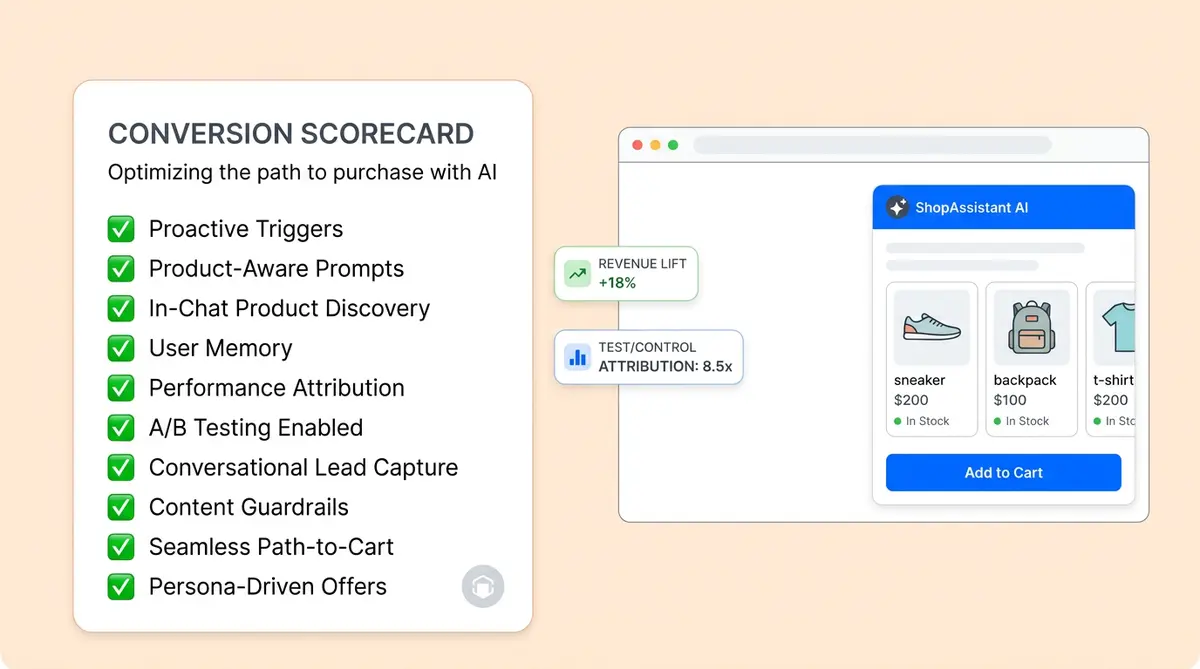
This e-commerce checklist covers 10 capabilities that separate a revenue-driving chat platform from a glorified FAQ chatbot. If you're evaluating vendors, use it to score any vendor's features you're evaluating, including Alhena AI.
1. Contextual Triggers That Don't Annoy
Generic pop-ups kill trust. Look for tools with scroll-depth triggers, time-on-page thresholds, and page-type awareness and design context. The assistant should appear when users and potential customers hesitate, not the moment they land.
Alhena ships nudges fired by scroll depth and timer rules, plus a custom SDK hook for anything else. Exit intent specifically requires wiring via the JavaScript API tools rather than a built-in toggle.
2. Product-Aware Conversation Starters
A shopper on a moisturizer PDP shouldn't see "How can I help you today?" They should see "Want to know if this works for oily skin?" Icebreakers tied to e-commerce catalog data convert because they mirror what the shopper is already thinking.
Alhena auto-generates product-page icebreakers from your product catalog attributes. No manual copy needed, and the value shows immediately in higher engagement. For e-commerce brands, that value compounds over time. For more on why static PDPs are losing ground, see our piece on how AI shopping assistants replace the scroll.
3. In-Chat Product Discovery
Can the assistant filter by size, colour, price, or other options like skin type inside the conversation? Can it surface alternatives when something is out of stock? This is where real-time sales conversations and a shopping assistant earn their keep.
Alhena's Product Expert Agent pulls live product inventory, shows carousel cards with products, and handles filter-by-attribute queries grounded in your actual products and data.
4. Add to Cart Without Leaving the Chat
Every extra click on the path to checkout between "I want this" and the cart is an e-commerce conversion leak. Don't settle for less. Your chat platform should let shoppers add items directly from the conversation window.
Alhena supports native add-to-cart on Shopify and fires a product:added_to_cart event on other platforms so your storefront can help handle it within the same session. Tatcha saw a 3x conversion rate after deploying this kind of frictionless checkout flow.
5. Guided Selling for Considered Purchases
Beauty routines, mattress firmness, supplement stacks: these need a guided quiz, not a search bar. The platform should walk shoppers through a single decision tree that feels like a knowledgeable salesperson.
Alhena offers quiz options and an outfit builder agent, making it easy to guide shoppers for e-commerce fashion brands. Victoria Beckham used guided flows to achieve a 20% AOV increase.
6. Persistent Memory Across Sessions
A returning shopper shouldn't re-explain their skin type, size preferences, or allergy concerns. It's what turns a transactional chat into a relationship.
Alhena's User Memory feature stores preferences across sessions and channels. We've written a deep dive on how unified memory works under the hood if you want the technical details.
7. Revenue Attribution You Can Defend
Ask any vendor: What's your attribution window? First touch or last touch? What qualifies as "influenced"? If they can't answer clearly, you'll never prove ROI to finance.
Alhena uses a 24-hour first-touch window gated on whether the AI provided a helpful answer. It's conservative by design, and the analytics dashboard makes results easy to present. It's also easy to set up. For a full breakdown of how to present these numbers, see how to measure AI chatbot ROI.
8. A/B Testing the Assistant Itself
You need to prove the chat widget is net-positive versus having no widget at all. That means a proper test/control split at the checkout page, within the cart, and across your site, not just before-and-after comparisons.
Alhena runs fingerprint-based test/control splits at the widget level. It's not prompt-level multivariate testing (for that, see our guide on multivariate testing for AI assistants), but it gives you clean incrementality data with built-in analytics.
9. Lead Capture That Feeds Your Stack
Emails collected in chat must flow into Klaviyo, HubSpot, or your CDP automatically. If leads sit in a silo on your website, they're invisible to your marketing tools, your nurture sequences never fire, and customers never hear from you.
Alhena's Lead Generation Agent pushes captured emails and phone numbers to HubSpot, Klaviyo, and mParticle in real time. You don't need CSV exports or manual syncing. If you're using Klaviyo, it's automatic.
10. Guardrails on Discounts, Tone, and Refusals
An AI that invents discount codes or goes off-brand is worse than no AI. You need strategic, operator-level controls: what the bot can and can't say, what products and offers it's allowed to surface, and to ensure it hands off to a human when needed.
Alhena's Guidelines system lets you set rules like "never offer discounts unless the customer has a valid promo code." The AI follows them without hallucinating alternatives. It's a strategic safeguard for your e-commerce brand.
How to Score Your Vendors
For each of the 10 capabilities above, rate every vendor on a simple scale:
- Native: ships out of the box, no dev work
- Configurable: possible with SDK/API wiring, third-party tools, or a custom integration
- Not supported: the vendor doesn't offer it at all
A platform with 7+ native features, built-in analytics, and a sales focus is built for conversion. Fewer than 5, and you're buying a support tool that happens to sit on product pages.
Want to see how Alhena scores on your specific stack? Use the ROI calculator to estimate your revenue success, or book a demo to walk through these capabilities live. You can also start free with 25 conversations and test it yourself.
Frequently Asked Questions
What is a CRO chat platform?
A CRO chat platform is a conversational AI tool designed to increase conversion rates on ecommerce sites, not just deflect support tickets. It includes features like contextual triggers, in-chat product discovery, add-to-cart actions, and revenue attribution.
How does a chat widget increase ecommerce conversion rates?
Chat widgets increase conversion when they offer product recommendations, answer purchase-blocking questions in real time, and let shoppers add items to cart without leaving the conversation. Tatcha saw a 3x conversion rate using this approach with Alhena AI.
What chat triggers work best for CRO?
Scroll-depth triggers and time-on-page thresholds outperform generic pop-ups. The best triggers appear when a shopper hesitates (e.g., 60% scroll on a PDP without adding to cart) rather than on page load.
How should I measure revenue from a chat platform?
Look for clear attribution methodology: what counts as an influenced sale. Don't accept vague answers, the attribution window length (Alhena uses 24 hours), and whether it is first-touch or last-touch. Conservative attribution is more defensible to finance teams.
Can a chat assistant replace a product quiz?
Yes. AI shopping assistants with guided selling capabilities can replicate quiz logic conversationally, adapting follow-up questions based on answers. This works well for beauty, supplements, and apparel where shoppers need help narrowing options.
How do I A/B test a chat widget for conversion impact?
Use a test/control split where a percentage of visitors see the widget and the rest do not. Compare conversion rates between groups over 2-4 weeks. Alhena uses fingerprint-based assignment to keep users in consistent groups.