Mobile devices drive roughly 73% of global e-commerce traffic, according to Mobiloud's 2026 data. Yet mobile conversion rates sit around 1.8%, less than half the 4.1% desktop average. That e-commerce gap isn't new, but the reason it persists might surprise you: the product detail page itself. On a 6-inch screen, the traditional PDP asks shoppers to scroll through images, read specs, compare variants, check sizing, scan reviews, and find shipping info before they ever reach "Add to Cart." Most don't finish. This post breaks down why scrolling is the real conversion killer on mobile and how an AI shopping assistant closes the gap.
The Mobile Conversion Gap Is a Scrolling Problem
Desktop shoppers see a PDP laid out across a wide screen. Price, images, specs, and the buy button are often visible without scrolling at all. Mobile customers get the same information stacked vertically, sometimes stretching 8 to 12 screen-lengths deep.
Every swipe is a decision point. Baymard Institute's checkout research shows that mobile cart abandonment reaches 78%, compared to 66% on desktop. The longer the page, the more exit opportunities you create. These mobile shopping experiences feel like manual work, not human shopping experiences. Sticky add-to-cart bars and thumb-friendly tap targets help at the margins, but they're band-aids on a structural problem: you're asking someone on a small screen to do a lot of reading before buying.
The real question isn't "how do we make the scroll better?" It's "how do we make the scroll shorter?"
What AI Powered Shopping Assistants Change on Mobile
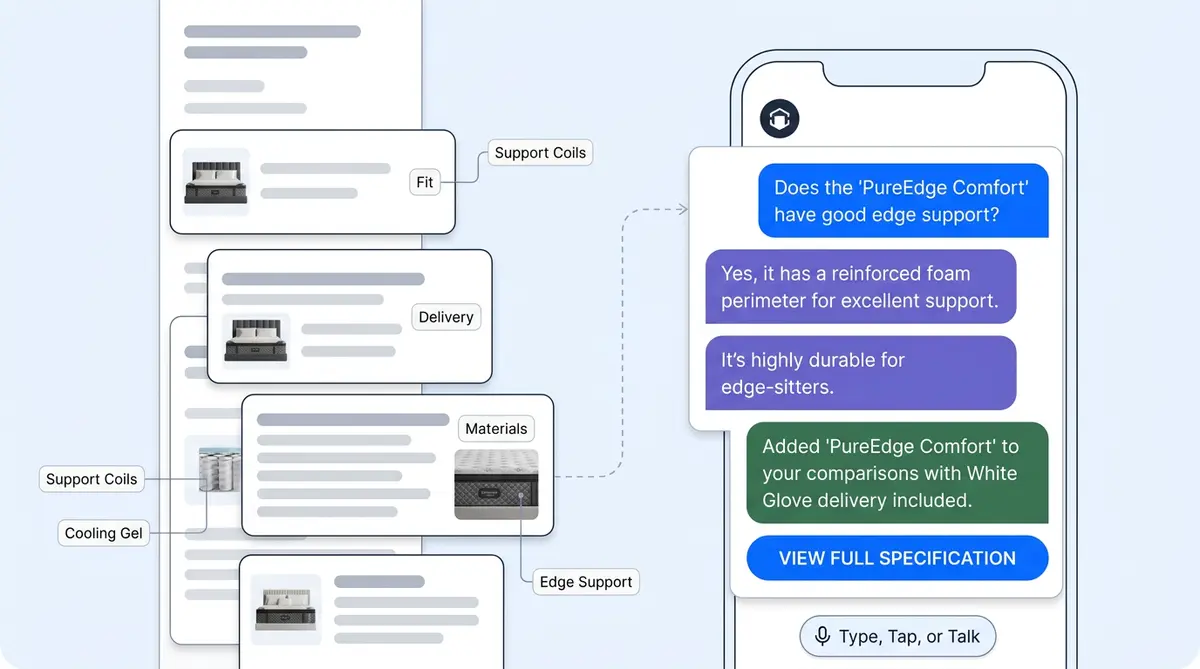
An AI shopping assistant sitting on a mobile PDP compresses the scroll into a conversation. Instead of using search or hunting through accordion tabs for answers, the AI assistant handles answering questions in real time. Rather than scrolling for shipping info, the shopper asks, "When will this arrive?" Instead of scrolling to the size chart, they type, "I'm 5'8" and 160 lbs; what size?"
Customers who engage with AI shopping assistants assistants on product pages convert at 4x higher rates than those who don't. That's 12.3% versus 3.1%. On mobile, where the scroll tax is highest, the lift is even more meaningful.
The assistant doesn't replace the PDP. It sits on top of it as an intelligent shopping agent, letting mobile users can skip straight to the information that matters to them. A user comparing two products like moisturizers doesn't need to open both PDPs in separate tabs (painful on mobile). They ask the assistant, get a side-by-side comparison, and add to the cart without leaving the conversation. Products, variants, and bundles can surface inside the chat.
From Scroll to Cart in Three Messages
Here's what a typical mobile interaction looks like with Alhena AI's shopping assistant:
- Shopper asks a product question: "Is this safe for sensitive skin?" The assistant answers using verified product information from the store, with tailored product recommendations powered by personalization based on browsing context and purchase history's catalog. No hallucinated claims, no generic responses.
- Shopper narrows their choice: "What about the unscented version?" The assistant pulls the variant, shows a rich product card with image, price, and ratings inline.
- Shopper buys: "Add it to my cart." The assistant populates the cart and pre-fills checkout. On mobile, this makes buying faster. Skipping even two taps can be can be the difference between a sale and a bounce.
Customers can complete that entire journey, from shopping journey start to cart, happened without scrolling past the fold. The real time automation handles product discovery, comparison, and checkout in one flow. Brands like Tatcha have seen a 3x conversion rate and 38% AOV uplift, turning AI-assisted customers into higher-value buyers. More customers can complete purchases without human agents. Victoria Beckham reported a 20% increase in average order value, proving the conversion and revenue increase is real for beauty and skincare brands.
The Two Things Mobile PDPs Still Need to Get Right
A conversational layer doesn't excuse a bad page. There are two layers to get right in 2026:
Layer 1: Foundational mobile hygiene. This is table stakes. Fast load times (sub-2.5 second LCP so products can load fast), legible typography, a sticky buy button, one-tap payment options like Apple Pay or Shop Pay, and swipeable image galleries. These aren't Alhena's job. They're your front-end team's job. Do them anyway.
Layer 2: The conversational surface. This is where conversational AI and the conversion gap actually closes. An AI assistant that answers product questions from real product catalog data for all products, handles sizing, product details, and compatibility queries. These queries across hundreds of products, can surface upsells, cross-sell suggestions and merchandising recommendations based on contextual customer intent, and moves shoppers to checkout inside the chat. Alhena deploys this tailored personalization layer in under 48 hours with no dev resources or complex pricing tiers needed. Alhena's AI agents connect to your business across Shopify, WooCommerce, Magento, and Salesforce Commerce Cloud.
Every e-commerce business that nails both layers wins. Layer 1 can keep customers from leaving out of frustration. Layer 2 keeps them from leaving out of indecision.
Voice: The Next Mobile PDP Surface
On mobile, hands aren't always free. A shopper comparing products while holding a toddler or cooking dinner can't scroll and tap easily. Voice AI adds another entry point to the PDP experience, letting users ask questions and add to the cart by speaking.
Alhena's voice commerce UX can handle add-to-cart and purchase handoffs grounded in the same live product catalog data as the chat widget. The PDP becomes a launchpad for whichever interaction mode fits the shopper's context: type, tap, or talk.
The PDP Isn't Dying. Its Job Is Changing.
The mobile PDP used to carry the entire persuasion burden: convince the shopper, answer every objection, and close the sale through page design alone. That was always a tall order on a small screen.
In 2026, the PDP's role is shifting. It's becoming a structured data source that feeds AI assistants, rather than a standalone sales page. Smart product data feeds smart AI assistants. The better your product data (descriptions, specs, reviews, FAQs), the better the assistant performs. And the better the assistant performs, the less your mobile customers need to scroll.
That's the real mobile-first blueprint: not a prettier page or a basic chatbot. AI shopping assistants go beyond basic chatbots and chatbot scripts by pulling real time product information and acting on it on top of it.
Ready to close the mobile conversion gap? Book a demo with Alhena AI or start for free with 25 conversations.

Frequently Asked Questions
Why do mobile PDPs convert at half the desktop rate?
Mobile PDPs stack all content vertically, creating 8 to 12 screen-lengths of scrolling. Each swipe is an exit opportunity. Mobile cart abandonment hits 78% compared to 66% on desktop, largely because shoppers lose patience before reaching the buy button.
How does an AI shopping assistant improve mobile PDP conversion?
AI shopping assistants compress the scroll into a conversation. Shoppers ask product questions, compare variants, and add to cart inside the chat without scrolling through the full page. Brands using this approach see conversion rates 4x higher. AI shopping assistants answer the exact question blocking the shopping journey than shoppers who browse without the assistant.
Can AI shopping assistants add products to cart from inside chat?
Yes. Yes. Alhena’s AI agent supports agentic checkout and agentic commerce, meaning the assistant can populate the cart, select variants, and pre-fill checkout fields within the conversation. On mobile, this removes multiple taps from the purchase flow.
Does Alhena work on Shopify, WooCommerce, and Magento mobile storefronts?
Alhena integrates with platforms like Shopify, WooCommerce, Magento, and Salesforce Commerce Cloud. The chat widget is responsive by default and deploys in under 48 hours with no developer resources required. Users can configure the assistant from a dashboard.
What results have brands seen using AI shopping assistants on mobile PDPs?
Tatcha saw a 3x conversion rate and 38% average order value uplift. Victoria Beckham reported a 20% AOV increase. Across Alhena customers, shoppers who engage with the assistant convert at 12.3% versus 3.1% for those who do not.
Do AI shopping assistants replace the product detail page?
No. AI shopping assistants sit on top of the PDP as a conversational shopping layer. The PDP still serves as the structured data source for all products that feeds the assistant. Better product data means better assistant performance, which means less scrolling for mobile shoppers.
How do AI shopping assistants and voice AI fit into mobile PDPs?
AI shopping assistants like Alhena can also use Voice AI. It lets mobile shoppers ask natural language questions and add to cart by speaking, useful when hands are busy. It uses the same product catalog data as the chat widget, creating multimodal touchpoints across interaction modes for customers: type, tap, or talk.