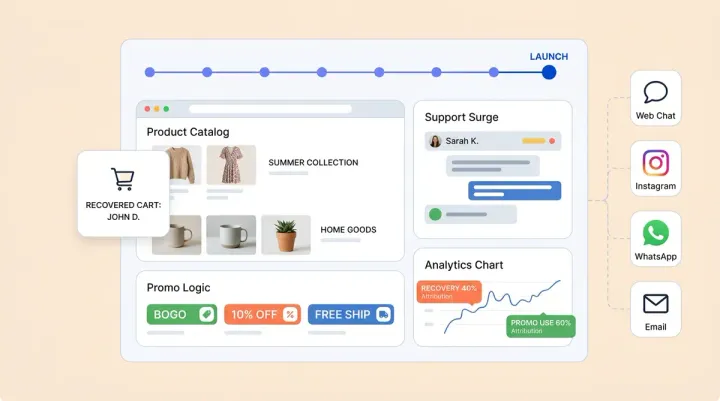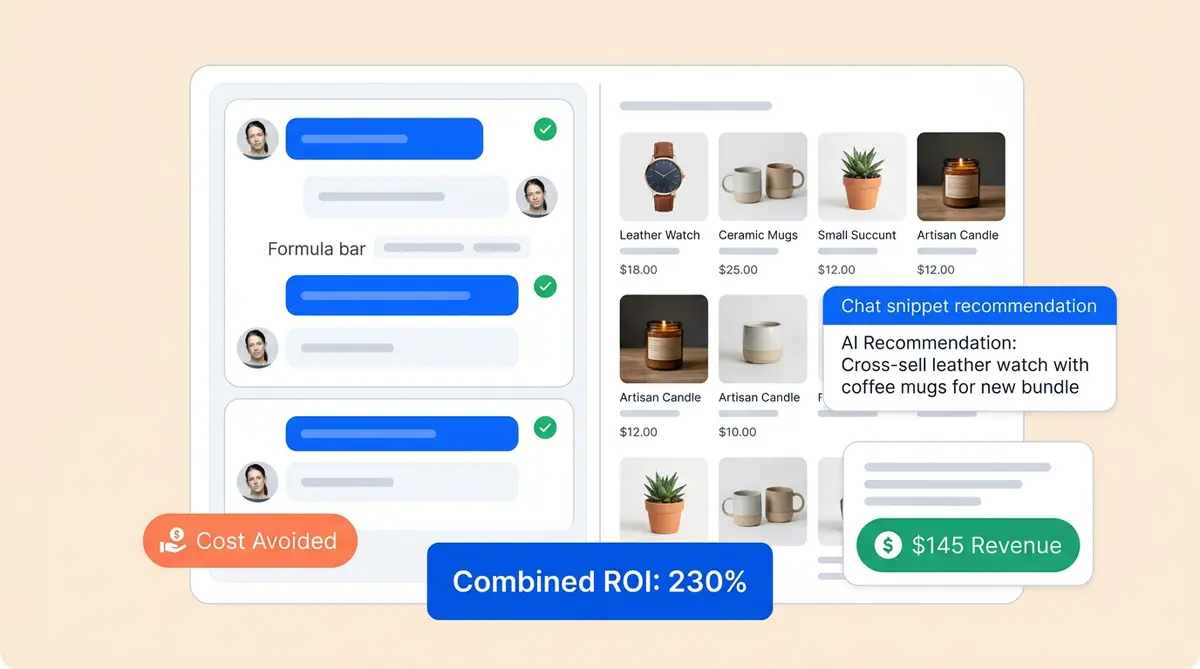
If you run a Shopify store, you probably spend hours tweaking ad spend and split-testing e-commerce landing pages, but can you answer a simple question: what's the actual return on your Shopify store chatbot? With rising customer support costs and tighter margins, the answer matters more than ever. The problem isn't a lack of data. It's that chatbot cost and chatbot value have two distinct levers. The ROI formula for each is different. To calculate the ROI properly and to calculate ROI accurately, you need both ROI calculations running side by side, and most merchants only measure one.
To understand what each platform charges before you calculate ROI, check our AI chatbot pricing comparison for 2026.
This post breaks down both levers with Shopify-specific metrics, gives you the formulas, and shows you a baseline calculation you can run this week.
The Two Levers of Shopify Store AI Chatbot ROI
The first lever is deflection savings: the costs you avoid when automation resolves a customer support ticket instead of a human agent. The second is attributed revenue: the sales (from product recommendations, cart recovery, and personalization) your AI shopping assistant influences along the customer journey before checkout.
Most Shopify store merchants only track deflection. That's a problem, because the revenue side is often worth more for long-term e-commerce growth. Tatcha attributes 11.4% of total site revenue to Alhena, with a 3x conversion rate, 38% AOV uplift, and lower cart abandonment. Victoria Beckham saw a 20% increase in average order value. Those results drive real commerce purchases but don't show up in a deflection-only dashboard. An AI chatbot that handles customer service inquiries and product recommendations simultaneously delivers value that pure support automation misses.
For a full breakdown of the deflection formula and five-step ROI calculation framework, see our guide to measuring AI customer service ROI. Below, we focus on the Shopify-specific implementation steps.
Where to Find Your Numbers in a Shopify Store
Getting your deflection rate is straightforward. In Alhena's dashboard, open Analytics > Agent Performance and note your Resolution Rate for the last 30 days. Alhena's AI agents only count fully resolved conversations. This metric counts only sessions the AI fully resolved without handing off to a human (full automation). If your chatbot vendor lumps escalated messages into the "resolved" bucket, your cost savings calculation is inflated. For context, Crocus achieved an 86% deflection rate, while Puffy hit 63% automated resolution at 90% customer satisfaction. Higher resolution rates improve response time, which directly affects customer retention, lifetime value, and time saved per agent. Check your analytics dashboard for response times before and after implementation.
For attributed revenue, open Analytics > Revenue Impact. Alhena's native Shopify store integration automatically tracks attributed revenue through webhooks. No install scripts, no Shopify app configuration needed. The dashboard surfaces Total Add-to-Cart GMV, Average Cart Value, and Daily Cart GMV. These signals also help with demand forecasting, refreshed every two hours. GMV figures exclude tax and shipping for a net positive signal.
The revenue attribution formula uses a 24-hour window between the AI interaction and the purchase. Only sessions where the bot returned a knowledge-grounded answer from your product catalog, inventory stock, and store data count. Generic fallbacks are excluded. For a deeper look at revenue formulas and NLP-driven attribution, our Ecommerce AI ROI Playbook covers the entire framework.
A Quick Worked Example
Here's a baseline calculation for a mid-size Shopify store with an active chatbot. The total cost of implementation is low, and most Shopify store merchants see a payback period under 30 days. Swap in your own numbers. The key inputs come from your customer support reporting and your AI dashboard.
- Monthly conversations: 8,000 sessions
- Resolution rate: 72%
- Total cost per human ticket: $5.00 (salary, tools, training costs)
- Chatbot cost per conversation: $0.35
- Monthly attributed GMV from AI: $45,000
- AI chatbot monthly cost: $800
Deflection cost savings: 8,000 x 0.72 x ($5.00 - $0.35) = $26,784/mo
Attributed revenue: $45,000/mo (from Revenue Impact analytics dashboard)
Total ROI: $26,784 in savings + $45,000 in influenced revenue = $71,784/mo against $800 in chatbot costs
Is the investment worth it? Even if you discount attributed revenue by 50%, the return still dwarfs the total cost. Track these items over three months to set a better baseline. Alhena's ROI calculator can model your specific scenario with accuracy across different conversion rates. The cost savings from deflected support tickets alone often cover the subscription. Beyond cost savings, using AI for order tracking and proactive chat widget messages helps convert browsers into buyers in real time. For any e-commerce brand, that turns your support channel into a revenue channel.
Six Questions to Ask Before You Sign
Whether you're evaluating your first Shopify store chatbot or switching bots, ask these before committing:
- Is revenue attribution automatic for Shopify? Webhook-based attribution should work on any Shopify store without custom policies or install steps.
- What's the attribution window? You want specifics: 24-hour window, first-touch rules, and knowledge-based answer filters. Vague claims aren't worth much.
- Does resolution rate exclude escalated items? Conversations that start with the bot but end with a human aren't fully automated.
- Can you segment analytics by channel? If your bot handles web chat, email, and Instagram DMs, you need each channel's ROI independently.
- Is there A/B testing for sessions? Correlation isn't causation. Our guide on holdout tests explains how to measure incremental purchases and growth.
- How do costs scale? Run the formula at 2x and 5x your current volume over six months. Check transparent pricing to set better expectations.
Sizing Your AI Budget for Shopify Plus Seasonality
ROI formulas tell you what happened last month. But if you're on a Shopify Plus store with seasonal peaks, you also need to plan ahead. BFCM, holiday gifting, and flash sales can push conversation volume to 2–4x your baseline. If your AI plan isn't sized for that, you'll either hit overage rates or lose coverage at the worst possible time.
Here's how to model it. Pull your last 12 months of ticket volume from your helpdesk (Gorgias, Zendesk, or Shopify Inbox). Identify your peak month and divide it by your median month. That's your spike multiplier. Most Shopify Plus brands land between 2.5x and 3.5x during BFCM.
Using the same 8,000 conversations/month baseline from our earlier example: a 3x BFCM spike means 24,000 conversations in November. On Alhena's Growth plan (1,200 credits/month at $999), you'd use your full allocation in the first two weeks. The remaining conversations would bill at the $1.20/credit overage rate, adding significant cost to that month's bill.
Compare that to upgrading to an Enterprise plan before the holiday season, where per-credit costs drop and volume caps are negotiable. The math usually favors upgrading for any spike above 2x. For brands between 1.5x and 2x, absorbing the overage on one or two months is often cheaper than a year-round plan upgrade.
The key takeaway: size your plan for median volume, not peak volume, and model the overage scenario before you sign. For a deeper look at how credit-based pricing compares to per-seat and per-resolution models, see our guide to credit-based AI pricing.
AI chatbot ROI on a Shopify store isn't one number. It's a cost savings line and a revenue line, each with its own formula and baseline. Measure the entire picture, and you'll make better, smarter decisions about where to spend. Ready to see what the numbers look like? Book a demo with Alhena AI or start free with 25 conversations.
Frequently Asked Questions
What are the two levers of Shopify store AI chatbot ROI?
The two levers are deflection savings (cost avoided when AI resolves tickets instead of human agents) and attributed revenue (sales influenced by AI interactions before checkout). Most stores only track deflection, missing the often-larger revenue side.
How does Alhena track attributed revenue on Shopify?
Alhena uses webhook-based attribution through its native Shopify integration. It tracks a 24-hour window between the AI interaction and purchase, counting only sessions where the AI returned a grounded, knowledge-based, relevant answer from your product catalog. The Revenue Impact dashboard shows Total Add-to-Cart GMV, Average Cart Value, and Daily Cart GMV.
What is a good deflection rate for a Shopify AI chatbot?
Industry benchmarks for AI chatbot deflection on Shopify implementations range from 60% to 86%. Crocus achieved 86% with Alhena, while Puffy hit 63% with a 90% CSAT score. Your target depends on query complexity, but anything above 60% with strong CSAT is solid.
How do I calculate monthly deflection savings?
The formula is: Total conversations x Resolution rate x (Cost per human ticket minus Cost per AI conversation). For a worked example with specific costs and numbers, see our practical guide to measuring AI customer service ROI.
What attribution window does Alhena use?
Alhena uses a 24-hour attribution window. The interaction must include a helpful, product-grounded response to count. Generic fallbacks and escalated conversations are excluded from revenue attribution.
Can I A/B test my Shopify AI chatbot to prove ROI?
Yes. Running a holdout test (where a control group doesn't see the AI) is the strongest way to prove incremental lift rather than just correlation. This separates sales the AI actually influenced from sales that would have happened anyway.