The Deflection Trap
Ask any e-commerce CX leader how they measure AI ROI, and you'll hear the same answer: deflection rate. If the AI-powered chatbot handles 60% of inbound queries, the business case "worked". Finance signs off, the team moves on, and nobody asks whether the AI systems actually made money.
That's the trap. Deflection is a proxy metric that measures what you avoided spending. It says nothing about what you earned. And when retailers like Tatcha attribute 11.4% of total site revenue to AI conversations, it's clear that using ticket deflection as your north star misses most of the value.
This playbook introduces a better metric: revenue per conversation. It also covers a risk variable most ROI models skip entirely, the cost per conversation when AI systems hallucinate.
Revenue per Conversation: The Metric That Matters
Revenue per Conversation (RPC) measures the actual margin each AI-powered interaction generates. The formula:
RPC = (Attributed GMV - Fulfillment and Refund Costs) / Total AI Conversations
Attribution is where it gets hard. Not every chat ends in a checkout. A shopper might browse three products with the AI's help, leave, and convert through a retargeting ad the next morning. You need defined windows across the customer journey:
- In-session: Customer buys during or right after the chat. Full credit to AI.
- 24-hour click-through: Customer clicks a product link in chat and returns to buy within a day. Partial credit.
- 7-day view-through: Customer interacted with AI but converted later through another channel. Fractional credit.
A worked example: a mid-market retailer doing $4.2M per year runs 38,000 AI conversations monthly. Of those, 4,200 convert (11% rate) at a $95 average order value. That's $399,000 in monthly attributed GMV. After subtracting roughly 12% for fulfilment and returns, the attributed margin is $351,000. RPC = $9.24 per conversation.
Now compare that to the deflection-only math. If the same brand deflects 60% of 38,000 conversations at $8 cost per conversation saved, that's $182,400 per month. Real money, but barely half the revenue contribution. Most retailers are sitting on an AI asset worth twice what their dashboards show. Alhena's analytics dashboard separates assist conversations from support conversations so both numbers stay visible.
Why Deflection ROI Plateaus
Cost-savings ROI from AI systems has a ceiling. Once you hit 60 to 70% containment, pushing higher degrades the customer experience. The remaining tickets are complex, high-emotion cases that need a human. You can't deflect your way to more savings without hurting CSAT. Proxy metrics like containment rate start to mislead at this point.
Revenue-side ROI doesn't plateau the same way. RPC scales linearly with traffic. More visitors mean more AI-powered conversations mean more attributed revenue at near-zero marginal cost. The retailers in the best position treat AI as both a support tool and a sales channel across the full customer journey.
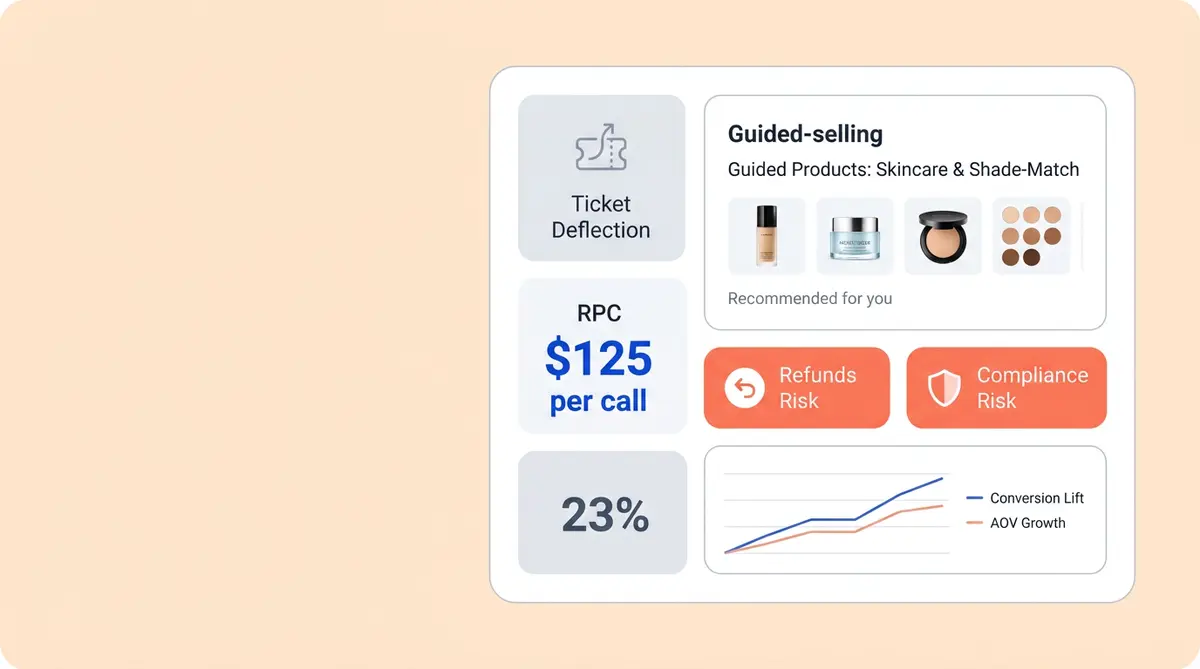
The revenue lines that pure-deflection tools miss: cart recovery from abandoned conversations; AOV uplift through guided selling (Tatcha saw 38% higher AOV); fraud prevention savings from AI-powered order verification; and post-purchase cross-sell at the moment a customer asks about their order. Victoria Beckham's 20% AOV increase came from exactly this kind of guided product matching within the AI ecosystem.
The Hidden Cost of Hallucinations
Every AI ROI model has a risk line most teams skip: what happens when the AI systems say something wrong?
A chatbot that promises free shipping when the policy is a $5.99 flat rate creates a refund obligation. An AI that tells a customer a retinol serum is "safe for pregnant women" creates a compliance exposure. An agent that confirms an out-of-stock item is "available and shipping tomorrow" creates a chargeback. Even Amazon's AI hardware and software investments face this challenge at scale.
The costs stack in three layers:
- Direct refund exposure: Every incorrect promise has a dollar value. Ten wrong shipping promises per month at an average order of $40 = $4,800 per year in unnecessary refunds.
- Brand trust decay: One viral screenshot of bad AI advice can cost more than a year of deflection savings. Model this as LTV loss across the customer journey.
- Compliance tail risk: In beauty, supplements, and financial products, an AI-powered claim that violates regulations triggers more than a fine. The legal review is the expensive part.
A formula to estimate your exposure:
Annual Hallucination Liability = Monthly AI Conversations x Error Rate x Average Cost per Error x 12
If that number is larger than your deflection savings, your ROI model is incomplete. The architecture fix is grounding: anchoring every response in verified product data and confirmed inventory securely rather than letting the model generate plausible guesses. Grounded AI isn't a marketing phrase. It's a specific engineering decision about retrieval over generation, and it changes the cost per conversation risk math entirely.
Your 30-Day ROI Pilot Checklist
Before evaluating any AI vendor or running a pilot with the one you have, answer these six questions:
- What's your fully loaded cost per conversation for human-handled tickets?
- What percentage of AI conversations involve a product question vs. an order status check?
- Can you attribute specific orders to specific AI conversations today?
- What's your AI error rate, and what does each error cost in refunds or goodwill credits?
- How does your conversion rate for AI-powered sessions compare to unassisted ones?
- What's your AOV for AI-assisted orders vs. site average?
If you can't answer three or more, you're tracking proxy metrics instead of the numbers that matter. The Alhena ROI Calculator can model the revenue side once you have your baselines.
Ready to see what your AI conversations are actually worth? Book a demo with Alhena AI or start for free with 25 conversations.