In 2026, customers reach support through chat widgets, voice agents, and third-party AIs acting on their behalf. A static help center can't serve any of them. True ai knowledge base software isn't a docs repository with a chatbot bolted on. It's a conversational AI system feeding multiple agents across multiple surfaces, from search queries to ticket deflection. Whether you’re onboarding a new knowledge management system or replacing an old one, this guide covers six criteria that separate real AI knowledge bases from dressed-up search bars and how to evaluate them before you commit.
What Makes a Knowledge Base "AI-Powered"? Six Criteria
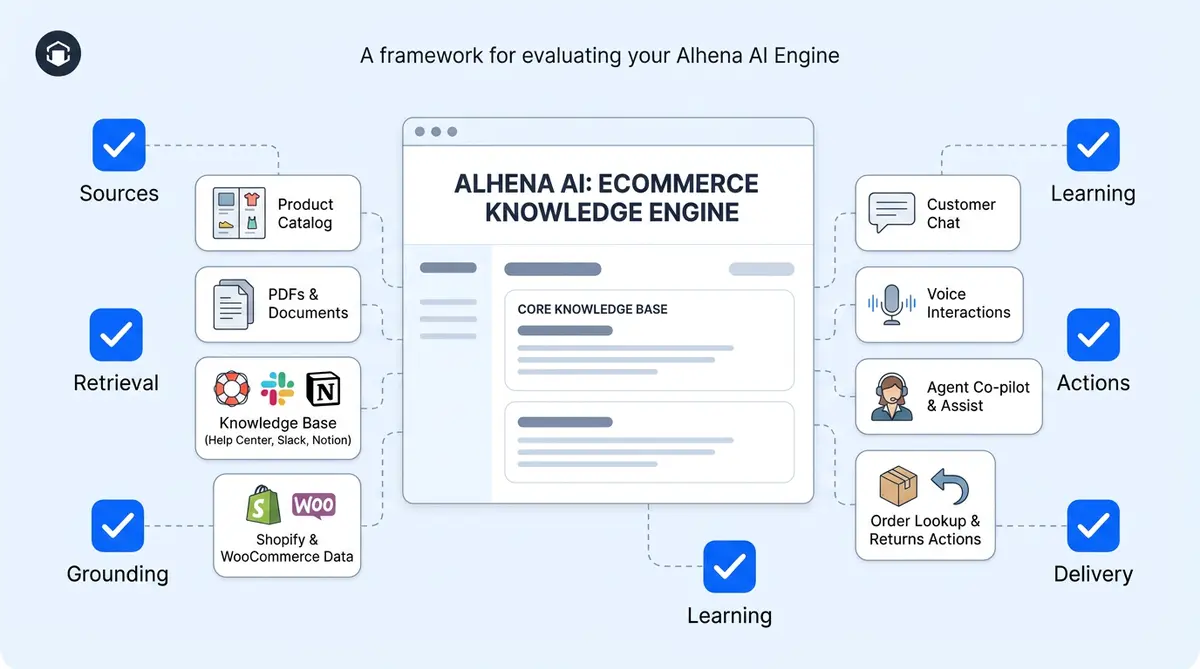
Not every tool that puts "AI" in its name earns the label. In 2026, here are six checks that separate genuine AI knowledge base software from legacy help centers with a generative AI chatbot wrapper. It pulls answers.
1. Source Diversity
Can it ingest websites, PDFs, help-centre articles, Confluence, Notion, Google Drive, Slack, Discord, CSV files, and commerce information and data like Shopify or WooCommerce information catalogs? The broader the ingestion surface, the fewer blind spots. Enterprise security and access controls matter too, Your AI system has.
2. Retrieval Quality
Pure vector search returns "close enough" results. The best platforms can use hybrid retrieval: semantic search, keyword matching, intent detection, and structured filters combined so the answer is better, more precise and accurate, not just plausible. Alhena AI calls this agentic RAG, where retrieval can adapt to context in real time.
3. Grounding and Hallucination Prevention
Does the tool cite sources? Does it refuse to answer when evidence is missing? A grounded system can constrain every response to retrieved, verified, trusted data. In e-commerce, wrong information can mislead customer questions and cost real money and tank your CSAT scores.
4. Continuous Learning
Static knowledge bases can decay fast. Expect auto-FAQ generation from real conversations, human feedback loops, smart flagging for QA review, and scheduled training and retraining. Alhena's continuous learning architecture runs weekly or monthly retraining plus incremental updates whenever new sources are added.
5. Agentic Actions
Can the knowledge base run a system that takes action, looks up an order, files a return, or recommends a bundle? Or is it read-only? The gap between answering queries and completing tasks is the gap between a cost center and a revenue channel. Alhena's self-service shopping assistant and Order Management module handle both sides.
6. Multi-Surface Delivery
Your knowledge base should deliver through a chat widget, conversational search, voice, social DMs, reply suggestions, virtual assistants, and headless access for external LLMs. If it only works inside one channel, you'll end up managing multiple knowledge bases.
AI Knowledge Base Tools by Use-Case Category
Ranking tools 1 through 10 implies a universal "best". The right AI knowledge base software platform depends on your use case. Here's how the market breaks down.
Ecommerce-Native AI Knowledge Bases
These platforms can ingest product catalogs, track orders, returns, and customer behavior, and tie conversations to revenue. Alhena AI sits squarely here, combining a knowledge base, conversational AI search, chat widget, voice agent, and help desk assistance on a single unified retrieval-grounded backbone. Its Headless mode exposes the same unified workspace to Claude and ChatGPT, so your information and intelligence travel wherever customers ask questions.
Support-Desk-Native Platforms
Tools built around Zendesk, Intercom, or Freshdesk excel at ticket deflection, ticket routing, ticket prioritization, support team productivity. The trade-off: they weren't designed to drive revenue or handle commerce data natively.
Enterprise IT and Employee-Facing Knowledge Bases
These can serve internal teams, pulling from Atlassian Confluence, SharePoint, and Jira. Strong for IT service desks and internal customer service, not customer support for e-commerce, not built for customer-facing e-commerce. They excel at enterprise search for internal knowledge.
General-Purpose Chatbot Builders
Drag-and-drop bot builders that can generate answers from uploaded docs. Fast to set up. 'Easy to set up' means fast time to value, but setup complexity varies, but it is shallow on retrieval quality, grounding, and action-taking. Fine for a landing page FAQ, not enough for thousands of daily support cases and use cases.
Integration Capabilities to Evaluate
Before you shortlist any AI knowledge base software, map it against five dimensions.
- Helpdesk connections: Gorgias, Zendesk, Freshdesk, Zoho Desk, Kustomer
- Ecommerce platforms: Shopify, WooCommerce, Salesforce Commerce Cloud, Magento
- Source ingestion: Websites, PDFs, documents, Notion, Google Drive, Slack channels, Discord, <a href="https://alhena.ai/blog/train-ai-github-repos-issues-knowledge-base/">GitHub</a>, YouTube, CSV
- Channel coverage: Web widget, voice, WhatsApp, Instagram DMs, email, Slack
- Developer extensibility: REST API, JS SDK, MCP servers, advanced tool calling
Alhena AI covers all five. Its multi-model, multi-agent architecture lets those tools call HTTP APIs, MCP servers, and spreadsheets to take action beyond simple retrieval.
How to Run a 30-Day Evaluation
Don't commit to annual contracts based on a demo. Run a structured pilot.
- Pick one channel. Start with your highest-volume surface, usually the web chat widget.
- Ingest a representative slice. Load your top 50 help articles, content, key information, product information, your product catalog, and your return/shipping policy.
- Build 20 evaluation queries with known correct answers spanning guided recommendation scenarios, order lookups, and policy questions.
- Measure four metrics: groundedness, accuracy, CSAT, and deflection rate.
- Expand or walk away. If it hits your thresholds, add channels and sources. If not, you've lost 30 days instead of 12 months.
For a deeper walkthrough, see our guide on how to run a low-risk AI pilot for your online store.
Pricing Models to Watch For
AI knowledge base pricing falls into four models: per-seat, per-resolution, per-monthly-active-user, and hybrid with revenue share. Per-seat pricing can punish growth and inflate costs. Per-resolution pricing can align cost with value but can spike at scale. The best fit for e-commerce brands is usually per-conversation or usage-based pricing that scales with traffic, not headcount.
Alhena AI offers flexible pricing based on channel mix and volume. Explore options on the pricing page or estimate savings with the ROI calculator.
The Bottom Line
In 2026, your knowledge base isn't a reference library. It's the reasoning layer behind every AI system your brand deploys. The right AI knowledge base software grounds answers in verified data, learns from every conversation, and takes action on behalf of your customers.
Ready to see how a retrieval-grounded AI knowledge base works in practice? Book a demo with Alhena AI or start free with 25 conversations.
Frequently Asked Questions
What is ai powered knowledge base software?
AI powered knowledge base software uses retrieval-augmented generation, semantic search, and continuous learning to deliver grounded, accurate answers from your company's content. Unlike traditional help centers, it reasons across multiple data sources and can power agents that take actions like looking up orders or recommending products.
How does an AI knowledge base differ from a traditional help center?
A traditional help center is a static library of articles that customers search manually. An AI knowledge base ingests those articles plus product catalogs, PDFs, Slack threads, and other sources, then retrieves and synthesizes answers in real time. It also learns from every conversation and can take actions, not just surface text.
What data sources should AI knowledge base software support?
At minimum: websites, PDFs, help-center articles, and product catalogs. Strong platforms also ingest Confluence, Notion, Google Drive, Slack, Discord, GitHub, YouTube, CSV files, and Google Sheets. For ecommerce, live Shopify or WooCommerce catalog sync is essential.
How does Alhena AI prevent hallucinations in its knowledge base?
Alhena uses agentic RAG to constrain every response to retrieved, verified data. If the knowledge base doesn't contain evidence for an answer, the system declines to guess. Smart flagging routes uncertain responses to human QA review, and human feedback loops continuously tighten accuracy.
Can AI knowledge base tools integrate with Shopify and WooCommerce?
Ecommerce-native platforms like Alhena AI integrate directly with Shopify and WooCommerce to sync product catalogs, inventory, and order data in real time. This lets the AI recommend in-stock products, look up orders, and process returns without switching tools.
How long does it take to set up ai powered knowledge base software?
Setup time varies by platform. Alhena AI deploys in under 48 hours with no dev resources required. You connect your data sources, configure guidelines and personality, and the onboarding process begins immediately with automated ingestion and training. Most brands go live on their first channel within a week.
What pricing models do AI knowledge base platforms use?
Four common models: per-seat, per-resolution, per-monthly-active-user, and hybrid with revenue-share. Per-conversation pricing tends to work best for ecommerce brands because costs scale with traffic rather than team size.
How do I evaluate AI knowledge base software before committing?
Run a 30-day pilot on one channel. Ingest a representative slice of your content, build 20 test queries with known correct answers, and measure groundedness, accuracy, CSAT, and deflection rate. If it hits your thresholds, expand. If not, you've lost 30 days instead of 12 months.