Fifty-nine percent of businesses regret at least one SaaS purchase made in the past 18 months, according to Capterra. In e-commerce, that regret often starts with a single phrase: "We need AI." The problem isn't a lack of options. It's that "AI chatbot for e-commerce" has become a catch-all label slapped on three fundamentally different products. This post gives you a 3-bucket framework so you can choose the right AI e-commerce vendor for your stores based on what their AI-powered tools actually do. The best AI shopping assistant for your Shopify or enterprise store depends on which buckets it covers.
Why "AI for Ecommerce" Means Three Different Things
Ask a Shopify brand what "AI for e-commerce" means, and you'll get a different answer depending on who picks up the phone. The CX director says 'chatbot'. The merchandising lead says AI-powered product discovery tools. The CMO says, "Something about ChatGPT showing our competitors instead of us."
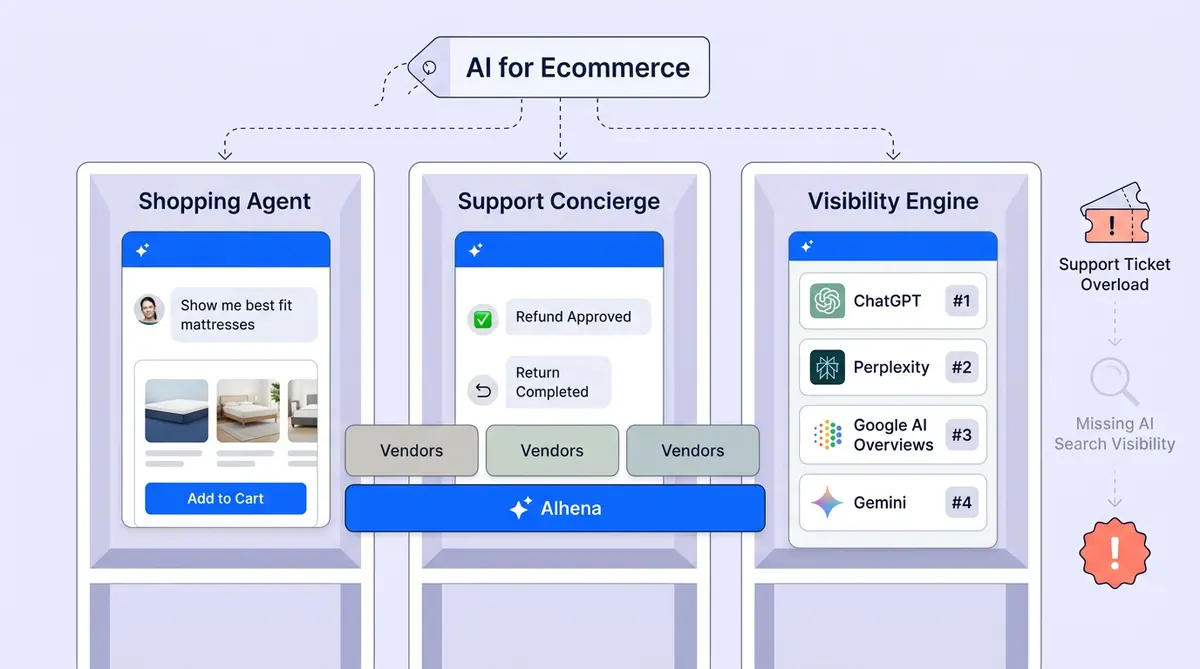
They're all right, and they're all describing different products. The market has quietly split into three distinct but complementary capability buckets:
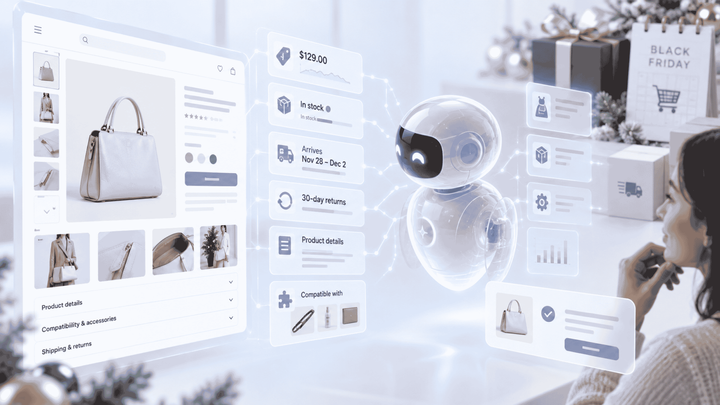
- Bucket 1: Shopping Agent uses an AI assistant to automate guided selling, product discovery, cross selling, upsells, recommendations, and cart population, reducing cart abandonment and turning browsers into buyers.
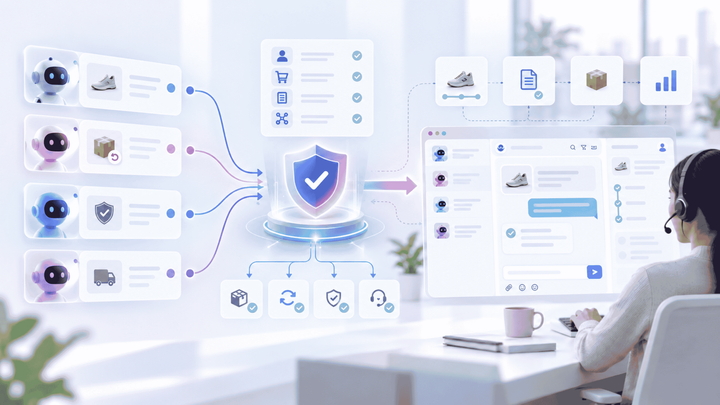
- Bucket 2: Support Concierge resolves post-purchase issues like order tracking, product attributes, returns, and refunds without escalating to a human.
- Bucket 3: Visibility Engine ensures your products appear when consumers ask ChatGPT, Perplexity, or Google AI for recommendations.
Most vendors cover one bucket. Some cover two. Almost none cover all three. And if you don't know which buckets you're buying, you'll end up with buyer's remorse inside six months. Our AI Agent Evaluation Checklist scores vendors across 10 criteria within Buckets 1 and 2. This framework adds visibility.
Bucket 1: The Shopping Agent
One killer question: "Can the AI populate a cart based on a conversation?"
A real AI shopping assistant and chatbot doesn't just answer "Do you have this in blue?" It guides a shopper through a multi-turn conversation, narrows options based on shopper intent, personalized preferences, and adds items directly to the cart.
If a vendor's "shopping AI" is really just a search bar with natural language processing, it's not a shopping agent. Ask for a live demo where the AI handles a multi-product conversation and builds a cart. If it can't, move on. For the full scoring rubric on shopping capabilities, see our 10-question evaluation checklist.
Bucket 2: The Support Concierge
One killer question: "Can it resolve an order issue end-to-end without escalating?"
Deflection isn't resolution. A chatbot that says "I've forwarded your request to our team" has deflected a ticket. An AI support concierge that processes a return, generates a shipping label, and confirms the refund timeline has resolved one. Shopify brands see this difference daily. The gap between those two outcomes is the gap between 40% cost savings and higher AOV versus frustrated customers and lost customer loyalty.
Intercom Fin averages a 66% resolution rate across 6,000+ customers. The Gorgias AI agent automates up to 60% of routine inquiries. Those are solid Bucket 2 numbers for any AI agent focused on customer engagement and loyalty. But without analytics that tie resolution to revenue, you’re flying blind. But neither tool populates carts (Bucket 1) or tracks your product visibility in AI search results and answers (Bucket 3). When you evaluate an AI support tool, score it on resolution, not deflection, then ask, 'What else does this vendor cover?' The best AI platforms automate resolution and customer engagement across the full journey. For detailed scoring criteria, use our evaluation checklist.
Bucket 3: The Visibility Engine
One killer question: "Does it track where your products appear in ChatGPT, Perplexity, and Google AI?"
This is the bucket most AI vendor evaluation frameworks ignore entirely. Every buyer's guide, checklist, and comparison post in e-commerce evaluates AI on shopping and support capabilities. None ask whether the vendor helps retailers show up where online shopping discovery happens.
Online shopping via generative AI grew 693% year-over-year during the 2025 holiday season. Google AI Overviews now appear on 14-16% of shopping queries. And 80% of sources cited in those AI overviews don't even rank on page one organically. Traditional SEO keywords, search rankings, target keywords, and AI visibility are different games with different rules.
A visibility engine, sometimes called an AEO (Answer Engine Optimization) or GEO (Generative Engine Optimization) tool, monitors how your products render inside AI-generated online shopping answers. Not just brand mentions, but whether specific SKUs appear with pricing, product attributes, ratings, and buy links. The distinction matters. A brand mention in a ChatGPT response doesn't drive revenue. A product card with a price and a link does. Compare priced tiers, free plan options, and feature sets before committing.
This category is new, and most AI tools, AI assistant platforms, and chatbot builders ignore it entirely. Your AI agent should autonomously track where products appear in AI-generated answers. Peec AI and Scrunch AI monitor brand mentions. Alhena AI Visibility goes deeper with SKU-level tracking, revenue growth attribution tied to AI data sources, and an AEO FAQ engine that generates citation-ready content AI models prefer to reference. For a full breakdown of the tools in this space, see our 10 Best AI Visibility Tools for Ecommerce comparison.
McKinsey projects that agentic commerce could reach $1 trillion in U.S. retail revenue by 2030. When AI agents shop on behalf of consumers, your products and product descriptions need to be easy to discover and recommendable by those agents. Whether you run a Shopify store or an enterprise e-commerce platform , ignoring Bucket 3 today is like ignoring SEO in 2010. Your product descriptions and product discovery strategy must include AI-powered visibility.
The Vendor Landscape: Who Covers What
Here's where the major players actually fall when you map them to the 3-bucket framework. This isn't about who's "best" in any single bucket. It's about coverage.
AI Ecommerce Vendor Coverage: 3-Bucket Map
| Vendor | Bucket 1: Shopping | Bucket 2: Support | Bucket 3: Visibility |
|---|---|---|---|
| Alhena AI | ✅ Agentic checkout | ✅ End-to-end resolution | ✅ SKU-level AEO/GEO |
| Zendesk AI | ❌ | ✅ Ticket automation | ❌ |
| Intercom Fin | ❌ | ✅ 66% resolution rate | ❌ |
| Tidio / ManyChat / Shopify apps | ✅ Conversational selling | ⚠️ Basic only | ❌ |
| Bloomreach | ✅ AI personalization | ✅ Support automation | ❌ |
| Peec AI / Scrunch AI | ❌ | ❌ | ✅ Brand-level monitoring |
| Gorgias | ⚠️ Pre-sales only | ✅ 60% automation | ❌ |
Zendesk AI and Intercom Fin are Bucket 2 specialists. They handle support well but weren't designed to sell products or track AI visibility. Tidio and ManyChat sit in Bucket 1, focused on conversational selling and social commerce but with limited support automation and no visibility features. Peec AI and Scrunch AI are Bucket 3 pure-plays, monitoring AI mentions but not handling customer interactions at all. They lack shopping, cross selling, or online shopping capabilities. Photoroom handles AI image editing but not guided selling, customer support, or visibility tracking. Bloomreach covers Buckets 1 and 2 but has no AI visibility product.
Alhena AI is the only vendor on this map that covers all three: a Shopping Assistant for Bucket 1, a Support Concierge for Bucket 2, and AI Visibility for Bucket 3. That isn't a marketing claim. It's a structural fact you can verify in a demo.
The 6-Month Regret Cycle
Here's the pattern we see repeatedly. A brand buys a support chatbot because CX tickets are piling up. Three months in, the CMO asks why the AI can't recommend products or build carts. Six months in, the marketing team discovers competitors are dominating AI search results while their products are invisible to ChatGPT and Perplexity.
Each gap is one of the biggest challenges: a new vendor evaluation, a new integration, and a new data silo instead of seamless coverage. Sixty-eight percent of technology leaders are already planning vendor consolidation, targeting a 20% reduction in vendor count for better value. The smart play is to evaluate and use AI tools across all three buckets from day one, even if you only activate one bucket first. The best AI platforms let you automate product discovery, support, and visibility from a single dashboard with built-in analytics.
Our Build vs. Buy guide covers the five dimensions of that decision. But before you get to build-or-buy, you need to know what you're buying. That's what the 3-bucket framework solves.
How Alhena AI Covers All Three Buckets
Alhena's Shopping Assistant handles Bucket 1 with AI-powered product discovery, guided selling, and agentic checkout that populates carts and pre-fills checkout forms on Shopify and other e-commerce platforms. You can customize the setup in under 48 hours with no dev resources needed to operate, and built-in analytics track every interaction. The Support Concierge covers Bucket 2 with an AI agent that autonomously resolves orders and can complete tasks like returns, and refunds end-to-end. Brands like Tatcha have seen 3x conversion rates, 38% AOV uplift, and 82% chat deflection, while Puffy achieved 63% automated resolution with 90% CSAT and strong brand loyalty.
For Bucket 3, Alhena AI Visibility tracks SKU-level product appearances across ChatGPT, Perplexity, Google AI Overviews, and Gemini, with revenue growth analytics (unlike FullStory, Hotjar, or similar session-replay and analytics AI tools that track behavior but don’t drive sales) that ties AI citations back to actual sales. The AI agent works autonomously across all three buckets. No other AI assistant on this list connects shopping, support, and AI visibility data on a single platform. That makes Alhena the best AI assistant for e-commerce brands that want one AI-powered platform to autonomously handle shopping, support, and visibility with full analytics.
Ready to find the best AI shopping platform? Book a demo with Alhena AI to see all three buckets in action, or start free with 25 conversations on the free plan. You can also estimate the revenue impact with our ROI Calculator. For a step-by-step framework, see how to pitch AI customer service to your leadership team.
Frequently Asked Questions
What are the three buckets in the AI ecommerce vendor evaluation framework?
The three buckets are Shopping Agent (guided selling, cart population, product attributes, recommendations, and cross selling), Support Concierge (post-purchase resolution for orders, returns, and refunds), and Visibility Engine (AEO/GEO tracking of how your products appear in ChatGPT, Perplexity, and Google AI Overviews). Most vendors and ai tools specialize in one or two buckets.
How do I evaluate an AI shopping assistant vendor for ecommerce?
Start with one question: can the AI populate a cart based on a conversation? If a vendor calls itself a shopping assistant but can't handle multi-turn product discovery and add items to a cart, it's really a search tool with a chat interface. Shoppers who engage with AI and customer engagement tools convert at 12.3% vs. 3.1% without it, so agentic checkout that reduces cart abandonment is the capability that drives ROI.
What is the difference between AI shopping agents and AI support concierges?
Shopping agents help customers find and buy products before checkout. Support concierges handle issues after the purchase, like order tracking, returns, and refunds. The key test: a shopping agent populates carts, while a support concierge resolves tickets end-to-end without escalating to a human. Most vendors specialize in one or the other.
What is an AI visibility engine and why does it matter for ecommerce?
An AI visibility engine tracks where your products appear in AI-generated shopping answers from ChatGPT, Perplexity, Google AI Overviews, and Gemini. It matters because generative AI traffic to retail sites grew 693% year-over-year in 2025, and 80% of sources cited in AI Overviews don't rank on page one organically. Traditional SEO won't get you there.
Which AI ecommerce vendors cover all three buckets?
As of 2026, Alhena AI is the only vendor and best ai ecommerce platform that covers all three buckets: a Shopping Assistant for personalized, AI-driven guided selling, chatbot-driven cart population, a Support Concierge for end-to-end issue resolution, and AI Visibility for SKU-level AEO/GEO tracking with revenue attribution. Bloomreach covers Buckets 1 and 2 but has no visibility product.
How do I avoid buying an AI tool I'll outgrow in six months?
Use the 3-bucket framework before you start scoring features. Most ecommerce brands that use AI for customer support start with features. Map each vendor to the three buckets (shopping, support, visibility) and ask whether your roadmap will require capabilities beyond what that vendor covers. Sixty-eight percent of enterprise technology leaders are already planning vendor consolidation, so buying a multi-bucket platform from day one avoids the regret cycle.
What is AEO and GEO in the context of AI ecommerce?
AEO (Answer Engine Optimization) focuses on making your products the answers AI engines give to customer questions. GEO (Generative Engine Optimization) is about ensuring AI models cite and recommend your brand in their generated responses. Both fall under Bucket 3 of the evaluation framework. McKinsey projects agentic commerce could reach $1 trillion in U.S. retail revenue by 2030, making these capabilities increasingly important.