For most stores handling more than about 1,000 support conversations a month, yes, and the payback usually lands inside the first quarter. AI agents in ecommerce cost between $0.60 and $2.00 per resolved conversation. The return comes from four places: support labour you stop spending, higher order values on assisted sessions, fewer returns because shoppers buy the right thing the first time, and carts that get recovered instead of abandoned.
For a low-volume store with a simple catalogue and few pre-sale questions, the answer flips. This page gives you the pricing models vendors actually use, the benchmarks worth trusting, a formula you can run on your own numbers, a worked example, and an honest read on when the spend is not justified.
What AI agents cost in ecommerce
There is no standard unit of pricing in this market, which is the single biggest reason quotes are hard to compare. Four models dominate, and the same store can get wildly different numbers depending on which one a vendor uses.
| Pricing model | What triggers the charge | Typical range | Fits |
|---|---|---|---|
| Per resolution | Only when the agent closes the ticket with no human touch | $0.60 to $2.00 | Support-led deployments with steady volume |
| Per conversation | Every conversation handled, resolved or not | $0.40 to $1.50 | Stores with high deflection rates |
| Tiered subscription | Flat monthly fee with an allowance, then overage | From $199 per month | Most SMB and mid-market stores |
| Platform plus seats | Base platform fee plus a licence per human agent | $500 to $5,000+ per month | Enterprise and agent-assist use |
Where Alhena sits: subscription tiers start at $199 per month for roughly 200 conversations, with overage credits around $1.20 per conversation. That is the full sticker price, published rather than quoted, which is deliberate. You should be able to model this before you talk to anyone.
What is not in the sticker price
Per-conversation cost is the number vendors lead with. It is rarely the number you end up paying. Budget for the rest of it:
- Implementation and integration. Connecting a helpdesk, a storefront, and an order system is not always the afternoon vendors describe. Ask for a named go-live date in the contract.
- Knowledge cleanup. An agent grounded in a stale help centre gives stale answers. If your policy pages contradict each other, that is your first cost, not the vendor's.
- Overage at peak. Black Friday volume against an allowance sized for March is where budgets break. Get the overage rate in writing.
- Escalations you still pay for. A 60% deflection rate means you are still staffing the other 40%.
- Contract length. Annual commitments usually cut the unit price by 15 to 25%, and remove your ability to walk after a bad quarter.
Four questions worth asking every vendor on the shortlist: what exactly counts as a resolution, what is the overage rate, is there a setup fee, and what happens to pricing if volume doubles.
What AI agents return
Return shows up in four line items. Two are cost reductions that finance will recognise immediately. Two are revenue effects that take a quarter to read cleanly.
1. Support cost you stop spending
This is the easiest one to measure and usually the largest. Multiply your monthly ticket volume by your deflection rate by the fully loaded cost of a human ticket, which for most mid-market ecommerce teams sits between $4 and $8 once you include salary, tooling, and management overhead. Manawa cut support workload by 43% after deployment, which is a realistic ceiling for a store with a well-documented policy set.
2. Higher order values on assisted sessions
A shopper who gets a useful answer mid-session buys more, and buys with more confidence. Tatcha saw a 38% uplift in average order value on assisted sessions. Compare assisted against unassisted sessions in your own analytics rather than taking a vendor's blended figure.
3. Margin from better recommendations
Recommendation quality has a margin effect independent of volume, because the right product for the shopper is often not the cheapest one they would have found by filtering. Industry benchmarks put the improvement at 2 to 5%.
4. Returns you never process
The most underrated line. In apparel and beauty, a large share of returns trace back to a sizing or suitability question that nobody answered before checkout. Every return avoided saves the shipping both ways, the restocking, and the support contact that comes with it. If your return rate is above 20%, model this line first, because it may be worth more than the support saving.
How to model your own ROI
Two inputs you already have, two you can estimate conservatively:
The formula
Monthly return = (conversations × deflection rate × cost per human ticket) + (assisted sessions × conversion lift × average order value)
Monthly cost = subscription + overage
Payback = setup cost ÷ monthly net
A worked example
A store running 3,000 support conversations a month, an $85 average order value, a $5.50 fully loaded cost per human ticket, 60% deflection, and 6,000 AI-assisted shopping sessions. The conversion lift is set at 0.5%, well below what most deployments report, because a model that only works on optimistic inputs is not a model.
Illustrative monthly view
Illustrative only. Swap in your own volume, deflection rate, and ticket cost. The two numbers that move this most are ticket cost and deflection rate, so get those right before anything else.
Run the same maths at 300 conversations a month and the picture changes: the support saving drops to roughly $990 against a subscription that has a floor, and the case rests almost entirely on the revenue side. That is the threshold worth finding for your own store. Alhena's ROI calculator will do the arithmetic if you would rather not build the sheet.
Where the return actually comes from
Seven mechanisms do the work. Each one maps to a line in the model above.
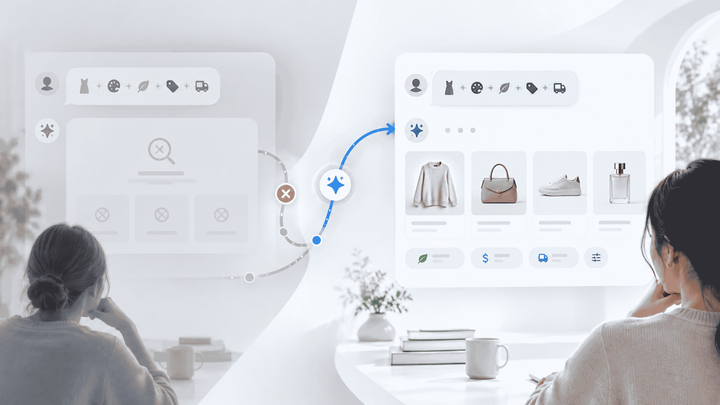
1. Guided discovery instead of keyword search
A shopper types "I need a projector for outdoor movie nights, but my backyard is small and gets windy." Filter-based search returns every outdoor projector. An agent reads the constraints, cross-references throw distance and durability ratings, returns two models, and explains why. That is the conversion lift line.
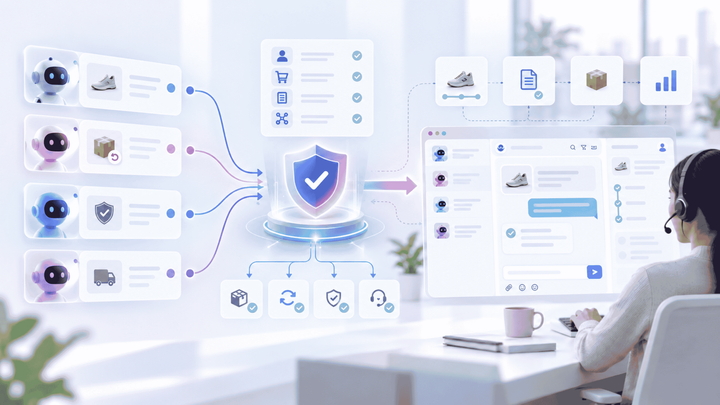
2. Routine support handled end to end
Order status, returns, address changes, and warranty questions are high volume and low judgement. An agent with write access to your order system does not just report on a return, it processes one. That is the support saving line.
3. Intervention at the moment of hesitation
A shopper with two items in the cart clicks away to read the warranty policy. An agent that recognises the pattern can surface the extended warranty terms and a shipping incentive before the session ends, rather than emailing about the cart three hours later.
4. Vertical expertise, not general politeness
Fit and sizing analysis, skin analysis from an uploaded photo, policy interpretation, complex booking. These are consultations, not FAQ lookups, and they are where the returns-avoided line comes from. A general chatbot cannot do them.
5. A knowledge base that updates itself
Every manual retraining cycle is a window where the agent is confidently wrong. Agents that ingest policy changes and new documents directly, and learn from live interactions, close that window. Native multilingual coverage, 90+ languages with real-time language detection, means one knowledge base serves every market instead of one per region.
6. Integration across the existing stack
An agent that cannot reach your helpdesk, storefront, and ERP is a search box with better manners. The integration surface is what separates a deflection tool from an agent that can act. It is also the line item most likely to blow the implementation timeline, so check it during evaluation, not after signature.
7. Guardrails that keep it safe
An agent with no boundaries is a liability. It can invent a product spec, offer a discount finance never approved, or repeat customer data it should not. In beauty, food, and financial services, one wrong answer carries legal exposure. Answers grounded in a verified catalogue and explicit business rules are the difference between an AI experiment and something you would put your brand behind.
When AI agents are not worth the cost
The honest version, because the failure modes are predictable and mostly visible before you sign.
- Under roughly 300 conversations a month. Subscription floors do not scale down. Below this, the support saving rarely clears the base fee and the case rests entirely on conversion lift.
- A single-product catalogue with almost no pre-sale questions. If shoppers know what they want and your support inbox is mostly shipping notifications, the discovery and returns lines are close to zero.
- Documentation that contradicts itself. Grounding only works if there is something trustworthy to ground in. Fix the help centre first, then buy the agent. In that order the agent is an amplifier; in the other order it is a liability.
- Support problems that are really logistics problems. An agent answers "where is my order" in two seconds instead of six hours. It does not make the parcel arrive sooner. If your ticket volume is a symptom of late shipping, you are buying a faster apology.
- No internal owner. Deployments that nobody reviews monthly drift. If no one owns the escalation logs and the accuracy checks, budget for the licence and expect the results of an unmaintained tool.
None of these are permanent disqualifications. They are timing signals. A store that fails three of them today may clear all five after a peak season.
Common questions
Per-conversation costs typically range from $0.60 to $2.00 depending on the vendor and billing model. Subscription tiers commonly start around $199 per month for roughly 200 conversations, with overage charged per conversation beyond the allowance. Enterprise deployments that include agent-assist seats run from $500 to $5,000 or more per month.
Return comes from four sources: reduced support labour, higher average order value on assisted sessions, fewer returns from better product matching, and recovered carts. Published results include a 43% support workload reduction at Manawa and a 38% AOV uplift at Tatcha. Most stores above 1,000 monthly conversations see net-positive returns within the first quarter, though the threshold depends on ticket cost and deflection rate.
An autonomous system that handles specific ecommerce tasks by understanding conversation, reasoning across your catalogue and order data, and taking real action such as processing a return or recommending a product. Unlike a scripted chatbot, it is not limited to pre-written paths.
Multiply monthly conversations by your deflection rate by the fully loaded cost of a human ticket, add assisted sessions multiplied by conversion lift and average order value, then subtract subscription and overage. Use a conservative conversion lift, around 0.5%, so the case does not depend on optimistic inputs.
Yes. Order management, support, inventory validation, and recommendations run in parallel without degradation, which is what separates an agent architecture from a single-purpose chatbot.
Through real-time language detection and translation from a single knowledge base, covering 90+ languages. You can open a new market without hiring a separate support team for it, and policy updates propagate to every language at once.
Guardrails set explicit boundaries on data privacy, brand voice, pricing, and compliance. They prevent invented product specs, unauthorised discounts, and off-brand messaging by grounding every response in verified product data and business policy rather than model recall.
Run the numbers on your own volume
The calculator takes your conversation volume, ticket cost, and average order value and returns a monthly net. No call required to see the figure.
Open the ROI calculator Book a demo