How to Use ChatGPT for Customer Service: A Complete Guide
ChatGPT for customer support: great at drafting replies, blind to your orders. Where it works, where it fails, and what to use instead.
In February 2024, a Canadian tribunal ordered Air Canada to pay a customer over a refund policy its website chatbot had invented. The airline's defense was that the chatbot was a separate legal entity, responsible for its own words. The tribunal rejected it.
Tribunal member Christopher Rivers put it plainly: it "makes no difference whether the information comes from a static page or a chatbot." Air Canada paid CA$812 in damages, interest and fees. [1]
That ruling is the whole ChatGPT-for-customer-service question in miniature. A large language model will produce something fluent, confident and plausible. Whether it's true is your problem, commercially and legally.
This guide covers where ChatGPT genuinely helps a support team in 2026, where it breaks when you put it in front of customers, what ChatGPT Enterprise and Custom GPTs do and don't fix, and how to evaluate a purpose-built alternative.
Can You Use ChatGPT for Customer Service?
Yes for internal work, not on its own as a customer-facing chatbot. The strongest uses of ChatGPT for customer support are internal: drafting replies, summarizing tickets, writing help-center content and analyzing feedback, anywhere a human reviews the output before a customer sees it. Out of the box it can't see your orders, inventory or policies, doesn't connect to your helpdesk, and answers confidently even when it's wrong. Customer-facing use needs grounding in your own data, live integrations, and a clean handoff to humans.
What ChatGPT Is (and Isn't) in 2026
ChatGPT is OpenAI's chat application. It runs on OpenAI's GPT-5-family models, and the specific version changes every few months, which is exactly why we don't pin one here. It is a generative AI system: it predicts the most likely next words in a response rather than looking facts up.
Most confusion about "ChatGPT for customer service" comes from mixing up three different things. There is the ChatGPT app that individuals use; there are ChatGPT Business and Enterprise workspaces for teams; and there is the OpenAI API, which developers use to build their own chatbots. They have different pricing, different privacy terms, and very different suitability for support.
| Plan | Price (US) | Relevance to customer service |
|---|---|---|
| Free | $0, ad-supported | Personal experiments only. |
| Go | $8/month | Individual use; not a business tier. |
| Plus | $20/month | An individual agent drafting replies. Unchanged in price since February 2023. |
| Pro | $100 or $200/month | Power users; two tiers since April 2026. |
| Business | $20/user annual, $25 monthly, 2-seat minimum | Shared team workspace, admin controls, data excluded from model training. |
| Enterprise | Custom | SSO, compliance, data residency, dedicated capacity. |
| OpenAI API | Pay per token | Building your own customer-facing bot. A separate product and bill. |
Prices move often; OpenAI changed its lineup several times in 2026 alone, so confirm on OpenAI's pricing page before budgeting. [4] The practical takeaway is that every plan above is a tool for your staff. Only the API route lets you put a model in front of customers, and that route means building the rest of the system yourself.
Where ChatGPT Works in Customer Service
The pattern that holds up is simple: use ChatGPT where a person reviews the output before it reaches a customer. Inside that boundary, it is one of the most useful tools a support team can have. These are the ChatGPT use cases for customer service we see work reliably.
- Drafting and rewriting replies. An agent pastes a rough answer and gets back a clear, on-tone version in seconds. The agent checks it and sends it. This alone is the biggest productivity gain most teams report.
- Summarizing long ticket threads. Escalations, shift handoffs and manager reviews all get faster when a forty-message thread becomes five lines.
- Writing FAQ and help-center content. First drafts of help articles, macros and FAQs, generated from your resolved tickets and then edited by someone who knows the policy. A good use of ChatGPT for customer FAQ work, as long as a human owns the final version.
- Analyzing feedback and sentiment. Clustering CSAT comments, reviews and survey verbatims into themes. Do this in a Business or Enterprise workspace so customer data stays out of model training.
- Translation and tone. Replying in the customer's language and adjusting register, which helps teams break the customer service language barrier without hiring for every market.
- Training new agents. Role-playing difficult customer scenarios so new hires practice before they meet real ones.
Every item on that list keeps a human between the model and the customer. That's not a coincidence, and it's the line most teams find out about the hard way. For the broader playbook, see our guide to improving customer service efficiency.
Can ChatGPT Work as a Customer Support Bot?
Not on its own. A ChatGPT customer service chatbot demos beautifully and fails in production, for five specific reasons. Four of them are architectural, which means no amount of prompt-writing fixes them.
1. It Answers Confidently When It Doesn't Know
Language models don't say "I'm not sure." They fill gaps with plausible text, a well-documented behavior called LLM hallucination. In a support context that means invented return windows, wrong product specs and shipping dates that were never promised. That is precisely what put Air Canada in front of a tribunal, and the ruling made clear the company, not the bot, owns every word. We explain why this is an accuracy imperative for ecommerce in more depth elsewhere.
2. It Can't See Your Orders, Inventory or Policies
"Where's my order?" is the most common question in ecommerce support, and ChatGPT has no way to answer it. It has no access to your catalog, order history, stock levels, return windows or shipping rules. When a customer asks whether a jacket comes in XL, a generic model can only guess.
3. It Doesn't Connect to Your Support Stack
ChatGPT doesn't natively integrate with Shopify, Zendesk, Gorgias or Freshdesk. It can't create a ticket, process a return, look up a tracking number or escalate with context. You can build all of that on the OpenAI API, but you are then building and maintaining a support platform, not deploying a chatbot.
4. Privacy Depends Entirely on Which Plan You Use
In April 2023, Samsung engineers pasted confidential source code and meeting notes into ChatGPT; within weeks the company banned generative AI tools on work devices. [3] That risk is still real on consumer plans.
But this is the part of the picture that has genuinely changed since 2023. Business and Enterprise workspaces exclude your data from model training, so privacy is now a procurement decision rather than a reason to avoid ChatGPT outright. The harder problems are the other four on this list.
5. It Can Be Talked Into Things
In December 2023, a Chevrolet dealership's ChatGPT-powered website chatbot was talked into agreeing to sell a new Tahoe for $1, after a user simply instructed it to agree with anything a customer said. [2] A customer-facing bot built on a general model follows instructions from whoever is typing, including instructions to ignore yours. That's called prompt injection, and a public chat widget invites it.
A chatbot is not a separate legal entity. Whatever it tells your customer, you said.
ChatGPT Enterprise for Customer Support and Service Desks
ChatGPT Enterprise is built for your employees, not your customers. It's a strong internal tool for support agents and IT service desks, with data excluded from training, SSO and admin controls. It does not give ChatGPT live access to your order systems, and it doesn't turn ChatGPT into a bot you can safely put in front of shoppers.
What Enterprise adds over the individual plans is real: enterprise-grade security and compliance, admin and usage controls, connectors to internal knowledge sources, higher limits, and data residency options. Pricing is custom. Reported 2026 figures cluster around $60 per seat with a roughly 150-seat minimum on an annual commitment, though OpenAI doesn't publish these, so treat them as reported rather than official. [5]
Using ChatGPT on an IT Service Desk
An internal IT service desk is one of the best fits for ChatGPT Enterprise, for a simple reason: the people asking questions are employees, and a wrong answer is recoverable. Service desk teams use it to search internal documentation, draft resolutions, triage incoming requests and write knowledge articles. The same logic applies to a ChatGPT-enabled knowledge base in a call center, where agents query internal docs mid-call and a human still delivers the answer.
That is an agent-assist pattern, and it is a legitimate one. The limit arrives when you try to move the same setup customer-side. Regulated teams, such as healthcare customer support, should also confirm compliance terms like a business associate agreement directly with the vendor before any patient data goes near a model.
For a purpose-built version of the agent-facing pattern, Alhena's Agent Assist gives human agents suggested replies, knowledge surfacing and real-time translation grounded in your own data.
Do Custom GPTs, the API or Fine-Tuning Fix It?
Each of OpenAI's customization routes solves a piece of the problem. None solves the whole thing.
| Option | What it fixes | What it doesn't |
|---|---|---|
| Custom GPTs | Lets you add your documents as reference knowledge. | Static uploads, no live order or inventory data. Can be prompted into revealing instructions and files. Lives inside ChatGPT, so it can't be embedded as a widget on your storefront. |
| OpenAI API, your own build | Full control; you can wire in live data and your own guardrails. | You now own retrieval, integrations, guardrails, handoff, analytics and maintenance. Typically months of engineering. |
| Fine-tuning | Tone, format and domain phrasing. | Adds no live data, doesn't eliminate hallucination, and requires machine learning expertise. |
We go deeper on the first option in our breakdown of OpenAI Custom GPTs. And you can watch a Custom GPT and Alhena answer the same questions from the same knowledge base; the GPT invents answers the knowledge doesn't support.
Watch: A Custom GPT and Alhena answering the same questions from the same knowledge base. The difference shows up where the knowledge runs out.
Can You Build a Customer Service GPT?
Yes, and on a paid ChatGPT plan it takes minutes: create a Custom GPT, upload your policies and FAQs, and write instructions for tone and scope. A customer service GPT built that way is genuinely useful as an internal reference for your own agents. What it can't be is your customer-facing support channel. It lives inside ChatGPT rather than on your site, it only knows the files you uploaded on the day you uploaded them, and it can't look up an order. If you want the same idea in front of customers, the requirements in the next section are what it takes.
What a Production Customer Service Bot Actually Needs
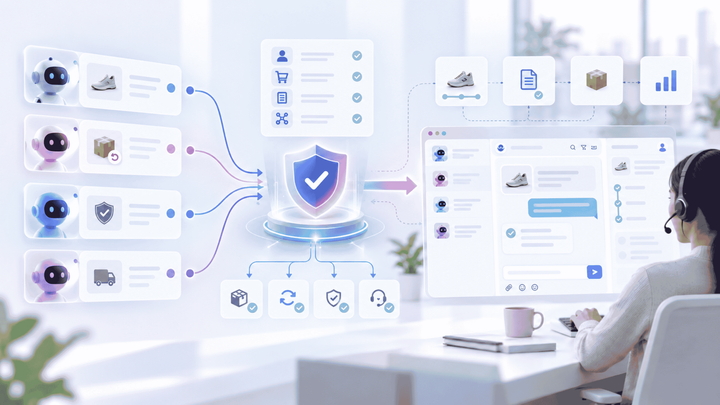
The gap between a demo and a deployment is specific and testable. A customer-facing support bot needs all seven of these:
- 1. Grounded answers only. It answers from your verified catalog, policies and help center, and says "I don't know" and escalates when the answer isn't there.
- 2. Live business data. Order status, inventory, shipping timelines and account details flow in so answers are specific rather than generic.
- 3. Native integrations. It works inside your existing stack, including WooCommerce, Shopify, Zendesk, Gorgias, Freshdesk and Intercom, rather than forcing you to rebuild around it.
- 4. A clean human handoff. When the question is out of scope, the conversation moves to a person with full context. Nobody repeats themselves.
- 5. Actions, not just answers. Tracking, cancelling, returning and exchanging, completed and confirmed in the system of record.
- 6. Omnichannel coverage. Web chat, email, Instagram and WhatsApp, and voice, with shared memory across them.
- 7. Measurement beyond deflection. Resolution, CSAT and revenue impact, not just the count of tickets that didn't reach a human.
Watch: How to set up human transfer in Alhena AI. Requirement four, the clean handoff, configured end to end.
Out of the box, ChatGPT meets part of the first requirement, fluent conversation, and none of the rest. Requirement five is where most AI support tools fall down, not only ChatGPT. When we tested live deployments across the industry, the gap between answering and acting was stark:
The full findings are in The State of Agentic CX 2026, and the distinction between the two is covered in agentic AI vs chatbots.
ChatGPT vs a Purpose-Built AI Agent
| Capability | ChatGPT | Purpose-built agent (Alhena) |
|---|---|---|
| Built for | General-purpose conversation | Ecommerce support and sales |
| Answers from | General training data, plus any uploaded files | Your verified catalog, policies and help center only |
| Live order data | None | Live sync with Shopify, WooCommerce, Magento |
| Actions | None natively | Track, cancel, return, exchange |
| Helpdesk integration | None native | Zendesk, Gorgias, Freshdesk, Intercom |
| Channels | ChatGPT app; API if you build your own | Web, email, Instagram, WhatsApp, voice |
| Safe to face customers | Not without significant engineering | Designed for it |
| Setup | Weeks to months of custom development | Under 48 hours, no developers |
| Analytics | Usage only | Resolution, CSAT and revenue attribution |
Alternatives to ChatGPT for Customer Service
If ChatGPT isn't the right front-line tool, the alternatives fall into four broad categories, each with a different trade-off.
- AI built into your helpdesk. Zendesk, Intercom and Gorgias all sell AI agents inside their own platforms. The simplest route if you're committed to one ticketing system.
- Standalone AI agent platforms. Vendors such as Ada and Forethought sit across channels and helpdesks and focus on automating support conversations.
- Ecommerce-specific agents. Tools built around the catalog and order system that handle pre-sale questions and post-purchase support in one agent.
- Build your own on the OpenAI API. Maximum control, maximum maintenance.
For a named, side-by-side look at the options, see our comparison of AI bots like ChatGPT.
How to Evaluate Any AI Customer Service Tool
Whichever route you're considering, including ours, run the same five tests before you sign anything.
- 1. Audit your top ten ticket categories. Rank the questions your team handles by volume. Those are the conversations any AI needs to handle first, and they tell you which integrations matter.
- 2. Map your integration requirements. List your commerce platform, helpdesk and channels. A tool that can't connect to all of them will create work rather than remove it.
- 3. Test for hallucination. Ask about products and policies that aren't in the knowledge base. If it invents an answer instead of saying it doesn't know, it isn't ready for customers.
- 4. Test an action, not just an answer. Ask it to change an order, then check the system of record. A confident confirmation message is not proof the change happened.
- 5. Measure beyond deflection. Ask how resolution is defined, how repeat contacts are counted, and whether the tool can attribute revenue. Our ROI calculator is one way to frame that.
Our guide to separating AI CX evidence from vendor claims goes further on how to pressure-test the numbers you'll be shown, and it applies to ours too.
Where Alhena Fits
We build a purpose-built AI agent for ecommerce, so read this section as a vendor's view and hold it to the tests above. Alhena uses the same class of large language models as ChatGPT for conversation, but the model is roughly 20% of the system. The other 80% is grounding: making sure every answer comes from your verified data, and that the agent says so when it doesn't know.
Support Concierge handles post-purchase work such as order tracking, returns and exchanges, while the AI Shopping Assistant answers pre-sale questions, recommends products and can populate carts. Both connect directly to your store and helpdesk, and go live in under 48 hours without developers.
Watch: Cut Support Costs with AI in 10 Minutes. A demo of Alhena's Support Concierge handling post-purchase work like order tracking, returns and exchanges.
The results brands have published are specific. Tatcha achieved a 3x conversion rate and a 38% AOV uplift, with 11.4% of total site revenue coming through AI-assisted conversations. Puffy reached 63% automated resolution at 90% CSAT. Crocus hit 86% deflection while holding 84% CSAT. Manawa cut support workload by 43% and response time from 40 minutes to one.
Key Takeaways
- Use ChatGPT where a human reviews the output. Drafting, summarizing, FAQ writing, feedback analysis and agent training are strong, safe uses.
- A customer-facing bot needs what ChatGPT doesn't ship with. Grounding in your data, live order access, native integrations, actions and a clean handoff.
- Privacy is now a plan choice; accuracy and actions are the real gaps. Business and Enterprise exclude your data from training. Neither stops the model from inventing a policy.
- You own what your chatbot says. The Air Canada ruling settled that. Evaluate any tool, including ours, on whether it knows when to stop talking.
Frequently Asked Questions
Can I use ChatGPT for customer service?
Yes, for internal work like drafting replies, summarizing tickets, writing FAQ content and analyzing feedback. It isn't safe on its own as a customer-facing chatbot, because it can't access your orders or policies, doesn't integrate with your helpdesk, and can state wrong information confidently.
Can you use a ChatGPT support bot for customer service?
Not reliably on its own. A ChatGPT support bot can hold a natural conversation, but it has no live order or inventory data, no native helpdesk integration, no built-in human handoff, and it can be manipulated through prompt injection. Customer-facing support needs a system grounded in your verified data.
Is ChatGPT free for customer service?
ChatGPT has a free, ad-supported plan, but it's designed for individuals. Teams typically use Business at $20 per user per month billed annually, or Enterprise at custom pricing. Building a customer-facing bot means using the OpenAI API, which is billed separately per token, plus the engineering cost of integrations.
What customer service tasks can ChatGPT do well?
Drafting and rewriting replies, summarizing long ticket threads, generating first drafts of help articles and macros, clustering feedback into themes, translating responses, and role-playing scenarios for agent training. All of these keep a human between the model and the customer.
What are the biggest risks of using ChatGPT for customer service?
Hallucinated answers such as invented return policies or wrong specs, no access to live order data, no helpdesk integration, prompt injection, and data exposure on consumer plans. The legal risk is real: in 2024 a Canadian tribunal held Air Canada liable for a refund policy its chatbot made up.
Can ChatGPT handle order tracking and returns?
Not natively. ChatGPT has no connection to your store, shipping carriers or returns system, so it can't look up an order or process a return. You would need custom API development to enable it. Purpose-built agents like Alhena handle tracking, returns and exchanges out of the box.
Does ChatGPT integrate with Shopify or Zendesk?
No. ChatGPT doesn't offer native integrations with Shopify, Zendesk, Gorgias, Freshdesk or similar platforms. Connecting them requires building on the OpenAI API, which means developer time and ongoing maintenance.
Can ChatGPT initiate conversations on its own help center?
ChatGPT itself doesn't sit on your help center or start conversations with your visitors. It responds when someone messages it inside the ChatGPT app. Proactive messaging on your own site, such as offering help on a checkout page, requires a chat widget built on the API or a purpose-built support agent that supports proactive triggers.
Is ChatGPT Enterprise good for customer support?
It's good for support agents, not for customers. Enterprise adds data excluded from training, SSO, admin controls and connectors to internal knowledge, which makes it a strong internal tool. It doesn't give ChatGPT access to live order systems or make it safe to deploy as a customer-facing bot.
Can ChatGPT Enterprise be used for an IT service desk?
Yes, and it's one of its strongest fits. Internal service desk users are employees and mistakes are recoverable, so teams use it to search internal documentation, draft resolutions, triage requests and write knowledge articles. A human still owns the final answer.
Are there ChatGPT Enterprise customer stories for customer service?
OpenAI publishes Enterprise customer stories on its site, but most focus on internal productivity rather than customer-facing support automation. For documented ecommerce support results, brands like Tatcha, Puffy, Crocus and Manawa have published outcomes with purpose-built AI agents.
Can Custom GPTs fix ChatGPT's limitations for customer support?
Partly. Custom GPTs let you upload documents as reference knowledge, but they can't pull live order or inventory data, can be prompted into revealing their files, and still draw on general training data. They also live inside ChatGPT, so they can't be embedded as a support widget on your site.
Can I build a customer service GPT?
Yes. On a paid ChatGPT plan you can create a Custom GPT with your policies and FAQs as reference knowledge, which works well as an internal tool for agents. It can't be embedded on your site, doesn't update with live order data, and can't take actions like returns, so it isn't a substitute for a customer-facing support agent.
What is a better alternative to ChatGPT for customer service?
For customer-facing ecommerce support, a purpose-built AI agent that connects to your store and helpdesk, answers only from verified data, and can take actions like returns and order changes. Alternatives range from helpdesk-native AI to standalone agent platforms; test any of them for hallucination and completed actions before buying.
Keep reading
- Alternatives: AI bots like ChatGPT: the options compared
- Deep dive: OpenAI Custom GPTs: what they can and can't do
- Evaluation: How to separate AI CX evidence from vendor claims
- Explainer: Why LLMs hallucinate, and what it means for support
See a Grounded Agent on Your Own Catalog
Ask it the questions ChatGPT gets wrong: order status, return windows, products that aren't in stock. Live in under 48 hours, no developers.