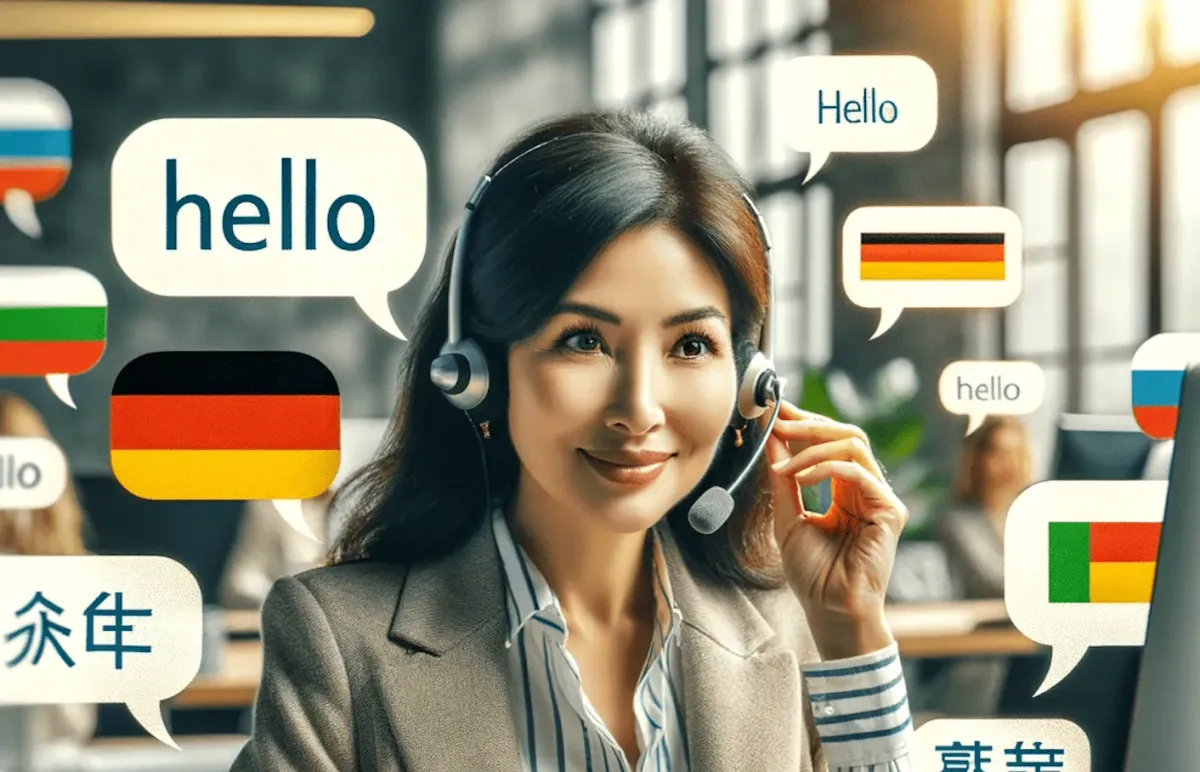
Ever had a team member jump on a service call with a customer only to find out that they couldn't understand each other?
It happens more often than you'd think. According to CSA Research, 76% of online shoppers prefer to buy products with information in their native language, and 40% will never buy from websites in other languages. When those same customers need support, the stakes get even higher.
Encountering a language barrier in customer service is a common occurrence, especially as page auto-translation tools have increasingly made it easier to interact with the digital world in whatever language your customer prefers. The problem occurs when they need to reach out for support.
You could always have your team try to power through the call, unable to fully understand them while they become increasingly more frustrated with your rep. Or, you could give up and consider it a lost customer. Neither is ideal. To improve your customer service, you need to have a process for dealing with language barriers in customer service as they pop up.
This guide covers everything from quick human-powered fixes to AI-driven multilingual support systems that handle translation automatically, so you can turn language barriers into a competitive advantage instead of a customer experience problem.
Why Language Barriers Cost More Than You Think
Language barriers don't just create awkward conversations. They directly hit your bottom line. Bad customer experiences are projected to cost companies $3.8 trillion in 2025, according to Hiver's customer service research. A chunk of that loss traces back to customers who couldn't get help in a language they understood.
Consider what happens when a non-English-speaking customer contacts your support team:
- Resolution time spikes. Agents spend 2-3x longer on tickets when there's a language gap, trying to interpret requests through broken phrasing or copy-pasting into Google Translate.
- CSAT drops. Customers who feel misunderstood rate their experience poorly, even if the agent eventually solves the issue.
- Repeat contacts increase. Miscommunication leads to wrong solutions, which leads to follow-up tickets, which drives up your cost per contact.
- Revenue walks out the door. 78% of customers have backed out of a purchase because of a poor customer experience. If that experience was caused by a language barrier, you lost a sale that was already yours.
The global multilingual customer support market hit $2.3 billion in 2024 and is on track to reach $7.6 billion by 2033. That growth tells you something: businesses are realizing that multilingual support isn't optional anymore. It's table stakes for any brand selling across borders or serving diverse domestic markets.
Common Types of Language Barriers in Customer Service
Before you can fix the problem, it helps to understand what kind of barrier you're actually dealing with. Not all language barriers look the same:
- Complete language mismatch: The customer speaks a language nobody on your team knows. This is the most obvious barrier and the hardest to solve without technology.
- Partial fluency gaps: The customer can communicate basic ideas in English but struggles with technical vocabulary, product-specific terms, or explaining a nuanced issue. These interactions take longer and often end in misunderstandings.
- Written vs. spoken ability differences: A customer might speak conversational English on a call but can't write a clear email, or vice versa. The support channel you offer can make or break the interaction.
- Dialect and regional variations: Even within the same language, regional differences in vocabulary, slang, and phrasing can cause confusion. A Spanish-speaking customer from Mexico may use different terms than one from Spain.
- Cultural communication styles: Some cultures are more direct in their communication, while others use indirect language. A customer from Japan might describe a product defect very differently than a customer from Germany, even if both speak English.
Each type calls for a different approach. A simple bilingual agent handles the first scenario fine, but you need AI-powered tools to cover all five at scale.
Overcoming Language Barriers in Customer Service
Fortunately, solving for customer service and language barriers is easier than ever. Plus, there is a systematic way you can solve the issue that's efficient for your team.
Here's a straightforward set of steps on how to overcome customer service language barrier issues, each a different tool to help handle the issue from a different angle:
1. Find Someone on the Team Who Can Speak the Language
Why overcomplicate things?
The simplest solution is to identify who on your team can speak the customer's language and transfer the ticket to them.
Even if they can't speak it fluently, if they can piece together enough of what your customer is saying to help them, it's a successful interaction.
With that said, doing this every time you have a language barrier issue isn't optimal.
You don't want your team to have to jump on Slack and ping the whole team each single time someone has a customer they can't communicate with.
That will only lead to wasted time as multiple team members stop to respond and help identify someone.
So, let's systematize it a bit:
2. Establish an Escalation Process for Language Barriers
There's no replacement for a rep who can speak the native (or fluent) language of your customer.
So, the best solution is to develop an escalation procedure when one of your reps encounters said language barrier to transfer that customer to a native or fluent speaker.
Here's one way to do it:
- Create a resource, such as a Google Doc or internal knowledge base article, with a list of team members who speak a language other than English
- Include their level of aptitude in that language
- And outline within the same document the process for reaching out to them and transferring the ticket
- Lastly, don't forget to announce the resource so the team is aware
With that in place, you might notice you're lacking in one or more language(s). This can be something to look for the next time you're hiring.
Over time, the goal should be to build up a team of capable bilingual or multilingual speakers of those languages that you commonly encounter.
3. Offer Multiple Communication Methods
Anyone who has:
- Learned a second language midway through life, or
- Grew up in a home where they learned their parent's native tongue but didn't formally learn how to write it
… knows that not every communication method is created equal. That typically equates to the person's verbal communication being adequate to hold a basic conversation while their written communication isn't.
If all you offer is email support, customers with a minimal grasp of English may not be well enough equipped to express their issue over text.
On the flip side, some may prefer to be able to take their time writing out their responses in a chatbot since they won't have to worry about taking a while to respond.
Offering every possible support option to your customers is by no means a necessity, but widening your customer's options is something to think about if you're looking to help proactively avoid language barrier issues in advance (unlike the first 3 tips which were all reactive).
Alhena AI's Support Concierge covers web chat, email, SMS, Instagram DMs, and WhatsApp, so customers can choose whichever channel they're most comfortable with.
4. Use AI for Instant Translation
Don't have someone on the team that can handle a particular conversation?
Turn to online translation tools.
Even a simple tool like Google Translate can sometimes be enough to help you figure out what your customer needs.
However, there are now far better AI-based tools than Google Translate. In fact, they're so good that you can in some cases carry an entire conversation without any other assistance than it translating the customer's responses (and your replies) for you.
According to a recent comparison of Google Translate and ChatGPT by Tech to Review, ChatGPT's translation capability has now pulled ahead of Google's, especially when dealing with context (key for customer service scenarios):
"In terms of accuracy, ChatGPT often outperforms Google Translate, particularly when dealing with nuanced language and context. Google Translate can provide a quick and rough translation, but ChatGPT shines when precision is essential."
It's by no means perfect yet, but a good enough option in many cases to communicate (and translate) in written form effectively when a fluent speaker isn't available.
5. Deploy a Generative AI Chatbot
Perhaps the fastest and most effective way to overcome the customer service language barrier is to deploy a generative AI chatbot, like Alhena AI.
A generative AI chatbot combines a different communication method (Tip #3 above) with instant AI translation (Tip #4 above) in real time.
Best-in-class generative AI chatbots:
- Only need your knowledge base to be written in one language: you don't have to write multiple versions of your knowledge base
- Automatically detect the language of the user's question
- Automatically respond and translate answers from the knowledge base in the detected language
- Can be deployed across all your customer support channels, including live web chat, email support, support via SMS, Slack-based support, and Discord-based support
By using a generative AI chatbot like Alhena AI, agents don't have to use real-time translation tools.
More importantly, customers can get accurate answers to their questions, all in their primary language.
6. Build a Multilingual Knowledge Base
Many language barrier issues start before a customer even contacts your team. If your help center, FAQ page, and product documentation only exist in English, non-English-speaking customers have no way to self-serve.
Building a multilingual knowledge base doesn't mean manually translating every article into 10 languages. Modern AI tools can handle this automatically. Alhena AI, for example, reads your existing knowledge base in one language and responds to customers in whatever language they write in, pulling accurate answers from the same source content.
This approach cuts inbound ticket volume because customers find answers on their own. Brands like Manawa, which operates across multiple European markets, used Alhena AI to automate 80% of inquiries and drop response times from 40 minutes to under 1 minute.
7. Train Your Team on Cultural Sensitivity
Language barriers aren't purely about words. Cultural context shapes how customers communicate, what they expect, and how they interpret your responses.
A few practical steps to build cultural competence on your support team:
- Teach agents to avoid idioms and slang. "Let me circle back on that" means nothing to a customer whose first language isn't English. Stick to plain, direct language.
- Train on communication style differences. Some customers will describe problems indirectly. Others will be blunt. Neither approach is wrong, but agents need to recognize the difference and adapt.
- Use visual aids when possible. Screenshots, annotated images, and step-by-step videos cross language boundaries better than text alone. If your support tool lets agents share screens or send images inline, use it.
- Speak slowly and clearly on calls. This sounds basic, but it's one of the most effective things an agent can do. Avoid rushing through explanations, and pause to confirm understanding after each key point.
Cultural training paired with AI agent assist tools gives your team the best of both worlds: human empathy backed by instant, accurate translation.
How AI Solves Language Barriers at Scale
The tips above work well for small teams with occasional language barrier encounters. But if you're an ecommerce brand selling globally, or a company with customers across the U.S. who speak Spanish, Mandarin, Vietnamese, Arabic, or any of the dozens of languages your customers actually prefer, you need a system that scales.
That's where AI-powered multilingual customer support changes the game. Here's what modern AI can do that manual processes can't:
- Real-time language detection. The AI identifies the customer's language from their first message and responds in that language automatically. No agent intervention needed.
- Single-source knowledge base. You maintain one knowledge base in English (or whatever your primary language is). The AI translates answers on the fly, keeping responses accurate and consistent across all languages.
- 24/7 multilingual coverage. Hiring agents who cover every time zone and every language isn't realistic. An AI chatbot handles inquiries in any language, around the clock, without staffing constraints.
- Consistent quality. Human translations vary by agent skill level. AI delivers the same quality of translation every time, especially when grounded in your verified product data rather than making things up.
Alhena AI's Shopping Assistant is built specifically for ecommerce and does all of the above. It's hallucination-free, meaning it only responds with information from your verified product catalog and knowledge base, so customers get accurate answers in their language without the risk of AI making up product details.
Brands like Tatcha have seen a 3x conversion rate and 82% chat deflection using Alhena AI, while Crocus achieved an 86% deflection rate with 84% CSAT across their multilingual customer base.
How to Provide Customer Support in Languages Your Team Doesn't Speak
This is the question that drives 335 monthly Google searches, and the answer is simpler than most businesses expect.
You don't need to hire native speakers for every language your customers use. Here's a practical three-step framework:
Step 1: Identify your top languages. Check your website analytics, customer surveys, and support ticket data to find which languages your customers actually speak. Most ecommerce brands find that 3-5 languages cover 80-90% of non-English inquiries.
Step 2: Deploy an AI chatbot that handles those languages. A tool like Alhena AI deploys in under 48 hours, requires no developer resources, and automatically supports conversations in any language your customers write in. It connects to your Shopify, WooCommerce, or other ecommerce platform to pull real-time product and order data.
Step 3: Set up human escalation for complex cases. The AI handles routine questions (order status, product info, returns) in any language. When a conversation needs a human touch, it routes to your team with a translated summary so agents have full context even if they don't speak the customer's language.
This hybrid approach, AI for volume and humans for complexity, is what Puffy uses to maintain 90% CSAT while automating 63% of inquiries.
Key Takeaways
- Language barriers in customer service cost real revenue: 40% of consumers won't buy from sites that don't speak their language.
- Start with quick wins: identify bilingual team members, create an escalation process, and offer multiple support channels.
- AI-powered multilingual chatbots are the most scalable solution, handling real-time translation across channels without requiring a multilingual team.
- Alhena AI deploys in 48 hours, detects customer language automatically, and responds accurately from a single-language knowledge base.
- Cultural sensitivity training complements AI tools, covering the nuances that pure translation misses.
- A hybrid model (AI for volume, humans for complex cases) delivers the best results for cost, quality, and customer satisfaction.
Discover What Else AI Can Do for You with Alhena AI
Solving language barrier issues doesn't have to be complicated.
With a generative AI chatbot like Alhena AI, you can give your customers:
- 24/7/365 support
- Highly relevant and accurate responses
- Faster response times
- Faster resolution times
- Answers that are automatically up-to-date with your knowledge base
- … All in their primary language.
Ready to break down language barriers for your customers? Book a demo with Alhena AI or start for free with 25 conversations.
Alhena AI
Frequently Asked Questions
How do you overcome language barriers in customer service?
Start with quick wins like identifying bilingual team members and creating an escalation process. For scalable coverage, deploy an AI chatbot like Alhena AI that automatically detects the customer's language and responds in it using your existing knowledge base. Brands using this approach have seen 80-86% of inquiries resolved without human intervention.
How can I provide customer support in languages my team doesn't speak?
Use an AI-powered multilingual chatbot that translates in real time. Alhena AI, for example, only needs your knowledge base in one language and handles customer conversations in any language automatically. For complex cases that need a human, the AI routes the ticket with a translated summary so your agents have full context.
What are the most common types of language barriers in customer service?
The five most common types are: complete language mismatch (no shared language), partial fluency gaps (basic English but struggles with technical terms), written vs. spoken ability differences, dialect and regional variations within the same language, and cultural communication style differences that affect how customers describe problems.
How much do language barriers cost businesses?
Bad customer experiences, including those caused by language barriers, are projected to cost companies $3.8 trillion in 2025. CSA Research found that 40% of consumers will never buy from websites in other languages, and 78% of customers back out of purchases after poor service experiences. The multilingual support market is growing at 14.1% CAGR, reflecting how seriously businesses are investing in solving this problem.
Can AI chatbots handle multilingual customer support accurately?
Yes, modern AI chatbots go well beyond basic translation. Alhena AI, for instance, is hallucination-free, meaning it only responds with verified information from your product catalog and knowledge base. It detects the customer's language, translates your knowledge base content on the fly, and delivers accurate answers. Tatcha saw a 3x conversion rate and 82% chat deflection using this approach.
What is the best way to handle language barriers in a call center?
A hybrid approach works best. Use AI to handle routine inquiries (order status, product questions, returns) in any language automatically, and route complex or sensitive conversations to bilingual agents with translated context. Pair this with cultural sensitivity training so agents can navigate communication style differences. Manawa cut response times from 40 minutes to under 1 minute with this model.
How does Alhena AI handle multilingual customer support?
Alhena AI automatically detects the customer's language from their first message and responds in that language. It pulls answers from your single-language knowledge base, translates them accurately in real time, and works across web chat, email, Instagram DMs, WhatsApp, and voice. It deploys in under 48 hours with no developer resources needed and integrates with Shopify, WooCommerce, Zendesk, and other platforms.
Do I need to translate my knowledge base into multiple languages?
No. With an AI chatbot like Alhena AI, you maintain your knowledge base in one language. The AI handles translation automatically when responding to customers. This saves significant time and cost compared to manually translating and maintaining knowledge base articles in every language your customers speak.