Your support inbox is growing faster than your team. Customers expect a reply within the hour, but most ecommerce brands take six or more. An AI email responder built for online retail can close that gap, but only if it understands orders, products, and shopping context. Generic email generators won't cut it. This guide breaks down what separates a useful AI email response tool from one that creates more cleanup work than it saves.
Why Most AI Email Response Tools Fall Short for Ecommerce
The majority of AI email response generator tools on the market were designed for office productivity. They help salespeople write cold outreach emails or write internal updates or assist managers who reply to emails all day with internal updates. That's a completely different job than answering a customer who wants to know where their package is, whether a dress runs small, or how to return a pair of shoes.
Ecommerce support emails carry context that general-purpose tools can't access. A customer asking "where's my order?" needs a reply pulled from your fulfillment system, not a perfect-sounding but empty template. Someone asking "will this moisturizer work for sensitive skin?" needs real data from your catalog, not a hallucinated email response.
When businesses plug in a generic AI email responder, they often end up with replies that sound fine but say nothing useful. The customer writes back, an agent steps in anyway, and the "automation" just added a step. For ecommerce brands, the bar is higher: the artificial intelligence needs to pull real order data, reference accurate product details, handle multiple languages, and know when to hand off to a person.
What a Good AI Email Responder Actually Does
At its core, an AI email response generator reads an incoming message, figures out what the customer wants, and drafts a reply. But the quality difference between tools comes down to what happens between "reads" and "drafts."
It Classifies Intent, Not Just Keywords
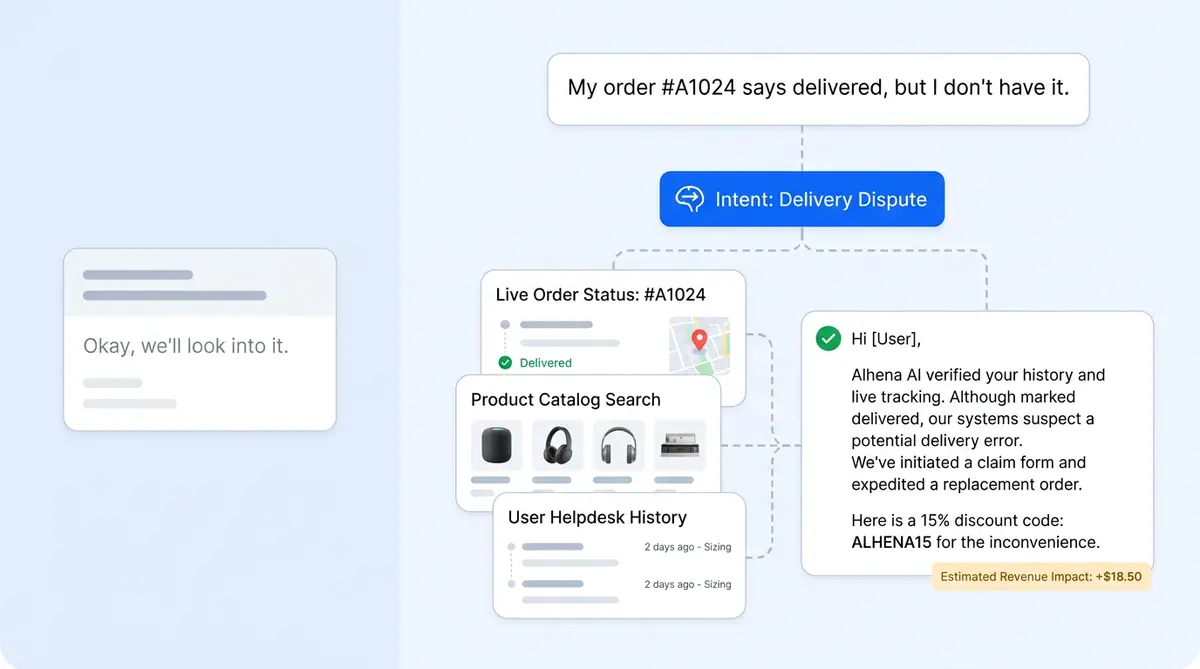
A solid AI reply generator doesn't just scan for words like "refund" or "shipping." It reads the full message and identifies intent. Is this person asking about a return policy in general, or are they requesting a return for a specific order? Those require very different replies. Good classification means fewer wrong answers and fewer escalations.
It Pulls Real Data Before Responding
The best AI customer service email response tools connect to your order management system, your product catalog, and your helpdesk. When a customer asks about delivery status, the AI checks the actual tracking data and responds with a real estimated arrival date. No guessing, no filler language like "please allow 5-7 business days" when the package shipped yesterday.
It Knows When to Stop
Not every email should get an automated reply. Complaints about a damaged luxury item, billing disputes, or emotionally charged messages need a human. A well-built AI email response generator identifies these situations and routes them to the right agent with full context attached, so the customer doesn't have to repeat themselves.
Five Things Ecommerce Brands Should Look for in an AI Email Responder
If you're evaluating tools, here's what actually matters for online retail. Skip the feature checklists with 30 items. Whether you’re comparing a simple reply generator or a full AI email response platform, focus on these five criteria that separate real response generators from marketing fluff.
1. Order and Product Awareness
The AI should connect to your ecommerce platform (whether that's Shopify, WooCommerce, Magento, or Salesforce Commerce Cloud) and pull live order data. It should also ingest your product catalog so it can answer questions about sizing, ingredients, compatibility, or whether an item is available, with accurate information.
2. Hallucination-Free Replies
This one matters more than people realize. A generic email response generator will confidently tell a customer their order ships in two days when your actual shipping policy is five. Or it'll recommend a product you discontinued last month. Every wrong answer erodes trust. The AI email tool you pick should ground every response in verified data from your systems, not generate plausible-sounding fiction.
3. Helpdesk Integration
Your team already lives in a helpdesk. Whether that's Zendesk, Freshdesk, Gorgias, or Intercom, the AI should work inside that existing workflow. That means creating tickets, updating ticket status, tagging conversations, and escalating within the same system your agents and users already use. If the AI tool requires agents to check a separate dashboard, adoption among users will drop fast.
4. Omnichannel Consistency
Customers don't only email. They message on Instagram, reach out on WhatsApp, and use live chat. The AI email responder you choose should ideally cover all of those channels with a single knowledge base. That way, a customer who starts on chat and follows up by email gets a consistent experience, ensuring the same answer regardless of channel. Alhena AI calls this omnichannel support, and it means one trained AI handles every channel instead of separate tools stitched together.
5. Revenue Attribution
Here's where most AI email tools stop short. They'll tell you how many tickets they deflected, but they won't tell you how many sales they influenced. For ecommerce, that's the number that justifies the investment. Look for a tool that tracks when an AI-assisted email conversation leads to a purchase, an upsell, or a recovered cart. Ticket deflection is table stakes. Revenue impact is the real metric.
How Alhena AI Handles Email for Ecommerce Brands
Alhena AI's Support Concierge treats email as one channel within a larger customer relationship, not an isolated inbox. Here's what that looks like in practice.
When an email arrives, Alhena reads the full message and classifies the request. If it's an order status question, Alhena pulls tracking data directly from your ecommerce platform and responds with an instant, exact delivery estimate. If it's a catalog question (say, "does this serum contain retinol?"), Alhena checks your product catalog and replies with the correct ingredient list. Every response is grounded in your actual data, which means zero hallucinations.
For requests that need action (a return, a cancellation, an address change), Alhena's Order Management Agent can execute those tasks directly, not just draft a reply saying "I've forwarded this to our team." Alhena can provide resolution in one interaction instead of waiting for a human to process it manually.
Stores using Alhena for customer service email see measurable results. Manawa cut response times from 40 minutes to under 1 minute and automated 80% of incoming inquiries. Crocus reached an 86% deflection rate while maintaining 84% customer satisfaction. Tatcha saw 11.4% of total site revenue attributed to AI-assisted conversations, proving that good support doesn't just save money, it makes money.
Alhena also connects to the helpdesks your team already uses. Whether you run Zendesk, Gorgias, or Freshdesk, Alhena works inside your existing workflow. Agents see AI-handled conversations alongside their own, and escalations come with full context ensuring nobody starts from scratch.
Email, Chat, Social, Voice: Why the Channel Shouldn't Change the AI
One underrated problem with standalone AI email response generator tools is that they only solve one channel. Your inbox gets faster, but your Instagram DMs, WhatsApp messages, and live chat are still handled separately, often with different tools and different knowledge bases.
That fragmentation creates inconsistency. A customer gets one answer by email and a slightly different one on chat. Worse, if they switch channels mid-conversation, the AI has no memory of what was already discussed.
Alhena's Product Expert Agent and Order Management Agent work across email, web chat, Instagram DMs, WhatsApp, and voice. The same catalog knowledge, the same order data, the same brand voice. If a shopper asks about sizing on Instagram and then emails about the same product, Alhena remembers the earlier conversation. That kind of continuity is rare, and customers notice it.
For teams with growing omnichannel customer experience needs, investing in a single-channel email tool is a short-term fix. You'll outgrow it the moment you need the same AI on a second channel.
Getting Started: What Setup Looks Like
One common concern with any AI email response generator is the implementation timeline. If it takes weeks of engineering work, most ecommerce teams won't bother.
Alhena deploys in under 48 hours with no developer resources required. The setup process works like this:
- Connect your ecommerce platform. Alhena integrates with Shopify, WooCommerce, Magento, and Salesforce Commerce Cloud to pull product data, order history, and inventory in real time.
- Connect your helpdesk. Link your existing support tool so Alhena can create, update, and resolve tickets without changing your agents' workflow.
- Train on your knowledge base. Alhena ingests your help center articles, FAQ pages, return policies, and past ticket history. The AI will learn your tone and policies. This is what keeps responses accurate and on-brand.
- Set your rules. Set clear rules for when the AI should respond automatically, when it should prepare a reply for human review, and when it should escalate immediately. You stay in control.
- Go live on email (and beyond). Start with email, then expand to chat, social, or voice whenever you're ready. The same AI, the same training, no extra setup per channel.
You can try it on your website yourself with 25 free conversations before committing. There's also an ROI calculator that estimates savings based on your current ticket volume.
Key Takeaways
- Generic AI email generator tools don't work for ecommerce. They lack order awareness, catalog data, and shopping context.
- The AI must be grounded in your data. Hallucinated replies damage trust and create more work for your team.
- Helpdesk integration is non-negotiable. If the AI doesn't work inside your existing support tool, agents won't use it.
- Think beyond email. A single AI that handles email, chat, social, and voice gives customers consistency and saves you from managing multiple tools.
- Revenue attribution separates good tools from great ones. Deflection saves money. Revenue tracking proves the AI pays for itself.
- Setup should take days, not months. Alhena deploys in under 48 hours, connects to your stack, and works inside your helpdesk from day one.
Ready to see how an AI email responder handles your actual support emails? Book a demo with Alhena AI or start for free with 25 conversations.
Frequently Asked Questions
What is an AI email responder and how does it work for ecommerce?
An AI email responder reads incoming customer emails, classifies the request (order status, inquiry type, return, etc.), pulls data from your ecommerce platform and helpdesk, and drafts an accurate reply. For ecommerce, this means the AI accesses live order tracking, product catalogs, and return policies before responding. Alhena AI does this across email, chat, social, and voice from a single knowledge base.
Can an AI email responder handle 'where is my order' emails automatically?
Yes. A good AI email responder connects to your fulfillment system and pulls real tracking data. When a customer asks about order status, it replies with the actual delivery estimate, not a generic template. Alhena AI's Order Management Agent does this automatically by integrating with Shopify, WooCommerce, Magento, and Salesforce Commerce Cloud.
How long does it take to set up an AI email responder for my online store?
Setup time varies by tool. Some require weeks of engineering. Alhena AI deploys in under 48 hours with no developer resources. You connect your ecommerce platform, link your helpdesk, upload your knowledge base, and set escalation rules. You can test with 25 free conversations to try before committing.
Will an AI email responder make up wrong answers about my products?
Generic AI tools sometimes hallucinate, meaning they generate plausible but incorrect information. This is dangerous for ecommerce where wrong product specs or shipping dates erode customer trust. Alhena AI grounds every response in your verified verified catalog data, order records, and help center content, so it only states what it can confirm.
Does Alhena AI only handle email or does it work on other channels too?
Alhena AI works across email, web chat, Instagram DMs, WhatsApp, and voice. All channels share the same product knowledge, order data, and brand voice. If a customer starts a conversation on Instagram and follows up by email, Alhena remembers the context from the earlier interaction.
How much does an AI email responder cost for ecommerce brands?
Pricing depends on your ticket volume and the channels you use. Alhena AI offers 25 free conversations to start, with paid plans scaling based on usage. You can estimate your savings using Alhena's ROI calculator at alhena.ai/roi-calculator before buying.
Can an AI email responder process returns and cancellations or just reply to emails?
Basic tools only draft replies. Alhena AI's Order Management Agent can execute actions like processing returns, cancelling orders, and updating shipping addresses directly within the email conversation. The customer gets resolution in one interaction instead of waiting for a human agent to step in.
What helpdesks does Alhena AI integrate with for email support?
Alhena AI integrates with Zendesk, Freshdesk, Gorgias, Intercom, Kustomer, Zoho Desk, and other major helpdesks. The AI works inside your existing support workflow, creating and updating tickets so agents don't need to switch between tools.
How do I know if an AI email responder is actually making my store money?
Look for revenue attribution, not just deflection metrics. Alhena AI tracks when an AI-assisted email conversation leads to a purchase, upsell, or recovered cart. For example, Tatcha attributes 11.4% of total site revenue to AI-assisted conversations, and Manawa automated 80% of inquiries while cutting response time from 40 minutes to under 1 minute.
Is an AI email responder better than canned responses and email templates?
Canned responses are static and one-size-fits-all. They can't pull live order data or adjust based on customer history. An AI email responder generates personalized replies grounded in real-time data from your ecommerce platform. Alhena AI replaces canned macros with dynamic, context-aware responses that match your brand voice.