The top-ranked brand in any AI search category captures an average 62% of AI Share of Voice, five times more than the third-place brand, according to Arcalea's 2026 industry analysis. That gap isn't a rounding error. AI powered search uses natural language processing to understand purchase intent, and the search results it returns are far more concentrated than traditional listings. It's the difference between owning a product category and being invisible in it.
Traditional search gave you 10 blue links per page. Generative AI and ai-powered search engines compress product discovery into three to five recommendations per query in 2026. Every item in your product catalog either shows up or it doesn’t. There’s no page two. When ai-powered search tools like ChatGPT, Perplexity, or Google AI Overviews answer "what's the best moisturizer for dry skin," they name a handful of brands. Everyone else doesn't exist. This compression turns AI visibility into a zero-sum game. Whether shoppers are browsing chatgpt alternatives or using Google's AI overview for shopping, category domination isn't a nice-to-have. It's the entire strategy. Traditional keyword rankings and organic search results don't predict who wins here. Semantic search and natural language processing power these AI engines, meaning they parse shopper intent from natural language, not just keywords. Visual search, product discovery behavior, and personalized shopping patterns all influence which brands AI engines recommend.
This post is the general's map for turning AI visibility into purchases. If you've been executing individual tactics (optimizing PDPs, building citations, tracking SOV), this is where those pieces connect into a coordinated category takeover. Every tactic referenced here links to its full step-by-step guide. No ai tool roundup or generative ai tools list can replace a unified strategy. This is about shaping the ai experience shoppers have when they search for your category.
What Category Domination Actually Looks Like
Category domination means your brand appears in 40% or more of AI-generated answers for your core product queries, across ChatGPT Shopping, Perplexity, and Google AI Overviews simultaneously. In a five-competitor set, 30%+ SOV signals category leadership. This applies across every search engine where ai powered personalization shapes visual search results and personalized product recommendations. In a ten-competitor set, 20%+ puts you in the dominant position.
The brands already doing this aren't guessing. Glossier appears in 81% of AI recommendations for beginner skincare queries. Bombas shows up in 77% of "best sock brand" queries. REI gets cited in 76% of outdoor gear educational prompts. These brands built citation moats across platforms, not just on one. They show up wherever shoppers are browsing, whether those shoppers are doing product discovery through ChatGPT or comparing search results on Perplexity. Their product catalog data, reviews, and editorial mentions give AI engines enough signal to recommend them with high confidence.
The critical nuance: the brand ranking first on ChatGPT rarely matches the leader on Perplexity or Gemini. Each platform weights different signals. ChatGPT leans on personalization and review sentiment to deliver relevant products. Category domination requires winning across all platforms, not just the biggest one. (For how to measure this, see our AI Share of Voice guide.)
The Category Audit: Know Where You Stand
Before you can dominate, you need to know where you're losing. A category audit maps your SKU-level visibility against your top five competitors across each AI platform.
The right ai tools automate this process, scanning your full product catalog against competitor catalogs across every AI platform. Without that data, you’re guessing. Understanding product discovery behavior is key to elevating your position. Start with three questions:
- Which platform are you weakest on? ChatGPT drives 97% of LLM commerce traffic, but if you're already strong there, your marginal gains come from Perplexity or AI Overviews.
- Which product subcategories are you losing? You might dominate "best running shoes" but get zero mentions for "best running shoes for flat feet." Break your category into subcategory search queries and track each one. Map every keyword shoppers use when browsing your category, from broad head terms to long-tail product-specific phrases.
- Where are competitors beating you, and why? Check their citation sources. Are they winning through review volume, expert content, or structured data you're missing?
Run these search queries across ChatGPT, Perplexity, and Google AI Overviews. Document which brands appear in shopper searches, in which positions, with what frequency. That's your baseline. Alhena's AI Visibility platform automates this at the SKU level across all three engines, so you're not running hundreds of manual prompts.
Platform Prioritization: Where to Fight First
You can't attack all platforms with equal intensity on day one. Each search engine uses different natural language processing models, different personalization signals, and different approaches to visual search and ai powered product recommendations. Prioritize based on your category:
ChatGPT Shopping is the default starting point. It commands 97% of AI commerce referrals and processes over 50 million shopping queries daily. If your product catalog doesn't appear in ChatGPT's search results when shoppers express purchase intent, nothing else matters yet. Keyword-based SEO alone won't fix this. You need optimized catalog data, structured feeds, and ai powered product pages that reflect shopper intent. Personalization signals, personalized product descriptions, and commerce-ready structured data all factor into whether AI recommends you or a competitor. Our ChatGPT ranking signals breakdown covers what drives placement.
Perplexity rewards fast movers. With 800% year-over-year growth and a live index that refreshes faster than ChatGPT's training data, brands that publish fresh content gain an outsized advantage. Perplexity shoppers also spend 57% more per order than ChatGPT referrals. Its semantic search capabilities, combined with visual search for product discovery and smarter personalized site navigation and real-time product discovery features, make it a high-intent channel for ai powered product recommendations. See our Perplexity optimization guide for the tactical playbook.
Google AI Overviews matter most for high-search-volume categories. AI Overviews now appear on 14% of shopping queries (up 5.6x in four months) and 83% of "best [product]" queries. Brands cited in AI Overviews earn 35% more organic clicks. The kicker: 80% of sources cited in AI Overviews don't rank in the top 10 organically, so traditional keyword rankings and organic search results won't save you here. You need an ai powered catalog strategy with visual search assets and personalization signals that feeds these engines the structured product data they want.
The 90-Day Category Takeover Roadmap
Category domination follows a three-phase sequence. Rushing to phase two without completing phase one wastes effort.
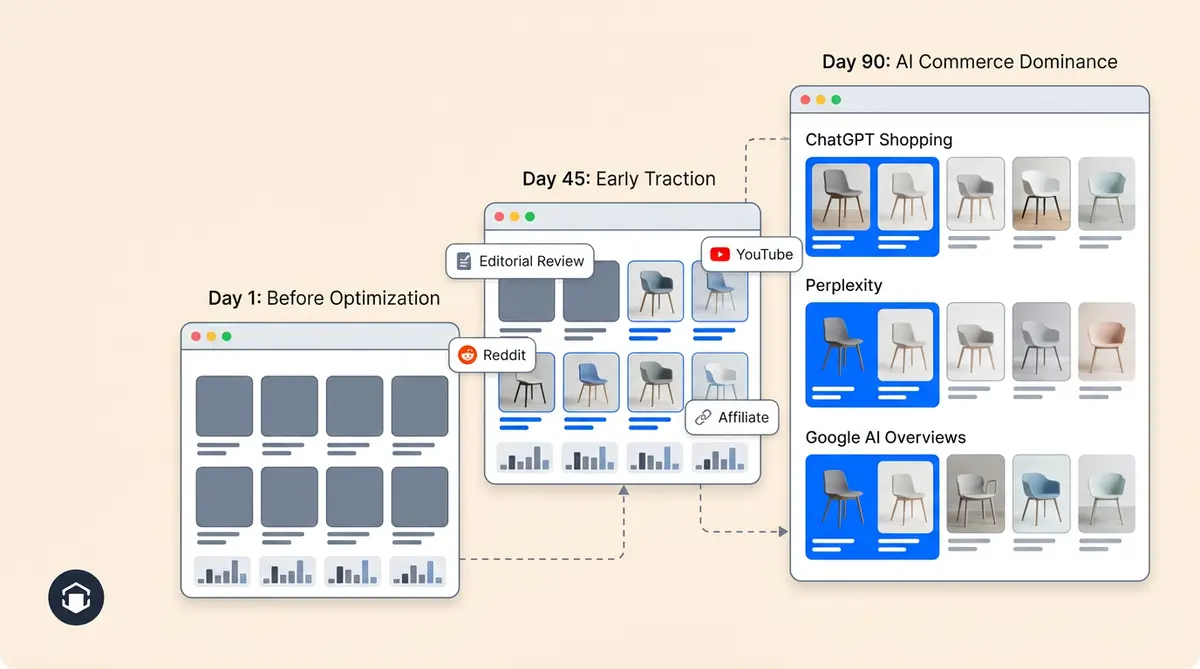
Month 1: Audit, Benchmark, Close Data Gaps
Run the full category audit described above. Benchmark your SOV against the top five competitors per platform. Then close your critical data gaps: missing schema markup, thin product descriptions, outdated specs, and catalog pages that aren’t optimized for AI retrieval. Remove irrelevant SKUs from your feed and make sure your merchandising data is clean. These are the errors that disqualify you from AI recommendations entirely. Use the PDP optimization checklist to fix your product pages systematically. Every item in your product catalog with irrelevant or outdated data is invisible to AI. Clean your catalog, enrich product descriptions on your site, and make sure ai tools can parse every SKU. Specifically, reduce the number of out-of-stock items in your feed and make sure navigating your product catalog returns relevant results for every search query. Map shopper behavior and purchase intent to understand how buyers move through your ecommerce product catalog.
Month 2: Build Citation Moat, Attack Competitor Weaknesses
With your data foundation solid, shift to offense. Build citations across the seven source types that drive AI recommendations: editorial reviews, expert roundups, Reddit threads, comparison articles, YouTube reviews, forum mentions, and affiliate content. Content updated within 30 days gets 3.2x more AI citations than stale content, so freshness is a weapon. Target the specific search queries and keyword variations that drive product discovery. Track shopper behavior and focus on elevating your product catalog in the search queries your shoppers use during product discovery. Map their intent at every stage, from browsing to buying.
Identify the subcategories where competitors are weakest and flood those gaps. If your competitor dominates "best wireless earbuds" but ignores "best wireless earbuds for small ears," own that niche first and expand outward.
Month 3: Cross-Platform Coordination, Defensive Positioning
By month three, you should see SOV gains on your primary platform. Now extend that presence to your secondary and tertiary platforms. A brand that leads on ChatGPT but is invisible on Perplexity has a flank exposed.
Coordinate your content calendar so new product launches, site updates, and seasonal merchandising changes hit all platforms within the same window. Smarter coordination helps shoppers discover your products and improves your competitive intelligence across each AI engine, seasonal updates, and review campaigns hit all platforms within the same window. Cross-platform consistency compounds your visibility. For vertical-specific playbooks, see our guides for beauty, fashion, and home and garden brands.
Defensive Positioning: Keeping What You've Won
Winning a category is hard. Holding it is harder. AI citations are volatile: 40 to 60% of cited domains change monthly across all major platforms, according to Profound's volatility research. Only 30% of brands remain visible from one AI answer to the next.
AI search results shift constantly because semantic search models retrain, personalized recommendation algorithms update, and new catalog data enters the index. Defensive positioning requires three ongoing practices backed by the right ai tools:
- Continuous monitoring. Track SOV weekly, not monthly. A competitor's new product launch or viral review can shift citations within days. First-party AI visibility data is the only reliable early warning system.
- Citation maintenance across every search engine. Update product content quarterly at minimum. Pages updated quarterly are 3x more likely to maintain their citations. Refresh review roundups, update comparison data, and keep specs current.
- Competitive displacement alerts. When a new competitor enters your category or an existing one surges, you need to know immediately and respond. Automated alerts on SOV changes by SKU and subcategory give you the reaction time to protect your position. The right ai tools let you scale this monitoring across your entire catalog, specifically by analyzing which competitors shoppers are navigating toward, so you can reduce lost purchase intent before it turns into a sale for someone else.
When Category Domination Isn't Worth It
Not every brand should pursue full category domination. Be honest about the math:
Niche categories with under 50 relevant AI queries per month won't generate enough traffic to justify the investment. Focus on appearing in those search queries, but don't build a war room around it. If your product catalog has fewer than 20 items in the category, the cost of ai tools and keyword tracking outweighs the return.
Categories with 20+ credible competitors face diminishing returns. Going from 5% SOV to 15% is valuable. Going from 15% to 40% in a fragmented market may cost more than the incremental revenue justifies.
Single-SKU brands should focus on subcategory domination rather than broad category ownership. Own "best organic baby formula" before trying to own "best baby formula." Focus on the specific product catalog items you have in stock and can buy ad spend behind if needed."
The right question isn't "can we dominate?" It's "what's the revenue value of the next 10 percentage points of SOV, and what does it cost to get there?" Alhena's ROI calculator can help you model that tradeoff.
From Tactics to Territory
Every tactical guide we've published, from PDP optimization to citation building to schema markup, is a tool in the kit. Category domination is about deploying those ai tools in sequence, analyzing your product catalog at scale to discover gaps, improve search results coverage, and reduce the stock of irrelevant data that holds your site back, against specific competitors, on specific platforms, with clear benchmarks for success. Elevating your personalized product discovery across every AI engine requires ongoing personalization, personalized search engine optimization, and intent-driven strategy across every ai powered platform.
AI search is still small in 2026 (roughly 1% of total traffic), but it's growing 165x faster than organic search and is projected to influence $180B+ in annual ecommerce revenue. The brands that learn from early generative ai implementation and establish category leadership now will have compounding advantages as the channel scales. The window for first-mover positioning is closing.
Ready to map your category and build a domination strategy? Book a demo with Alhena AI to see how our AI Visibility platform tracks SOV at the SKU level across ChatGPT, Perplexity, and Google AI Overviews, or start free with 25 conversations.
Frequently Asked Questions
What does category domination mean in AI search?
Category domination means your brand appears in 40% or more of AI-generated product recommendations for your core queries across ChatGPT Shopping, Perplexity, and Google AI Overviews. In a five-competitor set, 30%+ AI Share of Voice signals category leadership. The top-ranked brand typically captures 62% of all AI mentions, leaving little room for competitors as consumers increasingly rely on AI for buying decisions.
How do I measure AI Share of Voice for my product category?
Track how often your brand gets mentioned or cited in AI answers compared to competitors. Run category-relevant queries across ChatGPT, Perplexity, and Google AI Overviews, and document which brands appear, in which positions, and how frequently. Alhena's AI Visibility platform automates this at the SKU level across all three engines, providing weekly SOV benchmarks.
Why is AI search more competitive than traditional search?
Traditional Google shows 10 results per page. AI engines recommend only 3 to 5 brands per query, and ChatGPT recently dropped from 6-7 mentions to 3-4 per answer. The top 10 domains capture 46% of all ChatGPT citations per topic, making each recommendation slot far more valuable and the competition zero-sum.
Which AI platform should ecommerce brands prioritize first?
ChatGPT Shopping is the default starting point since it drives 97% of AI commerce referral traffic. If you're already strong on ChatGPT, shift focus to Perplexity (800% YoY growth, higher AOV) or Google AI Overviews (appearing on 83% of 'best product' queries). Your category audit will reveal which platform has the biggest gap.
How long does it take to dominate a product category in AI search?
A focused 90-day sprint can produce measurable SOV gains. Month 1 covers auditing and fixing data gaps. Month 2 builds citation moats and attacks competitor weaknesses. Month 3 extends cross-platform coverage. Full category domination typically takes 12 to 18 months of sustained effort, but early wins compound quickly.
How volatile are AI search citations?
Very. Between 40% and 60% of cited domains change monthly across all major AI platforms. Over six months, 70 to 90% of domains get replaced. Only 30% of brands remain visible from one AI answer to the next, which is why continuous monitoring and content freshness are essential for holding a leadership position.
Is category domination worth pursuing for niche products?
It depends on query volume. Niche categories with fewer than 50 relevant AI queries per month won't justify a full domination strategy. Focus on subcategory ownership instead. A single-SKU brand should dominate a specific subcategory query before expanding to the broader category.