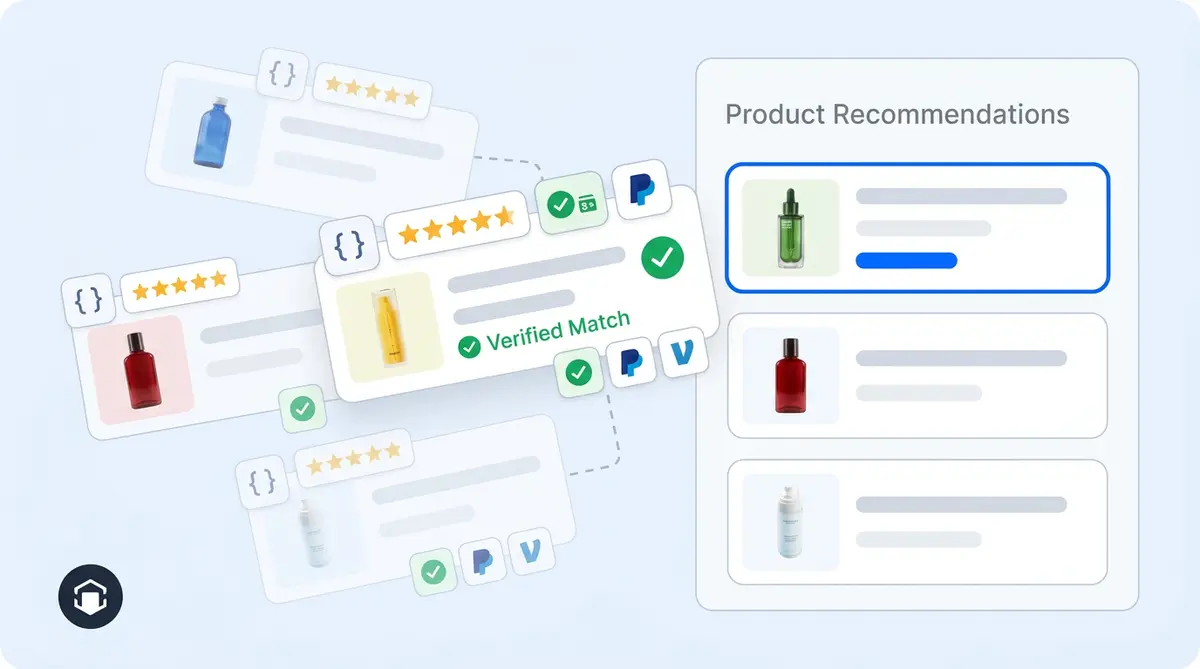
Perplexity ranks products on five signals, weighted roughly in this order: structured data completeness, review depth, real-time price accuracy, attribute-to-query matching, and third-party citation authority. There is no advertising and no bidding, placement is earned.
That last point is why this is worth your time. On a platform with no paid escape hatch, a small brand with complete Product schema can outrank a household name with thin data.
Here is how the selection works, and what to change this week.
Why are the top 3 slots worth fighting for?
Perplexity surfaces only a handful of products per query, so each slot carries weight that a page-one search result does not.
The traffic is also small and valuable rather than large and cheap. Across 310 brands, Perplexity supplied just 2.6% of US LLM referral traffic, but at an average order value of $129 against ChatGPT's $71, an 82% premium.
Shopify-derived analyses report the premium closer to 57% on a different basket mix. Treat 57% as the conservative floor and 82% as the upper end; both point the same way. For what the gap is worth once weighted by traffic share, see why Perplexity shoppers spend more than ChatGPT referrals.
How does Perplexity's shopping algorithm pick products?
Five signals, roughly in weight order.
1. Structured data completeness
Perplexity reads JSON-LD before it reads your HTML. Products carrying complete Product, Offer, AggregateRating and Review schema get parsed reliably; products without it often can't be parsed at all.
If the engine can't extract your specs, price and availability with confidence, it skips the product rather than guessing.
2. Review depth over review volume
Perplexity pulls sentiment from review content, not just aggregate scores. Two hundred detailed reviews describing specific use cases outperform two thousand five-star ratings saying "great product."
3. Real-time price accuracy
Perplexity cross-references your feed against your live site. If the feed says $49 and the page says $59, the mismatch drops the product from consideration entirely. It reads as unreliable data, not as a discount.
4. Attribute matching against query specifics
Perplexity users ask narrow questions: "best lightweight stroller for city apartments under $300." The engine matches structured attributes, dimensions, materials, skin type, use case, against those specifics.
Detailed attribute data beats brand size here, consistently.
5. Third-party citation authority
This is the signal most brands ignore. Perplexity's citation model pulls from across the web: review sites, forum threads, video comparisons, editorial roundups. Consistent entity information across those sources reinforces trust.
Your own product page rarely wins alone.
How much does the Merchant Program matter?
It's free, zero listing fees, zero commissions, zero transaction fees, and you remain merchant of record with 100% of revenue.
Two things it unlocks that auto-sync doesn't:
| Shopify auto-sync | Merchant Program | |
|---|---|---|
| Products surface | Yes (US stores) | Yes |
| Merchant dashboard | No | Yes |
| API and feed control | No | Yes |
| Checkout enablement | No | Yes |
| Ranking boost from checkout | No | Yes |
Checkout-enabled products get prioritised, because they keep the shopper inside the experience. One operational catch worth planning for: Buy with Pro runs through PayPal's Instant Buy, so those orders land in PayPal rather than your store admin.
Full walkthrough in our Perplexity merchant setup guide.
What should you do this week?
- Audit your schema. Add or repair JSON-LD for Product, Offer, AggregateRating and Review on every PDP. Include GTINs, brand, SKU, dimensions, materials and condition. Validate with Google's Rich Results Test.
- Reconcile feed against live site. Price, availability, images and descriptions must match exactly. Update daily at minimum; real-time if you can.
- Change what you ask for in reviews. Replace "how did we do?" with "what problem did this solve?" and "how does it compare to what you used before?" Depth is the ranking signal, not count.
- Enrol and enable checkout. Shopify stores already have baseline visibility, but enrolment unlocks the dashboard, feed control and the checkout ranking boost.
- Work your off-site citations. Audit which review sites, roundups and forum threads mention your brand, and whether the specs they quote are still correct. Outdated third-party sources actively cost you placement.
Step five is where most brands under-invest and where the leverage is highest, because it's the one signal competitors can't replicate by fixing their own feed.
Can small brands actually beat large retailers here?
Yes, and it's the clearest structural advantage in AI shopping right now.
Traditional search rewarded accumulated domain authority, which small brands cannot buy quickly. Perplexity's citation model weights machine-readable completeness instead, and complete Product schema takes a sprint, not three years of link building.
The caveat: you still need genuine third-party coverage. If nobody credible has written about your product, no amount of schema fixes that.
Key takeaways
- Five ranking signals: structured data, review depth, price accuracy, attribute matching, third-party citations.
- No ads, no bidding. Placement is earned, which is why data quality beats brand size.
- Perplexity sends 2.6% of LLM traffic at an 82% AOV premium, small channel, high value per visitor.
- The Merchant Program is free and unlocks the dashboard, feed control and a checkout ranking boost.
- Price mismatches are disqualifying, not merely penalised.
- Off-site citations are the underworked signal. Your product page rarely wins alone.
See whether you're in the top three
Alhena tracks how your products render and rank across Perplexity and every other AI shopping surface.
Frequently asked questions
Five signals, roughly in weight order: structured data completeness (JSON-LD Product, Offer, AggregateRating and Review schema), review depth and specificity, real-time price accuracy against your live site, how well product attributes match query specifics, and third-party citation authority from review sites and editorial coverage. There is no advertising or bidding, placement is earned.
No. Perplexity runs no advertising in shopping results and offers no paid placement. The Merchant Program itself is free, zero listing fees, zero commissions, zero transaction fees, and merchants keep 100% of revenue as merchant of record. Visibility comes from data quality and citation authority alone.
Yes. Across 310 brands from October 2025 to April 2026, Perplexity's average order value was $129 against ChatGPT's $71, an 82% premium. Shopify-derived analyses put the gap closer to 57% on a different basket mix, so treat 57% as a conservative floor. Perplexity supplies only about 2.6% of LLM referral traffic, so it is a small, high-value channel rather than a volume play.
Yes. Perplexity's citation model weights machine-readable data completeness over accumulated domain authority, so a smaller brand with full Product schema, GTINs and detailed attributes can outrank a household name with thin structured data. The limit is off-site coverage, schema alone won't compensate for having no credible third-party reviews or comparisons.
Indirectly but meaningfully. Enrolment unlocks the merchant dashboard, API and feed control, and checkout enablement, and checkout-enabled products receive a ranking boost because they keep shoppers inside the experience. US Shopify stores surface through auto-sync without enrolling, but auto-sync exposes only your existing data quality with no controls.
The product is dropped from consideration. Perplexity cross-references feed data against live site data, and a mismatch reads as unreliable sourcing rather than as a promotion. This is a disqualifying error rather than a ranking penalty, which is why daily or real-time feed updates matter more than feed size.
The Merchant Program dashboard shows impressions, clicks and conversion by product. For cross-platform visibility, Alhena AI Visibility monitors how your products render, how often they are recommended, and where you sit against competitors across Perplexity, ChatGPT, Gemini and Google AI Mode from one place.