Perplexity shoppers spend 57–82% more per order than ChatGPT referrals. But ChatGPT sends roughly 96% of all LLM traffic to ecommerce sites. Neither platform wins outright: ChatGPT owns volume, Perplexity owns value. Which one you prioritize depends on your price point and how much research your buyers do.
Most merchandising teams still treat "AI traffic" as one line in the analytics dashboard. It isn't. Two visitors arriving from two different AI engines behave so differently that they belong in separate forecasts.
This post is about the economics of that split — what the AOV gap is actually worth in revenue, and when it justifies the work. If you want the platform-by-platform setup mechanics (feeds, fees, checkout flows, analytics), read our four-platform comparison of ChatGPT, Perplexity, Gemini and Google AI Mode instead.
Which AI platform sends higher-value ecommerce traffic, ChatGPT or Perplexity?
Short answer: Perplexity, per visitor. ChatGPT, in total.
Perplexity sends fewer shoppers who spend considerably more each. ChatGPT sends nearly everyone else, at a lower cart size but a higher conversion rate.
Here is the full picture in one table.
| Metric | ChatGPT referrals | Perplexity referrals | Non-branded organic |
|---|---|---|---|
| Share of LLM referral sessions | ~96% | ~3–4% | — |
| Average order value | $204 | 57–82% higher | $238 |
| Conversion rate | 1.81% | Not consistently published | 1.39% |
| Revenue per session | $3.65 | ~$5.80 (modeled) | $3.30 |
| Dominant buyer mode | Broad discovery, product cards | Verified research, spec comparison | Mixed intent |
| Best-fit catalog | Under $200, low consideration | Complex, high consideration | All |
ChatGPT conversion and AOV figures: 94 seven- and eight-figure ecommerce brands tracked through 2025. Perplexity premium range spans a Shopify-derived analysis (57%) and Alhena's own 310-brand dataset (82%).
Why is ChatGPT's AOV lower than organic search?
ChatGPT referrals produce an AOV of $204 versus $238 for non-branded organic — a 14.3% discount. Conversion runs the other way, at 1.81% versus 1.39%, a 31% lift.
The cause is query shape. Most ChatGPT shopping prompts are broad and exploratory: "best running shoes under $150," "gift ideas for a 30-year-old." The model answers with product cards and carousels that reward a fast click, not a long deliberation.
That produces impulse-adjacent buying. More people convert, but they convert on simpler, cheaper items. An academic analysis of 973 websites representing $20 billion in combined revenue found ChatGPT-referred AOV actually declined across a 12-month window even as conversion rates improved.
Why do Perplexity shoppers spend 57–82% more per order?
Three mechanisms drive the premium, and they compound.
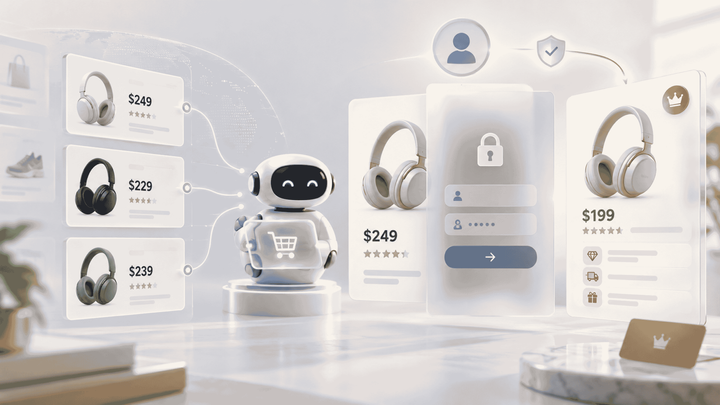
- Citations pre-validate the purchase. Inline sources mean the shopper has already checked the claim before they click. They arrive at the product page having finished their evaluation, not started it.
- The audience skews affluent. A WARC audit of Perplexity users found 80% are college graduates, 65% are high-income white-collar workers, and 30% hold senior leadership roles. Household income correlates directly with cart size.
- Query complexity is higher. Citation-first engines attract "which of these three has the best long-term value?" — a question asked much closer to checkout, with far less price sensitivity than "what should I buy?"
Why the 57% and 82% figures both exist
The 57% premium comes from a Shopify-derived analysis comparing Perplexity purchasers against other AI platforms. The 82% figure comes from Alhena's own study of 310 brands, which measured Perplexity AOV at $129 against ChatGPT's $71 on a smaller-basket sample.
Different baskets, different windows, same direction. Treat 57% as the conservative floor and 82% as the ceiling — and read the full 310-brand LLM traffic study for the methodology.
What is the volume-versus-value split actually worth in revenue?
This is the section most comparisons skip — and the one that should drive your budget.
A 57% AOV premium sounds decisive until you weight it by traffic. Here is the arithmetic on 10,000 AI referral sessions, holding conversion constant at ChatGPT's observed 1.81%.
| Input | ChatGPT | Perplexity |
|---|---|---|
| Sessions (of 10,000) | 9,610 | 340 |
| Assumed conversion rate | 1.81% | 1.81% |
| Average order value | $204 | $320 (+57%) |
| Revenue per session | $3.65 | $5.80 |
| Revenue | $35,077 | $1,972 |
| Share of AI revenue | 94.7% | 5.3% |
The takeaway is not "ignore Perplexity." It's that Perplexity captures 5.3% of AI revenue on 3.4% of AI sessions — it over-indexes by roughly 1.6×, and closer to 1.8× at the 82% premium.
That ratio is the number worth acting on. Perplexity will not out-earn ChatGPT in absolute terms this year for most catalogs. It will out-earn it per unit of optimization effort, because the same citation-worthy content that wins Perplexity also feeds Google AI Overviews and Gemini.
Which platform should your store prioritize?
Two variables decide it: your price point and how much your buyers research.
Map your catalog onto the grid below. Most brands sit in more than one quadrant, which is fine — prioritize by the quadrant holding your top 20% of revenue.
Why doesn't GA4 show most of your AI revenue?
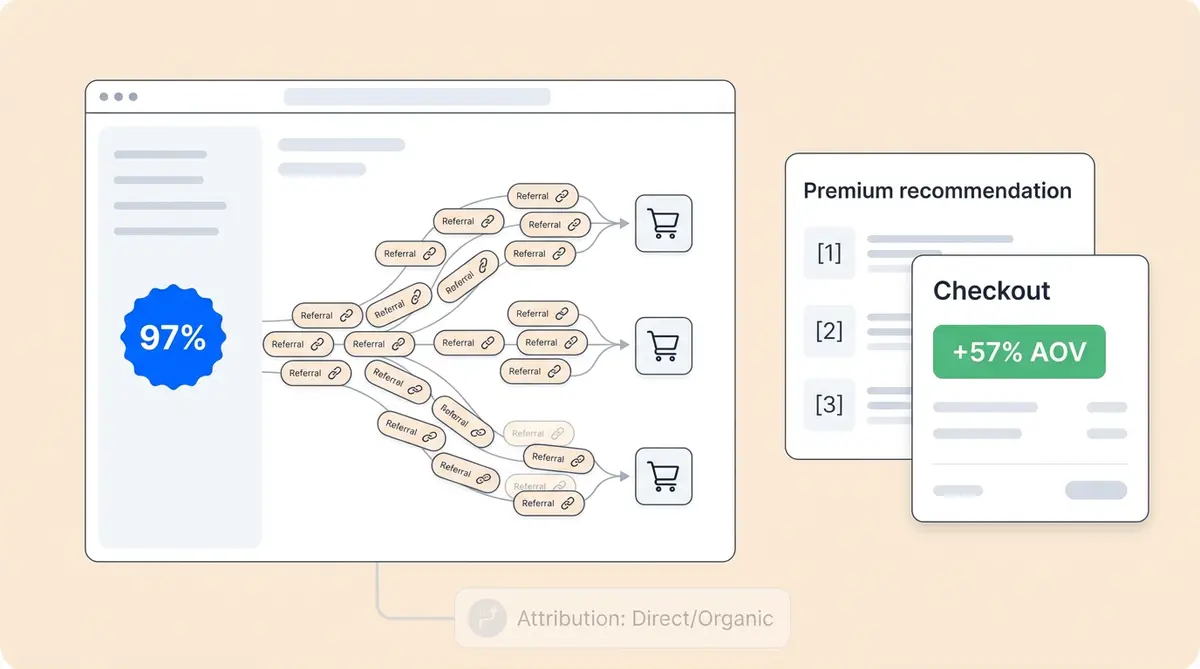
Because the majority of AI-influenced buying never carries a referral tag. A shopper gets a recommendation inside the assistant, then types your domain into the address bar. Analytics logs it as direct.
The scale of the gap is well documented. Salesforce reported that during Cyber Week 2025, AI and agents influenced 20% of all online purchases globally — $67 billion. Almost none of that appeared as LLM referral traffic in standard reports.
Two corrections worth making to how this era gets discussed: Adobe's widely-cited $14.25 billion figure is total Cyber Monday online spend, not AI-influenced spend. And AI traffic to retail sites grew 527% year over year through mid-2025, accelerating to Adobe's measured 693.4% across the 2025 holiday window.
Platform-level attribution is the fix. Alhena AI Visibility ties AI-influenced sessions back to actual orders across web chat, social commerce, email and voice — so you can see revenue by engine, not just sessions by engine. Our guide to LLM traffic attribution covers the GA4 setup.
How do you optimize for both without doubling the work?
Six moves. Four of them serve both platforms at once.
Feed hygiene — ChatGPT
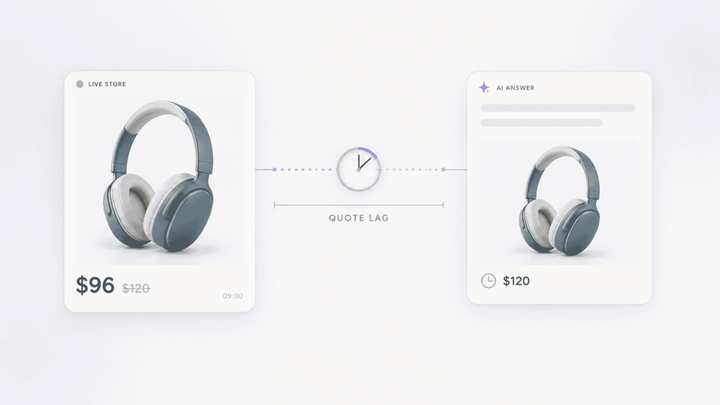
Real-time price, stock and variant accuracy. Stale feeds are the top reason products drop out of AI product cards.
Speed and specs above the fold — ChatGPT
Impulse-adjacent buyers abandon slow pages. Put price, availability and the three key specs where they load first.
Citation-worthy depth — Perplexity
Sourced buying guides, teardowns and spec comparisons. Citation engines cite what they can verify, not what markets well.
Comparison tables — both
Structured side-by-side data is the single most extractable asset for every engine. Build once, get cited everywhere.
Revenue attribution by engine — both
Split AOV, conversion and revenue per session by AI source. You cannot allocate budget against a single blended number.
Lift AOV after the click — both
The Alhena AI Shopping Assistant drove a 38% AOV uplift for Tatcha and 20% for Victoria Beckham by cross-selling live in the session.
That last one matters more than most teams expect. You cannot control which engine sends the shopper, but you can control what happens in the ninety seconds after they land — which is where embeddable shopping agents close the AOV gap regardless of source.
When does this flip? Four edge cases
1. Sub-$40 impulse catalogs
A 57% premium on a $22 order is $12.50. At 3.4% traffic share, that will not fund a content program. Stay ChatGPT-led and put the effort into feed accuracy.
2. B2B and high-ticket ($1,000+)
The maths inverts. On a $2,400 average order, Perplexity's smaller audience can out-earn ChatGPT outright, because a single incremental order covers a quarter's content investment.
3. Brands with no publishable expertise
Citation engines cite verifiable sources. If your category knowledge lives in a founder's head and nowhere else, you cannot win Perplexity — you can only win ChatGPT's structured-data game until that changes.
4. Regulated categories
Supplements, medical devices and financial products face tighter claim-checking in citation-first engines. Compliance-grade sourcing becomes an advantage rather than a cost, because unsourced competitors get filtered out.
Key takeaways
- ChatGPT sends ~96% of LLM ecommerce traffic at $204 AOV and 1.81% conversion — high volume, smaller carts.
- Perplexity sends 3–4% of traffic at a 57–82% AOV premium, driven by citations, affluent demographics and complex queries.
- Perplexity over-indexes revenue by ~1.6× relative to its traffic share — meaningful per unit of effort, small in absolute terms.
- Your quadrant decides your priority. High price plus high research means citation work first. Everything else means feed and speed first.
- Most AI revenue is invisible in GA4. AI influenced 20% of Cyber Week 2025 purchases ($67B) with almost none of it tagged as referral traffic.
- Post-click AOV lift is the hedge that works no matter which engine wins.
See which AI engines are actually paying you
Alhena tracks AI-influenced revenue by platform — and lifts AOV once the shopper lands.
Frequently asked questions
Yes. Perplexity referrals show an average order value 57–82% higher than ChatGPT referrals, depending on the dataset. A Shopify-derived analysis puts the premium at 57%; Alhena's study of 310 ecommerce brands measured Perplexity AOV at $129 versus ChatGPT's $71, an 82% gap. The direction is consistent across both.
Traffic share. ChatGPT accounts for roughly 96% of LLM referral sessions to ecommerce sites versus Perplexity's 3–4%. On 10,000 AI sessions, ChatGPT generates about $35,000 against Perplexity's $2,000. Perplexity earns a disproportionate 5.3% of AI revenue on 3.4% of sessions, but it does not out-earn ChatGPT in absolute terms for most catalogs.
Optimize for ChatGPT first if your products are under $200 and low-consideration — prioritize feed accuracy and page speed. Optimize for Perplexity first if your products are high-priced and research-heavy, such as electronics, furniture, active skincare or performance gear. Alhena AI Visibility scores your products across both engines so the decision runs on data rather than guesswork.
This is expected, not a problem with your store. ChatGPT referrals average $204 against $238 for non-branded organic — a 14.3% discount — because ChatGPT surfaces product cards for broad, exploratory queries that produce faster, simpler purchases. Conversion runs 31% higher to compensate, so revenue per session still comes out ahead at $3.65 versus $3.30.
Standard analytics misses most AI-influenced purchases because shoppers get a recommendation inside the assistant and then navigate to your site directly. You need platform-level attribution that stitches the full journey. Alhena ties AI-influenced sessions back to completed orders across web chat, social commerce, email and voice, showing revenue by engine rather than sessions by engine.
It depends on your price point. Below roughly $40 average order, the premium is too small to fund dedicated work. Above $1,000, a single incremental Perplexity order can cover a quarter of content investment. In between, the deciding factor is reuse: citation-worthy content that wins Perplexity also feeds Google AI Overviews and Gemini, so the work rarely serves one engine alone.
Verifiable, structured and sourced content: specification comparison tables, buying guides with cited testing data, materials and certification detail, and expert reviews with named authors. Marketing copy rarely gets cited because citation engines prioritize claims they can trace to a source. Our guide to how Perplexity picks its product recommendations covers the ranking signals in detail.
Yes, and for most catalogs it is the higher-leverage move. On-site AI assistants cross-sell and bundle during the session regardless of which engine sent the visitor. The Alhena AI Shopping Assistant has delivered a 38% AOV uplift for Tatcha and a 20% increase for Victoria Beckham by recommending complementary products in real time.
Complex, high-consideration categories where buyers weigh multiple decision factors: consumer electronics, home furnishing, skincare with active ingredients, performance and outdoor gear, and regulated products such as supplements. These match the research-heavy behaviour of citation platform users, where 80% are college graduates and 65% are high-income professionals.