Why Most Ecommerce Brands Can't See Their AI Search Revenue
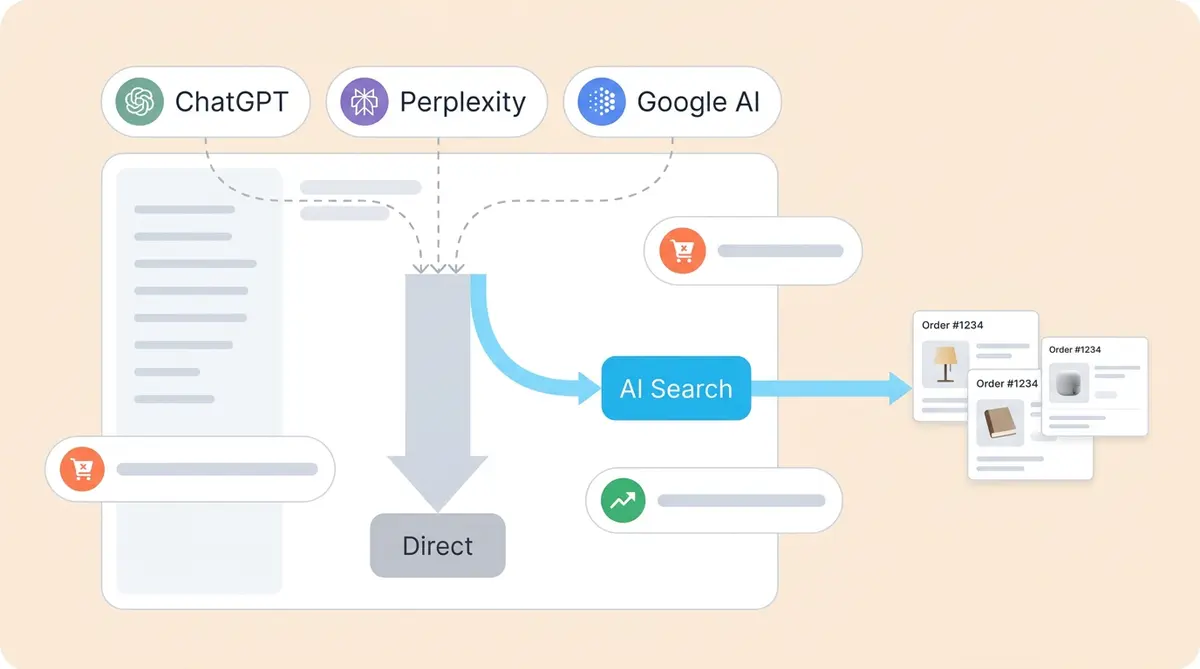
AI search traffic to ecommerce sites has grown over 1,000% in the past year. LLM-powered platforms like ChatGPT, Google AI Overviews, and Perplexity now send high-intent visitors directly to product pages. But here's the problem: over 70% of that LLM traffic gets misclassified as "direct" in GA4, which means most brands are blind to an entire revenue channel.
LLM traffic attribution is the practice of identifying, tracking, and tying revenue to visits that originate from large language models. Without it, you're making budget decisions with incomplete data. This guide covers how to set up AI search revenue measurement, track LLM referrals in GA4, and connect every AI-driven visit to actual dollars.
The Hidden Channel: How AI Search Traffic Disappears in Analytics
When a shopper asks an AI assistant "best moisturizer for dry skin" and clicks through to your product page, that visit should appear as an AI referral. Most of the time, it doesn't. LLM platforms strip or omit HTTP referrer headers, especially from mobile apps. The result? GA4 drops those visits into the "direct" bucket alongside bookmarks and typed URLs, with no source data preserved.
Google's own AI Mode had a confirmed tracking bug that removed referral attribution entirely until mid-2025. Even now, Google AI Overview clicks blend into regular organic search with no way to separate them. This creates a dangerous gap: if your analytics can't see LLM traffic, your team won't invest in the content strategy or AI visibility work needed to grow it.
The revenue impact is real. Across major ecommerce brands, AI search referrals convert at a significantly higher rate than non-branded organic search, roughly 31% above the baseline. Revenue per session runs roughly 10% higher. These aren't theoretical gains. They're dollars hiding in your "direct" traffic that you could be measuring, optimizing, and scaling. Industry surveys confirm this blind spot is widespread.
How to Set Up LLM Traffic Attribution in GA4
GA4 doesn't have a built-in AI search channel. You need to create one manually.
Create a Custom AI Channel Group
Go to Admin, then Data Display, then Channel Groups. Create a new group called "AI Search" with a source matching this regex:
chatgpt\.com|chat\.openai\.com|perplexity\.ai|claude\.ai|gemini\.google\.com|copilot\.microsoft\.com|meta\.ai|deepseek\.com
Place this rule above the "Referral" channel. GA4 assigns traffic to the first matching rule, so ordering matters.
Catch Dark Traffic with Behavioral Signals
Since most AI traffic hides in "direct," add a secondary detection layer. Filter direct traffic for new users and returning users landing on content pages with session durations over three minutes and three or more pages viewed. These behavioral signals correlate strongly with AI-referred visitors, who arrive with high intent on specific pages rather than browsing from the homepage.
Monitor AI Bot Crawl Activity
AI platforms crawl your site before they can recommend your products. Search server logs for user-agent tokens like GPTBot, ClaudeBot, PerplexityBot, and Google-Extended. Rising bot activity sends clear signals that your content is being indexed by large language models, even before referral clicks appear.
Building an AI Search Revenue Attribution Model
Last-click attribution consistently undercounts AI search. A shopper discovers your brand through an LLM, browses your site, then returns two days later via a branded Google search to buy. GA4 credits organic search. The AI gets nothing.
Use a three-layer model instead:
- Direct attribution: Revenue where AI search was the last click. This is your floor number, the minimum provable contribution.
- Assisted attribution: Revenue from conversion paths where AI search appeared at any touchpoint. Use GA4's conversion paths report to find these.
- Correlation analysis: Track branded search volume in Google Search Console alongside your AI citation activity. When LLMs start recommending your products, branded searches spike within days. These signals confirm AI influence even when direct referral data is missing.
Track revenue per session, conversion rate, pages per session, and sales cycle length for your AI search channel. Compare against organic search benchmarks to quantify the value AI traffic actually delivers. Even a small dataset of 30 days gives you directional insights.
How Alhena AI Connects AI Search Traffic to On-Site Revenue
Getting cited by AI search is half the equation. The other half is converting those visitors once they arrive.
AI-referred shoppers are pre-sold on a product or category. They arrive with context and intent. But most ecommerce sites greet them with the same static experience as every other visitor. That's a mismatch.
Alhena AI's Shopping Assistant picks up where external AI search leaves off. It answers follow-up questions about sizing, compatibility, and shipping using your actual product catalog, with zero hallucinations. It populates carts, pre-fills checkout, and tracks every interaction through built-in revenue attribution analytics.
Brands using Alhena see measurable results. Tatcha achieved 3x conversion rates and 38% higher AOV. Puffy reached 63% automated inquiry resolution with 90% CSAT. The full-funnel AI strategy works: earn the citation externally, convert the visitor on-site with Alhena AI.
Explore how this works across Instagram DMs and WhatsApp, or model the impact for your store with the ROI calculator.
Key Takeaways
- Over 70% of AI search traffic hides in GA4's "direct" bucket due to stripped referrer headers.
- A custom AI channel group in GA4 takes 10 minutes to set up and immediately surfaces LLM referrals.
- Last-click attribution undercounts AI search. Use assisted conversions and branded search correlation for the full picture.
- AI-referred visitors convert at higher rates and generate more revenue per session than organic search.
- Alhena AI turns high-intent AI search visitors into buyers with personalized, hallucination-free product guidance and complete revenue attribution.
Ready to measure and grow your AI search revenue? Book a demo with Alhena AI or start for free with 25 conversations.
Frequently Asked Questions
How does LLM traffic attribution help ecommerce brands grow AI search revenue?
LLM traffic attribution reveals the revenue AI search already drives to your store but hides in GA4's direct traffic bucket. Alhena AI pairs this visibility with on-site AI shopping that converts those high-intent visitors into buyers, giving you a full-funnel view from AI citation to checkout.
What is the fastest way to start tracking AI-referred revenue on Shopify or WooCommerce?
Set up a custom AI channel group in GA4 with regex matching for LLM referrer domains, then install Alhena AI's shopping assistant to track every AI-influenced interaction through its built-in revenue attribution dashboard. The full setup takes under 48 hours with no dev resources.
How do vertical AI agents improve conversion rates from LLM search traffic?
Vertical AI agents trained on your product catalog answer the specific follow-up questions AI search visitors bring, like sizing, compatibility, or ingredient details. Alhena AI's Product Expert Agent does this with zero hallucinations and has driven 3x conversion rates for brands like Tatcha.
Can AI shopping assistants attribute revenue back to specific LLM platforms like ChatGPT or Perplexity?
Yes. Alhena AI's revenue attribution analytics track the full journey from AI-referred entry to cart to purchase, broken down by source. This closes the gap that GA4 misses, where over 70% of LLM referral data gets stripped before reaching your analytics.
What role does AI visibility play in earning product citations from large language models?
AI visibility determines whether LLMs recommend your products at all. Alhena AI helps by keeping your product data structured, current, and AI-readable across every channel, so platforms like ChatGPT and Google AI Overviews have accurate information to cite when shoppers ask category questions.
How does Alhena AI's support automation reduce costs while increasing AI search conversions?
Alhena AI automates up to 82% of inbound inquiries with its Order Management and Product Expert agents, freeing your support team while capturing revenue from every AI-referred visitor. Brands like Crocus hit 86% deflection rates with 84% CSAT, proving automation doesn't sacrifice quality.
What personalization features help convert AI-referred shoppers who arrive with high purchase intent?
Alhena AI uses your product catalog and real-time inventory to deliver personalized recommendations, size guidance, and compatibility checks through web chat, email, WhatsApp, and Instagram DMs. This picks up exactly where the external AI left off, turning pre-sold visitors into completed orders.
How do I measure the revenue impact of adding an AI shopping assistant to my store?
Alhena AI's analytics dashboard shows attributed revenue, conversion lift, average order value changes, and deflection rates in real time. You can also model projected ROI before deploying using Alhena's free ROI calculator at alhena.ai/roi-calculator.
Is LLM traffic attribution worth investing in if AI search is still under 2% of my total traffic?
Absolutely. AI search traffic is growing 500-1,000% year over year and converts at significantly higher rates than organic. Alhena AI helps you capture this channel early with both AI visibility tools and on-site conversion, so you build baseline data now while the channel scales.
How does Alhena AI compare to general chatbots for handling AI search visitors?
General chatbots answer support tickets. Alhena AI is purpose-built for ecommerce sales: it recommends products from your actual catalog, populates carts, pre-fills checkout, and attributes every interaction to revenue. That sales DNA is why brands see 38% AOV lifts instead of just ticket deflection.