Your Best Price Is Behind a Login. Can a Shopping Agent See It?
AI shopping agents compare your anonymous price, not your member price. Learn how loyalty pricing loses agent comparisons and how to fix it with UCP.
Key takeaways
AI shopping agents usually shop logged out. They compare your public list price, not the member price, tier discount or subscriber rate your loyal customers pay. Agents compare your anonymous price, not your real one. Brands with rich loyalty economics can lose comparisons they should win unless they choose what is machine-visible and link shopper identity through protocols like UCP Identity Linking.
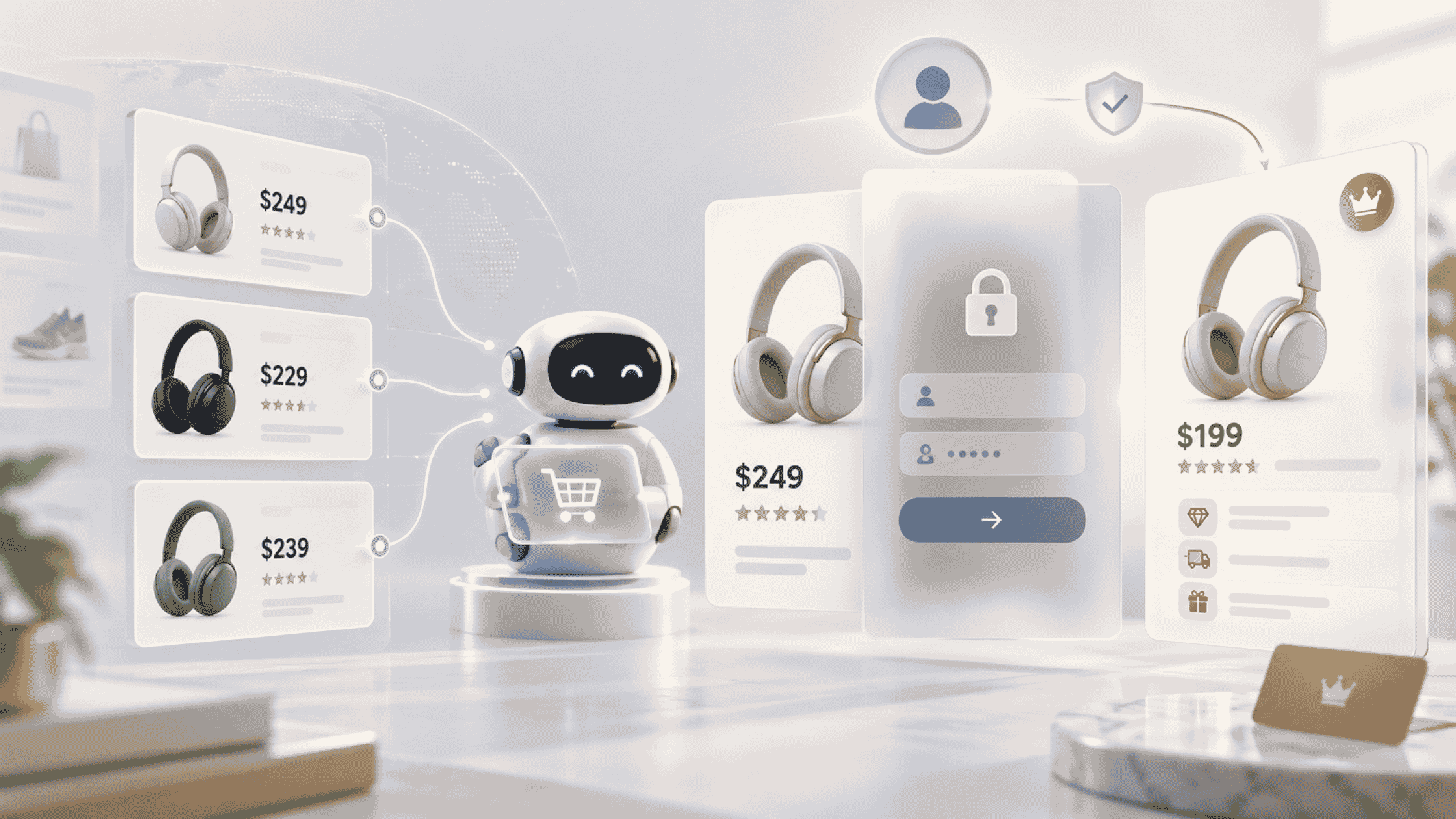
Here is a scenario playing out in AI answers right now. A shopper asks an AI assistant for the best deal on a vitamin C serum. The agent checks three retailers, sees $68, $64 and $62, and recommends the $62 option. Your brand listed $68. But that shopper has been a Gold-tier member of your program for two years, and her real price at checkout is $54.40 after her 20% tier discount, plus free shipping.
The agent never saw $54.40. It could not have. That price only exists after she logs in.
This post covers the pricing blind spot that agentic commerce creates, why it hurts the brands with the most generous loyalty programs, and a practical framework for fixing it without giving your margin away to every anonymous bot.
What Is "the Invisible Price"?
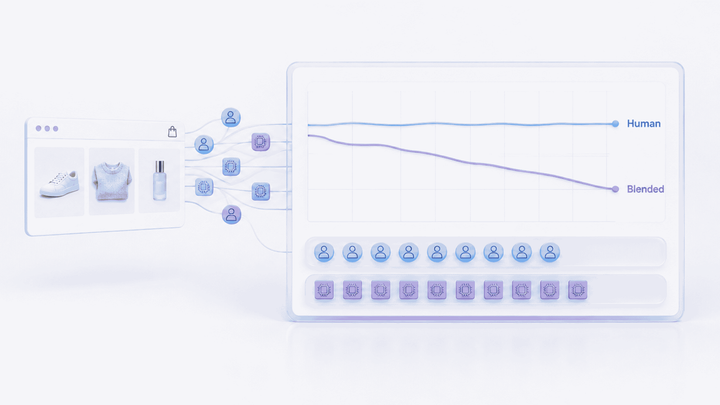
The invisible price is the price a known customer actually pays that an AI agent cannot see, because it only resolves after identity, membership or cart context is applied. Member prices, loyalty-tier discounts, subscribe-and-save rates, app-only coupons and auto-applied cart offers all qualify.
A login-wall discount is any discount gated behind authentication. The shopper has to sign in, or be recognized, before the price changes. For a human, the login wall is a speed bump. For an agent shopping anonymously, it is a brick wall.
The distinction matters because agents do not browse like people. A human member lands on your site already signed in, sees her price and buys. An agent fetches a catalog feed, a product page or a live catalog endpoint, extracts a number and ranks it against competitors. If the number it extracts is your public price, your loyalty investment does not count in that ranking.
Why Loyalty Pricing Is Now a Comparison-Shopping Problem
Price Comparison Is a Core AI Shopping Behavior
Comparison is not a side use case for AI shopping. It is the main event. In the ICSC and McKinsey report "Shopping in the Age of AI: Redefining Stores for a New Era," as reported by Retail Dive, 68% of consumers had used at least one AI tool while shopping in the past three months, and 62% said they had used AI to compare brands, models, prices or reviews. McKinsey's October 2025 analysis estimates agentic commerce could orchestrate $900 billion to $1 trillion in US B2C retail revenue by 2030. [1]
The traffic is already real. Adobe Analytics reported that AI-referred traffic to US retail sites grew 393% year over year in Q1 2026 and, by March 2026, converted 42% better than non-AI traffic, a reversal from converting 38% worse a year earlier. [2] By July 2026, Adobe said AI referrals to retail sites were up 62% year over year and converting 60% higher than other traffic. [3]
So agents are sending high-intent shoppers. The question is whose price they quote when deciding where to send them.
Your Best Customers Pay Prices the Public Never Sees
Loyalty is no longer a bolt-on. For many retailers it is the business:
- Ulta Beauty says in its fiscal 2025 10-K that approximately 95% of total sales came from members, with more than 46 million members at the end of fiscal 2025 (a record 46.7 million active members, up 5% year over year, per its annual report).
- Kroger told investors in its 10-K for the fiscal year ended February 1, 2025 that it serves approximately 63 million households and that over 95% of customer transactions are tethered to a Kroger loyalty card.
- CVS advertises on its retail media sales page that ExtraCare members make 77% of its sales. That is a company marketing claim, not an audited figure. [4]
- Target runs member-only events such as Target Circle Deal Days, where discounts are available only to Target Circle and Target Circle 360 members, with 360 members getting early access. [5]
- Amazon Subscribe & Save offers 5% off eligible items, rising to up to 15% when five or more subscriptions ship on the same day. [6]
The gap between public and member prices can be large. Albertsons says its forU Top Members, approximately the top 30% or slightly over 1 million households a week, save 35% or more weekly, a figure derived from total markdowns over gross sales between October 8, 2023 and October 5, 2024, combining member pricing, sale prices and digital coupons. That is a self-reported marketing figure, but it shows how far the logged-in price can drift from the shelf price.
Now imagine an agent comparing the shelf price.
Agents Compare the Anonymous Price
Most agent shopping flows today work from product feeds and public page data, and neither carries identity. Talon.One puts it plainly in its analysis of ChatGPT shopping: if an incentive appears only after login or only at checkout, an agent usually cannot factor it into the recommendation. [7]
This produces a perverse result. The brand that is most generous to its members, the one that invested most in tiers, points and exclusive pricing, looks more expensive to the agent than a competitor with no loyalty program at all.
Agents compare your anonymous price, not your real one.
Evidence: Loyalty Support Is Where Early Agentic Checkout Fell Short
OpenAI launched Instant Checkout in ChatGPT in September 2025 and pulled back from it in March 2026. OpenAI's merchant page now says purchases are completed on merchant-owned websites or apps rather than in a standalone ChatGPT checkout. [8] CNBC reported on March 20, 2026 that Forrester principal analyst Emily Pfeiffer called merchant onboarding "an arduous process" and said roughly 30 Shopify merchants were available via Instant Checkout as of February 2026.
Was missing loyalty support a cause? The honest answer is that it was one reported factor among several, and the sourcing varies:
- Stronger sourcing: Modern Retail reported in March 2026 that a C-suite executive at a large specialty retailer said in October 2025 that Instant Checkout would need real-time inventory, coupons, promotions, customer data collection, loyalty program integration and store pickup to be ready. Modern Retail concluded "it never got there." [9]
- Stronger sourcing: The replacement model leans heavily on identity. Walmart's app in ChatGPT, powered by its Sparky assistant, supports account linking, loyalty and payment through Walmart, according to Retail Dive and Payments Dive. [10] Walmart's Daniel Danker told Wired that in-chat conversion had been three times lower than click-out conversion.
- Secondary only: Some industry explainers, including evolveamz, list the lack of loyalty support among the reasons Instant Checkout failed. [11] Treat that as an interpretation, not a confirmed OpenAI explanation. OpenAI itself said the initial version "did not offer the level of flexibility" it wanted. [9]
The pattern is clear even with that caveat. When retailers rebuilt their AI shopping presence, they rebuilt it around logged-in identity.
How UCP Identity Linking Changes What Agents Can See
Google's Universal Commerce Protocol, launched at NRF in January 2026, includes an Identity Linking capability built on OAuth 2.0. In its March 19, 2026 update, Google said UCP would support Identity Linking so shoppers keep retailer loyalty benefits on UCP-integrated platforms, alongside new Cart and Catalog capabilities. [12] We covered the protocol landscape in our comparison of ACP vs UCP vs MCP.
Here is what Identity Linking actually does, according to the UCP specification [13] and Google's developer guide [14]:
- 1. The business declares the
dev.ucp.common.identity_linkingcapability in its UCP profile. - 2. The shopper authorizes the agent platform through a standard OAuth 2.0 authorization code flow, so the shopper consents at your login rather than handing over a password.
- 3. The business declares scopes that gate authenticated operations. Google's guide lists scopes such as
dev.ucp.shopping.checkout:manageanddev.ucp.shopping.order:read. - 4. With a valid token, the business can resolve who the shopper is and return what that shopper is entitled to.
Two details matter for loyalty teams. First, Identity Linking is optional; the merchant decides whether to offer it. Second, the spec is still moving. In an April 2026 discussion on the UCP GitHub repository, a maintainer sketched catalog scopes where a public "search" scope requires no authentication while a "vip" scope does. [15] That is a draft proposal, not settled spec, but it points to a future where member-only catalog views are a normal part of the protocol.
In other words, UCP gives you a way to show a linked member her real price. It does not show that price to an anonymous agent, and it should not. That is your decision to make.
Payment Rails Already Assume User-Set Limits
The payment networks are building the same logic. Visa's Intelligent Commerce Connect, launched in April 2026, provides tokenization, spend controls and authentication for agent-initiated payments across four protocols, including UCP and ACP. [16] Mastercard Agent Pay issues agentic tokens, and Mastercard's August 2026 Signals report says those tokens can be restricted by agent, merchant, category, spending limit, timeframe or usage rules. [17]
The takeaway for merchandisers: agents are being designed to work inside boundaries the shopper sets. A shopper who sets a budget ceiling is exactly the shopper whose member price decides whether you make the list.
What an Agent Sees vs. What a Member Pays
| Pricing type | Example | What an anonymous agent sees | What a logged-in member pays | Machine-visible by default? |
|---|---|---|---|---|
| Member price | Grocery "member price" tags | Regular shelf price | Discounted member price | No |
| Loyalty tier discount | Beauty Gold/Platinum sale events | Public price, maybe a generic sale banner | Tier-specific percentage off | No |
| Subscriber discount | Subscribe-and-save, replenishment plans | One-time purchase price | 5–15% off, recurring | Sometimes, if listed as a separate offer |
| Cart-applied offer | Spend $75, get 20% off; auto-applied BOGO | Item price only | Lower basket total | Rarely |
| App-only coupon | Mobile-exclusive codes | Nothing | App price | No |
| Points redemption | Redeem 500 points for $10 | Nothing | Effective price after redemption | No |
Every row where the answer is "No" is a comparison your brand can lose on paper while winning in reality.
A Framework: What to Make Machine-Visible, What to Keep Gated
Not every login-wall discount should come down. Gated pricing exists for good reasons: it rewards commitment, collects first-party data and protects margin. The goal is to be deliberate. Use this four-step framework.
Step 1: Inventory Your Invisible Prices
List every price that requires identity or context to resolve. For each, record the typical gap to the public price, the share of revenue it touches and the categories where it applies. Most loyalty and CRM teams have never written this list down, because until now humans were the only ones reading the price.
Step 2: Sort Each Price into One of Three Tiers
- Advertise openly. Structural, broadly available discounts, such as a standard subscribe-and-save rate, belong in feeds and structured data as a clearly labeled conditional offer. Let the agent see "$68, or $57.80 with subscription."
- Signal, but gate the number. For tier discounts, tell agents that a member price exists ("members save up to 20%; free to join") without publishing every tier's exact price. This gives the agent a reason to mention you and gives the shopper a reason to join.
- Keep fully gated. Personalized offers, win-back codes and one-to-one promotions should stay private. Publishing them trains shoppers and agents to wait for discounts.
Step 3: Link Identity Where It Pays
If your platform supports it, implement UCP Identity Linking so linked members get their real price and benefits inside Google AI Mode and Gemini. Prioritize it for categories where your member price most often beats the competitor's public price. Keep guest flows open; Identity Linking should add value, not add friction.
Step 4: Win the Conversation After the Click
Agents increasingly send shoppers to your site or app to buy. That is where the invisible price becomes visible again, provided your on-site experience can recognize the shopper and say, specifically, "you're a Gold member, so this is $54.40, and your 20% applies." This is the job of an on-site AI shopping assistant.
Quick checklist
- Every login-gated price documented, with gap and revenue share
- Subscription and member offers labeled in feeds and product schema where appropriate
- "Members save" messaging visible on public product pages and in feed descriptions
- UCP profile published, with Identity Linking evaluated
- OAuth-ready account system (many stores are not yet)
- On-site AI can read loyalty tier, points and subscription status
- AI visibility monitored for price accuracy on priority SKUs
How Alhena Sees the Prices Agents Miss
Alhena works on the other side of the login wall: inside the real conversations shoppers have on your site. That position shows something public price comparisons cannot.
Active Promotions and Discount Lookup. Alhena's Product Expert agent uses two read-only tools to answer deal questions from live Shopify and BigCommerce data: Lookup Discount Code validates a specific code, and Active Promotions surfaces what is currently running. The mechanics are covered in our deep dive on discount lookup and active promotions, and stacking rules are covered in how AI answers promo stacking questions.
A custom Loyalty Agent. With custom agents in Alhena, brands can build a Loyalty Agent that checks point balances, applies reward redemptions and looks up tier-specific benefits. Brands with proprietary loyalty engines connect them through API Tools.
Recognizing the logged-in shopper. Shopify storefronts can pass customer tags, lifetime value tier and subscription status to Alhena through the Website SDK's custom data feature, as described in our no-code agentic workflows guide. The result is an assistant that can say "your member price is" instead of "our price is."
Measuring the gap from the outside. Alhena AI Visibility tracks which SKUs ChatGPT, Gemini and Perplexity recommend and whether the prices they cite are accurate, which is how you find the products where the invisible price is costing you placements. See our guide to SKU-level AI visibility.
What Alhena has published publicly is directional. In its comparison with Rep AI, Alhena reports AI-engaged shoppers converting at 49.3% cart-to-checkout versus 26.3% for non-engaged shoppers, and Tatcha saw a 3x conversion rate and a 38% AOV uplift after deploying Alhena, per Alhena's customer data. Neither figure isolates loyalty pricing, so treat them as context, not proof.
What This Means for Your 2026 Loyalty Roadmap
The loyalty playbook of the last decade assumed a human would always see the benefit. That assumption no longer holds. Three shifts follow:
- 1. Loyalty design now includes machine visibility. Every new tier, perk or member price needs a decision about what agents can see.
- 2. Identity is the new price tag. A linked identity is how your real price reaches the agent. Treat OAuth readiness as a loyalty project, not just an IT ticket.
- 3. The post-click conversation is where loyalty proves itself. When the agent hands the shopper to your site, your AI has seconds to show her real price. Our playbook on what happens after the agent buys covers the retention side.
Brands that do this well will turn their loyalty program from a hidden cost in agent comparisons into a visible reason to choose them.
Frequently Asked Questions
What is the invisible price in ecommerce?
The invisible price is the price a known customer actually pays that an AI shopping agent cannot see, because it only resolves after login, membership or cart context. Member prices, loyalty tier discounts, subscriber rates, app-only coupons and cart-applied offers all qualify. Agents comparing anonymous public prices miss them, so brands with generous loyalty programs can look more expensive than they are.
Can AI shopping agents see member or loyalty pricing?
Usually not. Most agents compare prices from public product pages and feeds, which carry no shopper identity. A member price becomes visible only when the brand publishes it as a labeled offer or when the shopper links their account to the agent platform, for example through UCP Identity Linking in Google AI Mode or Gemini. Otherwise, agents compare the logged-out price.
What is UCP Identity Linking?
UCP Identity Linking is a capability in Google's Universal Commerce Protocol that uses OAuth 2.0 to let a shopper connect their retailer account to an AI platform. Google said in March 2026 that it lets shoppers keep loyalty benefits, such as member pricing or free shipping, on UCP-integrated surfaces. Merchants choose whether to offer it and which operations require a linked identity.
Should brands publish member prices so AI agents can see them?
Not all of them. Publish structural offers, such as a standard subscribe-and-save rate, as clearly labeled conditional prices. Signal tier discounts ("members save up to 20%") without exposing every tier's number. Keep personalized and win-back offers fully gated. The goal is to be chosen by the agent without training shoppers to expect every private discount.
Did ChatGPT Instant Checkout fail because of missing loyalty support?
Loyalty was one reported factor, not a confirmed single cause. Modern Retail reported that a large retailer's executive listed loyalty integration among features Instant Checkout needed and never got. OpenAI said the first version lacked flexibility, and Walmart reported three-times-lower in-chat conversion. Its replacement ChatGPT app supports account linking and loyalty, which suggests identity mattered.
How does Alhena help with login-gated discounts?
Alhena's AI shopping assistant answers deal questions using live store data through its Active Promotions and Discount Lookup tools. Brands can add a custom Loyalty Agent that checks points, applies redemptions and explains tier benefits, and can pass logged-in customer data to the assistant. Alhena AI Visibility tracks whether AI engines cite your products and prices accurately.
What is a login-wall discount?
A login-wall discount is any discount a shopper can only access after signing in or being recognized as a member, such as grocery member prices, beauty loyalty tier sales or app-only coupons. For humans it is a small step. For anonymous AI agents it is invisible, which means the discount does nothing to win the comparison that decides the recommendation.
See Your Real Price the Way Your Members Do
If your best customers pay less than your public price, some of your AI losses may be comparisons you actually won. Alhena can show you where shoppers are already asking about member pricing, and help your on-site AI answer with their real price.
Book a demoExplore the AI Shopping AssistantStart with a free plan