Why Coupon Stacking Questions Are Your Support Team's Least Favorite Question
Sixty-two percent of online shoppers actively search for promo codes before completing a purchase, according to DemandSage. And once they find one, the very next question from digital shoppers is predictable: "Can I use this code on top of the sale that's already running?"
Forty-six percent of shoppers abandon their cart when a code fails, according to UpSellit. That single question forces support agents into a maze of promotion rules, platform limitations, and edge cases. The answer changes depending on the discount type, the cart contents, the customer's loyalty tier, and whether the store even allows stacking. Get it wrong, and you either leak margin on deals or lose the sale entirely.
This post breaks down the mechanics of promotion stacking in ecommerce, why it trips up both agents and basic chatbots, and how AI that actually understands your promotion rules can answer these questions instantly without giving away the store.
The Anatomy of Ecommerce Promotions and Stacking Rules
Retailers hear this question daily. Before you can answer "Can I combine Code X with Sale Y?", you need to understand the layers involved. Ecommerce promotions aren't a single system. They're a stack of overlapping discount types, each with its own rules.
Product-Level vs. Order-Level vs. Shipping Discounts
Most platforms split discounts into three buckets. Product-level discounts apply to specific items (like 20% off a skincare set). Order-level discounts apply to the entire cart (like $15 off orders over $100). Shipping discounts waive or reduce delivery costs. The stacking question gets complicated because each type follows different combination rules.
On Shopify, for example, each line item can receive only one product discount at most. You can layer an order discount on top of a product discount, but you can't stack two product discounts on the same item. Since 2023, Shopify supports up to five discount codes per order, but only if each discount is marked as "combinable" in the admin settings.
Automatic Discounts vs. Discount Codes
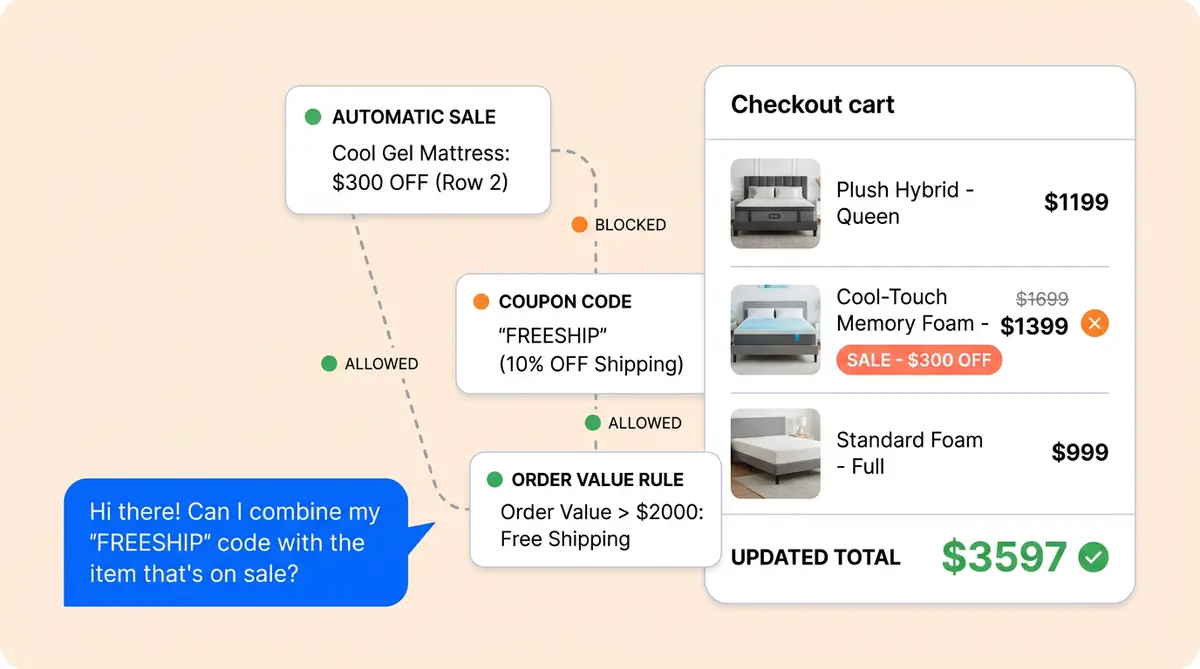
Here's where things get tricky for customers. Automatic discounts (like a sitewide 15% off digital sale) apply without a code. Discount codes require manual entry. When a shopper asks "Can I use my WELCOME10 code during the summer sale?", the answer depends on whether the automatic sale discount and the code-based discount are both marked as combinable, and whether they target the same discount type.
WooCommerce handles this differently: it lets merchants toggle an "Individual use only" flag per coupon, giving granular control over which multiple coupons can coexist. WooCommerce stores using Alhena can map these rules directly into the AI's knowledge base.
Exclusion Lists, Minimum Thresholds, and Expiration Windows
Beyond type compatibility, each promotion often carries its own conditions. A code might exclude sale items, require a $75 minimum cart value, apply only to first-time buyers, carry exclusive segment restrictions, or expire at midnight. A human agent must mentally cross-reference multiple digital promotion rules, exclusion lists, and savings thresholds for every stacking question. During a flash sale or BFCM weekend, that's hundreds of variations per hour.
What Happens When Promo Stacking Goes Wrong
This is the most dangerous question for AI to answer wrong. Say yes when the codes can't actually combine, and checkout fails in front of the customer. Say no when they can, and you lose a sale to a competitor. It hits retailers from both directions.
As we explored in why 80% of ecommerce AI pilots fail at the last 5%, promo stacking is one of those edge cases that separates a demo from production.
Margin Erosion from Accidental Over-Discounting
When agents mistakenly approve a stacked combination that shouldn't be allowed, customers get deeper discounts than intended. A 20% product discount stacked with a 15% order discount and free shipping can push final margins below profitability, especially when extra loyalty rewards are layered in, especially on lower-priced items with thin profit margins. During high-volume sales events, even a 2-3% over-discount rate compounds into significant revenue loss.
Cart Abandonment from Promo Confusion
The flip side is just as costly. When shoppers can't figure out whether their code works, or get a generic "this code cannot be applied" error, many walk away. According to UpSellit's research, correcting failed promo codes reduces checkout abandonment by up to 25%. That means one in four abandoned checkouts tied to failed codes could have been saved with a clear explanation.
The real-world math is simple: if 10-30% of shoppers offered an alternative after a failed code complete their purchase, a store processing 10,000 checkout attempts per month could be leaving hundreds of completed orders on the table.
Agent Burnout and Inconsistent Answers
Promotion questions make up 10-20% of all pre-sale support tickets, according to Fini Labs. They're repetitive, nuanced, and high-stakes. An agent might handle the same "Can I combine..." question 50 times during a sale, but the correct answer changes based on which specific codes, deals, and multiple promotions are involved. One wrong answer shared on social media ("The agent said I could stack them!") creates a customer service precedent that's hard to walk back. Brands like Tatcha, which saw 82% chat deflection with Alhena AI, recognized early that promotion queries are among the best candidates for AI automation.
Why Basic Chatbots Fail at Promo Stacking Questions
Most rule-based chatbots and FAQ pages handle promotions with static responses. They might say "We allow one promo code per order" or "Discounts cannot be combined with other offers." These blanket answers create two problems.
First, they're often inaccurate. Many stores do allow certain combinations, like stacking a loyalty discount with a shipping code, but not others. A static answer either over-restricts (costing sales) or over-permits (costing margin).
Second, they can't evaluate the customer's specific cart. When someone asks "Can I use SUMMER20 on these three items that are already marked down?", the answer depends on whether those specific items are excluded from the code, whether the cart meets the minimum, and whether the code's discount class conflicts with the sale's discount class. A keyword-matching chatbot doesn't have access to any of that context.
Generic AI chatbots built for general customer service face a similar limitation. They might understand the question perfectly but lack the integration layer to check real-time cart data, active promotions, and stacking rules. The result is either a hallucinated answer or a handoff to a human agent, which defeats the purpose.
How AI Actually Resolves Promo Stacking in Real Time
The difference between a chatbot that says "I'm not sure, let me check" and one that says "Yes, SUMMER20 works with the current sale on everything in your cart except the limited-edition palette" comes down to three capabilities.
Live Cart and Catalog Awareness
When a shopper asks a combinability question, Alhena's PlannerAgent routes it to the ProductExpertAgent, which fires two tool calls in parallel: lookup_discount_code (to validate the specific code and pull its full stacking metadata) and list_active_promotions (to enumerate every live sale on the store). On Shopify, the lookup call issues a GraphQL query that returns the code's combinesWith flags: product_discounts, order_discounts, and shipping_discounts. Those three booleans tell the AI exactly which discount categories this code can stack with. The AI cross-references these flags against the active sale's category for a deterministic answer, not a guess.
For a complete walkthrough of how these tools work under the hood, see our Discount Lookup and Active Promotions deep dive.
Alhena's Shopping Assistant pulls this data from Shopify, WooCommerce, Magento, or Salesforce Commerce Cloud through direct API connections. The AI sees the same pricing rules the checkout engine enforces, so its answers match what actually happens when the customer clicks "Apply."
Promotion Rule Ingestion
Advanced platform-native stacking rules (like Shopify's "combinable" flag or WooCommerce's "individual use" toggle) are part of the data Alhena ingests. But most brands also have business rules that sit outside the platform: "Never let total discount exceed 30%," "VIP customers can stack loyalty points with any code," or "Sale items are excluded from influencer codes."
These rules get configured through Alhena's guideline system, which uses trigger-action pairs. For example: Trigger: "Customer asks to combine a discount code with an active sale." Action: "Check the code's combinability flag, verify no excluded products in cart, confirm total discount stays under the brand's cap, and respond with the specific outcome." The AI follows this logic on every promotion question, with zero variation. Promo answers must be exact, not approximate. Source-of-truth API integration that reads live platform data beats knowledge-base-only AI every time.
Date-Aware Promotion Handling
Promotions have start dates, end dates, and often tiered windows (early VIP access, main sale, extended Cyber Monday). Alhena's Support Concierge tracks these windows automatically. It won't quote a BFCM deal before the sale starts, won't accept an expired code, and switches messaging the moment a promotion window opens or closes. Human agents often get caught referencing yesterday's deal or tomorrow's early access option. They don't catch expired windows fast enough. The AI doesn't make that mistake.
Alhena AI: Built for Ecommerce Promotion Logic
While most AI support tools handle promotion questions as just another FAQ topic, Alhena treats them as commerce events, connected to real catalog data, real cart states, and real revenue outcomes.
The Product Expert Agent Knows Your Catalog
Alhena's Product Expert Agent is trained on your full product catalog, including pricing tiers, sale flags, bundle rules, and category-level promotion eligibility. When a shopper asks "Does SAVE15 work on the new spring collection?", the agent checks the promotion's product scope against the actual items, not a cached FAQ.
The same tooling powers the "my code isn't working" diagnostic flow. When a shopper reports a failed code, the AI distinguishes between five failure modes: expired, minimum-not-met, excluded-category, already-used, and not-combinable. Each triggers a different response. An expired code gets a suggestion for the best active alternative. A minimum-not-met gets a nudge toward the threshold. Not every platform exposes this data equally. BigCommerce's V2 Coupons API doesn't return combinability metadata, so when the AI can't confirm stacking rules, it escalates to a human agent instead of guessing. That safe default protects margins better than a wrong answer ever could.
Agentic Checkout Closes the Loop
Answering the stacking question is only half the job. The other half is applying the discount and moving the customer toward checkout. Alhena's agentic checkout capability populates carts, applies valid promo codes, and pre-fills checkout fields directly within the chat. If a customer confirms they want to use SUMMER20, the AI doesn't just say "yes, it works." It applies the code, shows the updated cart total with savings applied, and nudges toward completion.
This end-to-end flow is why brands using Alhena see measurable revenue impact. Victoria Beckham saw a 20% AOV increase with AI-assisted shopping, partly because the AI eliminates the friction between "Can I use this code?" and "I bought it."
For a deeper look at this strategy, see our guide on how to increase AOV with AI shopping assistants.
Revenue Attribution for Promotion Performance
Every promo-related conversation Alhena handles is tracked through built-in revenue attribution analytics. Brands can see exactly how many promotion stacking questions the AI resolved, how many led to completed purchases, and what the average discount depth was. This data feeds back into marketing and promotion strategy: if customers keep asking whether Code X stacks with Sale Y, the marketing team should consider allowing it. Brands focused on increasing AOV can use these insights to optimize which codes stack.
Setting Up AI Promo Stacking Rules: A Practical Guide
Getting Alhena to handle your promotion logic doesn't require engineering resources or months of setup. Here's what the process looks like in practice.
Step 1: Map Your Promotion Types
List every active and recurring promotion type: sitewide sales, category discounts, segment-specific offers, first-purchase codes, influencer codes, loyalty rewards, gift cards, digital coupons, shipping thresholds, and bundle pricing. For each one, you must define what it can and can't combine with. Most brands find they have 5-10 distinct promotion types.
Gift cards add another layer of complexity, since they intersect with both payment methods and promotional discounts. See our breakdown of AI gift shopping in conversational commerce for more on this overlap.
Step 2: Configure Stacking Guidelines
Using Alhena's trigger-action guideline system, create rules for the most common stacking scenarios. Start with the top five promotion questions your support team handles. Common examples from retailers include:
- "Can I use [influencer code] during a sitewide sale?" (Often yes, with a cap.)
- "Can I stack my loyalty discount with a promo code?" (Depends on the brand's policy.)
- "Why isn't my code working on sale items?" (Usually an exclusion rule.)
- "Can I use two promo codes at once?" (Platform-dependent.)
- "Is there a better deal available right now?" (The AI can proactively suggest the best available offer.)
Step 3: Connect Your Commerce Platform
Alhena integrates with Shopify, WooCommerce, Salesforce Commerce Cloud, and Magento. The integration syncs product catalogs, pricing rules, discount configurations, and cart data. Setup takes under 48 hours with no developer involvement. And at roughly $0.50 per AI interaction vs. $6.00 for a human agent (Freshworks), the cost savings on high-volume promotion questions add up fast.
Step 4: Test with Real Scenarios
Before going live, run your most complex stacking scenarios through the AI. Try advanced edge cases: expired codes, codes applied to excluded products, carts that fall below minimum thresholds, and VIP-only offers used by non-VIP accounts. Alhena's hallucination-free architecture means the AI only states what the data confirms, so its behavior stays consistent, so it won't approve a stack that the checkout engine would reject.
Beyond Stacking: How AI Turns Promo Questions into Revenue
The smartest thing about handling promo stacking with AI isn't just answering the question correctly. It's what happens after the answer.
When a customer trying to save money before they buy finds their code doesn't stack with the current sale, a human agent typically says "Sorry, that code can't be combined." End of the deal. An AI built for ecommerce sales takes a different approach: it explains why the code doesn't apply, then suggests the better option. "SUMMER20 can't be combined with the current 25% off sale, but the sale discount is actually higher on the items in your cart. Your total with the sale alone is $84.50."
Alhena goes further with proactive promo nudges. The list_active_promotions tool runs during shopping conversations, so the AI can surface offers the customer never asked about: "you're $8 from free shipping" or "code SUMMER20 would save $12 on this cart." These nudges drive AOV the same way a skilled floor associate would, keeping the customer in the purchase flow instead of sending them to a competitor's site. Reducing hesitation at the moment of discount confusion is one of the highest-impact things an AI shopping assistant can do.
Brands running Alhena across digital channels like web chat, email, Instagram DMs, and WhatsApp see consistent promotion handling across every channel. A customer who asks about stacking on Instagram gets the same accurate, cart-aware answer they'd get on the website. No channel-specific training required for digital or social channels.
Protecting Margins While Maximizing Conversions
Gartner predicts agentic AI will resolve 80% of common customer service issues autonomously by 2029. Promotion questions, being rule-based and high-volume, are prime candidates. AI promotion handling is a margin protection tool as much as a conversion tool. By enforcing stacking rules precisely, every time, with no exceptions unless the brand configures one, Alhena prevents the slow margin leak that happens when agents make judgment calls on discount combinations. Puffy achieved a 90% CSAT score while automating 63% of inquiries, showing that customers don't mind talking to AI when it gives them fast, accurate answers about their discounts.
AI-enforced stacking rules also serve as a layer of fraud detection for ecommerce, preventing discount abuse before it reaches checkout.
Key Takeaways
- Promo stacking questions are high-volume, high-stakes support tickets that spike during sales events and directly impact both conversion rates and profit margins.
- Basic chatbots and static FAQs can't handle coupon stacking for retailers because they lack real-time access to cart data, promotion rules, and platform-specific combination logic.
- AI built for ecommerce resolves stacking questions by connecting to live catalog data, enforcing configurable business rules, and applying valid codes through agentic checkout.
- Correct promo stacking answers protect margins by preventing unauthorized discount combinations while still maximizing conversion by guiding customers to the best available offer.
- Alhena AI handles the full promotion lifecycle, from date-aware activation to real-time eligibility checks to checkout completion, across every sales channel.
Ready to stop leaking margin on promo stacking mistakes and start turning discount questions into completed orders and save on support costs? Book a demo with Alhena AI or start for free with 25 conversations.
Frequently Asked Questions
What is promo stacking in ecommerce?
Promo stacking is when a customer applies more than one discount to a single order. For example, combining a 20% sitewide sale with a WELCOME10 promo code. Whether stacking is allowed depends on the platform's discount rules, the types of discounts involved, and the merchant's configuration.
Can you combine discount codes on Shopify?
Since 2023, Shopify supports up to five discount codes per order, but only if each discount is marked as "combinable" in the admin settings. Each line item can still receive only one product-level discount. Order-level and shipping discounts can layer on top. Alhena AI reads these combinability flags in real time to give customers accurate answers.
How does AI handle promo code stacking questions?
AI built for ecommerce connects to the store's product catalog, active promotions, and real-time cart data. When a customer asks about combining codes, the AI checks each item's eligibility, verifies the codes' combinability rules, and calculates the stacked discount. Alhena's Product Expert Agent does this in under two seconds.
What happens when promo codes are applied incorrectly?
Incorrect code application hurts revenue in two ways. Over-discounting erodes margins when stacks are approved that shouldn't be. Under-discounting causes cart abandonment when valid codes are rejected. UpSellit's research shows that correcting failed codes reduces checkout abandonment by up to 25%.
Can AI prevent promo code abuse and discount fraud?
Yes. AI enforces stacking rules consistently on every interaction, with no judgment calls or exceptions unless the brand configures them. Alhena's hallucination-free architecture only confirms discount combinations that the checkout engine will actually honor, preventing both accidental over-discounting and code misuse.
How does Alhena AI differ from Zendesk or Intercom for promo questions?
Zendesk AI and Intercom Fin handle promo questions as text-based support queries. They can match keywords and surface FAQ answers, but they don't connect to live cart data, check platform-specific stacking rules, or apply codes through agentic checkout. Alhena is purpose-built for ecommerce with direct integrations into Shopify, WooCommerce, and Salesforce Commerce Cloud.
How long does it take to set up AI promo stacking rules?
With Alhena AI, setup takes under 48 hours. The platform syncs your product catalog, pricing rules, and discount configurations automatically through its commerce platform integration. Custom stacking guidelines are configured through a trigger-action system that doesn't require developer resources.
Does AI promo handling work across multiple sales channels?
Yes. Alhena handles promo stacking questions consistently across web chat, email, Instagram DMs, WhatsApp, and voice. The same promotion rules and cart awareness apply regardless of which channel the customer uses, so answers are always accurate and consistent.