The Real Question Behind Alhena AI vs Yuma AI
Gartner's February 2026 survey of 321 CX leaders found that 91% face executive pressure to implement AI this year. But the pressure isn't just to adopt AI. It's to prove AI pays for itself. That's where Alhena AI and Yuma AI take fundamentally different paths.
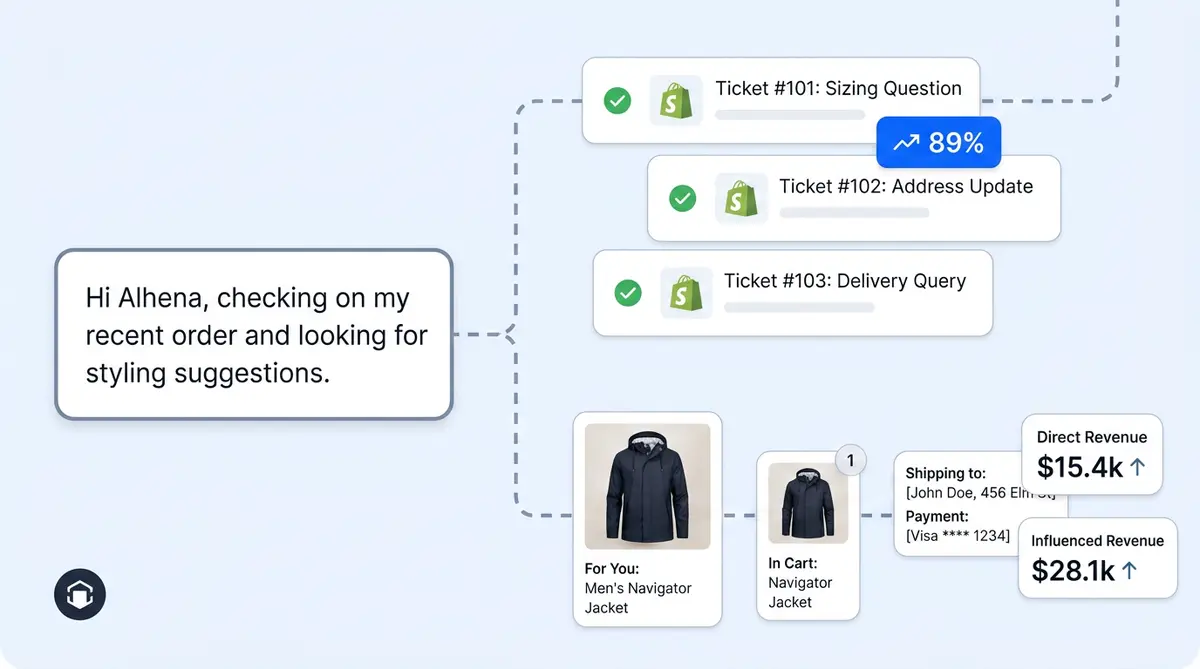
Yuma AI has built one of the deepest customer support automation engines in ecommerce. With 75+ pre-built Shopify actions, published automation rates as high as 89%, and outcome-based pricing, it's a strong choice for brands drowning in repetitive support tickets. Alhena AI starts from a different premise: what if your AI didn't just deflect tickets, but actually drove revenue? With AI-powered revenue attribution, agentic checkout, and dual AI agents, Alhena treats every customer conversation as a potential sale.
This guide breaks down both platforms across features, pricing, integrations, and real-world results so your team can access the data needed to decide which approach fits your brand.
Alhena AI vs Yuma AI: At a Glance
Before diving into the details, here's a side-by-side snapshot of where each platform stands.
Alhena AI vs Yuma AI: At a Glance
| Alhena AI | Yuma AI | |
|---|---|---|
| Core Focus | Revenue-first: sales + support | Support-first: ticket automation |
| Revenue Attribution | Built-in, end-to-end tracking | Limited (Sales AI widget only, Sept 2025) |
| AI Agents | Two: Product Expert + Order Management | Single model with Auto-Pilots |
| Channels | Web, email, Instagram, WhatsApp, voice | Email, chat, Facebook, Instagram (no voice) |
| Ecommerce Platforms | Shopify, WooCommerce, Magento, SFCC | Shopify (primary), BigCommerce/WooCommerce (beta) |
| Helpdesk Coverage | Zendesk, Freshdesk, Gorgias, Kustomer, Intercom | Gorgias, Zendesk, Kustomer, Gladly (no Intercom/Freshdesk) |
| Pricing | $1.10/conversation, free plan available | ~$0.60-0.70/resolution, no public pricing |
| Deployment Speed | Under 48 hours, self-serve | Days to weeks (white-glove onboarding) |
What Yuma AI Does Well: Support Automation at Scale
Yuma AI was born inside the Gorgias App Store in late 2022 and quickly became the go-to AI layer for high-volume Shopify merchants. Founded by startup founder Guillaume Luccisano (a three-time Y Combinator founder with exits including Socialcam to Autodesk for $60M), Yuma raised $5.75M from Google Gradient Ventures and Altman Capital Fund and has automated over 5 million tickets for 100+ paying customers.
The platform's strength is pure ticket deflection. Its Process Builder offers 75+ pre-built Shopify actions: issuing refunds, generating return labels, pausing subscriptions, canceling orders. For brands whose biggest pain is "where is my order?" volume, Yuma handles requests well, letting merchants automate CX and giving human agents productivity on complex CX issues.
The Yuma Product Suite
Yuma now offers four products:
- Support AI (core): Autonomous AI resolution with SOP-driven Auto-Pilots and a Safety Guard that runs 15-20 quality checks per response across models including OpenAI and ChatGPT.
- Sales AI (launched September 2025): An on-page Q&A widget for pre-purchase product questions. Parachute Home reported an 18% revenue-per-visitor lift.
- Social AI (launched January 2026): Facebook and Instagram comment moderation with purchase intent detection, claiming it can automate 60% of social moderation.
- Chat AI: A standalone chat interface that deploys in about five minutes.
Where Yuma Falls Short
Yuma's limitations become clear when you look beyond ticket deflection. Hallucination remains the most frequently cited issue in G2 reviews, despite the Safety Guard system. The platform doesn't support voice or phone channels. It's missing integrations with Intercom, Freshdesk, and HubSpot. And its ecommerce platform coverage beyond Shopify is still in beta.
Most critically for this comparison: Yuma's revenue tracking is limited to the Sales AI widget launched in September 2025. There's no unified revenue attribution across email, social, and chat channels. The DNA is still cost reduction, with revenue generation bolted on as an add-on.
What Alhena AI Does Differently: Revenue Attribution From Day One
Alhena AI was built around a different question. Instead of "how many tickets can we close?", it asks "how much revenue can AI generate?" This isn't a philosophical difference. It's an architectural one.
Two Specialized Agents, One Unified Memory
Alhena runs two purpose-built AI agents that share a unified memory layer:
- Product Expert Agent: Handles discovery and conversion. It runs adaptive product quizzes, makes personalized recommendations, cross-sells and upsells, and replaces traditional filter navigation with conversational search.
- Order Management Agent: Handles post-purchase support. Order tracking, returns, refunds, delivery issues, subscription management.
The handoff between agents is invisible. A customer who asks about sizing for a new pair of jeans and then checks on a previous order never has to repeat themselves. Yuma's single-model approach with Auto-Pilots can't replicate this kind of contextual continuity across pre-purchase and post-purchase interactions.
Agentic Checkout: AI That Actually Sells
The biggest gap between these two e-commerce AI platforms is what happens after a product recommendation. Yuma's Sales AI can answer product questions, but the customer still has to find the product, add it to cart, and check out on their own. Alhena's agentic checkout populates the cart and pre-fills the checkout page based on the conversation. The AI doesn't just recommend. It acts.
This matters because AI-engaged shoppers convert at 49.3% cart-to-checkout compared to 26.3% without AI assistance. Reducing friction between "I want this" and "I bought this" is where conversion happens.
Built-in Revenue Attribution Analytics
Every Alhena interaction is tracked from first AI touchpoint through completed purchase. The analytics dashboard lets you explore two attribution models within a single view: direct (customer bought during or right after an AI conversation) and influenced (customer engaged with the chatbot during their browsing journey before purchasing later). For CMOs who need to prove AI's revenue impact to the board, this is the kind of data that turns budget conversations from "how much does AI cost?" into "how much does AI earn?"
Real Results: Automation Speed vs Revenue Impact
Data tells the story better than feature lists. Here's how each platform performs in production.
Yuma AI Case Studies
- EvryJewels: 89% automation rate, cost per ticket dropped from $5.50 to $2.00
- Glossier: 91% accuracy on shipping queries, 87% faster response times
- Clove: 70% automation, 3x ROI in 90 days
- FINN: 45% automation, 90% reduction in resolution time
These are impressive support metrics. But notice what's missing: revenue generated. Yuma's case studies consistently report automation rates and cost savings, not dollars attributed to AI-driven sales.
Alhena AI Case Studies
- Tatcha: 3x conversion rate vs site average, 38% AOV uplift, 11.4% of total site revenue attributed to AI, 82% chat deflection
- Puffy: 63% automated inquiry resolution, 90% CSAT
- Victoria Beckham: 20% AOV increase, roughly 10% lift in online revenue
- Manawa: 43% lower workload, response time from 40 minutes to 1 minute, 80% inquiry automation
- Crocus: 86% deflection rate, 84% CSAT
Alhena reports both support metrics and revenue outcomes. Tatcha's 11.4% revenue attribution means the AI didn't just save money on support. It became a measurable revenue channel. That's the difference between a cost center and a profit center.
Integration Coverage and Platform Fit
Your ecommerce stack determines which tool actually works for you. Here's where each platform connects.
Ecommerce Platforms
Yuma's Shopify integration is deep and mature. If you run a Shopify store, Yuma connects natively through the app store with one-click installation. But BigCommerce and WooCommerce support are still in beta, and Magento and Salesforce Commerce Cloud aren't supported at all.
Alhena AI tools connect to Shopify (with 10-15 minute setup), WooCommerce, Magento, and Salesforce Commerce Cloud in production. For multi-platform brands or anyone not on Shopify, Alhena is the clear choice.
Helpdesk Integrations
Yuma works with Gorgias (its original home), Zendesk, Kustomer, and Gladly. Front, Re:amaze, and Salesforce Service Cloud are announced but not yet widely available.
Alhena covers a broader set: Zendesk, Freshdesk, Gorgias, Kustomer, Intercom, Zoho Desk, and HubSpot. If you're on Intercom or Freshdesk, Yuma simply isn't an option today.
Channel Coverage
Yuma handles email, chat, and social (Facebook and Instagram). Alhena adds voice AI and WhatsApp, which matters for brands selling through messaging-heavy channels or running phone support. As voice commerce grows, McKinsey projects agentic commerce reaching $1-5 trillion by 2030, and this gap will only widen.
Pricing: Cost Per Resolution vs Cost Per Revenue
On a per-interaction basis, Yuma looks cheaper. Plans start around $350/month for 500 resolutions (roughly $0.70 each), scaling to about $900/month for 1,500 resolutions. Yuma uses outcome-based pricing, meaning you only pay for tickets the AI fully resolves. It also offers a 100% ROI guarantee and a 30-day free trial. The catch: pricing isn't published, and you'll need a sales conversation to get exact numbers.
Alhena charges $1.10 per conversation with a free plan (50 conversations/month, no credit card required) and transparent pricing on the website. At high volume, that per-conversation cost adds up.
But here's what the per-interaction math misses: if Alhena's AI drives a 38% AOV uplift (like it did for Tatcha) or generates 11.4% of total site revenue, the $1.10 per conversation isn't a cost. It's an investment with measurable return. The right question isn't "which is cheaper per ticket?" It's "which generates more total value?" Use Alhena's ROI calculator to model the difference for your store.
For a deeper breakdown of how AI support costs compare across the market, see our TCO analysis for ecommerce AI.
When to Choose Yuma AI vs When to Choose Alhena AI
Choose Yuma AI If:
- You're a Shopify-only brand with no plans to expand to other platforms
- Your primary pain is ticket volume, not conversion rates
- You use Gorgias and want the tightest native integration
- You prefer white-glove onboarding where a team gets everything configured for you
- Your budget prioritizes the lowest per-ticket cost over revenue generation
Choose Alhena AI If:
- You want AI that drives revenue, not just deflects tickets
- You need revenue attribution to prove ROI to leadership
- You sell on multiple platforms (Shopify + WooCommerce, Magento, or Salesforce Commerce Cloud)
- You need voice support or WhatsApp as a sales channel
- You want to be live in under 48 hours without waiting for white-glove onboarding
- You're on Intercom, Freshdesk, or HubSpot for your helpdesk
- You want agentic checkout that populates carts and closes sales
The Bottom Line
Yuma AI and Alhena AI solve different problems for different types of ecommerce brands. Yuma is a strong support automation engine, particularly for Shopify brands on Gorgias who need to crush ticket volume. Its 89% automation rates and $2 cost-per-ticket results are real.
But the e-commerce AI market is shifting. BCG found that only 5% of brands generate measurable business value from AI. The other 95% are stuck measuring deflection rates instead of revenue impact. Alhena AI is built for the brands that want to be in that 5%, the ones asking "how much did AI sell?" not just "how many tickets did AI close?"
With dual specialized agents, agentic checkout, built-in revenue attribution, and omnichannel coverage including voice, Alhena doesn't just automate support queries. It turns your customer service operation into a revenue channel. And it does it across Shopify, WooCommerce, Magento, and Salesforce Commerce Cloud.
Ready to see how much revenue your AI could generate? Book a demo with Alhena AI or start for free with 25 conversations.

Frequently Asked Questions
What is the main difference between Alhena AI and Yuma AI?
Alhena AI is a revenue-first platform that combines AI shopping assistance with support automation. It tracks how much revenue AI generates through built-in attribution analytics. Yuma AI focuses primarily on support ticket automation, measuring success through deflection rates and cost-per-ticket savings rather than revenue impact.
Does Yuma AI offer revenue attribution?
Yuma AI launched a Sales AI widget in September 2025 that tracks some revenue metrics like conversion rates and items sold from widget conversations. But this tracking is limited to the on-page widget only. There is no unified revenue attribution across email, social, and chat channels like Alhena AI provides.
Which ecommerce platforms does Alhena AI support compared to Yuma AI?
Alhena AI works with Shopify, WooCommerce, Magento, and Salesforce Commerce Cloud in production. Yuma AI integrates primarily with Shopify, while BigCommerce and WooCommerce support are still in beta. Yuma does not support Magento or Salesforce Commerce Cloud.
Is Yuma AI cheaper than Alhena AI?
On a per-interaction basis, Yuma AI costs roughly $0.60 to $0.70 per resolved ticket compared to Alhena AI at $1.10 per conversation. But Alhena includes revenue-generating capabilities like agentic checkout and product recommendations. Tatcha saw 11.4% of total site revenue attributed to Alhena AI, making the higher per-conversation cost a positive-ROI investment.
Can Yuma AI handle voice calls?
No. Yuma AI is text-only, covering email, chat, and social media channels like Facebook and Instagram. Alhena AI supports voice AI along with web chat, email, Instagram DMs, and WhatsApp. For brands that need phone support automation, Yuma is not an option.
What is agentic checkout and does Yuma AI have it?
Agentic checkout means the AI can populate a shopper's cart and pre-fill checkout forms based on conversation recommendations. Alhena AI offers this capability, removing friction between product discovery and purchase. Yuma AI's Sales AI can answer product questions but does not take action to add items to cart or assist with checkout.
How long does it take to deploy Alhena AI vs Yuma AI?
Alhena AI deploys in under 48 hours with self-serve setup and no developer resources required. Shopify integration takes 10 to 15 minutes. Yuma AI uses a white-glove onboarding model where their team handles setup, which typically takes several days to weeks depending on the complexity of your support workflows.
Which helpdesks work with Yuma AI and Alhena AI?
Yuma AI integrates with Gorgias, Zendesk, Kustomer, and Gladly. It does not support Intercom, Freshdesk, or HubSpot. Alhena AI covers a broader range including Zendesk, Freshdesk, Gorgias, Kustomer, Intercom, Zoho Desk, and HubSpot.