The Problem: Most Brands Can't Answer "How Mature Is Our AI?"
According to BCG's September 2025 AI report, 88% of organizations now use AI in at least one function. But only 5% qualify as "future-built," meaning they actually generate measurable business value from it. The other 83% are stuck somewhere between "we deployed a chatbot" and "we have no idea what it's doing for revenue."
That gap exists because most ecommerce teams lack a structured framework for honest self-assessment. Some brands believe they're advanced because they added a chat widget last year. Meanwhile, their competitors run agentic checkout, proactive nudges across channels, and AI-attributed revenue dashboards that tie every conversation to a purchase. Without an AI CX maturity model, teams either overestimate their position (complacency) or underestimate the distance to best-in-class (missed urgency).
This post gives you a five-stage AI customer experience assessment framework, scored across four dimensions, that you can use as an internal strategy tool today.
For a technical deep-dive into the exact technology stack, team roles, and KPIs at each stage, see the companion Ecommerce AI Maturity Model playbook. This post focuses on strategic assessment: scoring your brand, identifying gaps, and building the business case to advance.
The Five-Stage AI CX Maturity Model for Ecommerce
This model evaluates your brand across four dimensions: shopping intelligence, support automation, engagement strategy, and measurement sophistication. Each dimension has clear signals at every stage so you can pinpoint exactly where you stand.
Stage 1: Reactive
Shopping intelligence: Nonexistent. No AI-assisted product discovery. Shoppers rely entirely on manual search and static category pages.
Support automation: A basic FAQ bot or no AI at all. Human agents handle everything, from order status to returns to product questions.
Engagement strategy: Entirely passive. A chat widget sits hidden in the footer, and fewer than 0.5% of visitors ever find it.
Measurement: You track chat volume and maybe CSAT, but have zero revenue attribution from AI interactions.
Diagnostic signal: Your AI is a cost line item with no measurable business impact.
Stage 2: Foundational
Shopping intelligence: Basic keyword search and static product recommendations. "Customers also bought" widgets, but no real conversation or personalization.
Support automation: AI handles simple ticket categories (order status, basic returns) at 30 to 50% deflection. Everything else goes to human agents.
Engagement strategy: AI appears on product pages but greets everyone the same way regardless of behavior, intent, or history.
Measurement: You track deflection rate and response time, but you can't connect a single AI conversation to a conversion event.
Diagnostic signal: AI reduces some support costs but doesn't influence revenue. Most brands that deployed a chatbot in the last 12 months sit here.
Stage 3: Intelligent
Shopping intelligence: Conversational search, guided discovery, and adaptive product quizzes that match shoppers to products through dialogue. Your AI knows your catalog deeply enough to make accurate recommendations, not hallucinated ones.
Support automation: Resolves 60 to 80% of tickets with hallucination-free responses grounded in verified product data, with smart escalation to human agents when needed.
Engagement strategy: Proactive nudges, PDP FAQs, and cart-stage prompts driven by behavioral signals. Engagement rates climb to 2 to 4% of visitors, up from the sub-0.5% of earlier stages. Brands at this level see measurable differences, as our research on proactive vs. passive AI engagement shows.
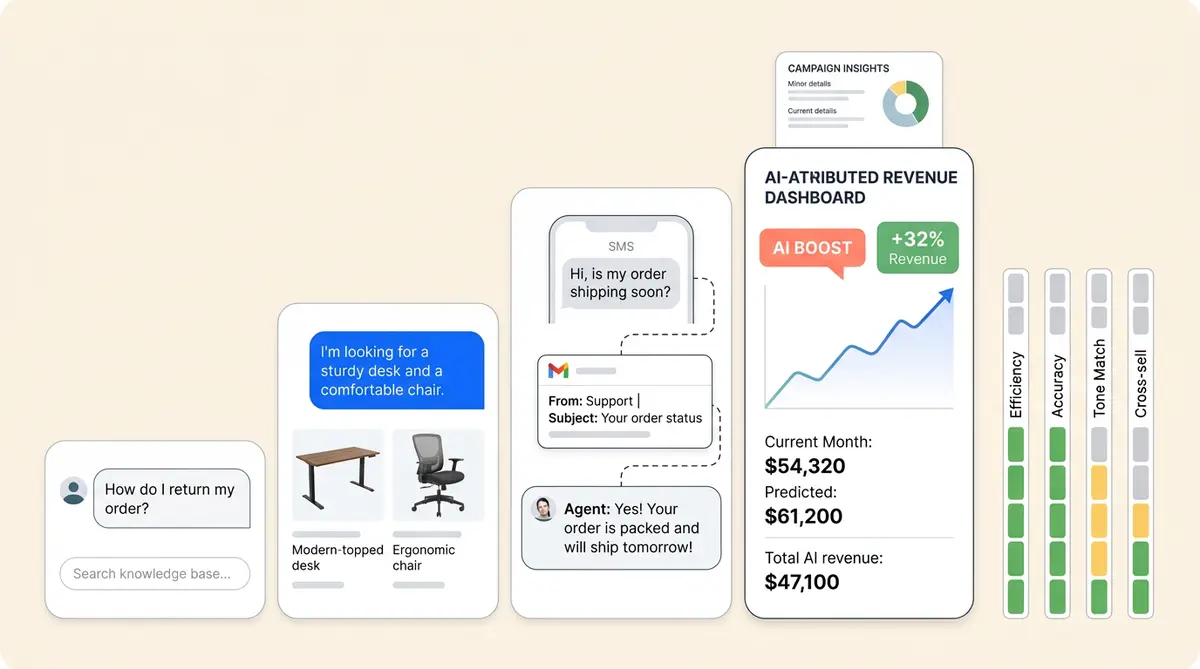
Measurement: AI-attributed revenue, conversion lift by engagement source, and AOV change for AI-assisted sessions are all tracked and reported.
Diagnostic signal: AI is a measurable revenue contributor, not just a cost reduction tool. You can tie specific conversations to purchases.
Stage 4: Agentic
Shopping intelligence: Agentic checkout that populates carts and pre-fills checkout from within conversations. Rich product cards with in-chat purchasing. Routine builders and outfit builders that drive multi-product carts.
Support automation: A full-service AI concierge handling complex workflows (subscription management, multi-step returns, warranty claims) autonomously across web chat, email, Instagram DMs, and WhatsApp.
Engagement strategy: 4 to 6% visitor engagement with channel-specific conversation flows. VIP recognition through unified memory. Personalized re-engagement based on past sessions, not just the current page view.
Measurement: Closed-loop revenue attribution connecting every AI conversation to purchases, with source-level analytics splitting performance by nudges, FAQs, and chat.
Diagnostic signal: AI drives 10%+ of total site revenue and influences conversion across every channel. Only about 5% of ecommerce brands operate at this level today, according to BCG's "future-built" segmentation.
Stage 5: Autonomous
Shopping intelligence: Predictive recommendations based on unified memory across sessions and channels. Proactive replenishment suggestions. AI-driven merchandising insights that inform product strategy itself.
Support automation: Self-improving from every interaction. Auto-generated FAQs, continuous knowledge base refinement, and declining escalation rates over time without manual intervention.
Engagement strategy: Adapts in real time to each visitor's behavior, intent, and history. Zero generic interactions. Every conversation is personalized from the first message.
Measurement: Predicts revenue impact and LTV influence, not just reports it. Your AI tells you what will happen, not just what happened.
Diagnostic signal: AI is an autonomous revenue engine that compounds its own performance over time.
Self-Assessment Checklist: Score Yourself Across Four Dimensions
Use these diagnostic questions to identify where your brand sits. Be honest. The value of this AI CX maturity model comes from accuracy, not optimism.
Shopping Intelligence
- Where does your AI source product knowledge? (Static database, live catalog sync, or real-time conversation context?)
- Can your AI guide a shopper through a multi-step product selection (skin type quiz, outfit match, technical spec comparison)?
- Does your AI populate carts or pre-fill checkout from within conversations?
Support Automation
- How many ticket categories does your AI resolve without human intervention?
- What's your current deflection rate? (Under 30% = Stage 1-2. Over 60% = Stage 3+.)
- Can your AI handle complex multi-step workflows like subscription changes or warranty claims?
Engagement Strategy
- What percentage of visitors engage with your AI? (Under 1% = Stage 1-2. Over 2% = Stage 3+.)
- Does your AI proactively reach out based on behavioral triggers, or does it wait for the customer to click?
- Are your AI conversations personalized by channel, page context, and customer history?
Measurement Sophistication
- Can you trace a specific AI conversation to a completed purchase?
- Do you track AI-attributed revenue as a distinct metric?
- Can you split performance by engagement source (nudge vs. FAQ vs. direct chat)?
If you want to quantify the revenue impact of moving up a stage, the Alhena AI ROI calculator can model the difference based on your current traffic and conversion rates.
How to Advance: Stage Transition Actions
Knowing your stage is only useful if you know what to do next. Here's the single most important action for each transition.
Stage 1 to 2: Deploy a commerce-connected AI with live catalog integration. Your AI needs real-time access to product data, inventory, and order information. Without this, it's just a glorified FAQ page. A platform like Alhena AI connects natively to Shopify, WooCommerce, and Salesforce Commerce Cloud, so your AI always reflects your actual catalog.
Stage 2 to 3: Add proactive engagement surfaces and hallucination prevention. Move from passive chat widgets to smart nudges on PDPs, cart pages, and high-exit pages. Ensure every AI response is grounded in verified product data so customers trust the recommendations. Start tracking AI-attributed revenue, not just deflection metrics. Our guide to AI shopping assistant KPIs covers what to measure at this stage.
Stage 3 to 4: Enable agentic actions and cross-channel deployment. Your AI should add items to cart, pre-fill checkout fields, and manage complex workflows without handing off to a human. Deploy across Instagram DMs, WhatsApp, and email with unified context. The Agentic Commerce Report details what this looks like in practice for DTC brands.
Stage 4 to 5: Implement continuous learning loops and predictive intelligence. Your AI should auto-generate new FAQ content from recurring conversations, flag knowledge gaps without manual review, and refine its own responses based on conversion outcomes. Alhena AI's architecture includes auto-generated FAQs, Guideline Studio, Conversation Debugger, and Smart Flagging that make this self-improvement cycle automatic.
How Alhena AI Accelerates Every Stage of the Maturity Model
Most platforms address one or two stages. Alhena AI is built to move brands through every transition.
Stage 1 to 2: Alhena deploys in under 48 hours with native integrations to Shopify, WooCommerce, and Salesforce Commerce Cloud. No dev resources needed. Your AI connects to your live catalog from day one.
Stage 2 to 3: Hallucination-free responses grounded in verified product data. Conversion Nudges and smart PDP FAQs turn passive visitors into engaged shoppers. Built-in revenue analytics let you see exactly which AI interactions drive purchases.
Stage 3 to 4: Agentic checkout populates carts and pre-fills checkout from within conversations. Vertical AI agents (Fit Analyzer, Skin Analyzer, Outfit Builder) handle specialized product guidance. Omnichannel deployment covers web chat, email, Instagram DMs, and WhatsApp with unified memory across every touchpoint.
Stage 4 to 5: Self-improving architecture with auto-generated FAQs that learn from every conversation. Guideline Studio gives you control over AI behavior without code. Conversation Debugger and Smart Flagging surface issues before they affect customers, making the AI compound its own intelligence over time.
Real results back this up. Tatcha reached 3x conversion rates and 11.4% of total site revenue from AI. Puffy achieved 63% automated inquiry resolution with 90% CSAT. Victoria Beckham saw a 20% AOV increase. These brands didn't start at Stage 4. They advanced one stage at a time with a platform designed for the full journey. Read their stories on the Alhena customer success page.
The Compounding Advantage Is Real
BCG's data shows that "future-built" companies (Stage 4-5 in our model) achieve 2x the revenue growth and 40% greater cost savings than laggards. That gap isn't closing. It's widening, because AI maturity compounds. Brands that reach Stage 4 generate data and learning loops that make their AI better every day, pulling further ahead of competitors still stuck at Stage 1 or 2.
The brands operating at Stage 4 and 5 didn't arrive overnight. They advanced one stage at a time, measured each step, and built advantages that are now nearly impossible for early-stage brands to close without accelerating their trajectory immediately.
Knowing your maturity stage is the first step. The State of AI Commerce 2026 report shows where the industry is headed. The question is whether your brand will lead or follow.
Ready to move up the maturity curve? Book a demo with Alhena AI to see where your brand stands today, or start for free with 25 conversations to test Stage 2 capabilities on your own store.
For a closer look at the operational and technical debt that accumulates at lower maturity stages, see our ecommerce AI maturity model breakdown with specific technology requirements and team structure implications at each level.
Wondering if your brand is even ready for AI? Start with these 7 key signs your business is ready for AI customer service before mapping your maturity stage.