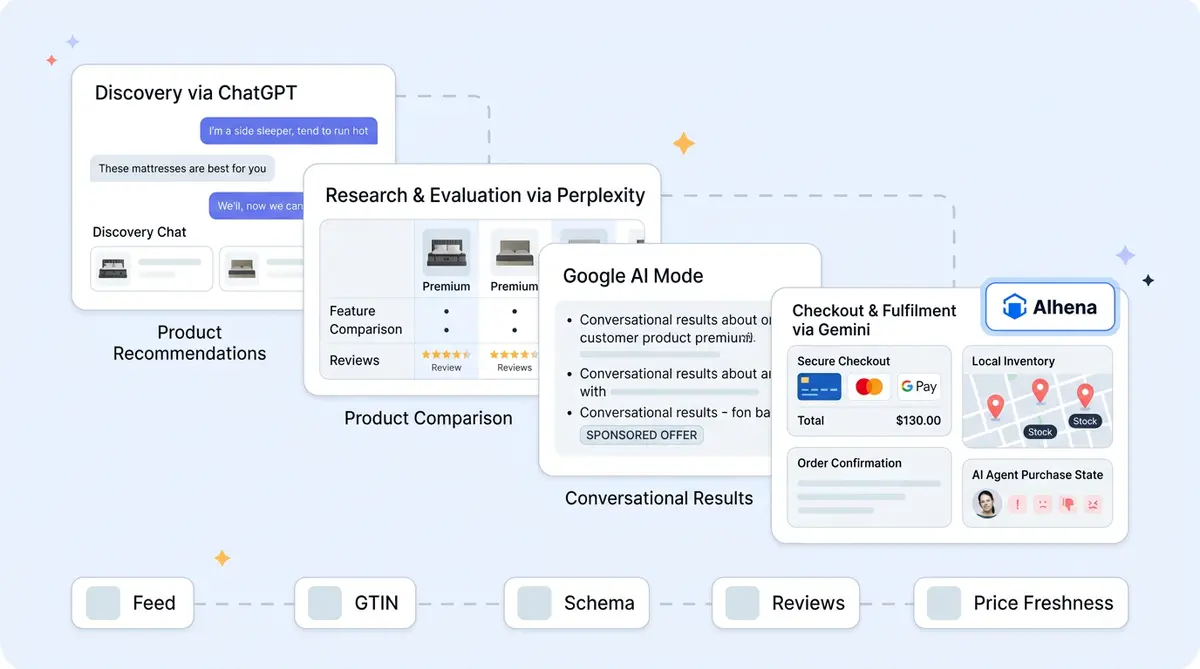
Getting listed on AI shopping platforms takes four separate applications. ChatGPT uses the Agentic Commerce Protocol, Perplexity requires its Merchant Program, and Google AI Mode and Gemini both read your Merchant Center feed. Shopify merchants can shortcut most of it with one admin toggle.
The hard part isn't the applications. It's that each platform reads product data differently, gives you different analytics, and changed its rules substantially during 2026.
This guide covers the current setup path for all four, what each feed actually requires, and how to track placement once you're live.
Google's Content API for Shopping shuts off on 18 August 2026. If your product feed still writes through it, your listings stop updating across Google Shopping, AI Mode and Gemini simultaneously. Migrating to the Merchant API is the single most urgent item on this page.
What changed across AI shopping platforms in 2026?
Three shifts that invalidate most guides written before March.
If you read a setup guide published in 2025, three things in it are now wrong.
- ChatGPT's in-chat checkout is gone. OpenAI discontinued Instant Checkout on 4 March 2026, saying the initial version didn't offer the flexibility it wanted. Roughly a dozen Shopify merchants had ever gone live. Purchases now redirect to your store, and OpenAI has refocused ChatGPT on product discovery.
- The 4% fee no longer applies the way it's usually quoted. That rate covered Shopify merchants using Instant Checkout. With checkout back on your own store, Shopify's agentic storefronts documentation lists no additional ChatGPT fee. Terms agreed with Etsy and Walmart were never made public.
- A second protocol arrived. Google and Shopify announced the Universal Commerce Protocol (UCP) in January 2026, covering the full commerce lifecycle across AI Mode and Gemini. Most brands will end up supporting both ACP and UCP — see our breakdown of ACP vs UCP vs MCP.
How do you get your products listed on each platform?
Four doors. Shopify merchants can skip through two of them.
| Platform | Where to apply | Feed format | Setup time |
|---|---|---|---|
| ChatGPT | chatgpt.com/merchants, or enable Agentic Storefronts in Shopify admin | ACP feed via API; auto-syndicated for Shopify | Minutes (Shopify) to weeks (direct) |
| Perplexity | Merchant Program application, plus business verification | CSV or XML via API, SFTP or S3 | 4–6 weeks |
| Google AI Mode | Already listed if you run Google Shopping | Google Merchant Center (Merchant API) | Immediate |
| Gemini | Same Merchant Center feed as AI Mode | Merchant Center + Schema.org markup | Immediate |
ChatGPT
Shopify merchants enable Agentic Storefronts from the admin, which syndicates the catalogue to ChatGPT, Google AI Mode, Gemini and Microsoft Copilot from one toggle. Everyone else applies at chatgpt.com/merchants and submits through ACP.
Required fields: title, description, price, availability, images, GTINs. Custom attributes like lifestyle tags aren't supported.
Perplexity
Two paths, and the difference matters. US Shopify stores can surface through auto-sync without joining the Merchant Program — but auto-sync only exposes whatever data quality you already have.
Joining the programme unlocks the merchant dashboard, API access and direct feed control. GTINs are mandatory; products without them don't appear. One operational catch worth planning for: Buy with Pro checkout runs through PayPal's Instant Buy, so those orders land in PayPal rather than your Shopify admin. Our full Perplexity merchant setup guide walks the application step by step.
Google AI Mode and Gemini
Both read your existing Merchant Center feed, so if you run Shopping campaigns you're already listed. The work is feed quality, not enrolment.
AI Mode rewards conversational attributes that standard Shopping feeds don't carry: answers to common product questions, compatible accessories, substitutes, and intended-use fields. Gemini adds account-level personalisation and reads Schema.org Product markup directly from your pages, so structured data matters beyond the feed itself.
What does it cost to sell through each platform?
Less than most 2025-era guides claim, because the fee landscape reset when in-chat checkout retreated.
| Platform | Listing fee | Transaction fee | Paid placement |
|---|---|---|---|
| ChatGPT | None | None on redirect traffic; the widely-quoted 4% applied to Shopify Instant Checkout, now discontinued | No |
| Perplexity | None | None — zero fees, zero commission | No |
| Google AI Mode | None | None | Yes — CPC via Google Ads, labelled sponsored |
| Gemini | None | None | Indirect, through linked Google surfaces |
Perplexity funds shopping through Pro subscriptions rather than merchant fees, and dropped advertising entirely in early 2026. For merchants, that makes it the lowest-risk channel to test — the only cost is preparing a clean feed.
Where does checkout actually happen?
This determines who owns the customer data and where your conversion optimisation work pays off.
| Platform | Checkout location | Who owns the order |
|---|---|---|
| ChatGPT | Redirects to your store | You, entirely |
| Perplexity | Hybrid — Buy with Pro in-platform, or redirect | You remain merchant of record; PayPal handles the transaction layer |
| Google AI Mode | Redirects to your product pages | You, entirely |
| Gemini | In-platform via Google Pay, including conditional purchases | Shared — Gemini can close the sale without a site visit |
Three of four route the shopper back to you. That's the strategic point: your storefront is still where AI-driven demand converts or doesn't, which is why on-site experience work outranks platform-hopping for most brands.
What analytics do you get from each platform?
Honestly? Not much, and this is the biggest operational gap.
| Platform | What you can see | What you can't |
|---|---|---|
| ChatGPT | Almost nothing native; UTM-tagged sessions in GA4 | Which prompts trigger your products, impression share, competitive position |
| Perplexity | Merchant dashboard: impressions, clicks, conversion by product | Prompt-level detail, competitor benchmarking |
| Google AI Mode | Google Ads and Search Console reporting, filterable | Full attribution — gaps remain as the surface rolls out |
| Gemini | Purchase data via Google Pay reporting | Any dedicated merchant dashboard |
Alhena AI Visibility closes this gap by monitoring rendering quality, recommendation frequency and competitive positioning across all four surfaces from one dashboard — so you can prioritise on measured performance rather than platform marketing claims.
Which platform should you set up first?
Sequence by where your data is already strongest, not by platform size.
Smaller teams should work this ladder in order rather than opening four workstreams at once. Each rung reuses the structured data from the one below it, so sequencing costs you almost nothing in lost time.
How do you tailor GEO strategy by engine?
Knowing the mechanics is step one. Deciding what to do differently per engine is harder, because each weighs different signals.
| Lever | ChatGPT | Gemini / AI Mode | Perplexity |
|---|---|---|---|
| Primary retrieval | Curated browse + ACP feed | Shopping Graph + Merchant Center | Live web retrieval per query |
| Highest-impact asset | Answer-first PDP copy and FAQs | Feed completeness + Product schema | Third-party citations and reviews |
| Recency sensitivity | Medium — hours for feed updates | Low to medium — feed cadence | Very high — live on every query |
| Where brands lose visibility | Thin PDP copy, buried answers | Feed gaps, missing GTINs or variants | Outdated third-party sources |
| Format that wins | Conversational Q&A on PDPs | Structured attributes, rich imagery | Expert reviews, editorial roundups |
For ChatGPT: answer first
Rewrite descriptions so sentence one answers the shopper's likely question. Add structured FAQ blocks to PDPs using buyers' actual phrasing.
For Google: feed hygiene is GEO hygiene
Audit GTIN coverage, clear Merchant Center disapprovals, fill in material, dimensions and colour variants. The same work serves Shopping and AI Mode.
For Perplexity: go off-site
It triangulates from expert reviews, forum threads and comparison sites. Your product pages rarely win alone — monitor which third-party sources mention you, and whether they're accurate.
For all four: convert the click
Discovery happens on the platform; conversion happens on your site. The Alhena AI Shopping Assistant picks up the conversation, delivering 3x conversions and 38% AOV uplift for Tatcha.
Why does maintaining four feeds get expensive?
Because you end up running Merchant Center for Google, CSV or XML exports for Perplexity, ACP for ChatGPT, and Schema.org markup for everything — four workflows for what should be one product data operation.
The fix is a single source of truth. Merchants who centralise product data, hold pricing and inventory accurate in real time, maintain complete GTIN coverage and invest in Schema.org markup build a base layer that performs across every AI surface at once.
Platform-specific optimisation only makes sense after that foundation exists. Before it, you're patching four symptoms of one problem.
Key takeaways
- Four platforms, four applications — but Shopify's Agentic Storefronts toggle covers ChatGPT, AI Mode, Gemini and Copilot in one step.
- Google AI Mode is the fastest start if you already run Shopping campaigns; your Merchant Center feed is already the data source.
- Migrate off the Content API before 18 August 2026 or your listings stop updating across every Google AI surface.
- Fees are lower than commonly quoted. Perplexity charges nothing; ChatGPT's 4% applied to a checkout feature that no longer exists.
- Three of four platforms redirect to your store, so on-site conversion work outperforms chasing platform placement.
- Native analytics are thin everywhere. Cross-platform visibility tooling is the only way to compare surfaces honestly.
See how your products render across all four
Alhena tracks recommendation frequency, rendering quality and competitive position from one dashboard.
Frequently asked questions
Each platform has a separate path. ChatGPT: apply at chatgpt.com/merchants or enable Agentic Storefronts in your Shopify admin. Perplexity: apply to the Merchant Program and pass business verification, then submit a feed by API, SFTP or S3. Google AI Mode and Gemini: both read your existing Google Merchant Center feed, so running Shopping campaigns means you're already listed. Shopify's Agentic Storefronts toggle covers ChatGPT, AI Mode, Gemini and Microsoft Copilot at once.
Not in the way it's usually quoted. The 4% service fee applied to Shopify merchants completing sales through Instant Checkout, which OpenAI discontinued on 4 March 2026. With purchases now redirecting to merchant storefronts, Shopify's agentic storefronts documentation lists no additional ChatGPT fee. Terms agreed separately with Etsy and Walmart were never disclosed publicly.
Your product feed stops updating. Because Google AI Mode and Gemini both read the same Merchant Center data as Shopping campaigns, a stalled feed removes you from all three surfaces simultaneously — pricing goes stale, out-of-stock items keep showing, and AI engines suppress listings with mismatches. Migrating to the Merchant API is the highest-urgency item for any merchant still on the legacy integration.
Not to appear. US-based Shopify stores can surface through Perplexity's auto-sync without joining the Merchant Program. But auto-sync only exposes your existing data quality — it doesn't give you the merchant dashboard, API access or direct feed controls. Joining unlocks those, plus Buy with Pro checkout. Note that Buy with Pro orders route through PayPal's Instant Buy rather than your Shopify admin.
ACP (Agentic Commerce Protocol) is OpenAI and Stripe's standard, live in ChatGPT since September 2025, focused on catalog ingestion and agent-initiated checkout. UCP (Universal Commerce Protocol) is Google and Shopify's coalition-backed standard announced in January 2026, covering the full commerce lifecycle across AI Mode and Gemini and supporting REST, MCP and A2A transports. Most brands will need both, since they serve different discovery surfaces.
At minimum: real-time accurate pricing, complete GTIN or UPC coverage (mandatory for Perplexity), Schema.org JSON-LD Product markup, high-resolution images, and authentic customer reviews. Beyond the minimum, Google AI Mode rewards conversational attributes — product Q&A, compatible accessories, substitutes and intended-use fields — that standard Shopping feeds don't carry.
ChatGPT and Google AI Mode both redirect shoppers to your store, so you own the transaction and the customer data entirely. Perplexity is hybrid — Buy with Pro processes in-platform via PayPal while you remain merchant of record. Gemini goes furthest, completing purchases with Google Pay in-conversation, including conditional purchases triggered by price drops.
No. Sequence them: start with Google AI Mode if you already run Shopping campaigns, add Perplexity next if you sell premium or high-consideration products, layer in ChatGPT when you're ready for discovery scale, and monitor Gemini rather than optimising for it. Each step reuses structured data built in the previous one, so sequencing costs almost no time compared with running four workstreams in parallel.
Native reporting is limited everywhere. ChatGPT offers essentially none, so UTM-tagged links and GA4 are your baseline. Perplexity's merchant dashboard shows impressions, clicks and conversion by product. Google AI Mode reports through Google Ads and Search Console. Gemini surfaces purchase data via Google Pay only. Alhena AI Visibility consolidates rendering quality, recommendation frequency and competitive position across all four in one place.