What Changes After a Product Data Fix? A 90-Day AI Visibility Test
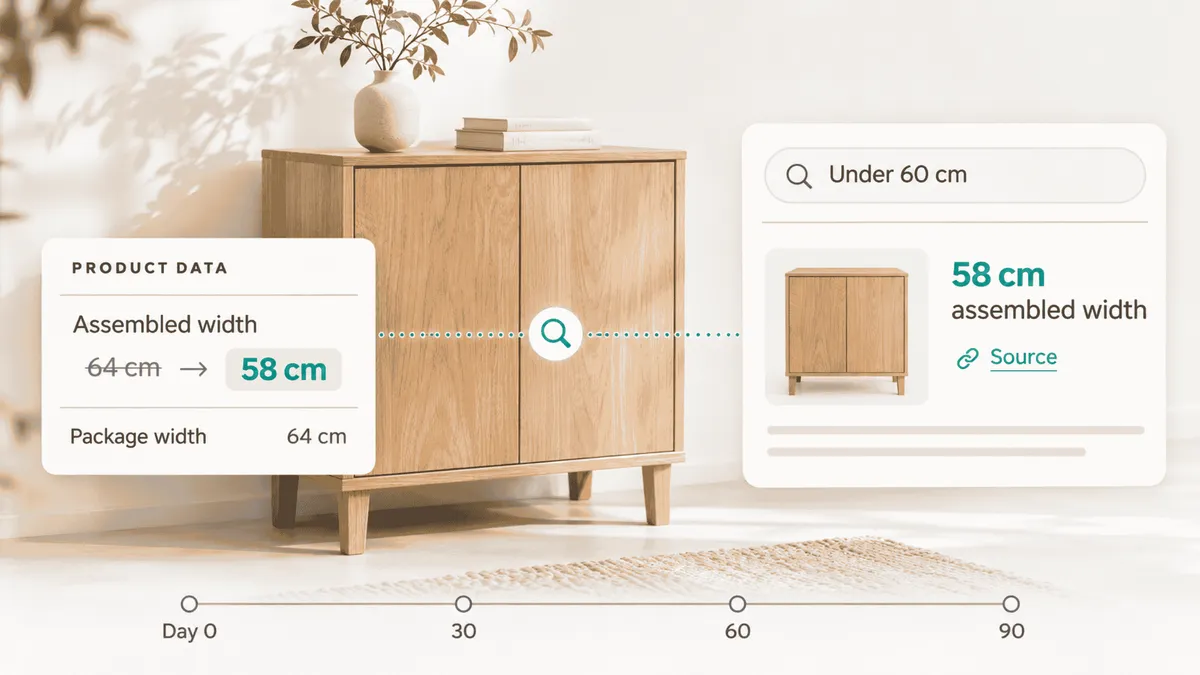
Imagine a cabinet that is 58 cm wide. Its product page lists 64 cm, the width of the shipping box. A shopper asks an AI assistant for a cabinet under 60 cm wide. Your product meets that requirement, but the published specification gives the assistant a reason to leave it out.
Your merchandising team catches the mistake. Someone corrects the page, checks the feed and closes the ticket.
The shopper’s question is still out there. What happens the next time someone asks it?
That is the question a useful AI visibility case study should answer. For an ecommerce brand, the work starts with an accurate product fact and follows it into the recommendations, explanations and sources that shoppers see.
To measure a product data fix, record a baseline before publication, repeat the same shopping questions after the change, and track product mentions, supporting citations, and factual accuracy separately. Review the results over defined periods, with comparison products and a record of other changes.
The cabinet is a hypothetical example. This article sets out a 90-day study framework; it does not report completed customer results. Ninety days gives the team a defined observation window, without promising when any search engine will reflect a correction.
What should a product data fix improve?
A corrected field has an immediate benefit: your page gives shoppers better information. Whether that correction changes an AI-generated answer is a separate question.
Generative engine optimization, or GEO, concerns how a brand and its products appear in answers from an AI search engine. A useful study connects that visibility to product discovery: can a shopper find a suitable item and understand why it fits the request?
In the cabinet example, several outcomes are possible. The assistant could continue using the old width. It could state the new width but recommend the wrong variant. It could cite the updated page while repeating the original mistake. It could also give a correct answer without linking to your site.
Each outcome points to a different next step. A single visibility score would struggle to explain all of them.
For this study, define success around a specific buying decision: does the answer use the verified product fact correctly when assessing the shopper’s requirement?
That keeps the work connected to merchandising and customer experience. The target is a recommendation the product can justify, giving the brand a useful test of its discovery strategy.
The broader work of GEO for ecommerce includes investigating what AI systems cite. A product correction study narrows that question to one documented change and what follows it.
Start with a correction you can prove
Choose an attribute with a clear source of truth. Dimensions, material composition, care instructions and model compatibility can work well for a first study because the expected answer can be checked.
For example, a skincare brand might correct a 30 ml versus 50 ml variant mismatch. A footwear retailer might clarify the upper material of a running shoe. Each change gives the team a specific fact to test.
Here, content quality means a precise fact, a clear label, the correct variant and evidence the team can verify. A longer product description is useful only when it resolves a relevant buying question.
Price and availability deserve their own freshness tests. Their underlying values can change repeatedly during a 90-day window, making it harder to follow one correction.
For the hypothetical cabinet, the intervention would be to distinguish assembled width from package width everywhere that field is published.
| Item to document | Illustrative record |
|---|---|
| Original problem | Shipping-box width was presented as product width |
| Verified product fact | The selected cabinet variant is 58 cm wide when assembled |
| Separate shipping fact | Its shipping box is 64 cm wide |
| Public correction | Label both measurements clearly and apply them to the correct variant |
| Evidence to retain | Approved specification, previous page version, revised page version and publication time |
The page might now say: “This cabinet is 58 cm wide when assembled. The shipping box is 64 cm wide.”
That wording answers the width question. It does not establish that the cabinet will fit every space: height, depth, door clearance and installation requirements may still matter. Keep those boundaries visible wherever they affect the buying decision.
Give merchandising responsibility for approving the fact, engineering responsibility for publishing it consistently, and an SEO or analytics owner responsibility for the measurement record.
Before launch, use a product data contract to define the attribute’s meaning, scope and source across systems. That gives the study an agreed version of the fact it is testing.
Also keep the intervention interpretable. If the team changes the specification, rewrites every description and launches a review campaign together, the study evaluates that combined effort. Document it accordingly.
Build the baseline before the 90 days begin
Collect observations before publishing the change. Two weeks is a practical starting point for planning; a volatile or lightly sampled prompt set may need longer. It is a proposed schedule, not a statistical minimum.
Use that period to find out how often the problem occurs and whether your measurement process can detect it reliably.
Choose questions that require the corrected fact
Build the prompt set from actual buying questions in search logs, customer conversations and support tickets. Match the shopper’s intent: discovering an item, comparing options or checking a specification. Keep individual customers’ personal information out of the questions.
The cabinet example needs several kinds of questions:
| Question type | Illustrative prompt | What it tests |
|---|---|---|
| Product discovery | “Suggest storage cabinets less than 60 cm wide.” | Whether an eligible product is discovered without its name in the question |
| Direct fact check | “What is the assembled width of [product and variant]?” | Whether the corrected fact is reported accurately |
| Comparison | “Which is narrower when assembled, [product A] or [product B]?” | Whether the answer compares equivalent measurements |
| Suitability limit | “Is [product and variant] less than 55 cm wide?” | Whether the assistant correctly rejects an unsuitable option |
Separate branded questions, which name your brand or product, from unbranded queries. A correct answer after you supply a product name tells you something different from the product appearing in an open shopping search.
Freeze the core questions before deployment. If new questions emerge later, track them in a separate exploratory set so the original comparison remains meaningful.
Repeat the questions under consistent conditions
Choose the AI platforms relevant to your shoppers, such as ChatGPT, Google Gemini and Perplexity. Include Claude or Microsoft Copilot if they matter to your market and you can observe the intended experience consistently. Define this coverage before starting the case study.
Record the exact search experience, language, market, account conditions and collection method. Include the AI model label when it is visible. A large language model, or LLM, name alone does not describe the search settings or sources available during the test.
Start fresh conversations and keep settings consistent. Treat Google’s AI Overviews and AI Mode as separate experiences, and distinguish a consumer interface from an API-based test.
Google’s AI features documentation explains that AI Overviews and AI Mode can use different models and techniques. It also says that AI overviews often do not appear. A combined “Google AI” score can conceal those differences.
Choose a repeatable schedule before launch, such as several fresh runs per prompt on fixed days each week. The appropriate volume depends on answer variability, the size of the change you need to detect and the team’s collection capacity.
The April 2026 research preprint Don’t Measure Once: Measuring Visibility in AI Search found variation across repeated runs and time. It supports repeated measurement, without establishing a universal sample size for every ecommerce category.
Preserve the full answer and cited URLs for each run, plus a dated copy or relevant excerpt of the sources used to judge the tested fact. Otherwise, a later page edit could change how an earlier answer is scored. Keep the expected fact and scoring decision alongside the evidence so a second person can review it.
Select comparison products
Track similar products that are outside the intervention. Match them as closely as practical on category, commercial relevance and baseline visibility. Use pages that already contain accurate information; correct known errors when you find them.
Log anything that could affect both groups, including a template update, feed change, promotion or stock movement. Include PR campaigns, new buying guides, review-site coverage, backlinks and marketplace updates in the same timeline. Check whether new sources appear in the recorded answers.
If a shared change reaches the comparison products, record that exposure. They may no longer provide a useful comparison for isolating the original fix. A Black Friday promotion, for example, belongs in the log even if the specification itself stays unchanged.
Days 1 to 30: Check whether the corrected fact reaches the answer
Start the follow-up clock when the correction is publicly available. First verify the live implementation for the intended SKU, variant and market.
Read the page as a shopper would. A corrected product description with an old specification still embedded elsewhere leaves conflicting information available.
Complete the technical SEO checks
Confirm that the fact is available as readable text, the page is accessible to the intended crawler and relevant internal links lead to it. For Google’s AI features, the page must be indexed and eligible for a search snippet. The observed answers show whether the page is cited and the corrected fact is represented accurately.
Inspect schema markup and relevant feed fields for the same variant. Google’s guidance on content for AI search experiences says structured data should match visible page content.
Google’s Product structured data guidance explains how product markup supports richer search appearances and how variant markup helps distinguish related products. Use supported fields accurately, while keeping the readable page clear about the same facts.
On Shopify, check the product record, rendered theme and connected feeds. The Shopify GEO guide explains these implementation checks. Keep traditional keyword rankings and organic search performance alongside the study, with separate measures for what appears inside generated answers.
Review the answer and its source
Then review the scheduled AI answers. Look for the new value, the correct measurement label and the right variant. Open the cited source to check whether it supports the statement.
For the cabinet, an answer that gives “58 cm” but labels it as package width still fails. So does an answer that applies the measurement to another model.
Record the first observed correct answer. Its timestamp tells you when your test first saw the correction reflected. It cannot tell you the exact moment an engine updated its information, and one correct answer does not establish that subsequent answers will remain correct.
Keep collecting the full set, including unchanged answers. Those are often the most useful clues about where the old fact is still circulating.
Days 31 to 60: Look for persistence across questions and sources
Continue the original schedule and question set. The useful question now is whether the improvement survives repeated observation.
Use the pattern in the answers to decide what to investigate next.
| Observed pattern | What to investigate |
|---|---|
| Direct answers become more accurate, but discovery stays flat | Whether the product appears in questions that do not name it |
| Citations rise while specification errors persist | Whether the cited source supports the exact variant and measurement |
| Older third-party pages remain the main sources | Whether retailer listings, marketplaces or review sites still publish the superseded fact |
| Corrected and comparison products improve together | AI engine changes, shared site updates, PR activity or market conditions affecting both groups |
A citation-worthy ecommerce product knowledge base connects product claims to public evidence. Apply the same scrutiny to the links inside the AI answer: does this source support this fact for this product?
If a second correction becomes necessary, make it and record the date. Keep results from the two versions distinguishable. The study should reflect what the team actually changed.
Days 61 to 90: Measure useful visibility
By the final month, the report should explain the relationship between product appearance and answer quality.
Use measures that answer distinct questions. These proposed study KPIs help an ecommerce business separate exposure from accuracy. They are not presented as existing Alhena dashboard metrics.
| Study measure | Calculation | What it helps explain |
|---|---|---|
| Product mention rate | Completed tests naming the target product, divided by completed tests | How often the product appears, including mentions that may reject it |
| Direct citation rate | Completed tests linking to the corrected page or a predefined evidence page, divided by completed tests | How often those pages appear as sources |
| Correct cited-answer rate | Completed tests that identify the product, state the tested fact correctly and cite a source supporting it, divided by completed tests | Whether a verifiable product fact reaches the answer |
| Inappropriate recommendation rate | Completed suitability-limit tests that recommend the product despite a disqualifying fact, divided by completed suitability-limit tests | Whether the answer still recommends a product that cannot meet the tested requirement |
Express each rate as a percentage, with the underlying counts beside it. Score a product once per answer for these measures, even if its name appears several times.
Keep a separate label for correct answers without citations. They may help a shopper, but they do not meet the definition of a correct cited answer.
Add competitive share of voice when useful
For this case study, one optional definition of share of voice is your brand’s counted appearances divided by all counted brand appearances in a fixed set of discovery questions. Count each brand once per answer and state which competitors are included.
Keep that group consistent, or flag any change to it. This measure describes relative exposure within the tested questions, not market share. A brand can gain ground on a competitor while its answers still contain specification errors, so retain the accuracy measures beside it.
If no brands appear in the tested answers, mark this measure as unavailable. Read it alongside the all-search product mention rate so unanswered searches remain visible.
Define what goes into the denominator
For an all-search visibility measure, a completed search that produces no AI answer counts as no AI visibility. Report technical failures and timeouts separately as missing observations. Include completed and attempted run counts so missing data stays visible.
If you also report visibility only among searches that generated an AI answer, name that measure explicitly and show how often the AI feature appeared. Otherwise, a change in the denominator can look like an improvement in product performance.
For suitability-limit questions, also report the share of completed tests that correctly reject the product or provide a verified suitable alternative. Show how often there is no usable answer. Fewer inappropriate recommendations alone could reflect more unanswered questions.
Compare periods using the same rules
Report the baseline and the three follow-up windows: days 1 to 30, 31 to 60 and 61 to 90. Use all scheduled observations within each window, with the same definitions throughout.
Show results by AI platform, search experience and question type. If you create a combined score, keep the weighting consistent so a higher number of completed tests on one engine does not quietly change the comparison.
Include percentage-point changes and the underlying counts. Where the sample supports an uncertainty estimate, account for repeated observations of the same prompts and products. Hundreds of runs of a few questions do not represent hundreds of independent shoppers.
Alhena’s AI visibility methodology distinguishes appearance frequency from position and describes the limits of its measurements. That distinction is useful here: an improvement in how often a product appears still needs a separate check on whether the answer is accurate.
Check suitable and unsuitable requests
Return to the cabinet. At 58 cm wide, it meets a request for a cabinet under 60 cm. It cannot meet a request for one under 55 cm.
The under-55 cm question is a check against over-recommendation. Both the original and corrected widths rule the cabinet out. A useful answer should explain that it is too wide or suggest a verified suitable alternative.
Other corrections can legitimately reduce recommendations. If updated compatibility information establishes that an accessory does not support a particular device, the assistant should stop recommending that combination.
This is why the study includes suitability-limit questions. Product data and AI citations matter because shoppers use those answers to make decisions. For customer experience teams, an accurate rejection can be useful evidence that a known suitability problem is being handled correctly. Evaluate suitable recommendations and correct exclusions separately, with unanswered tests visible in both.
Keep the outcome precise. The study can show fewer unsuitable recommendations in its tested prompts. A claim about fewer returns would require return data and a separate analysis.
Connect the findings to traffic and purchases carefully
The visibility study measures observed AI answers. Your analytics system measures a different part of the journey: visits and what happens after them.
Use acquisition reporting to track identifiable AI referral sessions, landing pages, purchases and revenue alongside the study. Keep the reporting rules stable, and record changes to collection or attribution settings.
Define the conversion metrics before comparing periods. For this report, purchase conversion rate can mean sessions containing at least one purchase divided by eligible sessions. State which sessions qualify. If order value matters, calculate average order value (AOV) from consistently defined order revenue and order counts.
The guide to tracking AI search traffic in GA4 covers source validation and ecommerce reporting. Use it to build the commercial view alongside the answer-level evidence.
Avoid assuming that every citation produced a visit, or that every measured visit can be traced to one of the prompts in your test. The datasets will usually answer different questions.
A rise in conversion rate among referred visitors is an observed commercial outcome. To connect it to the product correction, check which pages those visitors reached and whether the changed fact was relevant to their buying decision. More purchases alone do not demonstrate improved answer accuracy.
If revenue rises during the study, examine promotions, seasonality, availability and other activity before attributing the movement to the correction. “Visibility improved after the update” describes an observed sequence. Establishing that the update caused the improvement requires a design that can credibly rule out alternative explanations.
What a publishable ecommerce GEO case study should show
A useful GEO case study for ecommerce lets another team inspect the evidence and understand what the result means for its own catalog.
Publish the study dates, affected products, original error, approved correction and measurement method. Include the question categories, search experiences, completed run counts and results for every reporting window.
Show examples that explain the finding: a corrected answer, a persistent mistake and an unchanged answer where relevant. Keep the comparison-product results and other changes during the period visible. Readers of case studies should be able to distinguish one specification fix from a wider content optimization program.
If the correction produces no measurable movement within 90 days, say so. The product page may be more accurate while the measured AI responses remain unchanged. That is a valid finding and a reason to investigate retrieval, competing sources or the relevance of the tested questions.
The result should leave the team with a concrete decision. Expand the correction to a wider cohort, resolve a remaining source conflict, improve the measurement process, or continue observing because the evidence is still inconclusive.
How Alhena AI supports this work
Alhena AI Visibility helps ecommerce brands monitor how products appear in AI-generated shopping answers and identify product-page improvements. Its published capabilities include SKU-level tracking and recommendations for product Q&A content.
For a correction study, use those observations to identify products worth examining and the questions worth tracking. Pair them with the approved specification, change log and factual review described above. Check that the available monitoring cadence and search coverage match the study you intend to run.
The definition of success still belongs to the team. For one product, it may be a more accurate compatibility explanation. For another, it may be discovery in a previously missed use case or fewer recommendations for an unsuitable one. The same review can give customer experience teams a clearer record of which buying questions still need attention.
Explore Alhena AI Visibility to identify product-level gaps and establish a baseline for your next catalog improvement.
Frequently asked questions
What is a GEO case study for ecommerce?
A GEO case study for ecommerce documents a change intended to improve how products appear in generated shopping answers, then reports what happened. A useful study includes a baseline, dated changes, repeated observations, clear metrics and limitations. It distinguishes product visibility from citations, answer accuracy and sales.
How can product data affect AI citations?
Clear, accurate product data gives a source page information that can support an AI answer. Whether the page is retrieved and cited must be measured. A citation also needs inspection: linking to a product page does not establish that the answer used its specifications correctly.
Which AI platforms should an ecommerce brand track?
Choose services relevant to your shoppers and the search experiences you can test consistently. ChatGPT and Perplexity may be part of that set, but keep each interface, market and question group distinct. Check that any AI tool you use covers the selected experiences at the required frequency.
Does Product schema guarantee visibility in AI search?
No. Product structured data can support Google’s understanding and search appearances, but it does not guarantee an AI citation. Google’s AI features guidance says that established SEO practices remain relevant and that no special AI schema is required.
Is 90 days enough to prove a product data fix worked?
Ninety days is a practical observation window. The strength of the conclusion depends on the baseline, repeated measurements, answer variability and other changes during the study. A positive result over 90 days does not, by itself, establish causation or guarantee the result will persist.
Can AI visibility improve while product recommendations fall?
Recommendation quality can improve while recommendation frequency falls. Corrected compatibility or sizing information may appropriately rule a product out. Report that as a quality improvement in the tested scenarios, alongside the change in visibility.
How is an AI visibility case study different from an AI revenue case study?
An AI visibility case study examines whether and how products appear in AI-generated answers. A revenue study examines commercial outcomes, including conversion and attributed purchases. Linking the two requires validated referral and purchase measurement, plus a method for assessing other reasons sales may have changed.
Can we run PR activity during the study?
Yes. Record PR publication dates and check whether the new coverage appears among the cited sources. Overlapping changes limit what can be attributed to the product fix alone. Describe the combined work accurately when reporting the result.
Does this framework work for Shopify stores?
Yes. Use the same questions, scoring rules and observation windows. In Shopify, verify the corrected product and variant fields, the live page and relevant feed destinations. The storefront implementation may differ across businesses; the need for a consistent test remains the same.
Questions this guide answers
- How do you measure whether a product data fix improves AI visibility?
- What should a credible GEO case study for ecommerce include?
- Which product attributes should a brand correct and test first?
- How do you establish a baseline before a 90-day study?
- Which AI platforms and search settings should you include?
- What should you measure during days 1 to 30, 31 to 60 and 61 to 90?
- How do product mentions, website citations and correct answers differ?
- How can you compare your brand’s share of voice with competitors?
- How do PR campaigns and other changes affect the findings?
- Can better product information reduce unsuitable recommendations?
- How should referral visits, conversion rate and revenue be measured?
- How can Shopify stores use this framework, and where does Alhena AI help?