How to Build a Citation-Worthy Ecommerce Product Knowledge Base
A practical framework for connecting product facts, supporting evidence, and public answers.
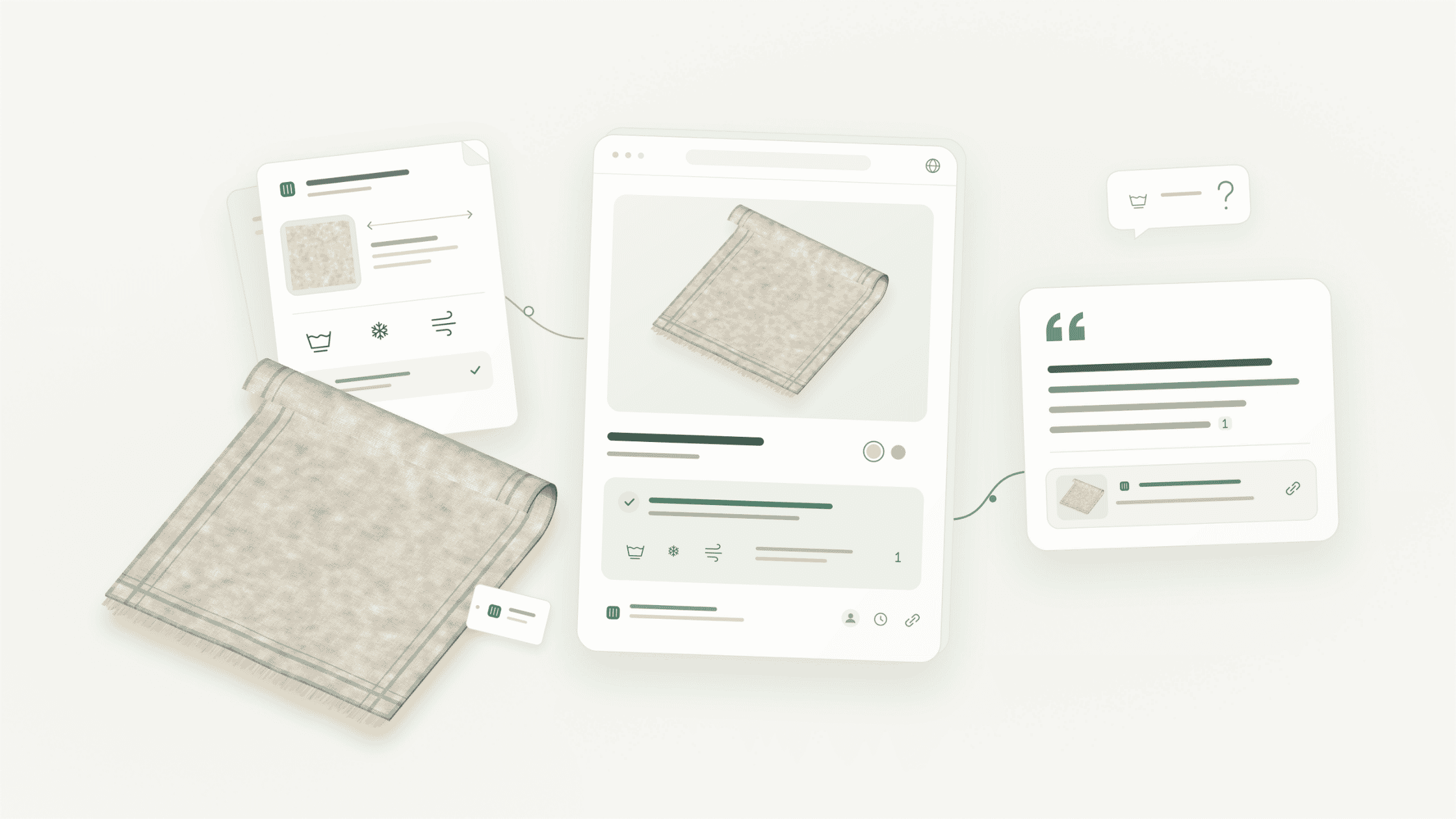
A shopper asks an AI search engine whether a rug can go in the washing machine. The product page calls it "easy to care for." A care guide elsewhere on the site recommends professional cleaning. A customer review says they've machine-washed theirs three times without trouble.
The brand has plenty of information about this rug. What it doesn't have is one answer anyone can check. Which instructions apply to this exact material and size? Which source is current? What should the shopper rely on, and what should an AI system summarizing the web on their behalf repeat?
This is where a lot of ecommerce content quietly falls short in AI search. The facts usually exist somewhere: a spec sheet, a supplier PDF, a merchandiser's inbox. They just aren't tied to the question, scoped to the right variant, or published where anyone outside the company can find them.
This guide shows how to fix that with a product knowledge base built on evidence. You'll get a copyable evidence template, a worked example, a simple rule for where each answer should live, and a small pilot for checking how your answers appear in AI search.
The short answer
A citation-worthy ecommerce product knowledge base ties each important product claim to supporting evidence, defines exactly which product and conditions it covers, assigns an owner, and publishes the approved answer on a public page. Start with real purchase questions, verify the answers, publish them where shoppers and search systems can reach them, then monitor how AI engines use them.
What makes a product knowledge base citation-worthy?
An ecommerce product knowledge base is an organized collection of product facts, usage guidance, limitations, and the sources behind them. It becomes citation-worthy when that information is turned into accurate, specific, publicly accessible answers that a shopper or an AI search system can verify.
In practice, a citation-worthy answer has five qualities:
| Quality | What it means | What it looks like in practice |
|---|---|---|
| Specific | The answer names the product, variant, and market it applies to. | "The 120 × 180 cm cotton version," not "our rugs" |
| Supported | The claim rests on an appropriate source. | A spec sheet, care label, test report, or certification |
| Clear | Conditions and exceptions sit right next to the answer. | "Cold, gentle cycle; air-dry only" in the same sentence |
| Current | Someone owns its accuracy and knows when to review it. | A named owner and a defined review trigger |
| Accessible | The approved version lives on a public page search systems can read. | Plain text on a product page or linked guide, not a gated PDF |
One caution before going further. "Citation-worthy" describes the quality of your content, not a guaranteed outcome. Google states that its AI features rely on the same SEO foundations as the rest of Search, need no special AI-specific markup, and don't guarantee inclusion (Google Search Central: AI features and your website).
ChatGPT, Gemini, Perplexity, and other engines make their own retrieval decisions too. What you control is whether your page holds the clearest, best-supported answer available when they go looking.
Start with the purchase questions your product content must answer
Don't start with the whole catalog. Start with a small group of commercially important products, such as bestsellers, high-consideration items, and products with stubborn return rates, then collect the questions that decide whether someone buys.
The best questions are about suitability. They sound like this:
- Apparel: "Does this fit true to size, and which measurements support that advice?"
- Furniture: "Will the assembled sofa fit through a 76 cm doorway?"
- Electronics: "Is this charger compatible with my exact phone model?"
- Homewares: "Do the care instructions change by material or size?"
Prioritize the questions that stand between a shopper and a confident decision. "What inspired this collection?" can wait. "Will this fit my car seat?" can't.
You'll find these questions in support tickets, chat transcripts, product Q&A, review text, return reasons, and on-site search logs. Store associates and customer service agents often know the top five by heart.
Keep one distinction firm as you collect them. Customer questions tell you where information is needed. Approved product sources tell you what the answer is. If hundreds of shoppers believe a jacket runs small, that's a reason to check the size chart, not proof that the jacket runs small.
For brands using the Alhena AI Shopping Assistant, on-site conversations are a useful input here because they capture questions in shoppers' own words. Those questions can also shape the prompts you track in Alhena AI Visibility, an approach described in how Alhena measures AI visibility.
Build a product evidence record for every important claim
The heart of a citation-worthy knowledge base is the product evidence record: one entry per important product question or claim, linked to the exact SKU or variant it covers. Here are the fields to include.
| Field | What to record | Why it matters |
|---|---|---|
| Product identity | Product name, SKU, variant, and manufacturer identifier (GTIN or MPN) where relevant | Answers drift when they attach to a product family instead of a specific item |
| Shopper question | The exact purchase question, in the shopper's words | Keeps the record tied to real demand |
| Approved answer | Clear wording the brand can substantiate | This is the text that gets published |
| Supporting source | Manufacturer specification, care instructions, test report, certification, or another appropriate record | Lets anyone retrace how the claim was reached |
| Scope and exceptions | Sizes, materials, models, regions, conditions, and exclusions | Stops a true answer from being applied to the wrong variant |
| Verification | Reviewer, accountable owner, source version, and last verified date | Shows the answer was checked, by whom, and against what |
| Public destination | The URL where shoppers and search systems can find the answer | An internal fact can't be cited from outside |
| Update trigger | The change that would require a fresh review | Turns maintenance into an event, not a guess |
Every important product answer should have a source, a scope, an owner, and a public destination.
You don't need new software to start. A shared spreadsheet is enough for a pilot, and many teams later move these fields into their PIM or content system. To be clear, "product evidence record" is an editorial workflow recommended in this guide, not the name of a built-in Alhena feature.
Copy this header row into a spreadsheet to get going:
product_name,sku,variant,manufacturer_id,shopper_question,approved_answer,supporting_source,source_version,scope_and_exceptions,reviewer,owner,last_verified,public_url,update_triggerThree writing habits make the approved answer far more useful:
- Write it to stand alone. If someone quotes only that sentence, it should still name the product and the conditions.
- Keep the exception close. Put it in the same sentence or the next one, never in a footnote.
- Claim only what the source supports. If the test covered 30 wash cycles, say 30 wash cycles, not "lasts for years."
For techniques on structuring text so retrieval systems can use it, see how to write documentation AI agents can actually use. This guide stays focused on the evidence underneath that writing.
A worked example: from vague copy to a verifiable answer
Let's go back to the rug. This is an illustrative example; the product, SKU, and details are fictional.
Original product copy: "An easy-care rug designed for busy homes."
Shopper's question: "Can I machine-wash the 120 × 180 cm cotton version?"
Verified answer: "The Rowan cotton rug in 120 × 180 cm (SKU ROW-C120) can be machine-washed on a cold, gentle cycle and air-dried. These instructions apply to this cotton variant only."
Here is the evidence record behind that answer:
| Field | Entry |
|---|---|
| Product identity | Rowan rug, cotton, 120 × 180 cm, SKU ROW-C120 |
| Shopper question | "Can I machine-wash the 120 × 180 cm cotton version?" |
| Approved answer | Machine-wash cold on a gentle cycle; air-dry. Applies to this cotton variant only. |
| Supporting source | Approved care instructions, version 3 |
| Scope and exceptions | Cotton, 120 × 180 cm. Other sizes and materials are checked against their own care instructions. |
| Verification | Owner: product merchandising. Checked against care instructions v3. |
| Public destination | The ROW-C120 variant's product page and the linked Rowan care guide |
| Update trigger | Any change to material, construction, backing, or care instructions |
The original line isn't false. It's just unhelpful, because "easy care" means something different to every reader. The verified answer names the product, size, material, and conditions, so nobody has to infer them.
It also gives the brand a traceable basis for the wording. If the supplier changes the rug's backing next season, the update trigger tells you exactly which answer to revisit.
Notice what the record does not do: it doesn't assume every Rowan variant shares the same instructions. That assumption is exactly the ambiguity this process is meant to remove.
The example also resolves the conflicting sources from the opening. The care guide recommending professional cleaning either covers a different variant, in which case the page should say so, or it's out of date and needs correcting. The customer review stays as it is. It's a valid account of one person's experience, but it isn't the brand's claim, so it shouldn't be the evidence behind one.
Decide where each answer belongs
Your knowledge base has two layers, and they do different jobs.
Internal records hold the source documents, approvals, revision history, and anything sensitive, such as supplier contracts or raw lab data. Public pages carry the approved answers that shoppers and external search systems can read.
For the public layer, match each type of answer to its natural home:
| Type of answer | Where it belongs |
|---|---|
| Product-specific facts and limitations | The product detail page for that product or variant |
| Detailed sizing, installation, compatibility, or care instructions | A dedicated guide, linked from the product page |
| Shipping, warranty, and returns terms | The current policy page, with product-level exceptions noted on the product page |
| Side-by-side comparisons | A comparison page, when shoppers genuinely weigh those options |
One point deserves a sentence of its own: adding a document to an internal AI knowledge base does not, by itself, publish that document for external AI search. Your on-site assistant may answer perfectly from a PDF that ChatGPT, Gemini, and Google's AI features can never see.
Published answers should appear as meaningful text, not only inside images or downloads. They should be linked from relevant pages and consistent with any structured data on the page. Google recommends exactly these practices for its AI features (Google Search Central).
Structured data should mirror what's visible on the page, never say more. For the attributes themselves, see 6 product data fields that make or break AI visibility. For Q&A blocks, see turning product FAQs into AI search rankings. If you're reworking the page layout, the PDP optimization checklist covers it. The evidence record is the layer underneath all three: it decides what the page is allowed to say.
Assign responsibility for the evidence
Product evidence touches several teams, so it helps to agree up front who does what:
| Team | Responsibility |
|---|---|
| Merchandising or product | Confirms specifications, variants, and intended uses |
| Customer experience (CX) | Surfaces recurring questions and answers that confuse shoppers |
| Subject experts (technical, safety, regulatory, materials) | Validate claims that need specialist review |
| Content and SEO | Turn approved information into useful public pages |
| Engineering or ecommerce operations | Keep the page, product feed, and structured data consistent |
Shared input is healthy, but each record still needs one accountable owner. When a record belongs to everyone, nobody notices when it goes stale.
The owner doesn't need a calendar reminder so much as clear triggers. Review a record when any of these happen:
- A material, formula, or construction change
- A new model version, or a supplier or factory switch
- Revised instructions, certifications, or test results
- Launch in a new market or language
- A new policy exception for that product
- A sudden rise in a specific question or return reason
For the routines that keep a knowledge base healthy week to week, see AI knowledge base ops for ecommerce teams.
Where Alhena fits
Alhena helps ecommerce teams connect the questions shoppers ask with how their products appear in AI answers. Alhena AI Visibility tracks which products show up in AI-generated shopping answers across engines including ChatGPT, Gemini, and Perplexity. It also provides product-page recommendations and structured Q&A suggestions, which help teams decide which answers to improve first.
On your own site, the Alhena AI Shopping Assistant answers shoppers in real time. Those conversations add a steady supply of real purchase questions, in real shopper language, to the top of this workflow.
The division of labor matters. The brand supplies and approves the underlying evidence; Alhena doesn't certify product claims, and no tool controls what an external engine cites. The process in this guide connects your evidence to published content, then uses visibility data to choose the next round of improvements.
Measure whether AI search uses your answers accurately
Run a small pilot before scaling: 10 to 20 products, each with a fixed set of three to five purchase questions. Then track five separate measures, because each one fails for a different reason.
| Measure | The question it answers | How to check it |
|---|---|---|
| Evidence coverage | How many priority questions have an approved, sourced answer? | Count complete evidence records against your question list |
| Publication coverage | How many approved answers have an accessible public home? | Confirm each record's public URL is live, linked, and readable as text |
| Citation coverage | How often does an AI answer link to the intended page? | Run saved prompts repeatedly and log which pages are cited |
| Answer accuracy | Does the AI answer keep the right product, variant, conditions, and limits? | Compare each AI answer with the approved wording |
| Commercial outcomes | What happens after visitors arrive from AI referrals? | Track engagement and conversion from AI referral traffic, where you can observe it |
Citation coverage here is a proposed pilot metric. It isn't another name for Alhena's Visibility Score, which follows its own published methodology.
Of the five, answer accuracy deserves the most attention. A citation that points to the right page but quotes the wrong size is not a win. It's a support ticket waiting to happen.
For every check, record the engine, prompt, date, language, and market. AI answers vary from run to run, so repeat each prompt rather than trusting a single result.
Treat any change after publication as a lead, not a verdict. It's worth investigating, but it doesn't prove your edit caused it. Alhena's own visibility methodology draws the same line, separating sampled visibility and attributed revenue from guaranteed placement or incremental impact.
First-party evidence is only half of how AI engines judge a brand. The other half is what reviewers and publishers say about you, covered in our GEO citation strategy guide.
The process in five steps
- Collect purchase questions for 10 to 20 priority products from tickets, chats, reviews, and returns.
- Create an evidence record for each important claim, with its source, scope, and approved wording.
- Publish the approved answer on the right public page: product page, guide, policy page, or comparison.
- Assign one owner per record and define the changes that trigger a review.
- Test repeatedly in AI search and track evidence, publication, citation, accuracy, and outcomes separately.
Start with one product category and the questions shoppers struggle with most. Verify the facts, record the evidence, publish the approved answers, and check how those answers appear in AI search. Then expand as you learn which information gaps matter most.
Frequently asked questions
Can a private product knowledge base earn public AI citations?
Not on its own. An internal upload doesn't create a public source that external AI engines can read. Publish the approved information on accessible pages, such as product pages and linked guides, and keep the internal record as the evidence behind it.
What if a product claim has no supporting evidence?
Mark it as unverified and route it to the record's owner. Publish only what the available evidence supports, and hold back or narrow the rest until a source exists.
Does complete product information guarantee AI citations?
No. Complete, well-sourced information makes your page a more useful source, but each search engine decides what it retrieves and cites. Google says plainly that inclusion in its AI features isn't guaranteed.
How is a product knowledge base different from a PIM?
A PIM (product information management system) stores product attributes and sends them to sales channels. A product knowledge base adds what a PIM usually lacks: the shopper question, the evidence behind each answer, its scope, and who verified it. Many teams keep both, with the PIM as the system of record for attributes.
Where should we start if our catalog is large?
Pick one category with high revenue or frequent pre-purchase questions, then choose 10 to 20 products within it. A tight pilot shows which information gaps matter before you invest across the full catalog.
Want to see where your products stand today?
Explore Alhena AI Visibility to find out which products appear in AI answers and where clearer product content could help.