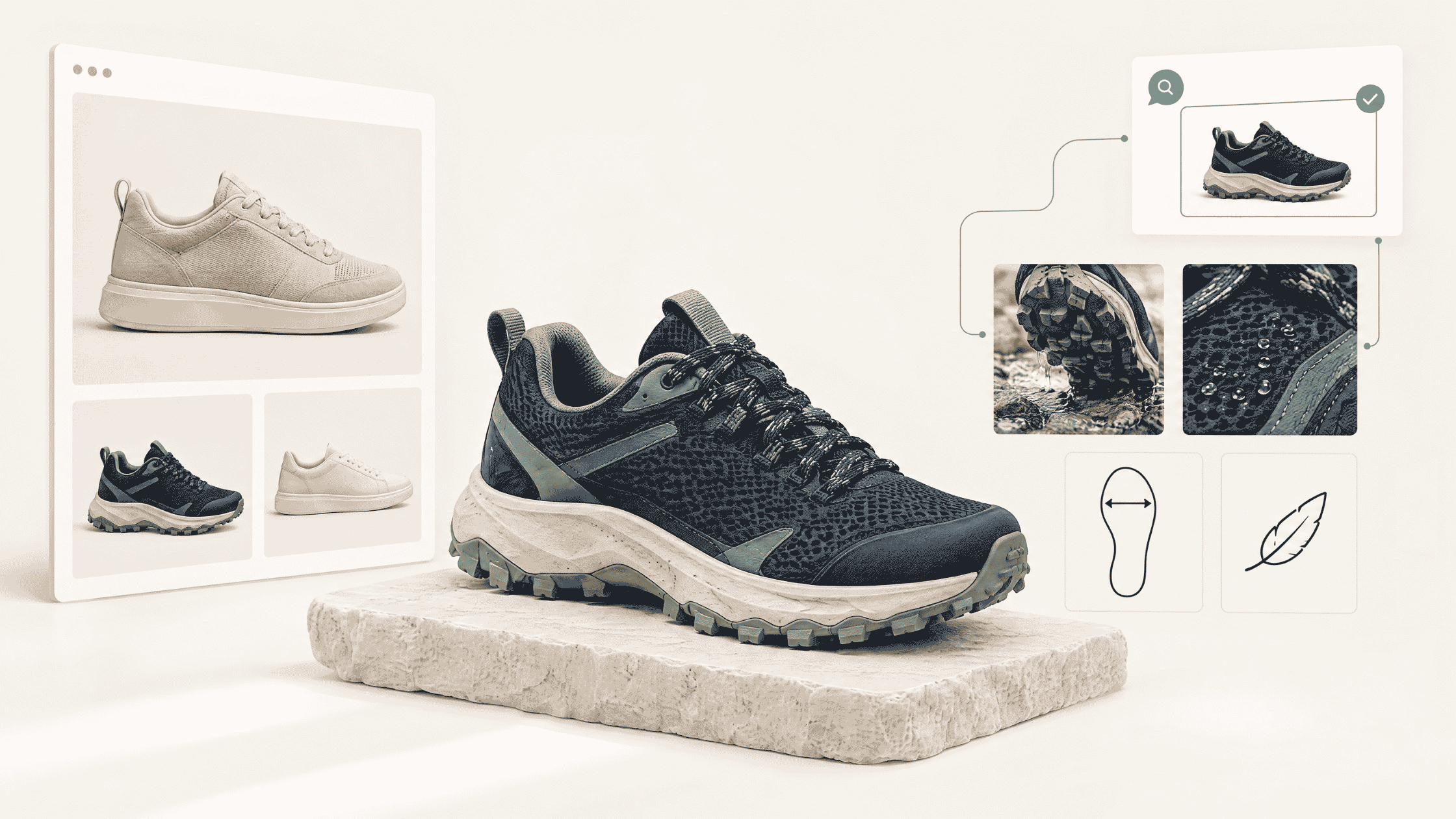
Your Merchandising Rules Don’t Reach AI Agents. What Replaces Them?
The answer: merchandising is not disappearing in the age of AI shopping. Its control surface is changing.
For a human shopper, merchandising can mean putting one shoe above another, moving a seasonal collection into the hero banner, pinning a high-margin SKU to the first row or burying an overstocked product.
For an AI shopping agent, most of those decisions are not portable.
An external agent such as ChatGPT does not inherit the private boost rule in your search platform. Instead, product selection can depend on the shopper’s stated constraints and machine-readable evidence such as product metadata, price, availability, descriptions, reviews and other product information. OpenAI says its shopping results consider structured metadata and user context, while its shopping research experience explicitly compares attributes including price, features and reviews. [1] [2] Google similarly says product attributes supplied through Merchant Center are used to match products to relevant queries. [3] [4]
That creates a new discipline for ecommerce teams:
placement merchandising decides where a product appears on a surface you control; attribute merchandising determines whether a machine can understand when that product deserves to appear at all.
The implication for merchandising leaders is larger than an SEO project. It affects what gets maintained, what gets measured and, eventually, where merchandising headcount and budget go.
The old merchandising control plane was visual
Traditional ecommerce merchandising assumes the retailer controls the shelf.
A merchandiser can decide which products occupy a homepage hero, which collection gets navigation prominence, which SKU is boosted for “summer dresses”, which products receive badges and which recommendations appear in “Complete the Look”.
Those controls remain valuable when a person is actually browsing your storefront.
But an increasingly important class of shopping journeys begins somewhere else.
HUMAN Security analysed more than one quadrillion digital interactions in 2025 and found that traffic from AI agents and agentic browsers grew 7,851% year over year. More importantly for retailers, 77% of observed agentic AI activity occurred on product and search pages. Retail and ecommerce accounted for 46.6% of agentic traffic, the largest individual vertical in HUMAN's analysis. [5]
Adobe is seeing the demand side move too. Its April 2026 retail analysis found traffic from AI sources to US retail sites up 393% year over year during the first quarter of 2026. In March, AI-referred traffic converted 42% better than non-AI traffic in Adobe's dataset. [6]
This is not evidence that category pages, visual merchandising or storefront UX suddenly stop mattering. It is evidence that merchandising now operates across two different audiences:
Humans encounter the arranged storefront.
Machines encounter the evidence underneath it.
And those audiences do not necessarily receive the same merchandising instructions.
There is an important distinction here. A retailer-owned AI Shopping Assistant can be connected to merchandising logic and explicit brand rules. Alhena, for example, supports commerce-aware recommendations grounded in catalogue and store data, while some Alhena industry experiences support product boosts for strategic SKUs.
An external shopping agent is different. You do not own its final ranking logic. OpenAI says ChatGPT chooses shopping results based on relevance to the user's intent rather than paid placement, and can take factors such as structured metadata, price, reviews, availability and user preferences into account. [1] [7]
That distinction changes the job.
Your merchandising rule has reach only inside systems that understand and honour that rule.
Your product evidence can travel much further.
Placement merchandising versus attribute merchandising
Consider a retailer selling running shoes.
A human visitor reaches the trail-running collection. The merchandising team can pin a strategic model to position one, give it a “Staff Pick” badge and put the collection in the homepage hero.
Now imagine a shopper tells an AI:
“I need lightweight trail shoes for wet ground, but I have a wide forefoot and I want to stay below £140.”
The useful ranking inputs are no longer “position one” and “hero campaign”.
They are things such as:
trail use, wet-weather grip, shoe weight, width options, toe-box characteristics, price, availability, reviews and credible evidence supporting those claims.
OpenAI's current shopping documentation is unusually explicit about this mechanism: when a shopper supplies a budget, for example, price receives more emphasis; its shopping research system can refine results around constraints and compare products on key attributes, reviews and features. [1] [2]
Google's own commerce infrastructure points in the same direction. Merchant Center describes accurate, correctly formatted product data as foundational for matching products to queries and for Google's AI-powered commerce experiences. Google's Product structured-data documentation also supports exposing information including price, availability, ratings and shipping in a standardised machine-readable format. [3] [8]
That gives merchandisers a useful operating distinction:
| Placement merchandising | Attribute merchandising | |
|---|---|---|
| Primary question | Where should this product appear? | For which shopper need should this product qualify? |
| Main control | Position, boost, bury, banner, collection | Attributes, claims, taxonomy, product copy, feeds, schema, reviews |
| Strongest on | Brand-owned visual surfaces | Search, conversational discovery and AI-mediated comparison |
| Typical input | Campaign calendar, margin, stock, seasonality | Shopper language, product evidence, constraints, reviews, catalogue gaps |
| Failure mode | Shopper does not notice the product | Machine cannot confidently match the product |
| Core KPI | Clicks, revenue per slot, collection conversion | Attribute coverage, answerability, recommendation inclusion, AI visibility |
| Portability | Usually surface-specific | Can propagate through PDPs, feeds, search systems and AI retrieval |
Attribute merchandising does not mean writing hundreds of adjectives into product descriptions.
It means converting genuine product knowledge into information systems can reliably retrieve, compare and substantiate.
“Great for runners” is weak attribute merchandising.
“278 g; 5 mm lugs; waterproof membrane; wide fit available; designed for technical trails” gives a retrieval system something it can work with — provided each statement is true, current and properly represented in the catalogue.
The difference is evidence density.
Conversation data tells you which attributes deserve the work
The difficult part is not recognising that richer product data is useful.
The difficult part is deciding which product data deserves enrichment first.
A PIM can contain hundreds of potential fields. A retailer could spend years cleaning them all.
This is where conversational commerce gives merchandising teams a signal they rarely had before: shoppers volunteering the actual criteria behind the purchase.
Alhena's analysis of more than one million AI conversations identifies recurring merchandising gaps when shoppers ask questions that product pages or catalogue schemas cannot answer. Examples include fit guidance, fabric weight, compatibility, care requirements and material sourcing. Alhena's recommended workflow is to map common multi-attribute queries against the existing catalogue schema, identify criteria shoppers use that the catalogue does not contain and prioritise the missing fields by query volume. [9]
That is a fundamentally different way to build a product taxonomy.
Historically, a field might exist because someone on the ecommerce team believed shoppers could care about it.
Conversation data tells you what shoppers are actually trying to resolve.
A useful merchandising metric follows from that:
Query-to-schema gap: the share of high-intent product queries containing a purchase criterion that cannot be answered reliably from existing product data.
Suppose hundreds of shoppers ask whether dresses are “bra-friendly”, but that property exists neither as a structured field nor as consistent PDP copy.
That is no longer merely a customer-service question.
It is an attribute-merchandising backlog item.
The same logic applies across categories.
In beauty, shoppers may reason in terms of undertone, finish, ingredient exclusions, sensitivity or compatibility with an existing routine.
In furniture, they may ask about renter-safe installation, room dimensions, doorway clearance, fabric durability or pet suitability.
In sport, they may combine surface type, weather, experience level, dimensions and injury considerations.
The merchandising system might think in category > subcategory > colour > size.
The customer thinks in problems and constraints.
That mismatch is where AI recommendations often become generic.
Alhena's separate 2026 stress test found what it calls “catalogue dumping” in five of 15 live deployments: systems responded to detailed constraints with popular or bestselling products rather than a reasoned match. Alhena's diagnosis is instructive for merchandisers: when the relevant constraint has no corresponding product data, ranking systems can fall back towards signals they understand, such as popularity. [10]
That is why the next merchandising audit should not begin with:
Which collections need a refresh?
It should also ask:
Which buying criteria appear repeatedly in shopper language but nowhere reliably in our product data?
Alhena's earlier analysis, What 1 Million AI Conversations Reveal About Ecommerce Merchandising Gaps, covers the discovery side of this problem. The operating-model consequence is the next step: once you know which attributes customers use, someone needs to own them.
Your merchandising budget should follow the new control surface
The uncomfortable part of this shift is organisational.
Most merchandising teams were designed around surfaces: homepage, PLP, navigation, onsite search, promotional collections and campaign launches.
Attribute merchandising crosses organisational boundaries instead.
A shopper asks for “a hypoallergenic necklace under £400 that won't irritate sensitive skin”.
Solving that well might require merchandising, product data, content, reviews, legal claim governance and search systems to work together.
No hero refresh can compensate for a catalogue that only knows:
necklace / gold / £365.
This does not justify abandoning visual merchandising or indiscriminately cutting merchandising roles. Humans still shop on websites, and brand-owned experiences still need curation.
It does justify questioning the marginal hour.
Should the next 20 hours go into testing a fifth ordering of a PLP that external AI systems may never reproduce?
Or should those hours go into identifying missing purchase criteria, enriching product fields, validating claims and making that information consistently accessible through feeds, PDPs and structured data?
Adobe's machine-readability benchmark makes that trade-off concrete. In April 2026, Adobe found average AI readability scores of 75% for retail homepages and 74% for category pages, but just 66% for individual product pages. In other words, by Adobe's scoring method, roughly one-third of PDP content was not machine-readable on average. [6]
That matters because the product detail layer increasingly acts as source material for AI systems.
Adobe's own commerce product now encourages merchants to refine titles, descriptions and product attributes, expose complete product details through structured metadata and identify incomplete product data that limits discovery across LLMs and other channels. [11]
The organisational response should be equally concrete.
| Merchandising workstream | Direction |
|---|---|
| Hero and campaign merchandising | Keep where human traffic and brand storytelling justify it |
| Repeated manual PLP reordering | Scrutinise the marginal return |
| Product attribute enrichment | Increase ownership and capacity |
| Catalogue taxonomy and synonym quality | Increase |
| Product claim substantiation | Increase |
| Feed and structured-data quality | Increase |
| Review mining for product evidence | Increase |
| Conversational query analysis | Make a recurring merchandising input |
| AI recommendation visibility testing | Add to the merchandising measurement stack |
The useful question for a VP of merchandising is therefore not, “Should I replace visual merchandisers with data people?”
It is:
What percentage of my team's effort is still optimising arrangements that only exist on surfaces we control, versus improving product evidence that can influence every discovery surface?
That is a budgeting question.
And increasingly, an AI visibility question.
Alhena's AI Visibility product is designed around this second control surface: measuring which products AI engines recommend or omit, examining how product information is rendered and tying AI discovery back to product and revenue metrics.
The merchandising team of the future therefore sits closer to product information management, customer insight and AI visibility than the traditional org chart suggests.
The new merchandising loop starts with shopper language
A modern merchandising operating rhythm can be surprisingly simple.
Start with the language shoppers use.
Then compare it with the language and fields your catalogue understands.
Then compare that with what AI systems actually recommend.
This creates a closed loop:
Shopper asks → conversation reveals criterion → merchandising identifies schema gap → catalogue is enriched → recommendation quality changes → AI visibility is measured → commercial outcome is attributed.
Alhena already describes the first half of that loop in its conversational data. Its commerce platform captures the questions shoppers ask, attributes they search by, comparisons they make, requested price points and gaps they encounter. The company says these patterns can be surfaced at category and product level rather than requiring merchandisers to read individual transcripts manually. [9]
That creates several useful replacement metrics for a team accustomed to thinking primarily in positions and slots.
Attribute demand coverage asks what percentage of commonly requested buying criteria your catalogue can answer reliably.
Constraint answerability asks whether the store can confidently answer compound requests such as “pet-safe, washable, cream, under £500 and available this week”.
Recommendation inclusion asks whether the correct SKU appears when the relevant need is expressed to an AI system.
Evidence consistency asks whether the PDP, product feed, structured data, review evidence and assistant all tell the same factual story.
Query-to-schema gap tracks customer requirements that repeatedly fall outside the catalogue model.
And AI-attributed revenue connects the entire exercise back to commerce rather than treating AEO or GEO as a visibility vanity metric.
This is where AI search visibility and conversational product discovery become one merchandising problem rather than separate software categories. Alhena's current positioning explicitly connects AI visibility at the product level with shopping assistance grounded in live catalogue data.
The first tells you whether machines can find and select you.
The second shows you what shoppers actually need machines to understand.
That feedback loop is difficult to recreate from keyword rankings alone.
A product now needs a case for being chosen
There is a deeper change hiding beneath “AI-ready product data”.
Traditional merchandising could sometimes manufacture prominence.
A product won because the retailer put it somewhere difficult to miss.
Agent-mediated merchandising increasingly requires something else:
a machine-readable case for why this product fits this particular request better than the alternatives.
That case can include structured specifications.
It can include credible descriptive claims.
It can include price and availability.
It can include reviews and review-derived evidence.
It can include compatibility, use case, fit, materials, dimensions, care requirements and trade-offs.
It can include brand expertise expressed clearly enough to retrieve and verify.
OpenAI says shopping research looks across retail sources for current information including price, availability, reviews, specifications and images, then produces recommendations explaining why individual products fit the shopper's requirements and what trade-offs they involve. [12] [2]
That should change how a merchandiser reads a PDP.
Do not only ask:
Does this page sell the product?
Ask:
Could an independent shopping agent use this page to prove when this is the right product?
Adobe's research suggests many retailers are not there yet. [6]
Google's product systems reward complete, correctly formatted product data. [3]
OpenAI's shopping systems increasingly work from structured product information, public retail sources, reviews and user constraints. [1] [2]
And Alhena's conversation data exposes the missing piece: the attributes real shoppers ask about but merchants have not yet encoded. [9]
This is the emerging discipline of attribute merchandising.
It does not replace every hero, collection or boost.
It replaces the assumption that arranging the shelf is enough.
For more on what happens when the product data cannot support the customer's constraint, read Why Does the AI Agent Just Recommend Bestsellers?. For the broader architectural shift, see Which Ecommerce Pages Survive the AI Shift?.
The common thread is simple:
Your merchandising rules only work where you control the ranking system. Your product evidence can work wherever a machine is deciding what deserves to be recommended.
The budget should begin to reflect that.
Frequently asked questions
What is attribute merchandising?
Attribute merchandising is the practice of improving the product attributes, structured claims, taxonomy, descriptions, feeds, reviews and other factual product evidence that search systems and AI shopping agents use to understand when a product matches a shopper's needs. It complements traditional placement merchandising rather than eliminating it. Google explicitly uses product attributes to match Merchant Center products with relevant searches, while OpenAI says structured metadata and product information contribute to shopping-result selection. [4] [1]
What is the difference between placement merchandising and attribute merchandising?
Placement merchandising controls where a product appears on a retailer-owned surface: for example, its position in a collection, search result or homepage module. Attribute merchandising improves the evidence explaining what the product is, who it is suitable for and which constraints it satisfies. Placement controls prominence within a specific interface; attributes are more portable across search, feeds, shopping assistants and answer engines.
Do AI shopping agents ignore ecommerce merchandising rules?
External shopping agents generally do not inherit a retailer's private boost, bury or campaign rules. They operate using the information and ranking systems available to them. OpenAI, for example, says its shopping products consider user intent and product information such as structured metadata, price, reviews, availability and other contextual factors. Retailer-owned AI assistants are different: because the merchant controls the implementation, they can be configured to respect explicit merchandising policies or product boosts. [1]
Why do product attributes matter for AEO and GEO?
Answer Engine Optimisation and Generative Engine Optimisation depend in part on machines being able to identify, interpret and retrieve accurate information about products. Adobe found product detail pages averaged only 66% on its AI-readability benchmark, while Google recommends structured product data and accurate Merchant Center product fields to make product information more usable across its search experiences. [6] [8] [3]
How can merchandisers decide which attributes to add first?
Start with shopper demand rather than attempting to enrich every possible field. Alhena recommends analysing common multi-attribute conversational queries, comparing them with the existing catalogue schema and prioritising missing attributes by query volume. Questions repeatedly asked in AI shopping conversations are direct evidence that shoppers care about information the current catalogue may not express clearly. [9]
Does traditional visual merchandising still matter?
Yes. Humans still browse storefronts, respond to campaigns and use retailer-controlled search and navigation. The shift is that visual placement is no longer the only merchandising control plane. As more product research occurs through AI systems, teams also need to invest in catalogue quality, machine-readable evidence and AI visibility. HUMAN's finding that 77% of observed agentic activity occurred on product and search pages, alongside Adobe's rapid growth in AI-referred retail traffic, shows why that second audience can no longer be treated as theoretical. [5] [6]