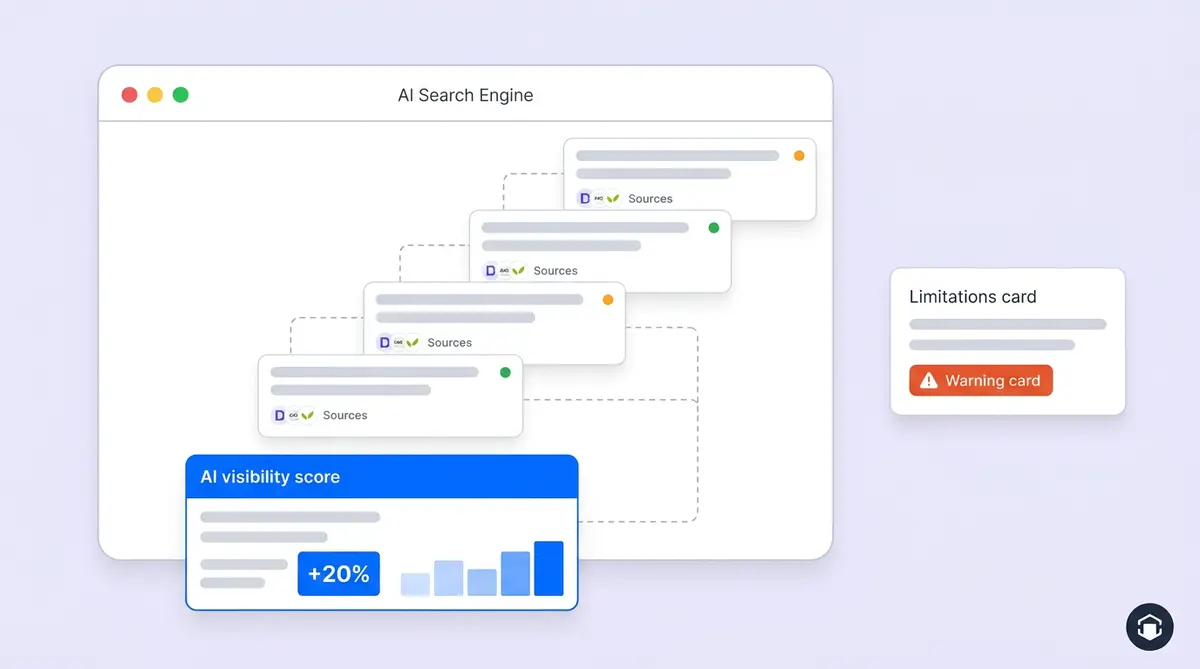
Alhena's AI Visibility Score is the percentage of your tracked prompts, across the AI engines it queries, where your brand appears in the answer, on a 0 to 100 scale. It is an appearance rate, not a prominence score: how high you rank when you do appear is a separate metric called Average Position. This page documents how that score and every signal beside it is produced, sampled, and bounded.
Last verified: July 2026.
Key takeaways
- Visibility Score (0 to 100) is an appearance rate: how often your brand shows up in AI answers, not how prominently. Average Position measures prominence separately.
- Prompts come from an auto-generated starting set you edit, and the 1 to 5 Volume rating is relative demand within your own set, not an absolute search volume.
- Five engines, ChatGPT, Google AI Overviews, Gemini, Perplexity, and Claude, run on a plan-based schedule from monthly to daily, because a single AI answer is noisy.
- Competitors are auto-discovered from your answers, not pre-declared, and scored on the same leaderboard math as your own brand.
- Revenue attribution joins AI-referred traffic to checkout events by visitor fingerprint and benchmarks it against your sitewide baseline. It is attribution, not proof of incrementality.
- Alhena does not do guaranteed placements, and scores move when engines update. The methodology is versioned and will change.
Disclosure: Alhena publishes this methodology page and sells the AI Visibility product it describes. Where this page contrasts Alhena with other tools, those facts come from the vendors' own public documentation, linked at first use and verified in July 2026.
What Alhena measures
Alhena reports three headline metrics, kept separate because they answer different questions.
Visibility Score is how often your brand appears in AI-generated answers across your tracked prompts, expressed as a percentage from 0 to 100. If you are tracked on 100 prompts and your brand appears in the answers to 40 of them, your Visibility Score is 40. It says nothing about whether you were listed first or fifth.
Average Position is how high you rank among the brands mentioned, on the prompts where you do appear. Lower is better. A brand can appear often, earning a high Visibility Score, yet sit near the bottom of every list, which is why frequency and prominence are two metrics and not one.
Visibility Rank is your standing among all the brands the engines mention across your prompt set, where number one is the most-mentioned brand. It is relative to the brands detected in your prompts, not the whole market.
Every metric is also split per engine, so ChatGPT and Perplexity each get their own line rather than one blended number.
| Signal | What it means | Unit or range | Key limitation |
|---|---|---|---|
| Visibility Score | How often your brand appears in AI answers across your tracked prompts | 0 to 100 (percentage of appearances) | Frequency, not prominence; a high score with a low Average Position means you appear often but near the bottom |
| Average Position | When you appear, how high you rank among the brands mentioned | Ordinal, lower is better | Computed only on prompts where your brand appears |
| Visibility Rank | Your standing among all brands the engines mention across your prompts | Number one is most mentioned | Relative to brands detected in your prompt set, not the whole market |
| Volume | Estimated demand for a prompt | 1 to 5, relative to your other prompts | Not an absolute search volume |
| Domain Rating | Authority of a domain cited in answers | 0 to 100 | Third-party authority estimate, not a score the AI engines publish |
| Fan-out position | Your Google rank on a search an engine runs under the hood | Ordinal, with a top-10 flag | Organic Google position, a proxy input to AI retrieval, not the AI answer itself |
How prompts are chosen
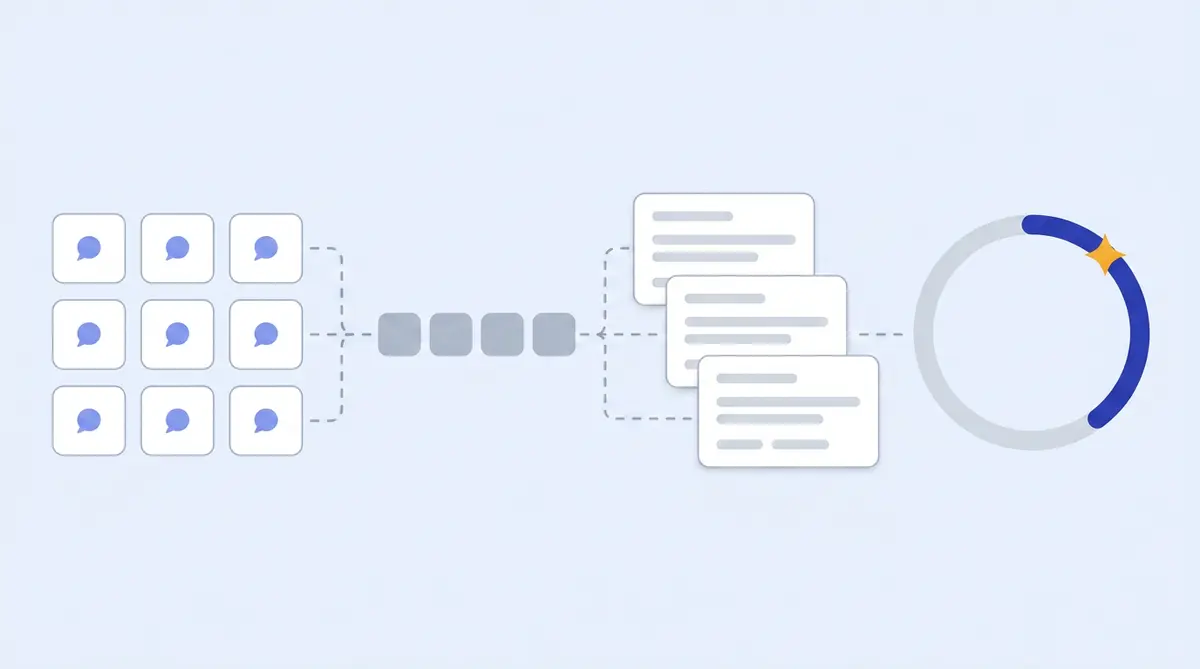
Alhena organizes tracking into topics and prompts, and for brands running Alhena's Shopping Assistant or Support Concierge, the questions real shoppers raise in those conversations (web chat, email, Instagram DMs, WhatsApp) inform which topics and prompts are worth tracking, so the tracked set reflects observed demand rather than guesswork; you can edit it at any time. A topic is a theme you track, such as "vitamin C serum." A prompt is a real question sent to the engines, such as "best vitamin C serum for sensitive skin." When you onboard, Alhena auto-generates a starting set of topics and prompts, which you then add to, edit, or trim so the set reflects the questions your buyers actually ask.
Each prompt carries a Volume rating from 1 to 5. This is a relative demand signal ranked against your other prompts, not an absolute monthly search volume. A Volume of 5 marks a prompt as high-demand within your own set, not a promise of a specific search count. Treat it as a way to prioritize, not a keyword-planner figure.
Which engines Alhena queries, and how often
Alhena queries five AI engines: ChatGPT, Google AI Overviews, Gemini, Perplexity, and Claude. All five are included in every paid plan.
Prompts run on a schedule rather than on demand, and the cadence is set by plan: monthly on Essentials, weekly on Growth, and daily on Scale. Faster cadence means fresher data and more refreshes to average over.
AI answers are non-deterministic. Ask ChatGPT the same shopping question twice and you can get two different brand lists. A Visibility Score is therefore an aggregate, computed across your full set of tracked prompts and updated on each scheduled refresh, not a reading from one answer. It is also why your dashboard score rarely matches a single answer you get by typing one prompt into ChatGPT yourself: you are comparing an aggregate with a single sample.
How competitors are detected
Alhena does not ask you to name your rivals before it can measure them. It auto-discovers every brand that appears in the answers to your tracked prompts and ranks them on a leaderboard. Two guardrails keep discovery honest: a mention only counts when a verbatim quote from the answer text confirms it, and brand-to-domain matching is validated against live search results and DNS resolution rather than trusting a model's guess. You can also add competitors manually, or star an auto-discovered brand to keep tracking it.
The leaderboard uses the same math as your own metrics: Visibility, how often the brand appears across your tracked prompts; Average position, its rank among the brands mentioned, where lower is better; Citations, its share of citations versus all brands cited; and Appears in, how many of your tracked prompts it showed up in. Your own brand is pinned to the top and badged.
Each competitor has a detail view with head-to-head scorecards, a 30-day visibility trend, engine-by-engine splits, and three action lists: Threat prompts, where the competitor lands in the top three and you rank below or are absent; Citation advantage, the pages cited in answers that mention them but not you; and Fan-out advantage, the behind-the-scenes searches where they rank in Google's top three and you do not.
How citations are measured
Citations are the domains and pages an AI engine pulls into its answer as sources. Alhena groups them two ways: by domain, every website cited at least once, and by page, each specific URL the engines pulled in.
Each cited domain carries a Domain Rating on a 0 to 100 scale, a domain authority estimate. Domain Rating is a third-party estimate, not a score the AI engines publish, so read it as a relative signal. Alongside it, Alhena reports Mentions, the total times a domain or page appeared as a source, and Unique prompts, how many distinct tracked prompts it showed up in, which separates broad influence from one repeated query.
How fan-out queries are tracked
When you ask an AI engine one question, it usually runs several web searches under the hood before it answers. Each of those is a fan-out query. Your AI visibility is downstream of them: if you do not rank on the searches an engine runs, you are unlikely to be retrieved into its answer.
Alhena records the fan-out searches the engines ran for your tracked prompts and, for each one, shows Your position, your organic Google rank for that search. It also reports how many of your prompts triggered each fan-out and rolls the set up into summary cards. The mechanics of fan-outs, and how to close the gaps they expose, are covered in our guide to fan-out queries.
How revenue attribution works
Most AI-visibility tools stop at whether you were mentioned. Alhena also measures whether AI-referred visitors bought, because the visibility data and the on-site purchase data live in the same system.
Attribution works in three steps. First, Alhena classifies incoming traffic by UTM parameters and referrer into per-engine buckets, such as ChatGPT, Perplexity, Gemini, and Claude, using a fixed traffic-source rule. Second, it joins that AI-engine traffic to actual checkout and cart events by visitor fingerprint, producing a checkout rate for each engine. Third, it benchmarks that rate against your sitewide baseline, to show whether AI-referred visitors convert above or below your average. This first-party join is detailed in our note on first-party data for AI visibility.
Two boundaries matter. Attribution is same-month: a visit in one month and a purchase in the next are not stitched together, which undercounts longer consideration cycles. And this is attribution, not incrementality. Alhena reports that AI-referred sessions were associated with these checkouts; it does not claim the purchases would not have happened otherwise. We report attribution, not causal lift. Proving lift requires a holdout or geo experiment, which a referral join cannot substitute for. The full method is covered in our guide to AI search revenue attribution.
What Alhena does not claim
A methodology is only trustworthy if it states its edges.
No guaranteed placements. No tool can guarantee a spot in an AI answer, because the engines control ranking and do not expose it. Treat any vendor promising guaranteed AI placement with suspicion.
Answers vary by user, session, and region. The score is an aggregate over repeated refreshes, not a fixed truth about what every person sees.
Scores move when the engines change. A model update or a change in how an engine retrieves sources can shift your visibility even if your site did not change. When a step change hits many brands at once, suspect the engine before your content.
Limitations and versioning
AI Visibility is a maturing product, and its documentation marks the feature as Beta. The measurement will change as the engines do. Product-card tracking currently reflects the cards ChatGPT surfaces for a topic and does not yet capture an equivalent surface on every engine, since engines render shopping results differently. The current definitions live in the product documentation, which is the source of truth if this page and the docs ever drift.
When we change how a metric is computed in a way that affects historical comparison, we note it. In short: these numbers are a well-instrumented estimate of a moving target, not a meter reading. Use them to find gaps, prioritize fixes, and measure direction over time rather than trusting any single figure.
The bottom line
Transparency here is the position, not a marketing risk. An AI-visibility number is only as useful as your ability to say what it does and does not mean, and most poor decisions in this category come from treating a noisy, engine-controlled estimate as a precise meter. The platform whose visibility data, on-site agent, and purchase outcomes live in one system can afford to show its work. Measure often, read the per-engine detail, act on the gaps, and hold every number, including ours, to its stated boundary. To see these signals on your own catalog, start with Alhena AI Visibility.
About the publisher: Alhena AI, founded in 2022 by ex-LinkedIn and Meta engineers, is an Agentic commerce AI platform on a mission to make online shopping more fun, efficient and social. Alhena's product suite spans AI Shopping Agents, Support Concierge, Voice AI, and AI Visibility (AEO and GEO tracking).