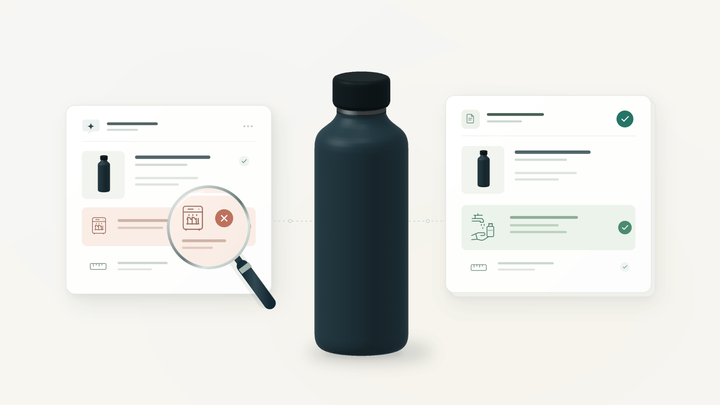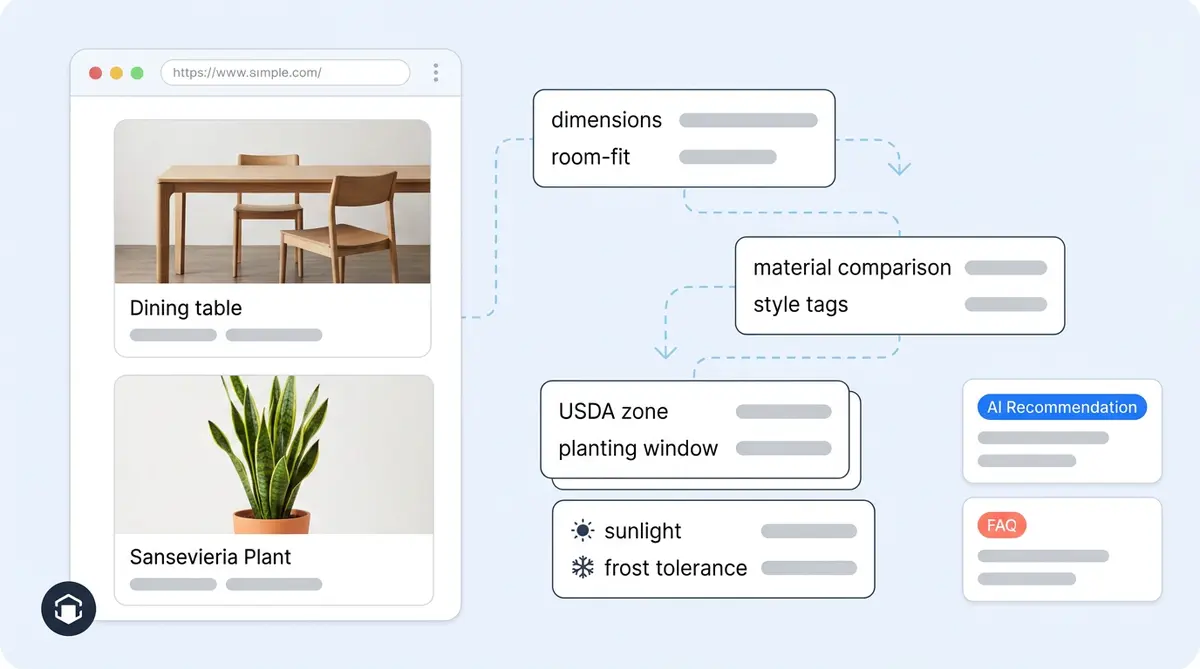
Powered by AI technology, home furnishing ecommerce converts at 2.86% from LLM (large language model) traffic, nearly double the baseline 0.5-1.8% conversion rate across North America for the category, according to Alhena's AI Commerce Performance data. But the ecommerce vertical still lags beauty (5.36%) and health (4.68%) in AI-driven conversion. The gap isn't about demand. It's about data. Home and garden products carry a complexity burden that most AI engines can't parse from unstructured product descriptions: spatial dimensions, material trade-offs (a challenge when using AI for product discovery), style taxonomies, room-fit calculations, climate-zone compatibility, and marketing strategy gaps.
Our sibling optimization guides cover AI visibility for fashion (visual search readiness, size-fit schema) and AI visibility for beauty (ingredient transparency, skin-type mapping across third-party platforms). This home garden visibility guide goes deep on what AEO and GEO actually look like for furniture, home decor, and garden commerce brands selling on marketplaces and DTC, where the product data, visibility, and brand presence challenges are fundamentally different.
Why Home and Garden Products Are Uniquely Hard for AI Engines
When a shopper asks ChatGPT "What's the best dining table for a 10x12 room?", the artificial intelligence needs to do math. It has to know the table dimensions (72"W x 36"D x 30"H), calculate clearance for chairs and walkways (36 inches on each side), and determine whether the furniture piece physically fits the space. Most ecommerce stores bury dimensions in a spec tab or list them inconsistently ("approximately 6 feet long"). AI engines can't reliably extract that.
Material complexity makes it worse. "Wood dining table" could mean solid oak, engineered wood, veneer over MDF, or reclaimed pine. Each has different durability, price, care requirements, weight, and feature sets. When Perplexity tries to answer "is teak or cedar better for outdoor furniture?", it needs clear comparison content, not marketing copy or behavior-driven content about "premium natural materials."
Style taxonomy adds another layer. Mid-century modern, farmhouse, coastal, Scandinavian, industrial, transitional: these aren't just aesthetic labels. They determine which products the recommendation engine suggests together through personalization. If your product data doesn't include structured style tags, AI can't answer "show me coastal-style outdoor furniture under $500" with your products.
Then there are compatibility questions that trip up every major AI platform: "Will this sofa fit through a 32-inch doorway?" "Can I use this rug on heated floors?" "Is this planter frost-proof?" These require structured attribute data that most home brands don't expose in machine-readable formats. According to Yotpo's AEO research, products without structured data on price, availability, and key attributes get excluded from AI consideration sets entirely.
Structuring Spatial and Dimensional Data for AI Search
The fix starts with how you format product specs. At every stage of the customer journey, AI-powered shopping results from AI-generated tools built on machine learning and natural language processing like ChatGPT Shopping and Perplexity parse structured data fields, not paragraphs of description text. Here's what "structured" looks like for a dining table:
- Exact dimensions in consistent format: 72"W x 36"D x 30"H (not "approximately 6 feet" or "standard dining height")
- Assembled vs. shipping dimensions: AI agents answering delivery and doorway-fit questions need both
- Seating capacity with context: "Seats 6 (8 with leaf extension)" rather than just "seats 6-8"
- Room size recommendation: "Best for rooms 10x12 ft or larger" as a dedicated structured field
- Clearance requirements: "Allow 36 inches from table edge to wall for chair movement"
- Weight and weight capacity: Critical for wall-mounted shelving, hanging planters, and patio furniture on elevated decks
This data belongs in Product schema (JSON-LD), not only in product-page copy. Complete structured data gives AI systems clearer price, availability, rating, and attribute signals. Our schema markup guide covers the JSON-LD implementation for ecommerce.
For garden products, the equivalent is spatial context for planting: mature spread dimensions, spacing requirements, container size recommendations, and vertical growth height. A shopper asking "What shrub works as a privacy screen for a 20-foot fence line?" needs your plant data to include mature width, spacing interval, and growth rate, all as structured fields.
Use-Case and Room-Type Tagging: Matching How Shoppers Query AI
Shoppers don't ask AI "show me SKU #4829." They ask "What's the best pet-friendly sofa for a small apartment?" That query contains three structured attributes: pet-friendly, small-space, and sofa. If your product data doesn't tag those attributes explicitly, AI engines won't surface your products.
The most impactful tagging strategies for home furnishing brands:
- Space context: small-space, apartment-friendly, fits narrow hallways, studio-optimized
- Lifestyle compatibility: pet-friendly, kid-safe, stain-resistant, easy-clean
- Environment rating: indoor-only, outdoor-rated, covered-patio, UV-resistant, frost-proof
- Room type: living room, bedroom, dining room, home office, nursery, entryway, patio, balcony
- Assembly difficulty: no-assembly, tool-free, 2-person assembly required, professional installation recommended
- Style taxonomy: mid-century modern, farmhouse, coastal, Scandinavian, industrial, transitional, boho, minimalist
These tags should live in your product schema as structured attributes, mapping directly to AI query patterns, not as marketing keywords buried in descriptions. When ChatGPT Shopping indexes your catalog, it maps these attributes to shopper queries. Without them, your $800 performance-fabric sofa loses to a competitor whose product data explicitly says "pet-friendly, stain-resistant, small-space."
For garden products, the equivalent tags include: drought-tolerant, low-maintenance, pollinator-friendly, deer-resistant, shade-loving, full-sun, native species, and edible. These map directly to how gardeners query AI: "What low-maintenance plants attract pollinators in partial shade?"
Material Comparison Content That AI Engines Can Cite
Here's where GEO intersects with AEO for home brands. Generative AI engines need clear, citable material trade-off content to answer comparison queries. "Is teak or cedar better for outdoor furniture?" is one of the most common AI-assisted furniture research queries, and the answer requires structured comparison, not a product page that just says "crafted from premium teak."
The content format AI models cite most reliably:
- Direct comparison tables with specific attributes: durability (years), maintenance frequency, price range per piece, weight, weather resistance rating, sustainability sourcing
- Clear trade-off statements: "Teak lasts 50+ years outdoors and develops a silver patina without treatment. Cedar costs 40-60% less but needs annual sealing to prevent graying and splitting."
- Use-case recommendations: "Choose teak for coastal or high-humidity environments where long-term durability matters most. Choose cedar for covered patios or seasonal use where budget is the priority."
This material comparison content lives on your buying guides and category pages, not product pages. Build dedicated buying guides for the comparisons shoppers and AI models search for: solid wood vs. engineered wood vs. veneer, natural stone vs. porcelain tile, performance fabric vs. leather vs. linen. Each page should lead with the direct answer, then support with structured specifications.
Pages with FAQPage markup addressing these material questions are 3.2x more likely to appear in Google AI Overviews. Our AEO FAQ Engine guide shows how to turn these product questions into AI search rankings.
Garden-Specific AEO: Climate Zones, Grow Seasons, and Plant Care Data
Garden ecommerce faces an AEO problem that home furnishing doesn't: time and geography sensitivity. "What should I plant in Zone 7 in April?" is a query with a narrow answer window. If your product data doesn't include USDA hardiness zones, planting windows, and regional compatibility as structured fields, AI engines can't serve your plants to the shopper who needs them right now.
The AEO strategies and structured data fields that move the needle for garden brands:
- USDA Hardiness Zone range: Zone 4-9 (not "cold-hardy" or "suitable for most climates")
- Planting window by region: "Plant outdoors after last frost, typically March-May in Zones 7-9"
- Sun requirements: Full sun (6+ hours), partial shade (3-6 hours), full shade (under 3 hours)
- Soil type compatibility: Clay, sandy, loam, acidic, alkaline, with drainage requirements
- Mature dimensions: Height and spread at maturity, not just pot size at purchase
- Bloom season and color: "Blooms June-September, purple/lavender"
- Care level: Low-maintenance, moderate, expert (with specific watering frequency)
- Companion planting compatibility: Which plants grow well together, critical for AI bundle recommendations
This data feeds both external AI visibility optimization and on-site AI performance. When Alhena's Gardening and Care solution answers "What should I plant in my shady London garden?", it draws on the same structured plant data that Perplexity and ChatGPT need to recommend your products. The AI Care Companion delivers seasonal care guidance and plant diagnostics, while the Plant Matchmaker suggests products based on climate and expertise level.
The Crocus Proof Point: Vertical-Specific AI Works for Garden Brands
Crocus, one of the UK's largest online garden retailers, deployed Alhena's AI with tangible results that validate the vertical-specific approach. Their numbers: 86% customer support deflection rate, CSAT improved to 84% (from below 80%), and a 3.7% ticket reopen rate, meaning the AI resolved inquiries correctly the first time. As Ben O'Donnell, Head of Customer Service at Crocus, put it: "We're treating Alhena like an agent. Customers sometimes don't even realize they're interacting with AI." Full results are in our Crocus case study and the 329-Brand AI Commerce Report.
For a complete guide to AI-powered customer service automation in this vertical, see how gardening and outdoor brands use AI customer support automation to scale.
What makes the Crocus deployment relevant to AI visibility specifically: the business insights, data analysis, and customer insights from on-site AI revealed the exact queries external AI engines try to answer. Questions about plant care schedules, soil compatibility, frost tolerance, and companion planting became structured FAQ content that feeds both marketing channels, customer engagement, and on-site conversion rates and off-site AI citations. Every chatbot interaction the system handles well represents structured knowledge that Google AI Overviews and ChatGPT can also extract.
For home furnishing, Puffy's deployment shows the same pattern: 63% automated inquiry resolution through AI automation with 90% CSAT (customer satisfaction). The on-site AI handles dimension questions, material comparisons, and delivery logistics, and that same enriched product catalog improves the brand's presence in AI shopping results. The AI for Home Furnishing guide covers the on-site half of this equation: visual discovery, room styling, and returns reduction.
Tracking AI Visibility at the SKU Level with Alhena
Alhena's AI Visibility tools go beyond brand-level monitoring. For home and garden brands with thousands of SKUs and large product inventory, the question isn't just "Does ChatGPT mention our brand?" It's "Does ChatGPT recommend our $1,200 teak dining set when someone asks for outdoor dining furniture that lasts?" SKU-level predictive analytics tools for visibility shows which individual products appear in AI shopping answers, which competitors appear instead based on popularity and data quality, and which product data gaps are keeping your best sellers out of AI recommendations.
The AEO FAQ Engine turns this data into action. It identifies the room-specific and product-specific questions shoppers ask (both on-site via the chatbot and in AI search results), then generates structured FAQ content targeting those queries. For a furniture brand, that means FAQs like "Will a 72-inch dining table fit in a 10x12 room?" and "What's the weight capacity of a floating shelf?" For a garden brand: "What grows well in Zone 6b partial shade?" and "How far apart should I space lavender plants?"
This data-driven closed loop, on-site AI capturing questions, structured data feeding external AI models, SKU-level tracking measuring the results, is what separates brands that gain AI visibility from those still wondering why their organic SEO search traffic dropped despite stable rankings. Gartner predicted traditional search volume would drop 25% by 2026 due to AI chatbots. For home and garden brands, the home garden brands that structured their product data for AI engines are the ones capturing that redirected demand.
Key Takeaways
- Home products are uniquely hard for AI engines because of dimensional complexity, material trade-offs, style taxonomies, and room-fit calculations that AI can't parse from unstructured descriptions.
- Structure spatial data explicitly: exact dimensions, room size recommendations, clearance requirements, and doorway-fit specs in Product schema, not just description copy.
- Tag use-cases as structured attributes: pet-friendly, small-space, outdoor-rated, kid-safe. These map directly to how shoppers query AI.
- Build material comparison content AI can cite: dedicated buying guide pages with direct trade-off statements and comparison tables for wood types, fabric types, and stone types.
- Garden brands need climate-zone AEO: USDA zones, planting windows, sun requirements, and soil compatibility as structured fields, not marketing adjectives.
- On-site AI and off-site AI visibility reinforce each other. Crocus (86% deflection, 84% CSAT) and Puffy (63% automation, 90% CSAT (customer satisfaction)) prove the model works for this vertical.
Ready to make your home or garden products visible in AI search results? Book a demo with Alhena AI to see SKU-level AI visibility tracking and the AEO FAQ Engine in action, or start free with 25 conversations.
Advanced capabilities like computer vision, deep learning, and sentiment analysis are already reshaping how AI shopping tools process home product images, parse review language, and match shopper intent to catalog items. Home and garden brands that structure their data for these systems today will capture disproportionate AI visibility as these technologies mature.

Alhena AI
Frequently Asked Questions
What use-case tags help home products appear in AI recommendations?
The highest-impact structured tags for home furnishing are: pet-friendly, kid-safe, small-space, apartment-friendly, stain-resistant, easy-clean, outdoor-rated, UV-resistant, and frost-proof. Add style tags (mid-century modern, coastal, farmhouse) and room types (living room, patio, nursery, home office). These map directly to how shoppers express purchase intent through AI assistants.
How do garden brands optimize for climate zone queries in AI search?
Add USDA Hardiness Zone ranges (e.g., Zone 4-9), planting windows by region, sun requirements (full sun: 6+ hours), soil type compatibility, mature plant dimensions, bloom seasons, and care levels as structured data fields. This lets AI engines answer queries like "What should I plant in Zone 7 in April?" with your specific products.
What kind of material comparison content do AI engines need from home brands?
Build dedicated buying guide pages with direct comparison tables: teak vs. cedar durability (years), maintenance frequency, price range, weather resistance. Lead with clear trade-off statements like "Teak lasts 50+ years without treatment; cedar costs 40-60% less but needs annual sealing." Pages with FAQPage markup on material comparisons are 3.2x more likely to appear in Google AI Overviews.
How does Alhena track AI visibility at the individual product level?
Alhena's AI Visibility tools monitor which specific SKUs appear in ChatGPT, Perplexity, and Google AI shopping answers, not just brand-level mentions. For a furniture brand with thousands of products, this shows which items AI recommends, which competitors appear instead based on popularity and data quality, and which product data gaps keep your best sellers out of AI results.
Does on-site AI like a shopping chatbot actually improve off-site AI visibility?
Yes. The questions shoppers ask your on-site AI reveal the exact queries external AI engines try to answer. Crocus deployed Alhena and achieved 86% deflection and 84% CSAT. The structured plant care and compatibility content generated from chatbot interactions feeds both marketing channels, customer engagement, and on-site conversion and off-site AI citations.
Which of these plants are safe for my cat if they chew on the leaves?
AI can identify which plants are safe for cats by cross-referencing authoritative toxicity databases (for example, ASPCA) with your pet profile (species, age, and likely exposure). Provide the plant name or photo and your cat's details; the system will return 'safe', 'caution', or 'toxic', plus next-step guidance (contact your vet or poison control for ingestion).
How is this guide different from the Fashion and Beauty AI visibility guides?
The Fashion guide focuses on visual search readiness, size-fit schema, and style trend tagging. The Beauty guide covers ingredient transparency and skin-type mapping across third-party platforms. This Home and Garden guide addresses spatial data (dimensions, room fit), material complexity (wood types, fabric durability), climate-zone tagging for garden products, and compatibility questions unique to this vertical.