Agentic AI helps home furnishing brands cut return rates by 25 to 40 percent through visual search, guided product discovery, and size-aware recommendations that close the gap between what shoppers see on screen and what arrives at their door. For furniture retailers losing $100 to $250 on every return, that gap is expensive.
This guide covers why furniture returns cost more than any other e-commerce category, how AI prevents them before they happen, and how Alhena AI's Shopping Assistant gives home design and living brands a purpose-built agentic solution for selling furniture online.
Why Do Home Furnishing Brands Have the Highest Return Costs in Ecommerce?
Home design and furnishing return rates sit between 15 and 20 per cent, according to Red Stag Fulfilment data. That's lower than apparel's 20 to 40 per cent range. But the cost per return is 3 to 5 times higher because of shipping weight and size.
Shipping a sofa back costs $150 or more. Processing a single furniture return eats 20 to 65 per cent of the item's original price. A $2,000 sectional return can cost $1,300 to handle when you add reverse logistics, inspection, and restocking.
What Causes Most Furniture Returns?
The top five reasons fall into two buckets: preventable and non-preventable.
Preventable with AI (70 percent of returns):
- Size and spatial fit: the sofa doesn't fit the living room layout
- Color or style mismatch: the fabric looked and felt different on screen
- Quality or durability concerns: expectations didn't match reality
- Post-purchase doubt: no reassurance after clicking "buy"
Non-preventable:
- Transit damage (roughly 80 percent of non-preventable returns)
AI addresses the first four causes directly. When a shopper can visualize a product in their space, ask detailed questions about materials, and get confident size recommendations, they buy right the first time and faster and keep what they order.
How Does AI Reduce Furniture Returns Before They Happen?
AI prevents furniture returns at three points in the shopping journey: discovery, evaluation, and post-purchase. Each one closes a specific part of the "imagination gap" that makes online furniture shopping risky.
What Is Visual Search for Home Furnishing?
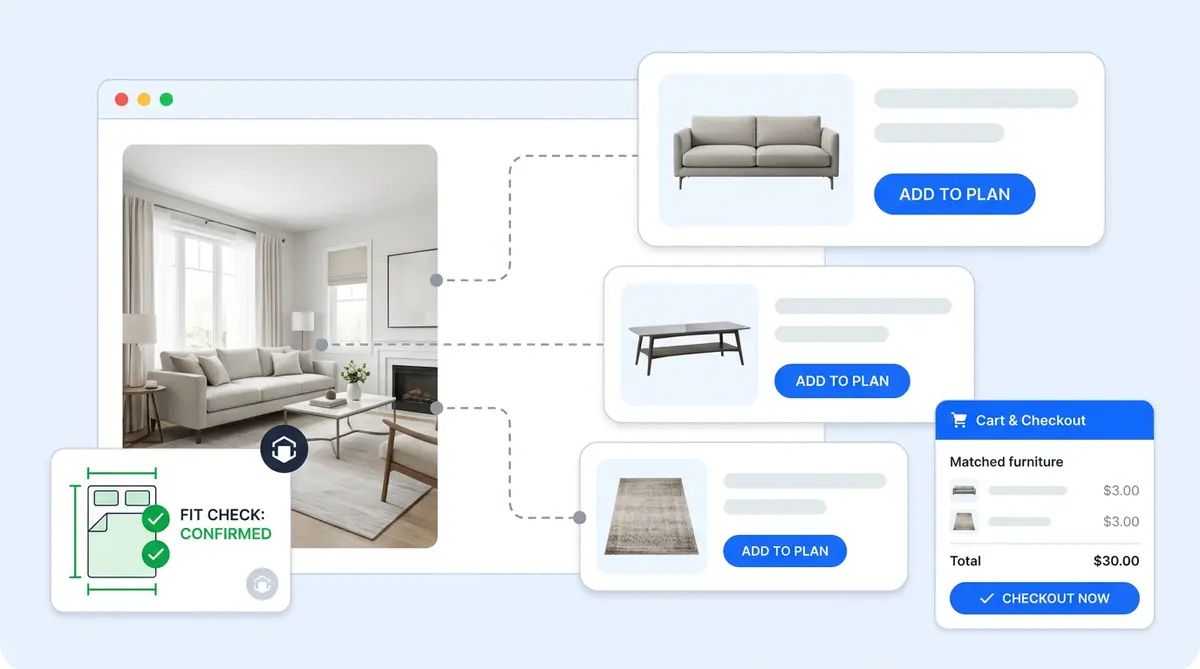
Visual search lets shoppers upload a photo of their room or living space, a mood board, design ideas, or an inspiration image. The AI analyzes the visual input and finds products from the retailer's actual catalog that complement the look and feel of the space.
Instead of exploring 500 sofas and guessing which one fits their living room aesthetic, the shopper can explore 5 to 10 curated matches in seconds. This removes style-mismatch returns because the recommendations are grounded in what the customer's space actually looks like.
How Does Guided Discovery Replace the Showroom?
A good showroom associate asks questions: What room or layout area is this for? What's your style? What's your budget? Do you have kids or pets?
An AI shopping assistant does the same thing at scale. It asks about room layout, type, design preferences, room designs, lifestyle needs, and budget constraints and space planning, then lets shoppers explore thousands of SKUs and narrows them down to a handful of ideal options. This guided selling approach, unlike basic design tools, is what separates an agentic AI concierge from a basic chatbot.
Retailers using guided AI discovery see conversion rates 4x higher than unassisted browsing and average order value increases of 12 to 22 per cent through smart bundling, based on furniture e-commerce benchmarks.
Can AI Recommend the Right Size and Fit for Furniture?
Yes. AI shopping assistants cross-reference product dimensions against room layout and measurements the shopper provides. If a customer says "my living room is 12 by 14 feet", the AI filters out oversized sectionals and generates recommendations for pieces that are the ideal fit.
The AI can also instantly flag potential issues proactively: "This dining table is 84 inches long. Make sure you have at least 36 inches of clearance on each side for chairs." That kind of pre-purchase guidance is exactly what prevents the "it doesn't fit" return.
What Makes Agentic AI Different from a Basic Furniture Chatbot?
A basic chatbot answers questions. An agentic AI agent takes action. The difference matters for home furnishing brands because furniture purchases involve multiple steps, high consideration, and complex post-purchase needs.
Here's what agentic means in practice:
- Product discovery: the AI searches your catalog, applies filters (size, material, style, price), and recommends specific products
- Cart population: the AI adds items to the shopper's cart directly from the conversation, including coordinated pieces
- Checkout assistance: the AI pre-fills checkout fields and walks the customer through the purchase
- Order management: after the sale, the AI tracks deliveries, handles return requests, and answers care questions so shoppers explore confidently
- Cross-channel continuity: a shopper who starts on Instagram DMs can continue the conversation on web chat with full context preserved
Home Furnishings Association data shows AI-attributed orders grew 393 per cent year over year in Q1 2026, with home goods brands seeing 3x more AI-driven traffic than apparel brands. Agentic AI isn't a future concept for furniture retail. It's already here.
How Does Alhena AI Work for Home Furnishing and Living Brands?
Alhena AI's home furnishing solution combines a product expert agent with an order management agent, giving furniture brands an end-to-end agentic AI that handles everything from first browse to full post-delivery support.
Visual Style Matcher: Upload a Photo, Get Catalog Matches
Shoppers upload a room photo or space snapshot or style reference image. Alhena's Visual Style Matcher analyzes the visual input and instantly finds products from your actual catalog that complement the space, style, mood, and feel. No generic stock suggestions. Every recommendation surfaces real products from your live inventory.
For a home furnishing brand, this means a customer can photograph their living area and instantly see sofas, accent chairs, and coffee tables from your catalog that fit the aesthetic. The result: fewer style-mismatch returns and higher confidence at checkout.
Personalized Room Styling and Curated Bundling
Alhena doesn't just recommend individual products. It builds curated room layouts and sets based on the shopper's interior designs, budget, and room type.
"Complete the look" suggestions pair a sofa with matching throw pillows, a coordinating rug, and a complementary side table. This approach increases average order value while reducing returns because the whole room comes together as expected.
Hallucination-Free Product Expertise, 24/7
Furniture shoppers ask detailed technical questions: What's the weight capacity of this bed frame? Is this fabric pet-friendly? What are the exact clearance and layout dimensions? Does this come in a different finish?
Alhena's Product Expert Agent answers these questions using only your verified product data. If a spec comes from Alhena, it's grounded in your catalog, not hallucinated from training data. This accuracy is critical for high-consideration purchases where wrong information leads directly to returns.
The AI covers dimensions, materials, fabric care, assembly requirements, delivery timelines, and warranty details, all available 24/7 without human staffing and without gaps in knowledge.
Omnichannel: Web, Instagram DMs, WhatsApp, Email, Voice
Home furnishing shoppers research across channels. They discover a dining set on Instagram, explore options on your website, then message on WhatsApp before buying.
Alhena's Social Commerce module delivers the same full guided shopping experience across every channel. A shopper who asks about a sectional sofa on Instagram DMs gets the same product expertise and style recommendations they'd get on your website chat, instantly delivered.
The conversation context carries across channels. Without repeating preferences, without starting over.
Agentic Checkout: From Conversation to Cart to Purchase
Alhena's agentic checkout takes the friction out of furniture buying. During a conversation, the AI can:
- Add recommended products directly to the shopper's cart
- Include coordinated room accessories as upsells
- Pre-fill checkout fields
- Answer last-minute questions about delivery and returns
This end-to-end flow means a shopper goes from "I need a new sofa" to a completed purchase without leaving the conversation. For a category where cart abandonment sits at 69.57 per cent, removing friction at checkout is a direct revenue lift.
What Results Do Home Furnishing Brands See with AI?
Alhena's home design and living customers report measurable results across support costs, customer satisfaction, and revenue.
- Puffy: 63 percent of consumer inquiries resolved automatically, 90 percent CSAT maintained
- Crocus: 86 percent deflection rate, CSAT climbed to 84 percent from under 80 percent pre-Alhena
Industry-wide, McKinsey reports that companies leading in AI personalization generate 40 percent more revenue than average performers. For a mid-size furniture brand doing $10 million in annual revenue with a 15 percent return rate, cutting returns by even 3 percentage points saves over $300,000 per year in reverse logistics alone.
How Do You Get Started with AI for Your Furniture Brand?
Getting an agentic AI shopping assistant running takes three steps and under 48 hours. No dev resources required.
Step 1: Audit your return data. Identify your top 10 highest-cost return SKUs. These are your quick wins. Look at the return reasons: are they size, style, quality, or damage?
Step 2: Clean your product catalog. Make sure every product has accurate dimensions, material descriptions, weight capacity, and care instructions. AI can only be as accurate as your data. If your catalog says "standard size" instead of "84 x 36 x 30 inches," the AI can't help with fit questions.
Step 3: Deploy Alhena AI. Alhena connects to Shopify, WooCommerce, and Magento, pulling your product catalog automatically for free setup. The AI trains on your product data, knowledge base, and brand voice. Most brands go live in under 48 hours.
Use Alhena's ROI Calculator to estimate your specific return reduction and revenue impact before committing.
Key Takeaways
- Home furnishing and home decor returns cost $100 to $250 per item, 3 to 5x more than standard e-commerce returns
- 70 percent of furniture returns are preventable with better pre-purchase guidance
- Visual search and style matching let shoppers upload room photos and get catalog-matched product recommendations
- Agentic AI goes beyond answering questions: it searches catalogs, populates carts, and completes checkout within the conversation
- Guided discovery with AI increases conversion rates by 4x and AOV by 12 to 22 percent for furniture brands
- Alhena AI deploys in under 48 hours on Shopify, WooCommerce, and Magento with no dev resources
- Real results: 63 percent automated resolution (Puffy), 86 percent deflection (Crocus), 3x conversion (Tatcha)
Ready to reduce returns and turn your home furnishing store into an agentic selling machine? Book a demo with Alhena AI or start free with 25 conversations to see how visual discovery, guided selling, and agentic checkout work for your catalog.
Frequently Asked Questions
How does AI reduce furniture returns for home furnishing brands?
AI reduces furniture returns through three methods: visual search that matches products to a shopper's room photos, guided discovery that asks about size, style, and budget preferences before recommending products, and size-aware filtering that cross-references product dimensions against room measurements. These pre-purchase tools close the imagination gap and can cut return rates by 25 to 40 percent.
What is an agentic AI shopping assistant for furniture ecommerce?
An agentic AI shopping assistant goes beyond answering questions. It takes autonomous actions like searching your product catalog, adding items to the shopper's cart, pre-filling checkout fields, and handling post-purchase order tracking. For furniture brands, this means a customer can go from 'I need a new sofa' to a completed purchase entirely within the AI conversation.
How does visual search work for home furnishing brands?
Visual search lets shoppers upload a room photo, mood board, or inspiration image. The AI analyzes the visual input and matches products from the retailer's live catalog that complement the space, style, and color palette. Alhena AI's Visual Style Matcher does this using your actual inventory, so every recommendation is a product the customer can buy today.
What results do home furnishing brands see with Alhena AI?
Alhena's home and living customers report strong results. Puffy achieved 63 percent automated inquiry resolution with 90 percent CSAT. Crocus reached 86 percent deflection rates with CSAT climbing to 84 percent. Tatcha saw a 3x conversion rate and 38 percent AOV uplift, with 11.4 percent of total site revenue attributed to AI.
How quickly can a furniture brand deploy an AI shopping assistant?
Alhena AI deploys in under 48 hours with no developer resources required. It connects to Shopify, WooCommerce, and Magento, automatically pulling your product catalog data. The AI trains on your product specs, knowledge base, and brand voice before going live.
Does Alhena AI work across Instagram, WhatsApp, and web chat for furniture brands?
Yes. Alhena's omnichannel architecture delivers the same guided shopping experience on web chat, email, Instagram DMs, WhatsApp, and voice. A shopper who starts a conversation about a sectional sofa on Instagram DMs can continue on your website with full context preserved, including style preferences and product selections.
How much do furniture returns cost ecommerce brands?
Furniture returns cost $100 to $250 per item in reverse logistics, compared to $10 to $30 for standard ecommerce products. Shipping a sofa back costs $150 or more, and processing a single furniture return eats 20 to 65 percent of the item's original price. Home furnishing return rates average 15 to 20 percent.
Can AI help with post-purchase support for furniture orders?
Yes. Alhena's Order Management Agent handles delivery tracking, return and exchange requests, assembly guidance, fabric care instructions, and warranty questions. At Puffy, 63 percent of post-purchase inquiries are resolved automatically without human intervention, maintaining 90 percent customer satisfaction.