A chatbot is a self-service search box with manners. An AI concierge is a virtual salesperson with memory. Both live inside a support widget on your e-commerce site in 2026, but that's where the similarities end.
According to a 2024 paper in the Journal of Service Management, an AI concierge is "a technologically advanced, intelligent and personalized assistant designated to an individual customer, proactively taking care of that customer's needs throughout the service journey." A chatbot sticks to answering questions. An AI concierge orchestrates the entire shopping experience: greeting, guiding, recommending, checking out, handling post-purchase customer service, and escalating to humans when needed, combining sales and support in one service platform.
Here's what actually separates them under the hood and why it qualifies as conversational AI.
A Team of Specialists, Not a Single Bot
A rule-based bot is one machine learning model answering one question at a time. Alhena AI's concierge works differently. It's a team of specialist agents coordinated by a central planner.
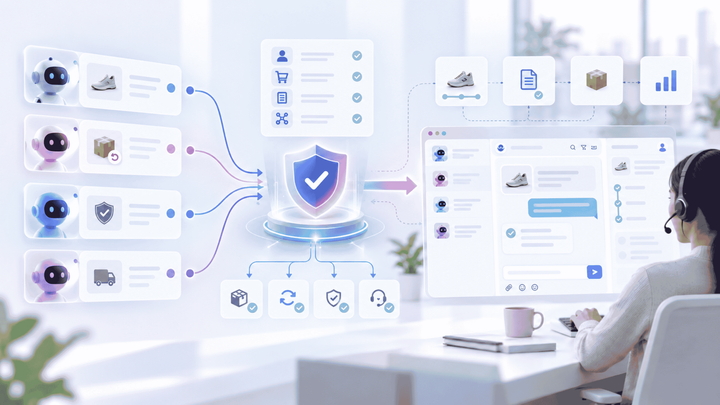
When a customer sends a message, the Planner analyzes the full conversational history, decomposes the request into sub-tasks, and routes each one to the right specialist: a Product Expert module for relevant recommendations, a Product Search specialist for catalog queries, an Order Management specialist for tracking and returns, a Sizing Agent for fit questions, or an Outfit Builder for styling. A dedicated Human Transfer agent can escalate when the AI reaches its limits.
This is why a customer can say "I bought the blue dress last month, does it come in medium, and can I return the shoes I got with it?" and get a single coherent answer to complex queries. Multiple agents run in parallel (catalog lookup, size availability, order history, and return eligibility), and the planner stitches results together. That approach would choke on the second clause.
Proactive Customer Engagement, Not Reactive Q&A
Traditional bots wait for someone to type. The AI initiates. It generates icebreaker prompts from your catalog data for each product page. It triggers AI nudges based on scroll depth, time on page, or exit intent ("Need help picking the right size?" when someone lingers on a product page). After every response, a Suggested Questions module generates smart, tappable follow-ups to keep conversations moving.
This matters because most customers won't click a chat widget when confused. They just leave.
Guided Shopping Through Adaptive Quizzes
When a shopper says "I need a new moisturizer," a chatbot dumps a product list. The concierge asks: "What's your skin type?" with tappable options (Oily / Dry / Combination / Sensitive), then narrows based on the answer, asks follow up questions until it has enough signal to recommend the best match confidently. These adaptive quiz flows are generated dynamically by the AI from your product catalog and knowledge base. No manual decision trees, no rigid workflow builders, no simple if-then rules to build or maintain.
Brands like Tatcha use this guided approach to achieve 3x conversion rates and 38% AOV uplift.
Personalization That Compounds Across Sessions
This is arguably the biggest concierge differentiator. These systems are stateless: every session starts fresh. Alhena's concierge automatically extracts and remembers a shopper's name, location, product preferences, past purchases, skin type, sizing, fit preferences, budget ranges, and stated concerns like allergies or use cases.
These relevant memories persist across sessions, tied to user identity. Next visit, the AI already knows: "Last time you mentioned you have sensitive skin, the new fragrance-free version just dropped." Brand admins can see exactly which memories influenced each AI response through the Answer Sources panel. For a deeper look at how this personalization compounds over time, see our luxury AI concierge workflows guide.
Native Commerce Actions, Not Just Links
A standard search result says "here's a link." The concierge adds the item to your cart. Direct native add-to-cart works on Shopify (zero setup, uses the cart API with automatic revenue attribution), WooCommerce, Salesforce Commerce Cloud, BigCommerce, and Magento.
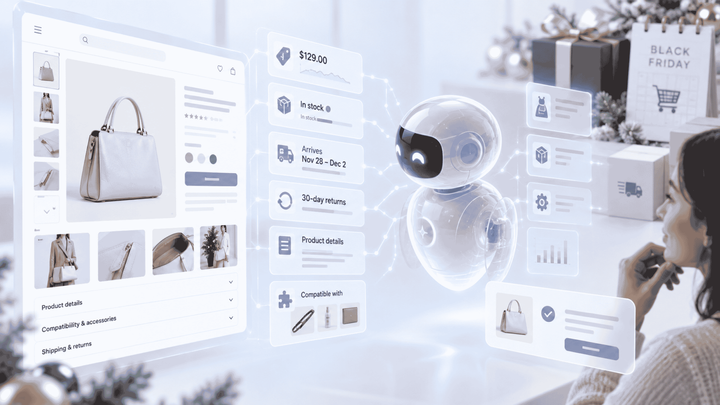
Responses render as scrollable product carousels with images, prices, star ratings, "View Product" and "Add to Cart" buttons. For fashion brands, the Outfit Builder renders complete looks with a hero image, coordinating items, and a combined outfit price. Every cart addition feeds into revenue impact analytics and customer information: Cart GMV, average cart value, and daily trends.
Agentic Intelligence, Not Simple Search
Under the hood, a traditional chatbot runs a basic vector similarity search over a knowledge base. Alhena's concierge uses agentic retrieval with specialized contextualizers: a ProductTaxonomyContextualizer that understands category relationships, a ProductMetadataContextualizer for attribute-aware retrieval (color, size, material, price range), and a help center DocumentationContextRetriever, and a HumanFeedbackContextRetriever that incorporates past human agent corrections.
Queries are rewritten with conversation history and user memory before retrieval, so "do you have it in blue?" correctly resolves "it" against the last-discussed product. A standard system would ask "what product are you referring to?"
Text, Voice, and Phone in One Platform
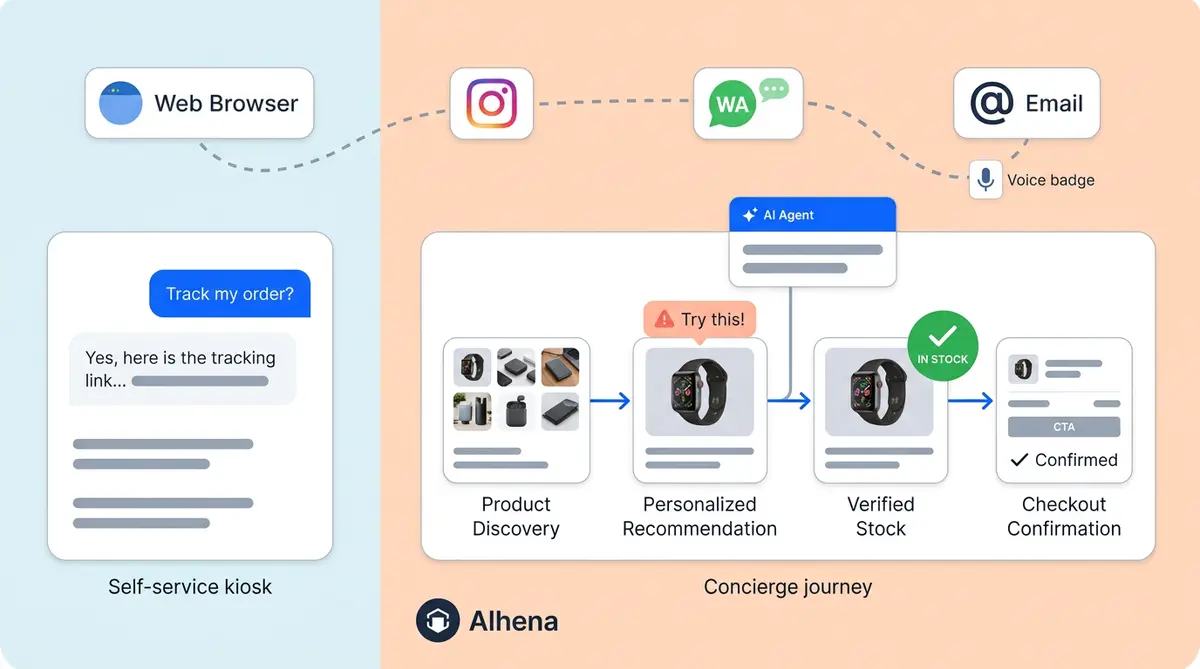
Voice AI isn't a bolt-on. It's a first-class channel with its own personality, configurable speaking speed, and SIP domain integration for inbound phone calls. Social Commerce extends the same concierge to Instagram DMs, WhatsApp, and SMS. A shopper who starts a conversation on Instagram and later visits your website quickly picks up right where they left off, creating connected interactions across every touchpoint.
When customer service escalation is needed, the Human Transfer agent collects contact info, respects business hours and timezones, tells the shopper what happens next, and hands full conversation context to the human agent through Agent Assist. Integration works with Zendesk, Gorgias, Intercom, and other major helpdesks.
The Bottom Line
A traditional bot optimizes for customer service deflection. An AI concierge optimizes for conversion, basket size, customer engagement, and retention. Everything that separates them, proactive nudges, adaptive quizzes, rich product UI, native cart actions, persistent personalization, multi-agent orchestration, serves that one distinction.
Puffy hit 63% automation of resolution with 90% CSAT. Victoria Beckham saw a 20% AOV increase. Manawa cut response times from 40 minutes to 1 minute. Companies can deploy in under 48 hours with zero dev resources.
Ready to see the difference? Book a demo with Alhena AI or start for free with 25 conversations.
Frequently Asked Questions
What is an AI concierge in ecommerce?
An AI concierge is a large language model-powered assistant that guides shoppers through the full buying journey, from product discovery to checkout. Unlike a basic chatbot, it uses persistent memory, real-time catalog data, and behavioral signals to deliver personalized, proactive recommendations across web, email, social, and voice channels.
What is the difference between an AI concierge and a chatbot?
Chatbots rely on keyword matching and scripted decision trees to answer preset questions reactively. AI concierges use LLMs with retrieval-augmented generation to understand natural language, remember past interactions, and take commerce actions like adding items to carts. The biggest functional difference is purpose: chatbots deflect support tickets, while AI concierges generate revenue.
Can an AI concierge replace a chatbot for customer support?
Yes. An AI concierge handles everything a chatbot does (FAQs, order tracking, return policies) while adding sales capabilities. Alhena AI’s Support Concierge resolves up to 70% of tickets without human help, and its Shopping Assistant drives 3x conversion rates. You get support deflection and revenue growth from a single platform.
How does an AI concierge drive ecommerce revenue?
AI concierges increase revenue by guiding shoppers to the right products through personalized recommendations, recovering abandoned carts with proactive outreach, and enabling in-chat checkout. Shoppers who interact with AI concierge tools convert at 4x the rate of unassisted visitors, and brands report AOV increases of 20% to 41%.
Is an AI concierge the same as an AI shopping assistant?
The terms overlap significantly. An AI shopping assistant focuses on product discovery and guided selling, while an AI concierge covers the full customer lifecycle including post-purchase support. Alhena AI combines both functions with a Product Expert Agent for shopping guidance and an Order Management Agent for post-purchase tasks and requests.
How long does it take to deploy an AI concierge?
Alhena AI deploys in under 48 hours with no developer resources needed. The system trains on your existing product catalog, knowledge base, and past support tickets. It integrates directly with platforms like Shopify, WooCommerce, Salesforce Commerce Cloud, and helpdesks like Zendesk, Gorgias, and Intercom.
What is agentic commerce and how does it relate to AI concierges?
Agentic commerce is the next step beyond AI concierges. While concierges guide and recommend, agentic AI autonomously researches, compares, negotiates, and completes purchases on behalf of shoppers. Gartner predicts AI agents will intermediate over $15 trillion in B2B spending by 2028. AI concierges are the bridge between today’s chatbots and tomorrow’s fully autonomous shopping agents.
How do I know if my store needs an AI concierge or a chatbot?
If your catalog is small, your queries are repetitive, and your only goal is cutting support costs, a chatbot may be enough. If you sell across multiple channels, have a large or complex catalog, and want AI to drive measurable revenue, you need an AI concierge. Use Alhena AI’s ROI calculator to model the expected return based on your specific traffic and conversion data.