Luxury brands need digital efficiency to scale. But the moment a digital interaction feels automated, transactional, or mass-market, it destroys the exclusivity and intimacy that defines high-end luxury commerce. That tension sits at the heart of every luxury e-commerce strategy in 2025 and 2026. The challenge is not deploying AI. It's deploying AI that feels like a private client advisor in a Mayfair boutique, not a chatbot on a checkout page.
Generic ecommerce AI handles returns, tracks orders, and answers FAQs. Luxury consumers don't need that. They need recognition, discretion, storytelling, and guidance. This guide covers six luxury-specific concierge workflows that generic tools simply cannot deliver, and shows how each one translates to measurable commercial results.
1. VIP Identification and Tiered Treatment
What generic AI does: Treats every customer the same. A first-time browser and a client who spent $40,000 last year get identical greetings, identical product grids, identical tone.
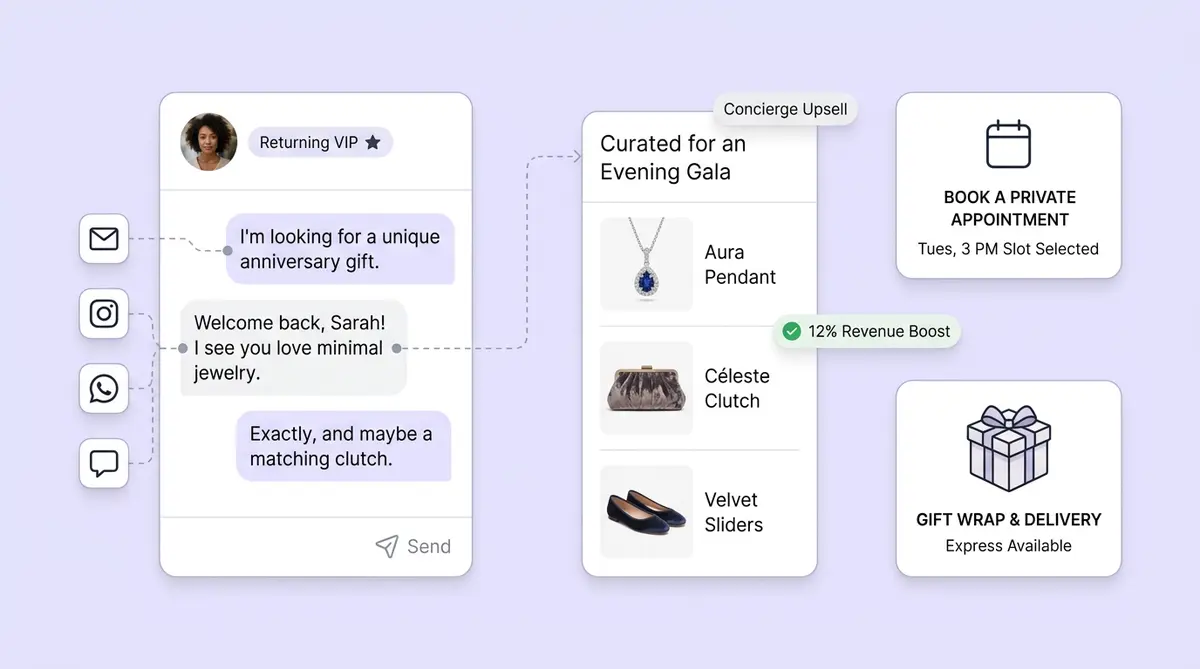
What a luxury AI concierge does: Recognizes returning high-value consumers through unified memory, past purchase history, and loyalty signals. The AI automatically adjusts its conversational tone, product curation depth, and service level. A VIP client might receive first access to new collections, private shopping links, or immediate escalation to a dedicated human advisor. None of this requires the client to identify themselves or enter a loyalty number. The AI already knows.
This tiered recognition mirrors what happens in the best physical boutiques, where the associate knows your name before you reach the counter. Alhena AI's Support Concierge maintains client profiles across web chat, email, Instagram DMs, and WhatsApp, so a client who browsed via Instagram last Tuesday and returns on the website today picks up exactly where they left off.
2. Discreet Upselling and Wardrobe Completion
What generic AI does: Shows "customers also bought" carousels and pop-up cross-sells. Aggressive, transactional, and completely wrong for luxury.
What a luxury AI concierge does: Suggests complementary pieces as styling completions rather than add-ons. When a client adds a tailored blazer to their cart, the AI frames a bag recommendation as "this completes the silhouette for your board dinner" rather than "frequently bought together." The upsell feels like personal wardrobe advice because it is, grounded in the brand's own editorial styling guidelines and catalog relationships.
This approach works. Victoria Beckham saw a 20% increase in average order value after deploying Alhena AI, proving that luxury-caliber AI drives measurable commercial results without compromising brand perception. The key is agentic checkout that walks the client from styling suggestion to pre-populated cart in one fluid conversation, removing friction at the moment of highest purchase intent.
3. Appointment and Personal Shopping Booking
What generic AI does: Drops a "contact us" link or pushes the visitor to a separate scheduling page. The conversation breaks. Context is lost.
What a luxury AI concierge does: Offers and books private in-store appointments, virtual styling sessions, or personal shopping calls within the same conversation thread. A client browsing evening wear can say "I'd love to try these on at your Madison Avenue store" and the AI confirms availability, suggests a time, and reserves the pieces for the visit. The transition from digital discovery to human-led clienteling happens without breaking the experience.
This workflow bridges the gap that costs luxury brands the most revenue: the 56% of luxury clients BCG found are unsatisfied with their shopping experience, largely because digital and in-store feel disconnected. Alhena's Agent Assist gives human client advisors full AI-powered context when the conversation escalates from digital to personal, so the in-store associate already knows what the client viewed, discussed, and hesitated on.
4. Gifting and Occasion-Driven Workflows
What generic AI does: Points to a "gifts" category page. Maybe filters by price. That's it.
What a luxury AI concierge does: Runs a guided gifting conversation that feels like working with a personal shopper and virtual concierge. The AI identifies the occasion (anniversary, birthday, thank-you), profiles the recipient through conversational questions ("What's her style? Does she prefer gold or silver? Is this for a formal event?"), recommends curated options from the catalog, and handles gift wrapping, personalization, and delivery coordination within a single thread.
Luxury ecommerce sees significant gifting volume where the buyer is not the end user. These transactions demand a different kind of guidance. The buyer often lacks product knowledge and relies entirely on the advisor's taste and expertise. A well-configured AI concierge fills this role at scale, asking the right questions and curating with the same judgment a seasoned boutique associate would bring. Beauty and skincare brands see particularly strong results with gifting workflows, where Alhena's Product Expert Agent matches occasion context to specific product recommendations.
5. Multi-Session Memory Across Consideration Cycles
What generic AI does: Starts fresh every visit. No memory of previous conversations, browsed products, or stated preferences. Every interaction feels like meeting a stranger.
What a luxury AI concierge does: Remembers what a client viewed, discussed, and hesitated on across multiple visits, channels, and weeks of deliberation. The next interaction picks up naturally: "I noticed you were considering the navy overcoat last week. It's still available in your size, and we just received matching cashmere scarves from the same collection."
This matters more in luxury than any other vertical. A $3,500 coat is not an impulse buy. Clients research across multiple sessions, compare options, consult partners, and return when ready. If the AI resets each time, the brand loses the engagement and relationship advantage that justified the price premium in the first place. Alhena AI's unified memory layer maintains continuous context across web, email, Instagram, and WhatsApp, so whether the client messaged on social media three weeks ago or chatted on the website yesterday, the conversation never starts from zero.
Want the technical details on how this memory layer works? Our deep dive into unified memory architecture covers identity resolution across channels, the UserProfile and UserMemory data layers, fact extraction from conversations, and the privacy controls that keep high-net-worth client data secure.
6. Provenance, Craftsmanship, and Storytelling
What generic AI does: Reads back product specs: "100% Italian wool, dry clean only, available in navy and charcoal." Accurate but soulless.
What a luxury AI concierge does: Articulates heritage, materials sourcing, artisan techniques, and brand history with the same depth and reverence that a trained boutique associate would. When asked about a handbag, the AI doesn't just list dimensions. It explains that the leather comes from a family-run tannery in Tuscany, that each bag takes 18 hours of hand-stitching, and that the closure hardware references the maison's original 1920s designs.
Luxury consumers buy stories as much as products. The AI must ground every recommendation in brand narrative rather than feature lists. Alhena AI achieves this through <a href="https://alhena.ai/blog/ai-brand-voice-luxury-heritage/">brand voice training</a> and customization that matches each house's unique tone and personality, pulling from your product catalog, editorial content, and brand guidelines to deliver responses that feel authored by your creative team, not generated by a machine. Rich product cards with editorial-quality presentation inside conversations complete the picture, ensuring visuals match the narrative quality.
Why These Workflows Drive Revenue, Not Just Satisfaction
Each of these six workflows directly impacts commercial metrics. VIP recognition increases repeat purchase rates and lifetime value. Discreet wardrobe completion drives higher average order values. Appointment booking converts digital browsers into in-store buyers (where conversion rates run 10x higher). Gifting workflows capture revenue from buyers who would otherwise leave because they didn't know what to choose. Multi-session memory shortens luxury consideration cycles. Storytelling builds the emotional conviction that justifies premium pricing.
For luxury retail brands and online retailers, the combined effect is what Tatcha experienced with Alhena AI: a 3x conversion rate, 38% AOV uplift, and 11.4% of total site revenue attributed to the AI concierge. Across deployments, Alhena brands typically see around 30% lifts in average order value and over 80% automation of routine inquiries, freeing human advisors to focus on the high-touch interactions that grow lifetime value. These results show businesses benefit from treating AI as a revenue-driving client advisor, not a cost-cutting ticket deflector.
Scaling Intimacy Without Losing It
The real promise of luxury AI concierge technology is scaling what was previously unscalable: the one-on-one client advisory relationship. A physical boutique can serve a handful of VIP clients at a time. An generative AI concierge configured with the right workflows, brand voice, and product depth can deliver that same quality of service to thousands of customers and clients simultaneously across every channel.
Not sure how an AI concierge differs from a standard chatbot? Our complete comparison breaks down the 6 key differences.
Evaluating specific vendors? Our Alhena AI vs Zowie breakdown and Shopify + Gladly integration guide cover the feature differences that matter most for luxury brands.
Alhena AI is purpose-built for this. The platform combines unified memory across channels for VIP recognition, brand voice training for each house's unique personality, agentic checkout for frictionless purchasing, and Agent Assist for smooth AI-to-human handoffs. Fashion, beauty, skincare, and jewelry brands on Shopify or Salesforce Commerce Cloud can deploy in under 48 hours with no developer resources required.
Luxury brands that treat AI as a cost-cutting chatbot will erode their brand equity. Those that deploy AI as a digital extension of their finest client advisor will scale intimacy, drive higher AOV, and serve more clients at the level previously reserved for in-store VIPs.
Ready to bring white-glove concierge service to every digital engagement touchpoint? Book a demo with Alhena AI or start for free with 25 conversations.
For a deeper dive into the financial case, see our guide to the full ROI framework for luxury AI concierges.
Frequently Asked Questions
How does AI concierge technology recognize VIP clients across digital channels without login?
Alhena AI uses unified memory that links client interactions across web chat, email, Instagram DMs, and WhatsApp to build persistent profiles. When a returning VIP client engages on any channel, the AI recognizes them through past purchase history and conversation context, then automatically adjusts tone, product curation depth, and service tier without requiring the client to identify themselves.
Can luxury brands use AI for discreet upselling without damaging brand perception?
Yes. Alhena AI frames complementary product suggestions as styling completions rather than transactional cross-sells. Instead of 'customers also bought,' the AI recommends pieces that complete a look for a specific occasion, making the upsell feel like personal curation advice. Victoria Beckham achieved a 20% average order value increase with this approach.
How does AI handle luxury gifting workflows where the buyer isn't the end user?
Alhena AI runs a guided gifting conversation that identifies the occasion, profiles the recipient through conversational questions about style preferences and lifestyle, curates appropriate options from the catalog, and coordinates gift wrapping, personalization, and delivery within a single thread. The experience mirrors working with a personal gift concierge at a luxury boutique.
Does AI concierge memory persist across multiple luxury shopping sessions over weeks?
Alhena AI maintains continuous context across sessions, channels, and weeks of deliberation. If a client considered a navy overcoat last Tuesday via Instagram and returns to the website two weeks later, the AI picks up naturally with awareness of what was viewed, discussed, and hesitated on. This multi-session memory is critical for luxury purchases where consideration cycles span days or weeks.
How does Alhena AI preserve luxury brand voice and storytelling in AI conversations?
Alhena AI is trained on each brand's specific product catalog, editorial content, and brand guidelines before deployment. The AI articulates heritage, materials sourcing, artisan techniques, and design history with the depth that luxury shoppers expect, grounding every recommendation in brand narrative rather than generic feature lists. Rich product cards with editorial-quality presentation complete the in-conversation experience.
How does Alhena AI protect the privacy and discretion of high-net-worth client data?
Alhena AI enforces enterprise-grade data controls designed for the discretion luxury clients expect. Client profiles are protected with encrypted data in transit and at rest, role-based access that limits which team members can view full profiles, and configurable data-retention policies. Brands can mask or redact sensitive fields in the concierge interface so advisors deliver personalized service without exposing full client identifiers. These controls support GDPR and CCPA obligations while maintaining the white-glove experience.
How does Alhena AI compare to Zowie, Gladly, or Salesforce for luxury concierge use cases?
Support-focused platforms like Zowie, Gladly, and Salesforce Einstein excel at ticket deflection and agent productivity, but they weren't built for luxury commerce workflows. Zowie focuses on automating repetitive support queries and lacks in-conversation cart creation. Gladly organizes conversations around customer profiles, which helps continuity, but doesn't offer agentic checkout or brand-voice training tuned to luxury storytelling. Salesforce Einstein resets context each session and prioritizes CRM workflows over guided selling. Alhena AI combines persistent multi-session memory, agentic checkout that pre-populates carts inside conversations, and editorial-quality brand voice training, delivering results like Tatcha's 3x conversion rate and 11.4% of total site revenue. For a detailed feature-by-feature breakdown, see our Alhena AI vs Zowie comparison.
How does Alhena AI connect with loyalty platforms and CRMs to identify VIP tier status?
Alhena integrates with your CRM or CDP to map customer identifiers and pull loyalty tier, purchase history, and preference data into the conversation in real time. When a VIP client engages on any channel, the AI surfaces their tier status and tailors its tone, product recommendations, and escalation behavior accordingly. Administrators define which signals trigger VIP treatment, so brands retain full control over tiering logic without requiring clients to identify themselves.
Can luxury brands control what client data the AI stores or reveals to human advisors?
Yes. Alhena AI offers configurable discretion settings that let brands limit data exposure at every level. You can choose ephemeral session-only memory, restrict which attributes are visible to advisors, pseudonymize client records, and set per-market retention rules. Sensitive fields like payment details or full identifiers can be masked by default, so human advisors see only the context they need to deliver personalized recommendations without compromising client privacy.