The luxury sector lost roughly EUR 100 billion in enterprise value over the past 12 months, according to Bain & Company's 2025 luxury report. EBIT margins slid to 15-16%. Against that backdrop, the question isn't whether an AI concierge belongs in a luxury brand's stack, whether fashion, hotels, AI travel, or hospitality. Travel concierge platforms, front desk teams, and guest concierge services face the same question: what is an AI concierge actually worth in terms a CFO cares about?
This post breaks down the math: the returning-customer curve, the stylist equivalency ratio, margin protection, brand-voice risk, and a four-factor payback model for finance.
The Metric Luxury Gets Wrong About AI
Most luxury businesses evaluate an AI concierge the same way they'd evaluate a help desk tool: tickets deflected, cost per inquiry and interaction, and headcount saved. That approach misses the point.
Cost savings are real. AI concierge interactions run $0.50-$0.70 each versus $8-$15 for a human agent. But for a luxury brand spending $175-$890 to acquire a single customer, trimming a few dollars off support barely moves the needle.
The real value sits on the revenue side. Tatcha deployed Alhena AI and saw a 3x conversion rate, a 38% AOV uplift, and 11.4% of total website revenue attributed directly to the AI assistant. Over one in ten revenue dollars came from AI-assisted engagement. Victoria Beckham saw a 20% increase in average order value after deploying Alhena's AI concierge.
The Returning Customer Curve: Why Year 2 Matters More
Standard ROI models stop at first-purchase metrics. But luxury economics compound differently. Luxury brands carry the highest LTV-to-CAC ratio in e-commerce: 5.2:1, per Mobiloud. A 5% higher retention lifts profits 25-95%.
An AI concierge changes this math. A shopper who buys a $320 serum after an AI-guided skin analysis comes back in 90 days for the refill, adds the cleanser at 180 days, and by the 365-day mark, her customer lifetime value looks nothing like the single-transaction figure from day one.
Standard chatbots and generic AI companion tools can't show this curve. They don't offer concierge services that track revenue over time. A commerce-focused concierge services platform retains memory of the full journey: first conversation, repeat visit, and cumulative revenue.
The Stylist Equivalency Ratio
A luxury personal shopper costs $50,000-$90,000 fully loaded per year and handles roughly 40-50 conversations per day. Alhena's AI handled approximately 9x more conversations than the human team at Tatcha, with 82% deflection and 81% CSAT. At Manawa, response time dropped from 40 minutes to 1 minute.
If one AI concierge handles the volume of 8-9 associates at comparable satisfaction, you're looking at $400,000-$810,000 in equivalent labor from a single deployment. That's not a software subscription. That's a restructuring of operations.
The human team doesn't disappear. Victoria Beckham redeployed their team to VIP outreach, AI travel concierge services, styling consultations, and the kind of emotional connection and human touch that justifies a $280 moisturizer. The AI delivered tailored responses to customer needs, handling product inquiries and routine questions. That's talent reallocation, not cost cutting.
Margin Protection, Not Just Revenue Lift
Bain's data shows 35-40% of luxury products now sell below full price. Every discount erodes brand equity and language. An AI concierge protects margins differently: instead of offering 15% off, it guides shoppers to the right product at full price.
A customer overwhelmed by 40 products either bounces or picks the cheapest option. With an AI concierge that understands her skin type and concerns, she buys the $320 serum, not the $85 starter kit. That's a 38% AOV uplift at full margin.
Returns matter too. AI-guided conversational discovery reduces return rates by up to 35%. Every prevented return is a product that doesn't need to be marked down or written off. Alhena's Product Boost feature lets brands surface high-margin items in real-time conversations.
The Brand-Voice Risk Premium
The valid counterpoint: what does a bad AI concierge cost? In 2024, Air Canada's chatbot fabricated a bereavement fare policy. A tribunal ruled the airline liable, establishing the precedent that AI agents are extensions of the company's voice.
For luxury, the stakes are higher. One viral screenshot of an AI recommending a competitor's product or using the wrong tone can cost more than a year of AI investment. Klarna replaced 700 agents with AI, then reversed course and rehired humans after quality degraded.
Purpose-built commerce AI like Alhena's Shopping Assistant grounds every response in the brand's actual product catalog, language guidelines, and policies. No hallucinations, always on-brand. These AI agents deliver instant, accurate answers. Brand-voice governance isn't a cost centre. It's part of the ROI calculation.
The 4-Factor Luxury AI Payback Model
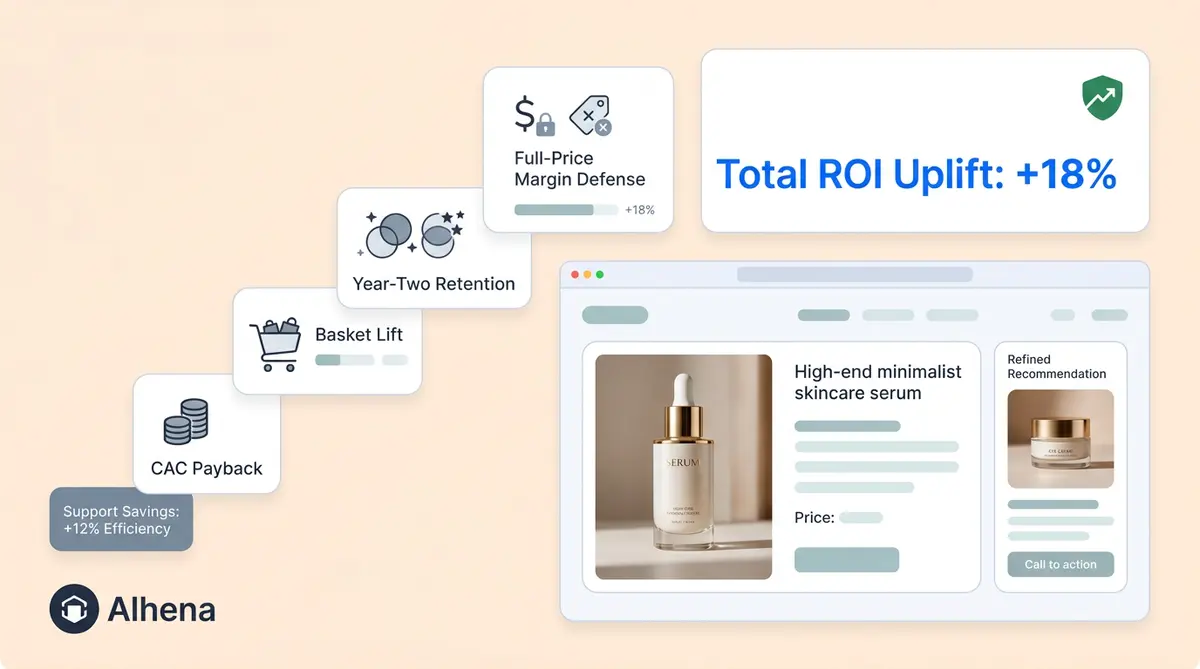
Here's the framework you can hand to your CFO. Four factors, each compounding on the others.
1. Acquisition Efficiency. With luxury CAC at $175-$890, AI concierge services converting at 3x the site average recovers acquisition costs faster. BCG estimates personalization reduces acquisition costs by up to 50%.
2. Basket Economics. AOV uplift of 20-38% at full price through guided discovery, not discounts. AI-powered recommendations show up to a 369% increase in AOV.
3. Retention Compounding. Personalized AI interactions drive 60% higher repeat rates and 33% higher LTV. Beauty and skincare brands see this most clearly in replenishment cycles.
4. Margin Defense. Fewer returns (up to 35% reduction), fewer markdowns, higher full-price sell-through. With U.S. online returns costing $743 billion in 2024, even a small improvement creates meaningful margin recovery.
No single factor justifies investment alone. Together, they create a payback model that looks very different from "tickets deflected". The compounding nature means returns look better at 18 months than at 6.
How Alhena AI Powers the Luxury Math
Alhena AI was built to transform and deliver e-commerce revenue, not just support deflection. It automates workflows through conversational interactions; its Product Expert Agent handles guided discovery, shade matching, and cross-sells grounded in your catalog. The Order Management Agent resolves shipping, returns, and order questions instantly, freeing your team for relationship building.
The platform works across Instagram DMs, WhatsApp, web chat, email, and voice. It integrates with Shopify, Salesforce Commerce Cloud, Zendesk, and Gorgias. Deployment takes under 48 hours without dev resources.
Built-in analytics use natural language processing and language understanding to optimize and track every conversation through to conversion. That's what you need to build and validate the four-factor payback model.
Key Takeaways
- Stop measuring AI concierge value through support cost savings alone. The real ROI lives in conversion rates (3x), AOV uplift (20-38%), and lifetime value compounding.
- Year 2 matters more than year 1. Personalized interactions drive 60% higher repeat rates and 33% higher LTV.
- One AI concierge replaces the output of 8-9 associates at comparable satisfaction, but the best brands redeploy humans to high-value work.
- Margin protection is a separate lever. AI-guided conversational discovery reduces returns by up to 35% and protects full-price sell-through.
- Use the 4-factor model (acquisition efficiency, basket economics, retention compounding, and margin defense) to build a CFO-ready business case.
Ready to run the luxury math for your brand? Book a demo with Alhena AI to see the payback model in action, or start free with 25 conversations. Use our ROI Calculator for projected impact.

Frequently Asked Questions
What is an AI concierge in luxury ecommerce?
An AI concierge is a purpose-built virtual shopping assistant that guides luxury customers through product discovery, shade matching, size recommendations, and personalized styling. Unlike generic chatbots that only handle support tickets, an AI concierge drives revenue by converting website users into buyers through expert-level product knowledge grounded in verified catalog data.
How do you measure the ROI of an AI concierge?
The most accurate approach uses four factors: acquisition efficiency (how fast you recover CAC), basket economics (AOV and units per order), retention compounding (repeat rate multiplied by lifetime value), and margin defense (full-price sell-through and return rate reduction). Tatcha saw 11.4% of total website revenue attributed to their AI concierge, which is a far more meaningful metric than tickets deflected.
How many human stylists can one AI concierge replace?
Based on Alhena AI deployment data, one AI concierge handles the conversation volume of approximately 8-9 human associates at comparable satisfaction scores (81-86% CSAT). At 0,000-0,000 fully loaded cost per associate, that represents 00,000-10,000 in equivalent labor. Most luxury brands redeploy human staff to high-touch VIP work rather than cutting headcount.
Does an AI concierge increase average order value for luxury brands?
Yes. Victoria Beckham reported a 20% AOV increase after deploying Alhena AI, while Tatcha saw a 38% AOV uplift. The mechanism is guided discovery at full price: the AI matches customers to the right product based on their preferences, resulting in higher-value purchases without discounting, creating premium experiences.
How does an AI concierge protect luxury brand margins?
AI concierges protect margins in two ways. First, they guide hesitant shoppers to the perfect product at full price instead of the cheapest safe option, reducing the need for promotional discounts. Second, they cut return rates by up to 35% through better product matching, which prevents the markdown-and-restock cycle that erodes margins.
What are the risks of using AI in luxury customer service?
The primary risk is brand-voice damage from hallucinations or off-brand responses. Air Canada was held legally liable when its chatbot fabricated a fare policy. Purpose-built commerce AI like Alhena eliminates hallucination risk by grounding every response in verified product data, intelligence, artificial intelligence, and verified catalog information and brand-specific knowledge bases, with watchdog systems that prevent off-brand outputs.
How long does it take to see ROI from a luxury AI concierge?
Most brands report measurable ROI within the first quarter through conversion rate and AOV improvements. The full payback model, including retention compounding and margin protection, typically shows strongest results at 12-18 months. Alhena AI deploys in under 48 hours with no dev resources, so time-to-first-value is measured in days, not months.
Can an AI concierge match the quality of a human personal shopper?
For routine product guidance, yes. Alhena AI achieves 81-86% CSAT across luxury deployments, comparable to human associates. The AI excels at instant responses (1 minute vs. 40 minutes), round the clock, always-on availability (round the clock service) with no missed calls, zero missed calls availability and 24/7 accessibility across time zones and multiple languages with multilingual support and multilingual service, seamless, frictionless integration, seamless, and consistent brand Voice AI. Voice AI offers Human associates still outperform AI on complex emotional interactions, which is why the best luxury brands pair both: AI for scale, humans for depth.