A vendor demo is a scripted path through a sandbox with a curated catalogue and a cooperative tester. Every one of those conditions is absent in production.
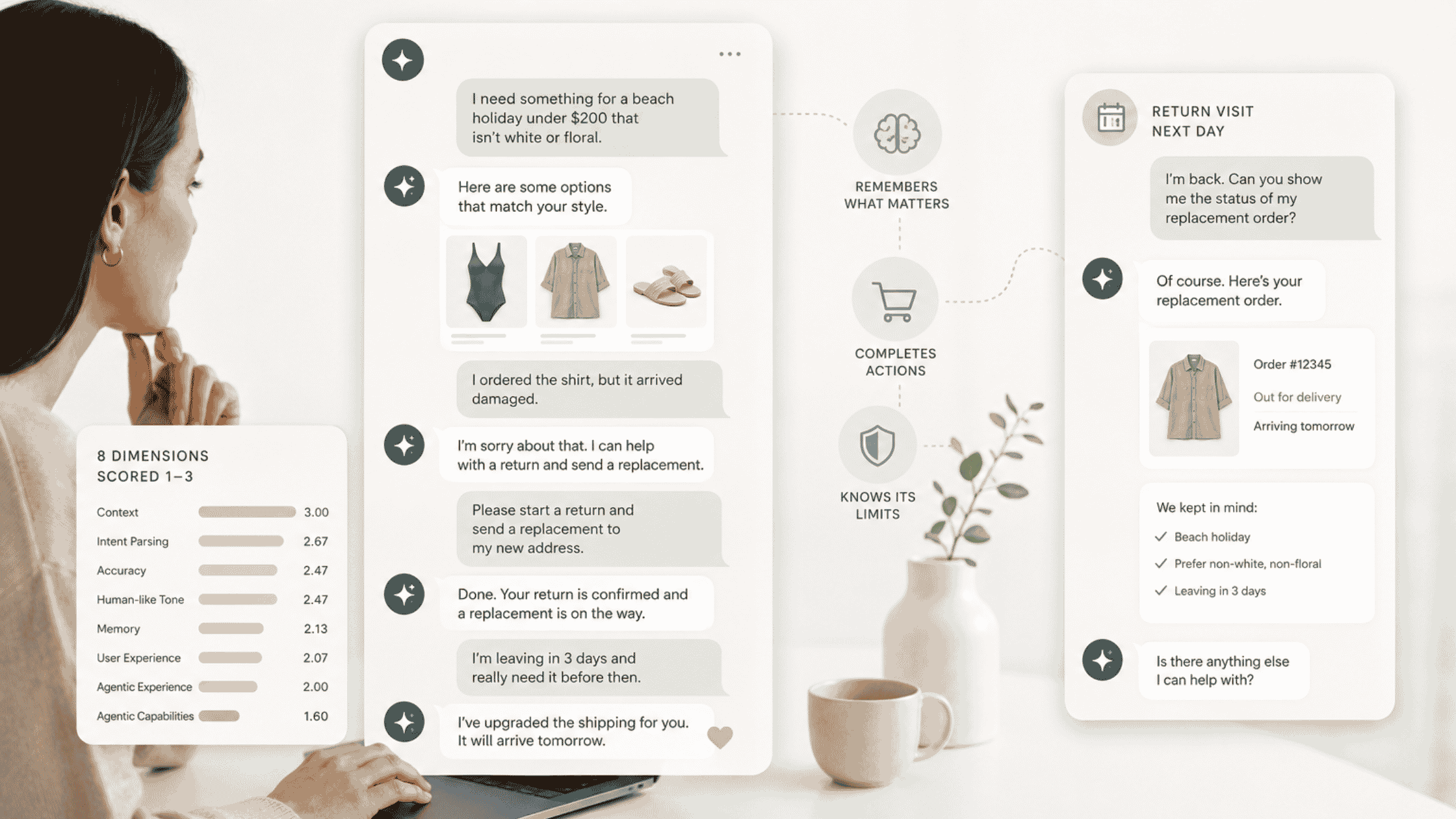
Test on a live storefront, not a demo. Use one continuous conversation spanning product discovery, a post-purchase issue, an agentic action and an emotional moment. Score across eight dimensions, test memory at three tiers, and infer no capability from marketing. That is the exact method Alhena used on 15 live deployments in 2026.
Why do demo environments mislead?
Not maliciously: structurally. A sandbox lets you assess the output of a happy path and nothing else. Alhena's 2026 stress test removed every one of those artificial conditions.
Each assistant was engaged on a real brand's public storefront, using each vendor's largest verifiable live deployment so nobody was judged on a pilot. The tester behaved as an ordinary shopper.
The results were sobering. All 15 could answer. Only 4 could complete a real action. Only 1 remembered a shopper across sessions.
Why is evaluating an AI agent different from evaluating a chatbot?
A chatbot produces one output per input. You can assess correctness by comparing what it said against what it should have said, across a static set of questions, and the score means something.
An AI agent does not work that way. It takes a multi-step path: it interprets, retrieves, calls a tool, checks the result, and sometimes writes to your systems. The final message is the smallest part of what happened. Two runs of the same request can take different routes and leave different side effects, because agent behaviour is not deterministic.
That changes what you are evaluating. You are no longer scoring a sentence. You are evaluating a workflow: whether the execution reached the end, whether each step was authorised, and whether the outcome the customer wanted actually occurred.
Three consequences follow, and they shape every rule below.
- Task completion is the primary measure, not correctness. An AI agent can be right about every fact in a conversation and still finish nothing. Field-wide, Accuracy averaged 2.47 while Agentic Capabilities averaged 1.60.
- The path matters as much as the output. Capture where the execution stopped, not only what the customer was told. An AI agent that failed at the write step and one that never attempted it produce a similar message and need completely different fixes.
- Behaviour drifts, so evaluation is a loop rather than an event. A single test date tells you about a single test date. Re-evaluate on a fixed cadence and after every change to prompts, tools or catalogue.
What are the five rules of the framework?
RULE 1One continuous conversation, four phases
Real shoppers do not send one clean message. They wander, backtrack, change their mind and get annoyed.
- Product discovery: an open, constrained question (“something for X, under Y, that avoids Z”).
- A post-purchase issue introduced mid-flow.
- An agentic action: a return, cancellation or address change. This is the multi-step workflow the whole evaluation turns on.
- An emotional moment: frustration, urgency, a gift with a deadline.
Testing these separately hides the failures. Running them end to end in a single conversation surfaces memory reset (5 of 15) and the handoff cliff (4 of 15), which only appear under conversational load.
RULE 2Test memory at three tiers
- Within-chat: state a constraint in turn 2, request a recommendation in turn 9.
- Logged-in: does it use order history, sizes and past conversations?
- Return-visit: close the tab, come back a day later. Does anything carry?
Tier three is where the field collapses: 1 of 15. Evaluate all three, because an agent can pass the first and fail the third, and only the third predicts whether a returning customer is recognised.
RULE 3Score eight dimensions, 1 to 3
Use a fixed rubric so two evaluators reach comparable scores. These are the field averages to measure yourself against.
RULE 4Use your vertical's signature task
Every category has one hard thing its best salesperson does. Shade match from a photo. A fragrance-free routine on budget. A mattress for two people with conflicting needs.
Define yours before you book a single vendor call, then make the AI agent do it live. Generic questions produce generic scores, and task completion on a generic question tells you nothing about task completion on yours.
RULE 5Infer nothing from marketing
Every claim must be observed. If you did not watch it complete the action, it cannot complete the action. Observation is the only validation available to a buyer, and the retrieval of a correct-sounding answer is not evidence of anything downstream, and this single rule is what separated the findings from the market's self-description.
What does the scoring sheet look like?
For each phase of the conversation, record six judgments against the same rubric.
| Question | Dimension |
|---|---|
| Did it understand? | Context, Intent Parsing |
| Was it right? | Accuracy |
| Did it hold the constraint? | Memory |
| Did it do the thing? | Agentic Capabilities |
| Was the doing any good? | Agentic Experience: did it confirm, explain consequences, offer alternatives? |
| Would a human have done better? | Human-like Tone, User Experience |
Then check for the seven failure modes: answer-only fallback, dead-end recommendation, UI disconnect, memory reset, catalog dumping, handoff cliff and unsafe confidence.
What does “good” look like?
Six criteria that double as your acceptance bar.
- Completes the task: not instructions, but completion.
- Sells inside the chat: product cards, comparisons, add-to-cart in-thread.
- Moves the storefront: conversation and commerce on one surface.
- Remembers responsibly: recalls what matters, transparently.
- Has vertical expertise: reasons like a specialist in your category.
- Knows its limits: declines what it should, then escalates with full context.
How do you keep evaluating after you go live?
The framework above answers a buying question. It tells you what an AI agent can do on your storefront on one afternoon. It does not tell you what the agent does on a Tuesday in March, after your catalogue has changed, a prompt has been edited and a new integration has shipped.
Buying decisions need a stress test. Running deployments need observability, and the two have different owners: your support lead runs the framework, your engineering team or the vendor runs the production side.
- Traces, not transcripts. A transcript shows what the agent said. A trace shows what it retrieved, which tools it called, which API returned an error and where the execution stopped. Only the second tells you why a task failed rather than that it failed.
- A regression suite built from real failures. Every failure you find becomes a test case. Ten conversations that broke last quarter make a better evaluation dataset than a hundred synthetic ones, because they are your edge cases rather than someone else's.
- An audit trail for every action. Each write to your order system logged with what the agent did and on whose authority, reviewable at volume rather than by sample.
- A rubric that does not move. Score against the same eight dimensions each quarter. If the rubric drifts, you cannot tell improvement from noise.
Close the loop by feeding what you learn in production back into the next evaluation, so the two run as one cycle rather than two projects. Ask any vendor which of these they expose. A platform that can only show you curated conversations cannot support continuous evaluation, whatever the demo looked like.
What are the five common evaluation mistakes?
- Testing accuracy only. Accuracy averaged 2.47 field-wide: it no longer differentiates.
- Believing containment metrics. An agent that explains a return without completing it is contained and unresolved.
- Running short conversations. Under ten turns, memory failures do not surface.
- Never testing the return visit. The single most discriminating test available, and almost nobody runs it.
- Not testing restraint. Ask something the agent should refuse. In regulated categories the confident answer is the liability.
All five share a root: define your success criteria before the test, in writing, so the result is a measurement rather than an impression.
What does this framework not measure?
Every methodology has an edge, and stating yours is part of making the results usable. Ninety minutes on a live storefront answers one question well: can this AI agent do the job a shopper actually came for. Five things it does not answer.
- Cost and latency at volume. A single evaluation session says nothing about what the workflow costs per conversation at ten thousand a day, or how response times hold under load. Ask for production numbers from an existing customer at your scale.
- Security and prompt injection. This benchmark measures what breaks when an ordinary shopper behaves ordinarily. Adversarial testing needs different testers, different success criteria and a different report.
- Multilingual and accessibility coverage. An AI agent evaluated in one language, by one person, on one device, has been evaluated in one language, by one person, on one device.
- Incident behaviour. What the agent does when an API is down or a tool times out matters more than what it does when everything works, and no scheduled test will surface it.
- Compliance posture. Whether transcripts are auditable and claims defensible in your jurisdiction is a legal assessment rather than a conversational one.
None of these are reasons to skip the stress test. They are the five questions to put alongside it, so the evaluation you take to an internal decision covers the whole picture rather than the part that is easiest to observe.
Key takeaways
- Test live, never in a demo environment. Every artificial condition hides a real failure.
- One continuous conversation across four phases surfaces failures that isolated intent tests miss.
- The return-visit test is the most discriminating: only 1 of 15 deployments passed it.
- Use the field averages as your baseline, from Context 3.00 down to Agentic Capabilities 1.60.
- Observe, don't infer. If you did not watch it happen, mark it no.
- State what the framework does not cover: cost at volume, security, language coverage, incident behaviour and compliance sit outside it.
- Evaluation does not stop at purchase. Traces, a regression suite and an audit trail are what keep an autonomous agent honest in production.
Frequently asked questions
About ninety minutes per vendor on your own live storefront, plus a return visit the next day. Evaluate one continuous conversation across discovery, a post-purchase issue, an agentic action and an emotional moment, then score the AI agent on eight dimensions.
Yes. A demo is a scripted path through a curated catalogue with a cooperative tester, and every one of those conditions is absent in production. Alhena tested only live deployments in 2026 for exactly this reason.
Different question, different owner. An automated eval measures correctness against a fixed dataset and catches regressions between builds, which is how you keep an autonomous multi-step workflow from drifting. This framework measures whether a real shopper's job gets done on your live storefront, which no offline evaluation can observe. Run both: the eval protects the model, the stress test protects the customer.
Move from a one-off test to observability. Capture traces rather than transcripts, so you can see which tools the agent called, what each one returned as output, and where the workflow stopped. Re-score the same eight dimensions each quarter against the same rubric. A platform that cannot show you an AI agent trace can tell you that a task failed, but not why.
Turn every failure into a test case. A conversation that lost the fragrance constraint becomes a permanent regression test, and ten of those make a better evaluation dataset than a hundred synthetic ones because they are your edge cases. Re-run them after every prompt change, integration update or catalogue migration. Agent behaviour is not deterministic, so a fix verified once is not a fix verified.
Yes, and separately. This framework measures what breaks when an ordinary shopper behaves ordinarily, which is what Alhena tested in 2026. Prompt injection and adversarial probing are a security exercise with different testers and a different success criteria, and passing one says nothing about the other.
Both, and the path is the part teams skip. The final answer tells you what the customer saw. The execution trace tells you which tool was called, what output came back and where the workflow stopped. An AI agent that hit an API error and one that never attempted the action produce a similar-sounding reply and need entirely different fixes, so evaluating the answer alone will send you after the wrong problem.
On a fixed cadence and on every change. Quarterly against the same rubric so you can compare like with like, plus a regression run after any prompt edit, tool change or catalogue migration. Agent behaviour is not deterministic, so a workflow that passed in January is not evidence about March. Treat evaluation as a loop that feeds production learning back into the next test.
Someone who handles real customer conversations, not only the person who owns the vendor relationship. Support leads recognise the failure patterns faster because they already know which intents generate repeat contacts on your storefront.
One long conversation reveals more than twenty short ones, because memory reset and handoff failures only surface under conversational load. Depth beats volume, provided the multi-phase conversation spans discovery, post-purchase, an action and an emotional moment.
Treat that as information. The methodology behind Alhena's 2026 benchmark rested on one rule: infer no capability from marketing. If you cannot observe it on your own site, the safe assumption is that it is not there.
The return visit. Close the tab, come back a day later and see whether anything carries. Only 1 of 15 deployments passed it in 2026, which makes it the most discriminating check available and the one almost nobody runs. That figure comes from Alhena's 2026 Agentic CX Stress Test.
Every action taken against your systems, with the input that triggered it, the output returned to the customer and the outcome. That audit trail is what lets you answer a compliance question at volume rather than by hand-picking conversations, and it is the first thing to ask a vendor to demonstrate in a regulated category.
Use the field averages as your baseline: Context 3.00, Intent Parsing 2.67, Accuracy 2.47, Memory 2.13, Agentic Capabilities 1.60. Anything at or below those on the bottom four dimensions is a median product. Source: Alhena's 2026 stress test of 15 live deployments.
Yes, and it is the fastest way to learn whether your current deployment sits at the field median. Score the AI agent, compare, then decide whether the gap is a configuration problem or an architectural one you cannot tune away.
Testing accuracy only, believing containment metrics, running short conversations, never testing the return visit, and never testing restraint. The first is a solved problem and the rest hide the failures that matter.
Ask the AI agent something it should decline, such as a medication interaction or a safety claim it cannot verify. Then check two things: that it declines with a named referral, and that the conversation stays commercially useful afterwards. In a regulated category this is a compliance test as much as a quality one.
Use the ten-question stress test
The full methodology, the eight-dimension scoring sheet and the ten diagnostic questions.