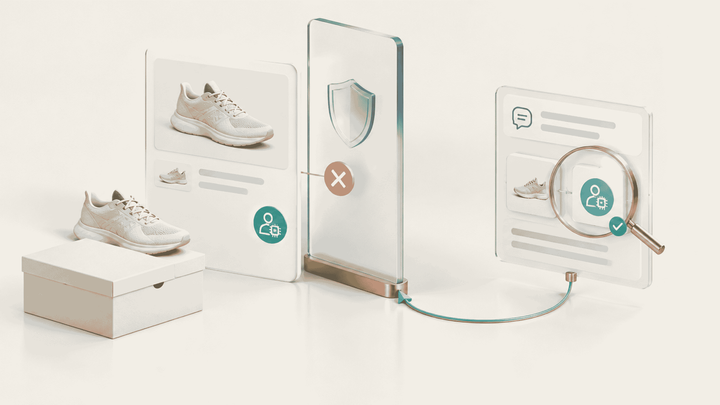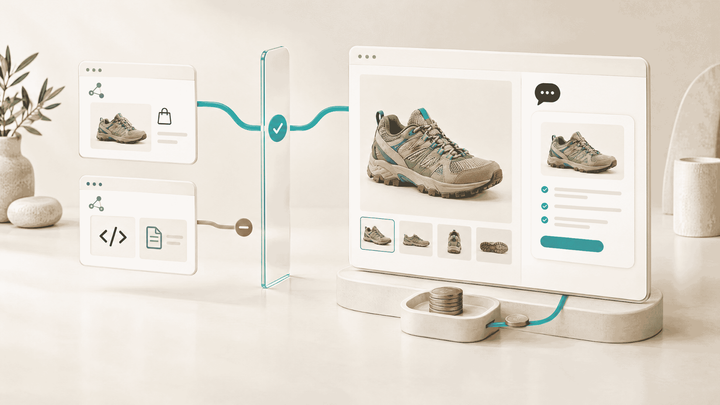
Buyers evaluate chat boxes as if they are all competing on the same axis. They are not. Three different machines wear the same interface.
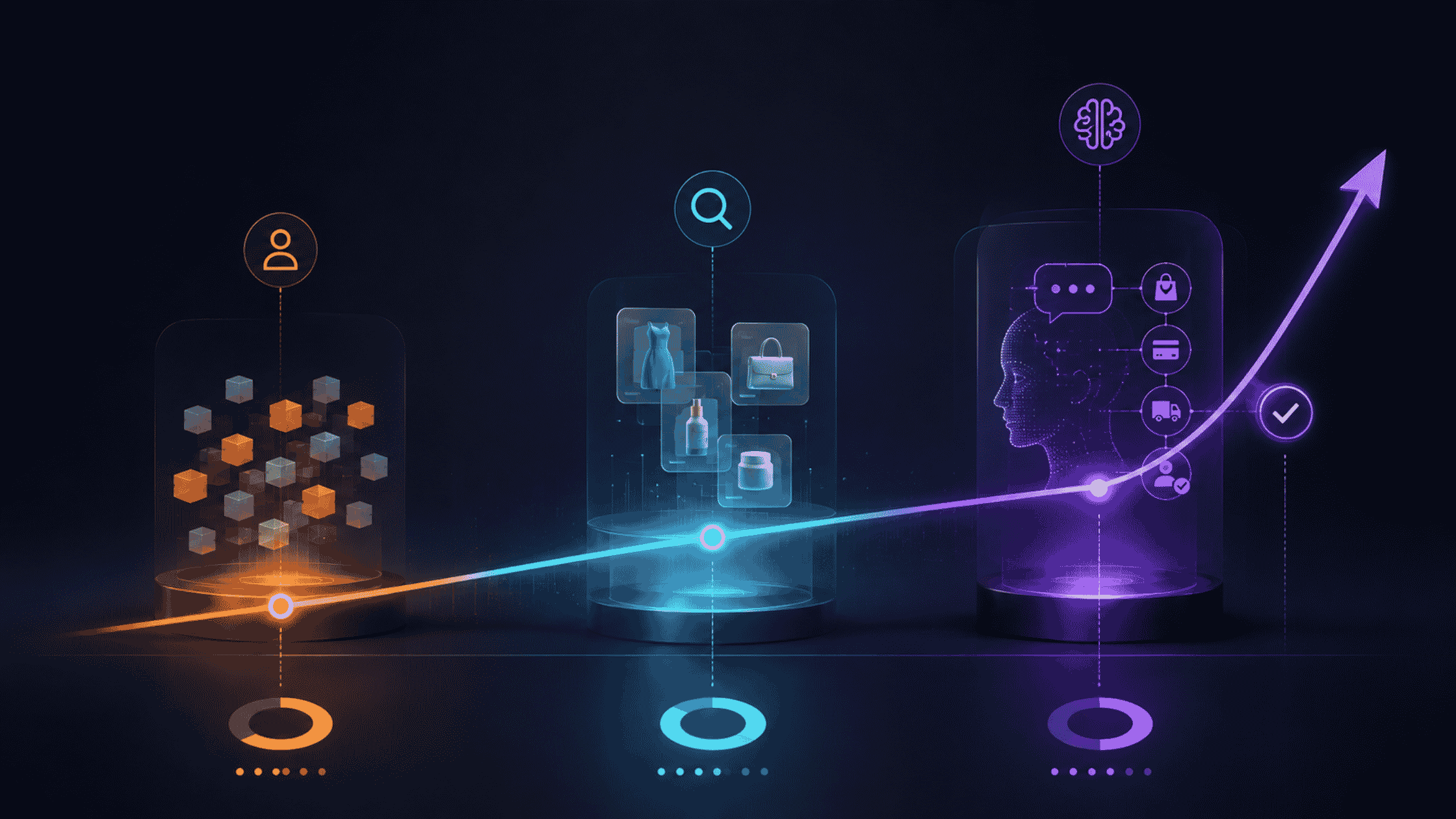
Three technologies present as a chat box on ecommerce sites, each with a structural ceiling. Personalisation engines plateau at Recommend. AI search engines reach Sell, then route the action elsewhere. Only agentic conversational assistants climb to Act and Remember. The foundation determines the ceiling: no amount of tuning moves it.
Why did three platforms get assessed by archetype?
When Alhena stress-tested 15 live deployments in 2026, three could not be scored on the same scale as the rest. Not because they performed badly, because they were built for a fundamentally different job.
An AI search and discovery engine, a personalisation engine, and an enterprise commerce platform's agentic layer were assessed by archetype instead. Their limits are structural, not performance-based.
What are the three archetypes?
| Personalisation engine | AI search & discovery | Agentic assistant | |
|---|---|---|---|
| Built to | Match products to a profile | Interpret a query, surface results | Hold a conversation, finish a job |
| Strength | Behavioural inference, ranking | Semantic understanding, catalogue coverage | Intent parsing, task execution, context retention |
| Ceiling | Recommend | Sell | Act & Remember |
| Typical failure | Catalogue dumping (5 of 15) | Dead-end recommendation (6 of 15) | Answer-only fallback, when weak |
| Handles a return? | No | Routes you to the help centre | Yes, if it reaches the Act rung |
Personalisation engines plateau at Recommend
These systems excel at “customers like you also bought.” Ask one to reason about “fragrance-free, under $80, for dry-but-acne-prone skin” and it often falls back to popularity.
That is why catalogue dumping appeared in 5 of 15 deployments. Ask it to cancel an order and it has no concept of an order to cancel.
AI search engines reach Sell, then hand off
Discovery engines genuinely help at the top of the funnel. They understand messy queries and carry a shopper to the point of decision.
What they cannot do is complete. The action lives in a different system, so the conversation ends with a link: the dead-end recommendation and UI disconnect patterns, each observed in 6 of 15 deployments.
Only agentic assistants reach Act and Remember
The distinguishing property is not the model. It is the plumbing: write access to order systems, control of the storefront UI, an identity model, and a persistence layer.
In the full field, only 4 of 15 could complete a real action and only 1 remembered a shopper across sessions, a fair proxy for how few deployments are genuinely in this archetype. Alhena's own agent scored 3.00 across all eleven verticals tested.
Why is the ceiling structural rather than a roadmap item?
“We'll add actions next quarter” is sometimes true. Usually it is a rebuild.
- A profile-and-ranking system has no representation of a task. Adding one is a second product, not a feature.
- A stateless search layer has nowhere to put memory. Persistence is a data model, not a toggle.
- A system without UI control cannot move the storefront, so conversation and commerce stay separate surfaces.
This is exactly why the field scores 3.0 on Context and 1.6 on Agentic Capabilities.
How do you identify which one you have?
- “Take me to it.” After a recommendation, does the storefront actually move?
- “Cancel my order.” Does it attempt the action, or produce a URL?
- State a constraint, wander, then ask for a match. Does the constraint survive, or does popularity take over?
- Leave and come back tomorrow. Does it know you?
Failing these does not make a product bad. A best-in-class discovery engine is worth owning. But if you bought it expecting resolution and retention, you bought the wrong ceiling.
Key takeaways
- Three archetypes share one interface: personalisation engines, search engines and agentic assistants.
- Each has a hard ceiling: Recommend, Sell, and Act/Remember respectively.
- Ceilings are architectural. Profile-and-ranking systems have no representation of a task.
- Catalogue dumping and dead-end recommendations are the diagnostic signatures of the first two archetypes.
- Buy for the rung you need: discovery for findability, personalisation for merchandising, agentic for resolution.
Frequently asked questions
They solve different problems. Personalisation improves ranking and merchandising across the whole site. An agentic assistant resolves tasks and holds context inside conversations. The mistake is buying one and expecting the other's ceiling, which Alhena documented as a structural limit rather than a roadmap gap.
Not quite. Conversational AI describes the interface: natural language in, natural language out. Agentic describes the outcome, meaning whether the conversation changes anything in your systems. All three archetypes in this comparison are conversational AI. Alhena's 2026 stress test found all 15 live deployments could hold a conversation and 4 could complete a task, and that distance is the whole difference between the two terms.
An older NLP chatbot classifies an utterance into a predefined intent and responds with a scripted reply, so any customer need outside the intent list simply fails. A large language model interprets the request in context and can reason about constraints nobody scripted for. Intent classification is a machine learning problem. Completing a return is an integration problem, and better natural language processing does not create write access. Alhena's 2026 field data scored Context at a perfect 3.0 and Agentic Capabilities at 1.6.
In the interface layer of all three, which is exactly why the chat boxes look identical. Generative AI made every archetype fluent. It did not give a personalisation engine a representation of an order, or give a search layer somewhere to persist memory. Alhena's 2026 study found all 15 deployments could answer accurately and 1 could recognise a returning shopper. Fluency is the floor now, not the differentiator.
A personalisation engine uses machine learning to analyse behaviour across the customer journey and rank products against the profile it infers. A search and discovery engine reads the catalogue and interprets the query in real time. An agentic assistant works from what the shopper stated in this conversation plus the order record, and it needs authorisation to write back to that record. The first two predict a preference. The third acts on a stated one.
Ask why this one after a recommendation, then say take me to it, then ask it to cancel an order. A reasoning agent explains the causal link, moves the page and attempts the action. A ranking layer restates the description and hands you a link.
They coexist well, and many brands use AI in both places. Discovery engines improve findability on category and search pages while the agentic layer owns the conversation, the action and the memory. Conflict only arises when you assume the search layer also covers post-purchase resolution.
Treat it as a rebuild rather than a release. A profile-and-ranking system has no representation of a task, no identity-authorised write access and no persistence layer. Adding those is closer to a second product than a feature, which is why Alhena scored some platforms by archetype instead.
Because the action lives in a system it cannot reach. Search and discovery engines typically top out at the Sell rung and route anything transactional elsewhere, which showed up as dead-end recommendations in 6 of 15 deployments Alhena tested in 2026.
Escalation quality is one of the clearest tells. A search or personalisation layer escalates by giving up, so the shopper gets a link or a form and starts again from zero with a human agent. An agentic assistant should recognise its limit and hand over the whole conversation, so customer support opens with context rather than a transcript. Alhena documented weak escalation among the seven failure modes in its 2026 study, and it usually traces back to an agent that could not act in the first place.
An AI platform bundled with your commerce stack varies enough by implementation that Alhena assessed one such AI system by archetype rather than ranking it in 2026. Apply the same test as any vendor: can it complete an action, move the storefront, and recognise a returning shopper.
That the limit comes from architecture rather than roadmap. Personalisation engines plateau at recommending, search engines reach selling and route the action away, and only agentic assistants reach acting and remembering. No amount of prompt engineering moves a platform between those tiers.
Buy for the rung you actually need. If shoppers cannot find products, a discovery engine pays back fastest. If conversations end without resolution or purchase, only an agentic assistant closes that gap, and it also absorbs much of what a discovery layer would have done.
Score them on capability rather than category language: completing an action, selling in-thread, moving the storefront, remembering across sessions, vertical reasoning and restraint. Alhena's 2026 field data gives the baseline, where 15 of 15 could answer and 1 could remember.
No, and that is the trap. Three different kinds of artificial intelligence present as the same chat box: personalisation engines, search and discovery engines, and agentic assistants. The interface is identical and the ceilings are not.
Consumers rarely name the technology. They describe the outcome. With a personalisation engine the customer experience is a wall of products that ignores the constraint they just stated. With AI search it is a good recommendation followed by a link. With an agentic assistant the interaction ends with the thing actually done, in real time, without a handoff into customer support. Alhena's 2026 testing found all 15 deployments could respond fluently, so what a consumer notices is not the language, it is whether anything happened.
Which engine is behind your chat box?
The report shows how each archetype performed against real shopper tasks, and exactly where each one stopped.