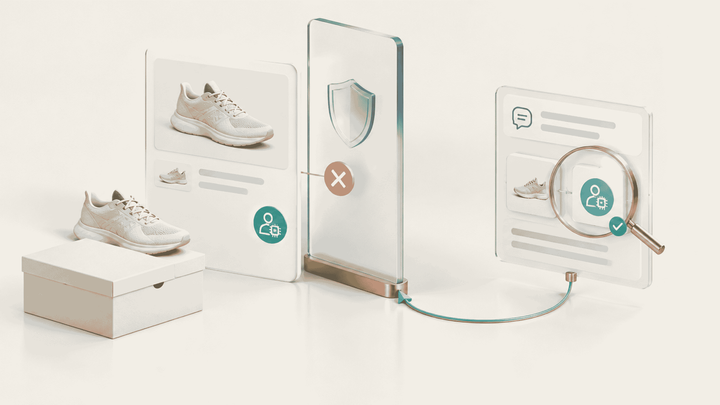
Most CX failures announce themselves. This one is polite, accurate, well-formatted, entirely on-topic, and completely useless.
Answer-only fallback is when an AI agent accurately explains how to complete a task it cannot perform: “here's how to start a return” instead of starting the return. It was the most common failure in Alhena's 2026 stress test, present in 10 of 15 live deployments, and it looks like success on a containment dashboard.
Why does this failure pass its own test?
The response is well-written and on-topic. The customer leaves the conversation. The conversation was contained.
Every metric that matters to a quarterly report looks healthy. Then the ticket arrives anyway, from a customer who has now failed at the task twice: once with your AI, once in your returns portal.
How often does answer-only fallback happen?
It sits directly on top of the study's headline finding: all 15 deployments could answer a question, and 4 could complete one.
Agentic Capabilities scored 1.6 out of 3.0: the lowest in the entire study, against Context at a perfect 3.0.
Why is deflection not the same as resolution?
| Metric | The question it asks | What answer-only agents score |
|---|---|---|
| Deflection | Did this conversation avoid becoming a ticket? | Excellent |
| Resolution | Was the customer's problem solved? | Zero |
Worse, the failure is invisible in the transcript. You have to follow the customer into the next system to see it: a different tool, with a different owner.
Three symptoms suggest you have this problem even when the dashboard looks fine.
- Containment is high and ticket volume is flat. The conversations went somewhere. The work did not disappear.
- Repeat contacts within 24 hours cluster on task-shaped intents: returns, cancellations, address changes.
- Your most-contained intents are your most-ticketed intents. That correlation should not exist.
Who is the agent actually working for?
A shopper who types “cancel my order” is delegating a task. They are asking something to make a decision on their behalf, and they cannot see what it is able to do. That is an ordinary delegation problem with an ordinary name, the principal-agent problem: the party doing the work and the party who wants the outcome are not the same, and they do not hold the same information.
Most of the time the two interests line up. A resolved return is good for the shopper and good for the brand. Answer-only fallback is what it looks like when they come apart by a few degrees. The conversation ended, which is what the merchant measured. The task did not, which is what the shopper wanted.
The asymmetric information is the sharp part. A shopper cannot tell whether the agent will not act or cannot act, so they assume the first and conclude the brand is unhelpful. The agency cost is their own time: they delegated the task and received instructions for doing it themselves.
The same structure repeats one level up. A brand delegates its customer experience to a vendor, and the contract specifies containment. An agent that explains the return maximises the number the vendor is paid on. An agent that attempts the return and occasionally fails does not. This is not a story about self-interest, and nobody has to act in bad faith for it to happen. It is a story about measurement, and the empirical picture from 2026 is exactly what that conflict would predict.
Which makes part of the fix contractual rather than technical. Align the agreement to completed actions and 24-hour repeat contacts, and the incentive points the same way as the outcome. No architecture change will solve a measurement problem, and no measurement change will solve a missing write path, which is why the two have to be fixed together.
Why do agents fall back to explaining?
- No write access. Reading order status is a query. Cancelling an order is a mutation with financial consequence.
- No identity model. Many widgets have no concept of an authenticated customer at all.
- No UI control. Even when the action is possible, the agent cannot move the storefront: UI disconnect, present in 6 of 15 deployments.
- No safe failure path. Teams that could not guarantee a clean rollback reasonably disallowed actions. Defensible, but it should be a known limitation, not a surprise.
What does real resolution sound like?
“I've found it: the merino crew in charcoal, delivered on the 3rd. I've started the return and emailed your prepaid label. Refund lands 3–5 days after we receive it. Want me to swap it for a different size instead?”
Four things happened: the order was identified, the mutation performed, the consequence confirmed, and a retention path opened.
That last move is the commercial argument. An agent that can act can sell during a support interaction. An agent that can only explain cannot.
How do you test for it in ninety seconds?
- Ask it to cancel an order. Did it cancel, or explain?
- Ask it to change a delivery address. Action, or URL?
- Ask it to start a return. Did a label arrive in your inbox?
- Ask for a product, then say “add it to my cart.” Did anything change?
Count how many produced a completed action rather than an accurate description. In the 2026 field, the average was roughly one in four.
Key takeaways
- Answer-only fallback appeared in 10 of 15 deployments, making it the most common AI CX failure of 2026.
- It is invisible on containment dashboards because the conversation technically ended in-channel.
- Agentic Capabilities scored 1.6 / 3.0 field-wide, the lowest of eight dimensions.
- Four architectural causes: no write access, no identity model, no UI control, no rollback path.
- Acting enables selling. An agent that can process a return can also offer the exchange.
Frequently asked questions
Containment measures whether the conversation stayed in channel, not whether the problem was solved. An agent that explains a return without completing it contains perfectly and resolves nothing. Alhena found this pattern in 10 of 15 live deployments.
Follow the customer into the next system. Track 24-hour repeat contacts by intent, and check whether your most-contained intents are also your most-ticketed. That correlation should not exist, and when it does it is hard to argue with.
Ask what the number counts before comparing anything. If resolution means a completed task, Alhena's 2026 field data found 4 of 15 deployments could complete an action at all. If it means a contained conversation, almost any vendor posts a high number.
It is the classic signature. The response was accurate and polite so satisfaction holds up, while the task was never completed. The damage shows in repeat contacts rather than surveys, which is why transcript review catches it earlier.
It needs authenticated identity, write access to the order record, an integration with your returns provider and a rollback path. If your vendor cannot demonstrate all four live on your storefront, the gap is architectural rather than configuration.
When it rises without ticket volume falling, yes. That combination means conversations are being absorbed rather than resolved, and the work is reappearing somewhere your dashboard is not watching.
It rewards it, which is not quite the same as causing it but is close enough to matter. If your vendor's SLA is written around containment, an agent that explains the return has met the target and an agent that attempts the return and fails has not. Those incentives are not aligned with your interests, and certainly not with the shopper's best interest. Align the contract to completed actions and 24-hour repeat contacts instead, and the behaviour tends to follow the measurement.
Sometimes, and the honest version of it is defensible. A team that cannot guarantee a clean rollback may reasonably decide not to delegate write access to an agent at all, and that risk aversion is a judgement rather than an engineering failure. What is not defensible is leaving the customer to discover it. The information asymmetry is the whole problem: you know the agent cannot act, and the shopper finds out after investing six minutes. An agent acting on your behalf should say what it cannot do at the start of the conversation rather than at the end.
Task-shaped ones: returns, cancellations, address changes and order modifications. Answer-only fallback concentrates there, because those are precisely the intents that require system access rather than retrieval.
It means it clears the baseline. All 15 deployments Alhena tested could answer accurately, and Context scored a perfect 3.00 field-wide. Answering stopped being a differentiator, which makes it a poor basis for a renewal decision.
The agent identifies the order, performs the action, confirms the downstream consequence such as refund timing, and offers an alternative like an exchange. That last move is why acting and selling are the same capability rather than two features.
Both, with different costs. In support it turns a resolution into a ticket. In shopping it turns a good recommendation into a dead end, which Alhena tracked separately as dead-end recommendation in 6 of 15 deployments.
How many agents resolved versus merely explained?
The count, the transcripts, and the seven failure modes with frequencies.