Google Shopping and AI search used to be separate worlds. One ran on product data and bids. The other ran on language models and citations. In 2026, those worlds share the same infrastructure, and most brands and retailers haven't noticed. For a complete walkthrough of these tactics, see our AI search engine optimization guide.
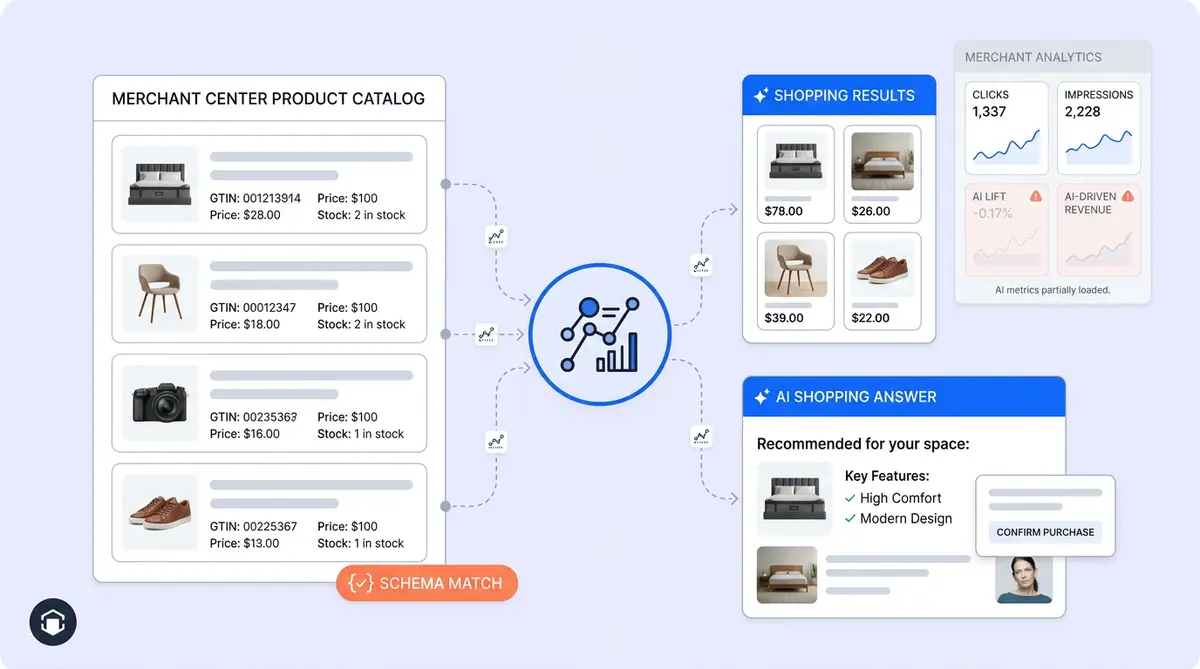
Google's Shopping Graph, the structured data layer built from Merchant Center feeds, now helps ground product mentions via the Shopping Graph in Google's AI Mode, AI Overviews, and Gemini shopping answers in conversational mode. That means the catalog optimization work you've done for a decade quietly became an AI visibility asset.
This post explains the overlap, what it means for your catalog, and how to treat both channels as one discovery system.
Google Shopping and AI Surfaces Share the Same Product Graph
When you submit product data to Google Merchant Center, you're populating Google's product graph with structured attributes: titles, GTINs, pricing, availability, product photos, images, and product highlights. That graph has always powered the Shopping tab and free listings.
What changed: Google's generative AI surfaces, including new agentic checkout features in AI Mode, now draw on that same product graph when answering shopping queries. A consumer asking Google AI Mode, "What's the best lightweight running shoe under $150?" gets an answer grounded partly in the structured catalog data retailers already maintain, influencing the purchase decision.
The practical consequence is simple. A missing GTIN, stale availability status, or generic title in your catalog doesn't just hurt your shopping results performance. It can silently exclude your SKU from AI shopping mode answers where no traditional "ranking" exists to diagnose.
Shopping Graph Attributes That Pull Double Duty
Not every Merchant Center attribute matters equally for AI surfaces. Based on how Google's product graph structures information, these carry the most weight across both channels:
- Title with specific attribute keywords (brand + product type + key differentiator)
- GTIN/MPN/Brand for unambiguous product identity
- Availability and price matching your live PDP within Google's tolerance window
- product_highlight attributes, the closest thing to "AI-friendly bullets" inside the feed
- Structured variant attributes (color, size, material) that let AI answers filter precisely
If you want a deeper breakdown of which data fields influence AI recommendations specifically, our guide on product data fields that matter for AI shopping covers the full picture.
Your PDP must agree with your feed.
Google's algorithm cross-references your Merchant Center data against what it finds on your product detail pages. When Merchant Center says "in stock" but the PDP says "sold out," Google penalizes both Shopping results' visibility and AI grounding confidence.
The next step is straightforward: your Schema.org Product and Offer markup should echo the same data your catalog contains. Price, availability, brand, GTIN, aggregate ratings. Two sources telling the same story builds the trust signals that AI surfaces rely on. These signals directly influence product visibility.
For a full technical checklist, see our PDP optimization checklist for AI visibility (compare the <a href="https://alhena.ai/blog/ai-brand-visibility-analysis-tools/">best AI brand visibility analysis tools for 2026</a>).
The Measurement Gap Between Both Channels
Google Shopping has clear attribution through Google Ads. You know which products got impressions, clicks, and conversions from the Shopping tab.
AI surfaces have almost nothing. In AI Mode, there's no native "Merchant Center to AI Mode citation rate" report. Google doesn't tell you which of your SKUs appeared in an AI-generated answer, how often, or whether shoppers clicked through.
This is where dedicated AI visibility monitoring fills the gap. Alhena's AI Visibility platform tracks how your brand and products appear in AI shopping answers across ChatGPT and Gemini. It reports a visibility score, citation share, competitor comparison, and content-gap recommendations per prompt you define.
It doesn't replace Merchant Center diagnostics. It sits alongside them, covering the AI leg, including agentic checkout surfaces, that Google's own tools don't report on yet. Together, you get a complete view of how your catalog performs across both discovery channels when consumers research a purchase.
A Quick Action Plan for Merchants
You don't need a new optimization discipline. You need to connect the work you're already doing to AI outcomes:
- Run Merchant Center diagnostics. Close all "Disapproved" and "Limited" items. Every disapproved SKU is invisible on both channels.
- Audit your top 50 SKUs for GTIN/MPN completeness and product_highlight and product visibility coverage.
- Verify PDP schema matches feed data. Price, availability, brand, and ratings should agree exactly.
- Pick 10 high-intent purchase prompts for your category and start tracking SKU-level AI citation share.
- Compare Shopping tab rankings vs. AI citations for the same queries. Investigate gaps where consumers can find you in shopping but don't appear in AI answers.
For merchants already running AI visibility tracking, our weekly AI visibility workflow provides an operational cadence that fits into existing merchandising reviews.
One Catalog, Two Discovery Surfaces
The merchants who win in 2026 aren't learning a new channel from scratch. They're recognizing that Google Shopping and AI search already share the same foundation: accurate, structured product data maintained consistently across your feed and your site.
Retailers who stop treating Merchant Center hygiene and AI visibility as separate workstreams. It's one merchandising KPI now.
If you want to see how your products currently appear in AI shopping answers, book a demo with Alhena AI or start tracking for free.
Frequently Asked Questions
Does Google Merchant Center data directly influence AI Mode answers?
Google has not confirmed Merchant Center as a direct AI Mode ranking signal. But Google's product graph, built largely from Merchant Center feeds, is shared infrastructure that grounds product mentions across AI surfaces. Keeping your catalog accurate through regular optimization is the most efficient way to ensure your catalog is correctly represented.
Which Merchant Center attributes matter most for AI visibility?
Title, GTIN/MPN/brand, availability, price, and product_highlight attributes carry the most weight. These provide the structured identity and descriptive context that AI systems use to match products to shopper queries.
How do I know if my products appear in Google AI Overviews or AI Mode?
Google doesn't offer a native report for this. You need dedicated AI visibility monitoring tools that track your brands and SKU presence across AI surfaces. Alhena's AI Visibility module tracks citation share across ChatGPT and Gemini, with prompt-level reporting.
What happens if my Merchant Center data conflicts with my PDP schema markup?
Google cross-references both sources. Mismatches (e.g., feed says "in stock" but PDP says "sold out") reduce trust signals and can cause your product to be excluded from both Shopping results and AI-grounded answers.
Can I optimize for Google Shopping and AI search at the same time?
Yes. Both channels rely on the same foundation: accurate, structured product data. Catalog optimization, complete schema markup, and consistent pricing/availability serve both channels simultaneously. The work is not additive; it's shared.
How is AI visibility tracking different from Google Ads reporting?
Google Ads reports impressions, clicks, and conversions for Shopping campaigns. AI visibility tracking monitors whether your products appear in generative AI answers, how often, and alongside which competitors. The two cover different discovery surfaces with different attribution models.