Every ecommerce platform claims to "use AI" now. The difference isn't whether AI exists in the stack. It's whether AI was the starting point or an afterthought.
That distinction, AI-native versus AI-enhanced, determines what your shopping experience can actually do for customers. It sets the ceiling on ecommerce experience quality, response accuracy, conversion optimization, and revenue growth. Shopper expectations in 2026 keep rising. This post gives you a strategy framework to tell the two apart.
What AI-Native Actually Means
A modern AI-native platform was designed from day one with AI as the foundation for generative AI and model-based reasoning, retrieval systems, and agent orchestration. The data model, the routing logic, the memory layer: all of it builds on a foundation where AI innovation is the primary conversational interface, not a sidebar widget for users.
Many companies start with an AI-enhanced platform that, by contrast, started as an existing software product (a traditional ticketing system, a live chat tool, a CMS) and later added embedded AI functionality later through plugin-based modules or API wrappers.
It's not that one label is inherently bad. It's a spectrum. But they produce very different outcomes when ecommerce outcomes and commerce revenue are the goals for businesses.
Five Tests to Distinguish AI-Native from AI-Enhanced
Use these observable signals as you explore any vendor:
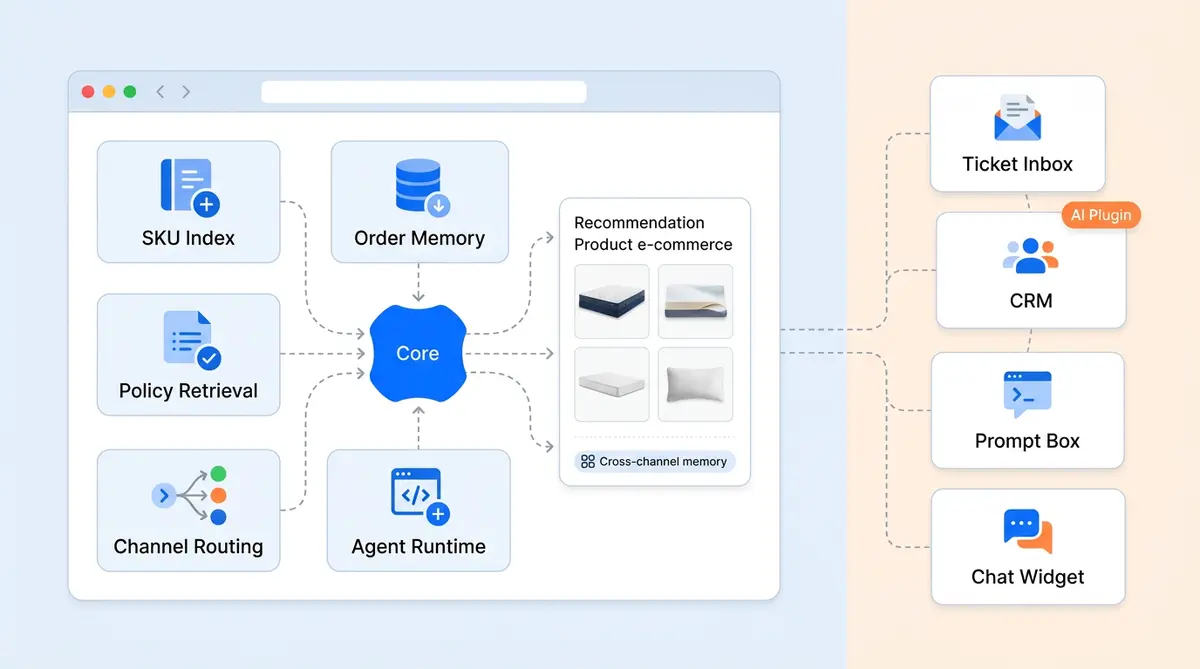
- Agent runtime: Is the AI runtime a first-class citizen with its own orchestration infrastructure, or a feature tab inside a broader product? AI-native platforms typically run multi-agent systems with specialized routing between specialized agents and models.
- Retrieval architecture: Are indexes purpose-built for commerce entities (SKUs, products, policies, order management data, reviews), or is everything dumped into a single generic vector store? Agentic RAG with commerce-specific retrieval is the AI-native platforms approach.
- Cross-channel memory: Does the system remember customers across chat, email, social, and voice by design? Or does each channel start fresh? Unified memory requires infrastructure-level commitment, not a plugin.
- Learning loops: Does the system improve through continuous learning from every interaction, or does it wait for quarterly learning development updates tied to the host platform's release cycle?
- Data freshness: When a price changes or a SKU goes out of stock in 2026, how fast does the AI know? Minutes (AI-native) versus hours or days (plugin-dependent infrastructure sync).
Score any vendor your team evaluates on these five dimensions. The pattern becomes clear quickly.
Why Bolt-On AI Caps Ecommerce Outcomes
When AI is added to a platform that wasn't designed for it, three constraints emerge, making true personalization harder:
Schema mismatch. Plugins inherit the host platform's data shape. If the host was built for tickets, the AI reasons over ticket-shaped data, not commerce-shaped data. It can close tickets but misses behavioral and predictive context. It can't make recommendations with context about fit, ingredients, or compatibility.
Context fragmentation. Bolt-on AI typically lives in one channel. A customer who chats on your site, then emails, then DMs on Instagram gets three separate conversations with no shared memory. True individual customer understanding requires a single customer graph with behavioral and predictive data that spans every user touchpoint.
Prompt-only customization. Most enhanced platforms expose a "system prompt + knowledge base" interface. It's fine for basic Q&A. It doesn't support grounded retrieval, optimization of policy enforcement, or agentic workflows and automated workflows like populating carts or pre-filling checkout.
What AI-Native Architecture Makes Possible for Ecommerce Brands
When AI-native platforms assume AI-first, new commerce experiences become structurally possible:
- Real-time catalog grounding: Catalog, inventory, and policy changes reach the AI within minutes, not after a nightly sync. Every answer reflects current reality across the full shopper lifecycle, which is why purpose-built agent architectures produce hallucination-free responses grounded in verified data.
- Revenue-driving conversations: The AI doesn't just answer questions. It understands purchase intent, surfaces tailored recommendations through conversational discovery, and drives conversion with tailored suggestions within the same conversation journey. Brands like Tatcha have seen 3x conversion rates and 38% higher average order values from this approach (full case study).
- Agentic commerce readiness: As shopping shifts toward AI-native buyers who delegate purchases to shopping agents, your team needs machine-readable products, structured data, and APIs that external agents and AI systems can query. AI-native platforms are already shaped for this. The two front doors problem (your site + LLM storefronts) demands it.
- Omnichannel from day one: Omnichannel coverage across web chat, email, Instagram DMs, WhatsApp, and voice all run on the same AI runtime with shared omnichannel memory, not separate integrations bolted together.
The Buyer's Checklist
Before you evaluate any AI commerce vendor, ask these questions:
- Can the AI take actions (add to cart, apply discounts, manage returns), or only answer questions?
- Does memory persist across channels without manual configuration?
- How quickly do catalog changes reach the AI? Get a specific number.
- Is the AI grounded in your actual product data, or does it generate answers from general training?
- Can it attribute revenue directly to AI-assisted conversations?
If the answer to most of these is "no" or "partially," you're looking at an AI-enhanced tool, not an AI-native one.
Alhena AI was built as an AI-native ecommerce platform from the ground up. Two specialized AI modules (Product Expert and Order Management) work across every channel with shared memory, real-time catalog grounding, and built-in revenue attribution.
Ready to see what AI-native commerce looks like in practice? Book a demo or start free with 25 conversations.

Frequently Asked Questions
What does AI-native mean in ecommerce?
AI-native means the platform was designed from the ground up around language models, retrieval systems, and agent orchestration. The data model, routing logic, and memory layer all assume AI is the primary interface, not an add-on feature bolted onto an existing product.
How can I tell if a vendor is AI-native or AI-enhanced?
Ask five questions: Does the AI have its own agent runtime or live inside another product? Are retrieval indexes built for commerce data (SKUs, policies, orders)? Does memory persist across channels? Does the system learn continuously? How fast do catalog changes reach the AI? If most answers point to limitations, you are looking at an AI-enhanced tool.
Why does AI architecture affect personalization quality?
Bolt-on AI inherits the host platform's data shape, which is often ticket-centric or session-centric. This forces the AI to reason over data not designed for commerce-based recommendations recommendations. AI-native platforms store and retrieve commerce entities natively, so personalization can deliver tailored answers that factor in product attributes, purchase history, behavioral signals, predictive intent, and real-time inventory.
Can AI-enhanced platforms still deliver good results?
Yes, for basic use cases like FAQ deflection or ticket routing, AI-enhanced platforms work fine. The gap appears when you need cross-channel memory, real-time catalog grounding, revenue-driving product recommendations, or agentic actions like cart population. Those require infrastructure-level support.
How does Alhena AI handle real-time catalog changes?
Alhena's retrieval layer syncs product, inventory, and policy data within minutes of changes. This means the AI always reflects current shopper-facing pricing, availability, and policies without waiting for nightly batch syncs that bolt-on solutions typically depend on.
What is agentic commerce and why does architecture matter for it?
Agentic commerce is the shift toward AI shopping agents buying on behalf of consumers, using tools like ChatGPT or Gemini as storefronts. AI-native platforms are already structured with machine-readable data and agent-callable APIs. AI-enhanced platforms, built for human interfaces, require significant rearchitecting to participate in this channel.