Gartner predicts 40% of agentic AI projects will be canceled by 2027, not because the technology fails, but because the ai agent architecture does. That's a staggering failure rate for an artificial intelligence category attracting billions in investment. The problem? Ecommerce organizations are deploying AI agents without understanding what separates a chatbot wrapper from a production-based agent system. Most organizations bolt a language model onto a support widget and call it "agentic." It isn't. This post will explore the ai agent architecture patterns that actually work for ecommerce, with a real-world view of production code examples from brands generating measurable revenue through autonomous AI.
What Is AI Agent Architecture?
AI agent architecture is the structural design of how an AI agent perceives input, reasons about it, takes action, and learns from outcomes. Think of it as the artificial intelligence blueprint that determines whether your AI can only answer questions or actually do things for your customers.
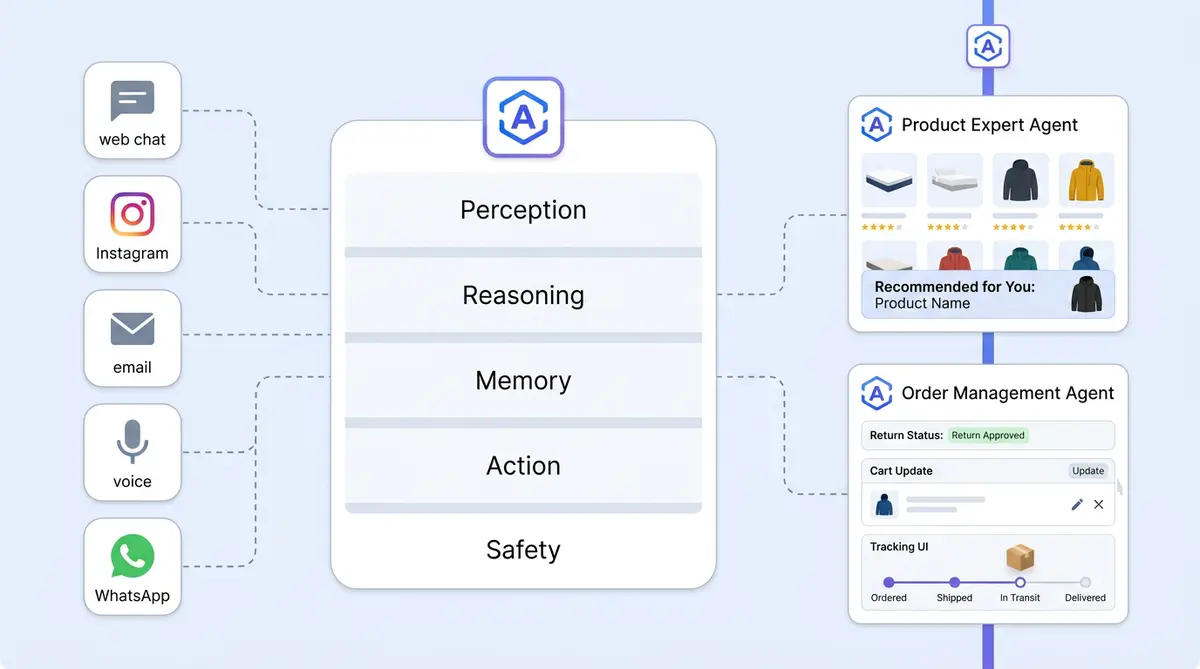
Every production-grade agent relies on four core layers: perception (understanding what the user wants), reasoning (the LLM model backbone that processes language and makes decisions), memory (retaining context across interactions), and action/tools (the integrations that let the agent interact with real systems based on user needs).
These layers form what engineers call the "agent loop": perceive, reason, plan, act, learn, repeat. Each cycle refines the agent's understanding and improves its output through continuous evaluation. This loop runs continuously throughout a conversation, not just once per message. It's the core design pattern that distinguishes an autonomous agent from a request-response chatbot from a systems view.
Why do ecommerce agents need a different architecture than general-purpose agents? Three reasons. First, product catalog complexity. A retailer with 50,000 SKUs, each with attribute-based variants, seasonal pricing, and regional availability, creates a data surface based on complexity that generic agents can't handle based on standard approaches. Second, real-time inventory. An agent that recommends an out-of-stock product destroys trust. Third, payment safety requirements and governance. Any agent that touches cart and checkout flows needs governance requirements that general-purpose systems don't consider.
The 5 Core Components Every Ecommerce AI Agent Needs
An effective ai agent architecture diagram for ecommerce includes five distinct components working in concert. Miss one, and the system falls apart.
1. The Perception Layer (Understanding Shopper Intent)
The perception layer handles natural language understanding for the messy, vague queries real shoppers type. "Something cozy for fall" isn't a product name. It's an intent signal that requires semantic interpretation, mapping "cozy" to materials like cashmere, fleece, and wool, while "fall" maps to seasonal collections and earth-tone color palettes.
Modern perception layers also handle multi-modal input: text, voice, and images. Visual search lets a shopper upload a photo from Instagram and find similar products in your catalog. Channel awareness matters too. The same agent needs to process different input formats across web chat, Instagram DMs, email, and voice without losing context.
Here's the ecommerce twist most general ai agent architecture patterns miss: intent classification isn't just NLP. It's mapping language to shopping stages. A shopper asking "what's good for dry skin?" is browsing. "How does this compare to CeraVe?" is comparing. "Does this ship by Friday?" is ready to buy. Each stage requires different response requirements and strategy.
2. The Reasoning Engine (LLM + Commerce Context)
The LLM backbone processes language and generates responses. But raw LLMs hallucinate. They'll confidently recommend products that don't exist, invent ingredient lists, or quote prices from their training data instead of your current catalog. In ecommerce, hallucinations don't just look bad. They drive returns, refund requests, and lost customers.
The fix is RAG (Retrieval-Augmented Generation): pull real-time catalog data, inventory levels, and pricing before generating a response. This grounds every answer in verified data rather than statistical prediction.
Alhena AI's approach takes this further. Their Product Expert Agent is trained on the retailer's actual catalog, policies, and brand tone. Instead of a generic LLM guessing about products, the reasoning engine queries verified product data, checks inventory in real time, and generates responses that match the brand's voice. The result is what Alhena calls "hallucination-free AI," where every product claim traces back to verified data.
3. The Memory System (Session, Customer, and Catalog Memory)
Memory is what separates an agent from a stateless chatbot. A proper multi agent ai architecture needs three types of context working together.
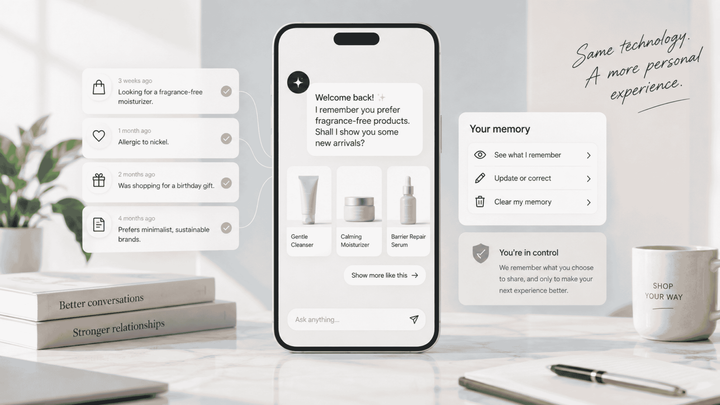
Session memory tracks cart state, current browsing context, and conversation history within a single interaction. Without it, a shopper who says "show me that in blue" after discussing a specific jacket gets a confused response. Customer memory stores purchase history, size preferences, past returns, and lifetime value across sessions. A shopper who returned a size M last month should get a size S recommendation this time. Catalog memory holds product embeddings, variant relationships, and seasonal inventory cycles. It's what enables the agent to know that a specific moisturizer pairs well with a particular serum.
This is what enables personalization at scale. Alhena AI maintains a unified, role-based memory across both of its specialized agents (Product Expert and Order Management), so a customer's conversation history and preferences persist whether they're discovering products or tracking a return.
4. The Action Layer (Tools + API Integrations)
What makes an agent different from a chatbot: it can do things, not just say things. The action layer connects the agent to real systems through API integrations.
In ecommerce, the critical actions include: search the catalog, add items to cart, apply discount codes, check real-time inventory, initiate returns, and track orders. Alhena AI's agentic checkout takes this further by populating carts and pre-filling checkout forms directly from the conversation. A shopper can go from "I want the vitamin C serum and the SPF 50 moisturizer" to a pre-filled checkout in seconds.
Integration depth matters more than breadth. Native connectors to Shopify, WooCommerce, Salesforce Commerce Cloud, Magento, Zendesk, and Gorgias outperform generic API wrappers because they understand the data models natively. A Shopify-native integration knows about variants, metafields, and draft orders. A generic wrapper treats everything as flat JSON.
Alhena also connects to social commerce channels like Instagram DMs and WhatsApp, turning every conversation into a potential transaction regardless of where it starts.
5. The Safety Layer (Guardrails + Escalation)
The safety layer is where most ecommerce AI architectures fall short, and where the consequences are highest. Content filtering prevents off-brand responses. A luxury skincare brand's AI shouldn't sound like a discount retailer. Action approval sets spending limits, discount caps, and requires human sign-off for high-value actions.
Hallucination prevention is the most critical guardrail. Every product claim must be grounded in verified data, not generated from training data. When Google's research found 17.2x error amplification without centralized control, that number captures what happens when agents operate without data grounding. One wrong product detail cascades into bad recommendations, incorrect cart additions, and customer complaints.
Escalation triggers define when the agent hands off to a human, gracefully and with full context. Alhena's Agent Assist passes the complete conversation history, customer profile, and AI-generated response suggestions to human agents. The customer never has to repeat themselves. Puffy, a mattress brand using Alhena, achieves 63% automated inquiry resolution with graceful escalation for the rest.
Architecture Patterns for Ecommerce AI Agents
Not every store needs the same ai agent architecture. Four proven approaches cover the spectrum from simple, rule-based support automation to full-journey, agent-based orchestration.
Router Architecture (Support Triage)
A single orchestrator routes incoming queries to specialized handlers based on intent classification. Think of it as a smart switchboard. "Where's my order?" goes to the tracking handler. "I want to return this" goes to the returns handler. "What moisturizer works for oily skin?" goes to the product recommendation handler.
Best for: customer support where queries fall into clear task categories. Alhena's Order Management Agent uses this pattern, routing between tracking, returns, and exchanges with high accuracy. It's the simplest architecture to deploy and debug, making it ideal for stores that primarily need support automation.
Planner-Executor Model (Shopping Concierge)
The agent breaks a complex request into sub-tasks and executes them sequentially. When a shopper says "I need a complete skincare routine for dry, sensitive skin under $150," the planner creates a multi-step execution plan: identify skin type concerns, filter compatible products, check ingredient conflicts, build a routine within budget, and present the recommendation with rationale.
Best for: product discovery where shoppers have complex, multi-constraint needs. This approach shines when the AI agent acts as a personal shopping concierge rather than a search bar replacement. It's what enabled Tatcha to achieve a 3x conversion rate with Alhena AI, because the agent doesn't just find products, it builds personalized routines.
Multi-Agent Orchestration (Full-Journey Coverage)
Multiple specialized agents, each with their own reasoning and memory, are coordinated by an orchestrator. This is the pattern for covering the entire shopping journey from discovery through post-purchase support.
Alhena AI's architecture follows this model. The Product Expert Agent handles discovery, recommendations, and product comparisons. The Order Management Agent handles post-purchase: tracking, returns, and exchanges. A unified context layer connects both agents, so a customer's shopping preferences inform their support experience and vice versa.
Best for: brands with 10,000+ SKUs that need both pre-purchase and post-purchase AI. Victoria Beckham uses Alhena's multi-agent setup to drive a 20% increase in average order value, because the product agent's recommendations are informed by what the support agent knows about returns and satisfaction patterns.
Human-in-the-Loop Design (High-Stakes Decisions)
The agent handles routine tasks autonomously and escalates edge cases to human agents with full context and AI-generated response suggestions. This isn't a fallback. It's a deliberate architectural choice for situations where the cost of a wrong answer is high.
Best for: luxury brands, high-ticket items, and complex B2B orders. A $5,000 handbag purchase warrants human involvement. So does a B2B order with custom pricing and net-60 terms. Alhena's Agent Assist provides human agents with real-time AI suggestions, customer history, and conversation summaries so they can respond faster without starting from scratch. Manawa, a travel experience marketplace, cut response times from 40 minutes to 1 minute using this hybrid approach.
Why Most Ecommerce AI Architectures Fail
McKinsey found that 62% of companies are experimenting with agentic AI, but only 10% are successfully scaling it. That gap isn't about technology selection. It's about architecture mistakes that compound over time.
Building on a chatbot foundation instead of an agent framework. This is the "chatbot with extra steps" trap. Teams add a GPT wrapper to their existing support widget and expect agent-level behavior. But chatbots lack the memory, action, and safety layers that define an agent. You can't bolt those on after the fact.
Ignoring the context and recall layer. Without recall, every conversation starts from zero. Your best customer gets the same cold-start experience as a first-time visitor. No size preferences, no purchase history, no context about a return they filed last week.
No grounding in product data. Hallucinations destroy trust and drive returns. If your agent recommends a product with the wrong ingredients, or one that's been discontinued, you've created a worse experience than having no AI at all.
Monolithic design instead of modular agents. A single agent handling everything from product discovery to return processing can't specialize or scale. Modular agents with clear boundaries are easier to debug, test, and improve independently.
Missing observability. If you can't trace why the agent recommended a specific product or measure how recommendations affect conversion rates, you're flying blind. Revenue attribution should be built into the architecture, not added as an afterthought. Without it, you can't prove ROI, and that's exactly why projects get canceled.
How Alhena AI's Agent Architecture Works in Production
Alhena AI's architecture is a working example of these principles applied to ecommerce at scale. Two specialized agents divide the workload: the Product Expert Agent handles discovery, recommendations, and product comparisons, while the Order Management Agent handles tracking, returns, and exchanges.
Unified memory connects both agents across every channel, including web chat, email, Instagram, WhatsApp, and voice. A customer who chats about a product on Instagram and later calls about a return gets a continuous experience. No context lost, no repeated questions.
Alhena's ai agent architecture is hallucination-free by design. Every response is grounded in the retailer's verified catalog, policies, and real-time inventory. The system doesn't generate product details from LLM training data. It retrieves them from the source of truth.
Deployment takes under 48 hours with no dev resources required. Alhena connects natively to Shopify, WooCommerce, Magento, Salesforce Commerce Cloud, Zendesk, and Gorgias. Revenue attribution analytics are built into the architecture, tracking how AI conversations influence add-to-cart events, conversions, and average order value.
The results speak for themselves. Tatcha achieved a 3x conversion rate. Victoria Beckham saw a 20% increase in AOV. Manawa cut response times from 40 minutes to 1 minute. These aren't demo metrics. They're production numbers from live ecommerce operations. You can estimate your own potential ROI with Alhena's ROI calculator.
Choosing the Right Architecture for Your Store
The right ai agent architecture depends on your catalog size, customer journey complexity, and operational requirements and goals. With $67 billion in AI-driven Cyber Week sales (Salesforce) and 805% year-over-year growth in AI-referred traffic during Black Friday 2025, the question isn't whether to deploy an AI agent. It's which architecture pattern to choose. Here's a decision framework:
Under 500 SKUs with basic support needs: Start with the router approach and a single agent. It handles FAQ-style tasks, order tracking, and simple product recommendations. Fast to deploy, easy to maintain.
500 to 10,000 SKUs with active product discovery: Move to the planner-executor model with a product specialist agent. Shoppers browsing catalogs this size benefit from guided discovery, where the agent breaks down complex needs into actionable recommendations.
10,000+ SKUs with full-journey coverage: Multi-agent orchestration with specialized agents for pre-purchase and post-purchase. This is where Alhena AI's two-agent architecture excels, giving you the full benefits of AI agents across the entire customer lifecycle.
Luxury and high-ticket items: Human-in-the-loop hybrid. Let the AI handle routine interactions autonomously while flagging high-stakes decisions for human review. The AI doesn't replace your team. It makes them faster and better informed.
The key question: do you need a support agent, a sales agent, or both? With 68% of retailers planning agentic AI adoption in the next 12 to 14 months (Deloitte 2026), the answer for most growing brands is both. Use our AI agent evaluation checklist to map your requirements to the right architecture.
Ready to see how the right ai agent architecture translates to revenue? Book a demo with Alhena AI or start for free with 25 conversations. Check our pricing page to find the plan that fits your store. See also our headless commerce AI chatbot architecture guide.
For a closer look at the memory system, see our engineering deep dive into how Unified Memory works under the hood.
Frequently Asked Questions
What is AI agent architecture?
AI agent architecture is the structural design of how an AI agent perceives input, reasons about it, takes action, and learns from outcomes. It includes four core layers: perception (understanding user intent), reasoning (the LLM backbone), memory (retaining context), and action (tool integrations that let the agent interact with real systems).
What are the main components of an ecommerce AI agent?
An ecommerce AI agent needs five core components: a perception layer for understanding shopper intent, a reasoning engine grounded in product data via RAG, a memory system covering session, customer, and catalog context, an action layer with API integrations to platforms like Shopify and WooCommerce, and a safety layer with guardrails, hallucination prevention, and human escalation triggers.
What is the difference between single-agent and multi-agent architecture?
Single-agent architecture uses one AI agent to handle all tasks, which works for simple support needs. Multi-agent architecture uses multiple specialized agents coordinated by an orchestrator, each with their own reasoning and memory. Multi-agent systems are better for covering the full shopping journey from product discovery through post-purchase support.
How do AI agents use memory in ecommerce?
Ecommerce AI agents use three types of memory. Session memory tracks cart state and conversation history within a single interaction. Customer memory stores purchase history, size preferences, and past returns across sessions. Catalog memory holds product embeddings and variant relationships. Together, these enable personalized recommendations at scale.
What causes AI agent hallucinations in product recommendations?
Hallucinations occur when an AI agent generates product details from its training data instead of verified catalog information. This leads to recommending discontinued products, inventing features, or quoting wrong prices. The fix is RAG (Retrieval-Augmented Generation), which grounds every response in real-time product data before generating an answer.
What is the best architecture pattern for an ecommerce AI agent?
It depends on your store's complexity. Stores under 500 SKUs do well with a router pattern for support triage. Stores with 500 to 10,000 SKUs benefit from a planner-executor pattern for guided product discovery. Stores with 10,000+ SKUs need multi-agent orchestration. Luxury and high-ticket brands should add a human-in-the-loop layer.
How long does it take to deploy an AI agent for ecommerce?
With platforms like Alhena AI, deployment takes under 48 hours with no developer resources required. Alhena connects natively to Shopify, WooCommerce, Magento, and Salesforce Commerce Cloud, pulling your product catalog automatically and working across web chat, email, Instagram DMs, WhatsApp, and voice from day one.
For a deep dive into how attackers target ecommerce AI chatbots, read our guide on prompt injection attacks on ecommerce AI.
How does Alhena AI's agent architecture prevent hallucinations?
Alhena AI grounds every response in the retailer's verified catalog, policies, and real-time inventory data. Instead of generating product details from LLM training data, the system retrieves information from the source of truth before generating a response. This ensures every product claim, price, and availability status is accurate and current.