The Two Surfaces of Modern AI Brand Discovery
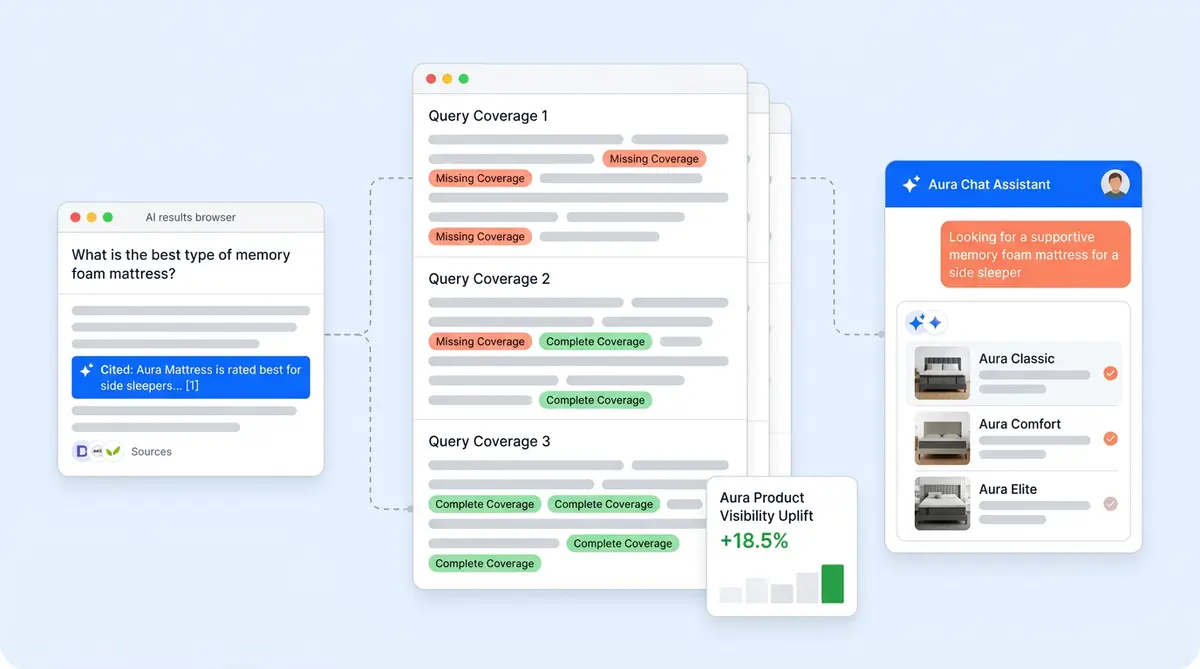
Shoppers now ask AI questions in two places: outside your site and inside it.
Outside, they open ChatGPT or Gemini and type "best vitamin C serum for sensitive skin". The AI pulls from dozens of sources, names a few brands, and the consumer forms an opinion before shoppers visit any store. This is Generative Engine Optimization (GEO) territory, where brands compete to be cited in AI-generated responses. For a complete walkthrough of these tactics, see our AI search engine optimization guide.
Inside, the same customer lands on your site and asks your AI shopping assistant a similar question: "Will this work for my skin type?" or "How does this compare to the other formula? " If the assistant can't respond, the customer leaves your site. That customer to ask ChatGPT instead.
Most GEO strategies treat the outside surface as the whole problem. But the content that powers your on-site assistant and the content that earns AI citations are the same content. Building for one makes the other easier. This post explains how to start building that layer.
What an AI Shopping Assistant Contributes to GEO
Your AI shopping assistant doesn't train ChatGPT or Gemini. No vendor can honestly claim that. But deploying one forces a content discipline that GEO rewards.
It forces you to write answers explicitly. To make an assistant accurate, you need clear, published answers to questions like "What's the difference between these two products?" and "What's your return window?" Those same pages are exactly what AI search engines summarize and cite. If your assistant can handle it, there's a crawlable page behind it.
It surfaces the questions buyers actually ask. Customer conversation logs reveal real-language queries with clear purchase intent that you may not have on your site yet. Each unanswered question is a candidate page that doubles as an e-commerce AEO target. Tatcha saw a 3x conversion rate after deploying Alhena's AI assistant, partly because the assistant flagged content gaps the brand then filled.
It encourages structured product data. Product attributes like specs, materials, sizing, and compatibility: assistants rely on this data to give accurate answers. AI tools and engines summarize from it. When your product catalog is clean and better structured, both surfaces benefit.
The content discipline an assistant requires happens to be the same content discipline GEO rewards, making your site better positioned. That's the connection.
A Double-Duty Content Checklist
Each item below serves both your on-site assistant and your off-site AI presence. If you're building content for one, you're building for both.
- Comparison pages ("X vs. Y," "best [category] for [use case]"): assistants need these for in-conversation e-commerce comparisons, and AI engines cite them in "best of" answers.
- Buyer-persona FAQs organized by use case, not by internal department. "What moisturizer works for dry skin in winter?" works better than a generic "Moisturizer FAQ."
- Structured product attributes in machine-readable form: spec tables, fit guides, ingredient lists. Both surfaces pull from these for retail brands and retailers of all sizes in the retail space, from small D2C retailers to larger retailers.
- Policy clarity on returns, shipping, and warranty. Assistants must handle policy questions accurately. AI engines surface policy facts in e-commerce shopping queries.
- Third-party validation like reviews, editorial mentions, and forum threads. Generative engines weight these heavily for credibility and trust. Alhena's AI Visibility feature highlights content gaps where competitors get cited and you don't.
- Refresh cadence. Both surfaces decay when product info goes stale. A seasonal product page that hasn't been updated in months hurts your assistant's accuracy and your citation relevance.
For a deeper breakdown of the metrics that matter, see our guide to AI Share of Voice.
Measuring Progress Without Overclaiming
The outside surface and inside surface have different metrics, but they share a signal worth watching.
Outside metrics (AI search presence): track how often your store appears in AI answers for tracked prompts, your citation share vs. competitors, and per-prompt status (strong, weak, or not mentioned). Alhena's AI Visibility dashboard surfaces these metrics and identifies content gaps. For the full picture of how AEO, GEO, and SEO relate, that guide covers the differences.
Inside metrics (on-site assistant): track containment rate, conversion rate of assisted vs. unassisted sessions, and the top unanswered questions. Alhena's ecommerce analytics show which conversations led to cart additions and checkout and which questions the assistant couldn't answer.
The cross-surface signal. When a prompt marked "Not mentioned" in your AI Visibility report also shows up as a top unanswered question in your assistant logs, that's a high-priority e-commerce SEO and e-commerce content brief. It's failing on both surfaces at the same time. Fix that page first.
Today, the link between AI citations and on-site revenue is directional, not fully measurable. Track citation metrics on the outside, conversion metrics on the inside. The connection is real, but don't overclaim closed-loop attribution.
Why This Framing Matters More Than Another GEO Tactics Post
Most GEO advice says "create authoritative content" and "earn citations." True but vague. The assistant angle makes it concrete: you already have a system (your AI shopping assistant) that tells you exactly which questions shoppers ask and which answers are missing. That's a ready-made content brief for GEO.
Brands using Alhena's Product Expert Agent and other AI agents and shopping agents already have conversation data showing where their content falls short as an AI agent. Pairing that with AI Visibility monitoring closes the loop: you see where you're invisible in AI search, check whether the same gap exists on your own site, and prioritize the pages that fix both problems at once for better results.
If you're running an Alhena shopping assistant, your conversation logs are already a content brief generator. Pair these tools with AI tools and a full content audit to see which gaps are hurting you on both surfaces. Book a demo with Alhena AI or start free with 25 conversations.
Frequently Asked Questions
Does an AI shopping assistant directly improve your GEO score?
Not directly. Your assistant doesn't train external AI models. But the content you create to make the assistant accurate (comparison pages, FAQs, structured product data) is the same content AI search engines summarize and cite.
What is the connection between on-site AI assistants and AI search presence?
Both rely on the same underlying content. The structured product pages, FAQ answers, and comparison guides you build for your assistant are also the pages ChatGPT and Gemini cite when answering buyer questions.
What content types help with both AI assistants and GEO?
Comparison pages, buyer-persona FAQs organized by use case, structured product attributes (specs tables, fit guides), clear policy pages, and third-party validation like reviews. These formats serve both surfaces because they answer specific buyer questions in a structured e-commerce and ecommerce format that e-commerce sites can deploy.
How do I measure AI search visibility for my ecommerce brand?
Track Visibility Score (how often you appear in AI answers), Citation Share (your share vs. competitors), and per-prompt status (strong, weak, or not mentioned). Alhena's AI Visibility dashboard monitors these metrics across supported engines.
What is the cross-surface signal in GEO?
When a prompt where you're not mentioned in AI search results also appears as a top unanswered question in your assistant logs, that's a high-priority content gap. It's failing on both surfaces simultaneously, so fixing it gives you a double return.
Can Alhena AI help identify content gaps for GEO?
Yes. Alhena's AI Visibility feature highlights prompts where competitors get cited and your brand doesn't, and suggests content directions to close those gaps. Pair this with your assistant's unanswered-question logs to prioritize pages that improve both on-site and off-site performance.