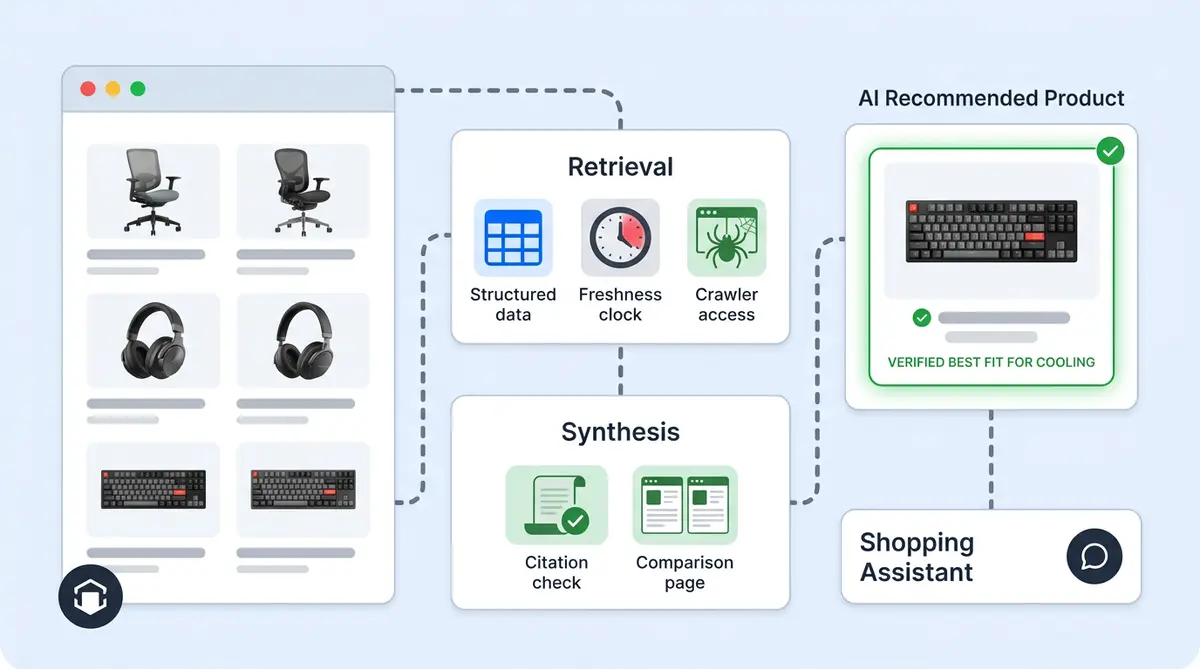
Alhena's 329-brand Agentic Commerce Report found that LLM and generative AI traffic converts at 2.47%, ranking and converting. It ranks fourth among all acquisition channels, above Google Ads (1.82%) and Meta Ads (0.52%). Yet most ecommerce teams have zero strategy for getting their products recommended by AI.
For how AEO fits alongside GEO and traditional SEO, see our AEO vs GEO vs SEO comparison.
Answer engine optimization (AEO) is the practice of optimizing your product content for generative engine algorithms. These generative AI systems and AI systems, structured data, and digital footprint so LLMs, answer engines, and tools like ChatGPT, Gemini, and Perplexity select and recommend your SKUs and have them cited in their ai-generated answers.
Schema markup is the technical foundation of AEO. Our schema markup for AI search guide covers the exact fields and formats ecommerce brands need.
This isn't a future trend. It's a current revenue channel that DTC brands are either capturing or ceding to competitors right now. In the digital marketing landscape, answer engine optimization matters. This topic every DTC growth teams should prioritize. Enterprise organizations and mid-market organizations need AEO solutions too. Here's the framework for winning it.
Brands selling across languages and regions also need language-specific source and content checks.
Why AEO Matters Specifically for Ecommerce
AEO for ecommerce is fundamentally different from AEO for publishers or SaaS companies. Publishers optimize domains. SaaS companies optimize brand pages. Ecommerce brands sell individual SKUs, which means optimization must happen at the product level, rather than the domain level.
When a shopper asks an answer engine "what's the best vitamin C serum for acne-prone skin," the AI doesn't send them to browse a skincare homepage. It recommends specific products for that specific query. You either win the recommendation or you're invisible. There's no position two, no "above the fold" advantage. The AI picks a handful of products and names them.
The data from Alhena's ecommerce clients confirms the scale of this opportunity. ChatGPT drives 97% of all LLM referral traffic in 2025. Through 2025 and into 2026, these LLMs are the new storefronts. LLMs are rapidly becoming primary shopping tools for users globally in a market to ecommerce stores. Users who engage with an AI shopping assistant on-site convert at 9.84%. Brands using proactive AI engagement see 5.5x higher interaction rates from users than those relying on passive chat widgets.
This means the entire AEO playbook for ecommerce comes down to one approach question: can answer engines confidently recommend your specific SKUs for the queries your customers are asking? If the answer is no, every strategy below exists to fix that.
The 5-Step AEO Framework for DTC Brands
Step 1: Schema Markup Foundation
Answer engines need machine-readable product data to make recommendations. Without structured data, they're guessing based on whatever text they can scrape from your pages. With it, they can extract price, availability, ratings, and specs programmatically and build confident answers.
Implement Product, FAQ schema, Review, and HowTo schema on every PDP using JSON-LD format. Fill in every field: price, availability, SKU, brand, specifications, ingredients, dimensions, color variants. Partial schema is almost as bad as no schema. If an AI engine can't confirm a product's price or availability, it won't recommend it.
Think of structured data as the product information layer AI engines actually read. Your lifestyle photography, brand narrative, and editorial copy exist for human visitors. Schema markup exists for machines. Both matter, but only one determines whether AI recommends your offerings.
Alhena AI Visibility includes Rendering Analysis that shows exactly how AI engines read each of your product pages (see our <a href="https://alhena.ai/blog/aeo-faq-engine-product-questions-ai-search/">AEO FAQ engine guide</a> for the full playbook). Instead of guessing whether your schema is complete, with the right tools you can see the gap between what you've published and what AI engines actually extract. This turns answer engine optimization audits from a quarterly project into a continuous feedback loop for data management and feed management.
Step 2: Product Feed Optimization
Your approach to product feed optimization (Google Merchant Center, Shopify feed, or custom feed) is the single most important data source for AEO tools, optimization tools, and answer engine shopping platforms. ChatGPT Shopping, Gemini's shopping features, and Perplexity's Buy with Pro all pull directly from merchant feeds, not from your store’s HTML.
Every field in your feed needs to be thorough, accurate, and specific. "Blue shirt" is not a product title that wins AI recommendations. "Men's Slim-Fit Oxford Button-Down Shirt in Navy, 100% Cotton, Machine Washable" gives an AI engine enough specificity to match against detailed shopper queries.
Audit your feed for coverage against what AI shopping platforms actually extract. The fields that matter most: product title (descriptive, not branded shorthand), full product description, GTIN/UPC, brand, color, size, material, availability, price, shipping details, and product category. Missing fields mean missed recommendations.
Alhena's Rendering Analysis works here too. It shows how AI shopping models interpret your feed data per SKU, so you can identify which products have missing data before those gaps cost you citations and visibility.
Step 3: Content That Answers Purchase Questions
Product descriptions written for humans don't always work for AI engines. "Our luxurious formula melts into skin for a dewy, radiant glow" tells an AI engine nothing useful. "Lightweight gel moisturizer with 2% hyaluronic acid and niacinamide, formulated for oily and combination skin, fragrance-free, 50ml" gives it everything it needs to match against a shopper's query.
When you write and rewrite product content, rewrite to answer the questions users actually ask AI. Not "gentle formula" but "Is this safe for sensitive skin? Yes, this product is dermatologist-tested and free of parabens, sulfates, and synthetic fragrance." Add text-based FAQ sections. Also add a dedicated section with per product covering sizing, compatibility, ingredients, use cases, and comparisons.
Format counts. Conversational, search-ready, conversational content in Q&A-style format matches how answer engines prefer to deliver direct answers. Here’s an example of the clarity this provides: A question-answer pair on your PDP can be cited directly, or pulled into a featured snippet. Featured snippets and ai-generated answers both favor this format. Getting cited in direct answers and ai-generated answers. A paragraph of marketing copy can't.
Alhena's Shopping Assistant captures the actual questions shoppers ask about each product in real time. This first-party conversational data tells you exactly which purchase questions to answer on each PDP, eliminating guesswork from your content optimization.
Step 4: Build Off-Site Credibility
AI engines don't rely solely on your store's content. They cross-reference what third-party sources say about your products — editorial reviews, forum mentions, "best of" roundups, and expert recommendations all factor into whether an AI recommends your SKU. Building this off-site credibility layer is essential, but the tactics are distinct from on-site AEO. For a detailed breakdown of the seven source types AI engines actually index, see our GEO citation strategy guide.
Reviews and UGC signals also influence AI recommendations. For the full three-lever framework, see our guide on how AI chooses which products to recommend.
Step 5: Measure and Monitor
You can't improve what you can't measure, and most brands and their users are flying blind on AI visibility. They optimize product pages and feeds without any way to know whether AI engines actually recommend their items, for which queries, or how often.
Effective AEO measurement requires tracking. Success requires a systematic approach that requires commitment at the SKU level across multiple AI engines. Which of your products does ChatGPT recommend for "best running shoes for flat feet"? Does Gemini recommend the same ones? What about Perplexity? When a competitor launches a new product, does your citations and visibility drop?
This is where Alhena AI Visibility closes the loop. It provides SKU-level tracking across ChatGPT, Gemini, and Perplexity, showing exactly which SKUs get cited and recommended for which queries. Combined with Alhena's on-site Shopping Assistant conversion data, you get a closed-loop view from AI search visibility to on-store engagement to purchase. No single other tool connects external AI visibility with first-party shopping assistant data in a single, unified, single-pane platform.
Schema and Product Feed Tactics That Actually Move the Needle
Not all structured data is created equal. AI engines weight certain Product schema fields more heavily when constructing recommendations.
The fields answer engines weight most for citations:
- name: Descriptive product name with key attributes (not just brand + model number)
- description: Specification-rich, 150-300 words, covering materials, use cases, and differentiators
- brand: Explicit brand entity, not just text (use @type: Brand)
- offers: Complete with price, priceCurrency, availability, and itemCondition
- aggregateRating: Star rating plus review count. AI engines heavily favor products with social proof signals
- review: Individual reviews with author, datePublished, and reviewBody. The more detailed, the better
Customer reviews and user-generated content also shape AI answers. Learn more in our guide to leveraging reviews and UGC for GEO.
For a breakdown of the best tools to track your brand across AI engines, see our guide to AI search visibility tools.
FAQ schema outperforms generic content for AI citation because it pre-formats information in the exact question-answer format AI engines use to deliver responses. A product page with five schema-marked FAQ pairs about sizing, ingredients, compatibility, care instructions, and return policy gives an AI engine five ready-made answer snippets it can cite directly.
For product feeds, audit against what AI shopping platforms actually render. Pull your feed from Google Merchant Center and check every product for: title completeness (does it include product type, key attributes, and brand?), description quality (does it answer focused, purchase-intent questions?), image quality (high resolution, white background, multiple angles), and attribute coverage (color, size, material, GTIN, gender, age group where applicable).
The gap between what you think your feed contains and what AI engines actually extract is often significant and costly. The gap is significant and growing. Items you assume are well-represented may be missing critical fields that prevent AI recommendation. This is why rendering analysis matters: you need to see your products the way AI engines see them, not the way your merchandising team sees them.
The Measurement Layer Most Brands Are Missing
Here's the uncomfortable truth about AEO in 2026: most brands are optimizing blindly. They restructure product pages, enrich feeds, build citations regularly, and then have no way to verify whether any approach worked. Did AI engines start recommending their products? For which queries? How often? They don't know.
This measurement gap exists because traditional analytics tools weren't built for AI search. Google Analytics can tell you how many visitors came from ChatGPT (if you set up the right UTM tracking), but it can't tell you which of your 500 products ChatGPT actually recommends, or which competitor items it recommends instead of yours.
Without a visibility score or measurement framework, AEO in 2026 is guesswork at scale. You might spend months optimizing product feeds only to discover that AI engines still recommend a competitor for your highest-value queries. Or you might be winning recommendations you don't even know about, missing the chance to double down on what's working.
Alhena AI Visibility was built to solve this exact problem. It tracks your SKU visibility across ChatGPT, Perplexity, and Gemini at the SKU level, showing which products get recommended, for which queries, and how your citations and visibility change over time when you regularly monitor it.
What makes it different from generic AI monitoring tools is the closed loop. Alhena connects external AI visibility data with on-store shopping assistant conversion data, so you can trace the full path from "AI recommended this product" to "shopper engaged with our assistant" to "purchase completed." This first-party data advantage means you're not just tracking visibility. You're tying AI recommendations directly to revenue.
The DTC teams seeing the strongest AEO results are the ones that treat it as a measurable channel, not a hope-based SEO experiment. They monitor which SKUs AI recommends, identify gaps, fix misrepresentations, monitor competitor visibility, and optimize continuously based on real data.
Ready to see which of your products AI engines actually recommend? Explore Alhena AI Visibility or book a demo to see the full platform in action.
The data your AI assistant collects also powers post-cookie personalization. Learn how in our guide to building AI-powered personalization without third-party cookies.
Alhena AI
For beauty brands specifically, ingredient transparency is the single strongest driver of AI visibility, outweighing even ad spend by a factor of four.
Frequently Asked Questions
What is answer engine optimization for ecommerce?
Answer engine optimization (AEO) for ecommerce is the practice of optimizing product content, structured data, and digital footprint so AI engines recommend your specific SKUs in their generated answers. Alhena AI Visibility tracks this at the SKU level across ChatGPT, Gemini, and Perplexity, showing exactly which products get recommended.
How do AI engines decide which products to recommend?
AI engines select products based on schema coverage, product feed accuracy, content relevance to the query, and third-party citation signals. Alhena AI Visibility's Rendering Analysis and monitoring shows how each AI engine reads your product pages, so you can see exactly what missing data prevent recommendations.
Does AEO replace traditional SEO for ecommerce brands?
No. AEO builds on top of SEO. AI engines still use search indexes during the retrieval stage, so traditional rankings matter. AEO adds a synthesis layer where AI selects which products to cite. Alhena AI helps brands optimize for both by connecting AI visibility data with on-store conversion metrics.
What structured data do I need on product pages for AEO?
Implement Product, FAQPage, Review, and HowTo schema in JSON-LD format on every PDP. Fill in every field: price, availability, SKU, brand, specs, and aggregateRating. Alhena AI Visibility audits your schema implementation and shows which fields AI engines actually extract per product.
How do I measure whether AI engines recommend my products?
Track AI visibility at the SKU level across multiple engines. Alhena AI Visibility monitors which products get recommended for which queries across ChatGPT, Gemini, and Perplexity, then connects that data to on-store shopping assistant conversions for closed-loop revenue attribution.
How does product feed optimization affect AI recommendations?
AI shopping platforms like ChatGPT Shopping pull directly from merchant feeds, not store HTML. Sparse feeds mean invisible items. Alhena AI Visibility's Rendering Analysis shows how AI shopping models interpret your feed data per SKU, identifying gaps before they cost you visibility.
What conversion rate should I expect from AI-referred ecommerce traffic?
Alhena's 329-brand Agentic Commerce Report found LLM traffic converts at 2.47%, ranking above paid social and paid search. Shoppers who engage with Alhena AI's on-site Shopping Assistant convert at 9.84%, with proactive engagement driving 5.5x higher interaction rates.
How quickly can I see results from an AEO strategy?
Product feed and structured data improvements can show visibility changes within weeks as AI engines re-index. Citation building takes longer. Alhena AI Visibility provides continuous monitoring so you can track progress and identify which optimizations move the needle fastest.
Looking for industry-specific AI visibility tactics? Read our AEO and GEO playbook for home and garden playbook.
Once your on-site AEO is solid, the next step is generative engine optimization. Our GEO guide covers how to influence AI across third-party sources.