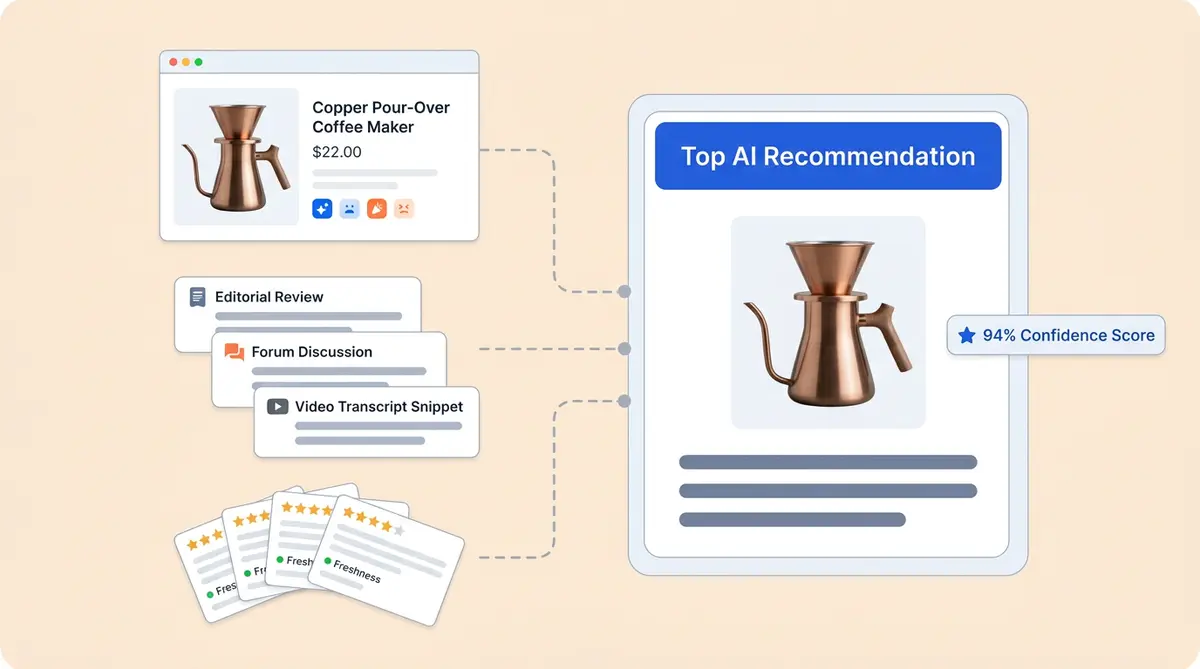
Product reviews influence AI recommendations through four signals: volume, recency, sentiment specificity, and cross-platform consistency. When ChatGPT, Gemini, or Perplexity has to choose between two comparable products, reviews are the tiebreaker. Schema gets you considered. Reviews decide who gets named.
Most ecommerce teams treat reviews as a conversion-rate asset. They sit on the product page, they lift add-to-cart, and that is the end of the brief.
That framing is now out of date. Reviews have quietly become a retrieval asset, and the brands treating them that way are the ones getting named when a shopper asks an AI assistant what to buy.
Why do reviews decide which product wins?
An AI assistant answering "best eye cream for dark circles" cannot return ten blue links. It has to name one, two, maybe three products.
That constraint changes everything. The model needs a reason to prefer one candidate over another, and the differentiating evidence is almost never on the brand's own page, because every brand claims to be the best.
Reviews are where the model finds an independent, specific, dated answer to "does this actually work for the person asking." That is the tiebreak.
The evidence backs this up. SE Ranking found that brands with active listings on review aggregators such as G2, Capterra, and Trustpilot earn roughly three times the ChatGPT citation rate of brands without them.
And the traffic that results is not incidental. Alhena's Agentic Commerce Report, built on transaction data from 329 ecommerce brands, puts LLM-referred conversion at 2.47%, ahead of Google Ads at 1.82% and Meta Ads at 0.52%.
Which review signals do AI models actually weigh?
Four signals, in the order they get applied.
Volume
Enough reviews to read as a real product, not an untested one.
Recency
Dated proof the product still performs, not proof it once did.
Specificity
Named conditions and use cases the model can match to a query.
Consistency
The same story across platforms, so the model is not forced to hedge.
Does review volume and recency actually matter?
Yes, and recency does more work than most teams assume. A product carrying 340 reviews from the past six months reads very differently to a retrieval system than one carrying 12 reviews from 2022.
Stale review profiles tend to get filtered before content quality is ever assessed. The model has no way to confirm the formulation, the fit, or the firmware is still the same product people praised three years ago.
Why does a specific review beat a five-star rating?
Because a star rating contains no matchable attributes. "Love it, 5 stars" gives a model nothing to connect to a query about sensitive skin, wide feet, or humid climates.
A review that names a condition, a duration, and an outcome gives the model a citable passage. When ChatGPT recommends something "for eczema-prone skin," it is drawing on reviews where someone said those words.
What happens when reviews conflict across platforms?
The model hedges, or it skips you. A product sitting at 4.6 on a marketplace, 4.5 on your own site, and 4.5 on Trustpilot creates a reinforcing pattern that raises recommendation confidence.
Strong marketplace reviews paired with complaint-heavy Trustpilot entries create uncertainty instead. Faced with uncertainty and a two-slot answer, the model reaches for the safer candidate.
Which review platforms earn the most AI citations?
Not all review surfaces carry equal weight. Independence is the variable that matters most, because a model discounts a rating you host and control.
| Surface | Why AI weighs it | Priority |
|---|---|---|
| Independent aggregators Trustpilot, G2, ConsumerReports | Verified-purchase rules and editorial standards make them a validation layer the brand cannot edit. | High |
| Category authorities Wirecutter, CNET, niche guides | Editorial testing produces comparison language that maps directly onto buyer queries. | High |
| Marketplace reviews Amazon and similar | High volume plus verified purchase, though heavily crowded at the category level. | Medium-high |
| Forums Reddit, Quora, category communities | Question-and-answer structure is clean to extract, and upvotes signal which answer is credible. | High |
| Video reviews YouTube, TikTok | Auto-generated transcripts turn one review into thousands of indexable words. | Medium-high |
| On-site reviews Your PDP | Necessary for schema and for on-page context, but discounted for independence. | Baseline |
A note on prioritisation: an analysis of 25,337 AI citations by Peec AI and DeltaV found product pages accounted for 16.3% of citations, behind articles at 23.7% and listicles at 19.6%.
Your product page is not the main event. It is one input among several, and usually not the deciding one.
How do you generate reviews AI models will actually cite?
Four changes to the request, not the volume target.
- Ask a specific question, not for a review. Replace "leave us a review" with "how did this work for your skin type?" or "what problem did this solve?" Specific prompts produce the specific answers models can match.
- Delay the request to match the product. Skincare needs two to three weeks before there is a result to describe. Electronics need long enough to test features. A request sent 24 hours after delivery reliably produces "arrived fast, looks good."
- Make photo and video reviews one tap. Visual reviews double as UGC, and platforms that display them keep shoppers on the page longer.
- Reply to every review, including the bad ones. A response containing a specific fix becomes indexable content in its own right, and a consistent response pattern reads as a trustworthy operator.
Alhena Review Management handles the timing and prompt logic so requests go out at the point where a customer actually has something specific to say.
How does UGC outside your site feed AI recommendations?
On-page reviews are one input. The wider internet is the other, and it is the one growing fastest in influence.
Why do YouTube transcripts outperform blog mentions?
YouTube auto-generates a transcript for every video. A ten-minute review from a creator with a modest following yields thousands of words of natural-language product description, including comparisons and edge-case usage.
That transcript is retrievable text. One detailed creator review can carry more weight than a dozen thin blog mentions, because it contains the situational detail those mentions lack.
How much do Reddit threads influence ChatGPT?
More than most brands expect. In the Peec AI and DeltaV citation study, Reddit appeared among the top-cited domains for seven of the eight brands analysed, and UGC domains as a group returned 1.16 citations per retrieval.
Threads are structurally ideal for extraction: a clear question, several lived-experience answers, and upvotes ranking which answer the community trusts. The caveat is authenticity. Astroturfing gets detected and does more damage than the mentions were ever worth.
Do TikTok and Instagram mentions count?
Indirectly, and increasingly. Captions, comments, and transcripts all produce indexable text, and a video with real view counts and an active comment thread forms a dense signal cluster around the product name.
Treat social as a signal amplifier rather than a citation source. It rarely gets cited outright, but it feeds the discussion that does.
What are the edge cases most guides skip?
| Situation | What actually happens | What to do |
|---|---|---|
| New product, almost no reviews | Volume gates you out before content is assessed. | Borrow authority: seed one or two editorial or creator reviews, and lean on brand-level aggregator ratings while SKU reviews build. |
| Reformulation or v2 launch | Old reviews describe a product that no longer exists, and models cannot tell. | Reset the review surface for the new SKU and state the change explicitly in copy so the transition is legible. |
| Strong ratings, no recommendations | Reviews are generic. High stars, zero matchable attributes. | Change the prompt, not the volume target. Ask about use case and condition. |
| One bad aggregator profile | Acts as a disqualifier and outweighs several positive surfaces. | Fix negative signals before building positive ones. Sequence matters here. |
| Seasonal or occasional products | Recency scoring penalises you in the off-season. | Time review requests to the usage window, not the purchase date. |
| Non-English markets | Recommendation strength varies by language, and English reviews do not transfer. | Build review depth per market. Check citations in the local language. |
How do you know whether any of this is working?
Not from rankings. Only 16.7% of sources cited in Google AI Overviews overlap with the top organic results for the same query, so a page-one position tells you very little about whether a model will name you.
The measurable unit is citation rate: for a set of buying-intent prompts, how often does your product appear, from which sources, and against which competitors.
Alhena AI Visibility tracks that at SKU level across ChatGPT, Gemini, Perplexity, and Google AI Overviews, and its External Source Monitoring shows which review surfaces are being pulled into those answers.
Where does the feedback loop close?
This is the part that compounds. Every conversation the Alhena Shopping Assistant has with a shopper captures first-party intent: the questions asked before buying, the objections raised, the comparisons made.
That language is the input to your review programme. If shoppers keep asking whether a product suits sensitive skin, that becomes the post-purchase prompt, which produces reviews containing the exact phrasing models match against real queries.
Your first 30 days
Run this against your top 20 revenue-driving SKUs, not the full catalogue.
- Test 20 buying-intent prompts across ChatGPT, Gemini, and Perplexity. Record whether you appear and which sources get cited.
- Audit review recency per SKU. Flag anything whose newest review is more than six months old.
- Sample 50 recent reviews and count how many name a condition, use case, or duration. Under 20% means your prompts are the problem.
- Claim and update your profiles on the two or three aggregators that matter in your category.
- Find and fix your weakest independent profile before adding anything new.
- Rewrite the post-purchase request into a specific question, and reset the send delay to match real usage.
- Reply to every unanswered review from the last 90 days, negatives first.
- Identify the three creators in your category whose videos already surface in AI answers.
- Re-run the same 20 prompts at day 30 and compare citation rate against the baseline.
Key takeaways
- Reviews are the tiebreak. Schema and citations qualify you. Reviews decide which of the qualified products gets named.
- Specificity beats stars. A review naming a condition, duration, and outcome is retrievable. A five-star rating with no detail is not.
- Recency is a filter, not a bonus. Stale profiles get dropped before content quality is assessed.
- Independence outranks volume. Verified third-party ratings carry more weight than the same number on a page you control.
- Fix negatives first. One weak independent profile disqualifies faster than three strong ones qualify.
- Measure citation rate, not rankings. Organic position and AI citation overlap far less than most teams assume.
See which reviews AI is actually citing
Alhena AI Visibility tracks your products across ChatGPT, Gemini, Perplexity, and Google AI Overviews at SKU level, and shows the exact sources behind every answer.
Frequently asked questions
Yes. AI engines weigh review volume, recency, sentiment specificity, and cross-platform consistency when selecting which products to name. Reviews function as the tiebreak between products with comparable structured data, because they are the only independent, dated evidence that the product works for the situation described in the query.
There is no fixed threshold, and volume alone is not what decides it. What matters is having enough recent reviews to read as an actively used product, combined with detail models can match to queries. A product with 60 specific reviews from the last quarter typically outperforms one with 400 generic reviews from two years ago.
They do, because marketplace reviews combine high volume with verified purchase. They are strongest as part of a consistent pattern across several surfaces. Marketplace strength paired with a weak independent profile elsewhere tends to make models hedge rather than recommend.
Yes. SE Ranking found brands with active listings on aggregators including Trustpilot, G2, and Capterra earn roughly three times the ChatGPT citation rate of brands without them. The advantage comes from source independence, since a model discounts a rating the brand hosts and controls.
Aim for a steady flow, with your newest review inside the last quarter. Recency functions as a filter rather than a bonus, so products whose most recent review is over a year old often get dropped before content quality is assessed at all.
It can, by borrowing authority. Editorial placement in a category buying guide, a detailed creator review, and brand-level aggregator ratings all provide independent evidence while SKU-level reviews accumulate. Alhena AI Visibility shows which of those sources are already being cited in your category.
YouTube does so directly, because auto-generated transcripts turn a single review into thousands of words of indexable, natural-language product description. TikTok and Instagram contribute more indirectly through captions, comments, and the wider discussion they generate around a product name.
Yes, on two counts. A response containing a specific resolution creates additional indexable content on a page models already retrieve from, and a consistent pattern of engagement reads as a more trustworthy operator than silence in the face of complaints.
Broader generative engine optimization covers structured data, external citations, and technical readiness across your whole catalogue. This focuses on one layer of that, the review and UGC signals models use to break ties. For the full framework, see the GEO for ecommerce websites guide and the GEO citation strategy guide.