Every new market your ecommerce brand enters traditionally requires hiring representatives who speak that language. Serving 10 markets through your website means staffing 10 customer service teams, each needing product knowledge training, policy familiarity, and shift coverage across time zones. At an average cost of $35,000 to $55,000 per agent annually, supporting even five languages with two agents per language runs $350,000 to $550,000 per year before management overhead. Multilingual AI solutions collapse this cost structure by handling 90+ languages from a single deployment, removing language barriers, turning what used to be an ecommerce business headcount problem through automation and AI-driven automation, turning support automation into a configuration one that improves the entire shopping and checkout experience for online ecommerce sales. Global companies that use ai for multilingual support see higher purchase intent from international shoppers.
How a Multilingual Chatbot Detects Language Automatically
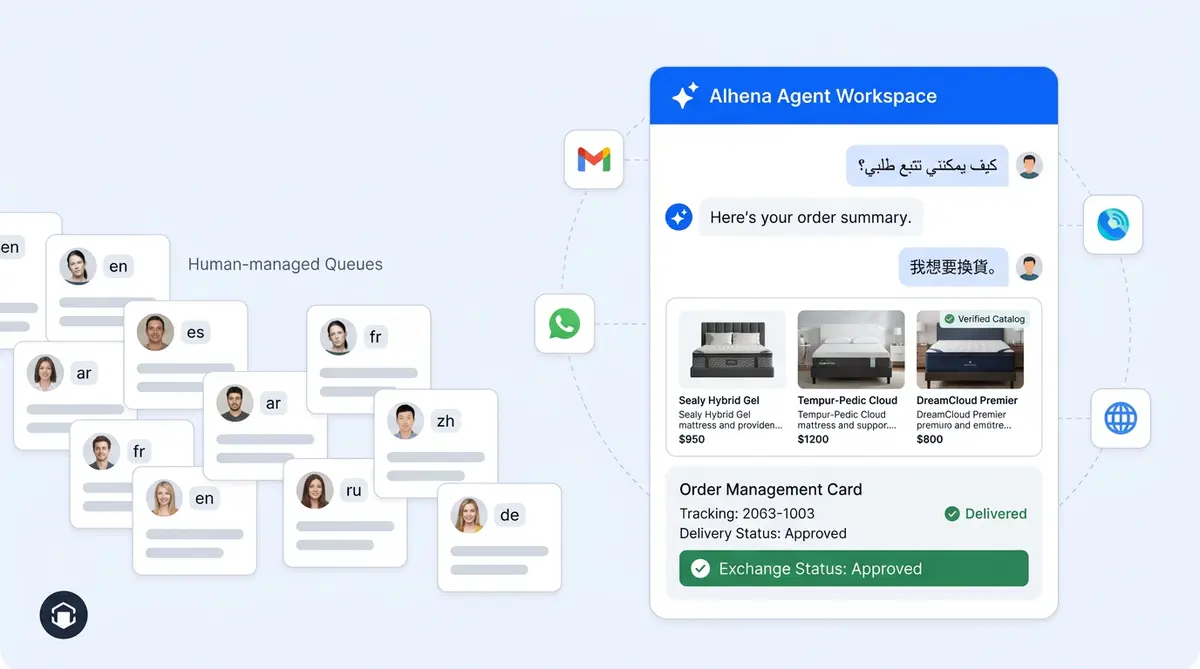
When a shopper types their first message, the multilingual chatbot identifies the language instantly. No dropdown menus, no pre-routing, no "select your language" screens. A Portuguese shopper on your storefront gets Portuguese responses. A French shopper on the same storefront gets French. Detection happens at the message level using natural language processing, so the system handles code-switching too. Bilingual shoppers who mix English and Spanish mid-conversation don't break anything. The AI picks up on shopper intent, follows along and responds in the shopper's native language, whichever language they shift to.
This is different from routing-based setups where customers get sent to language-specific queues. There are no queues. Integration is direct: one AI system powered by natural language processing and machine learning. These ai systems adapt to each storefront (NLP) and advanced NLP models that read, understands, and replies in the detected language within seconds based on each shopper’s input, 24 hours a day, across every channel.
Four Localization Layers That Go Beyond Translation
Basic machine translation tools convert words from one language to another, but they fail to adapt to ecommerce context. Ecommerce localization requires far more context. Without proper context, translations miss the mark. Context includes. Here are four layers that multilingual AI must handle to actually serve international shoppers well.
Currency and Pricing Context
When a German shopper asks "Is this worth the price?" the AI must translate that question and reference the EUR price from their storefront, not the USD price from your US catalog. Regional pricing expectations matter too. A shopper in Southeast Asia has different value perceptions than a shopper in Scandinavia. The AI must understand the shopper's intent, pull the correct localized price and frame its response around that number.
Sizing and Measurement Localization
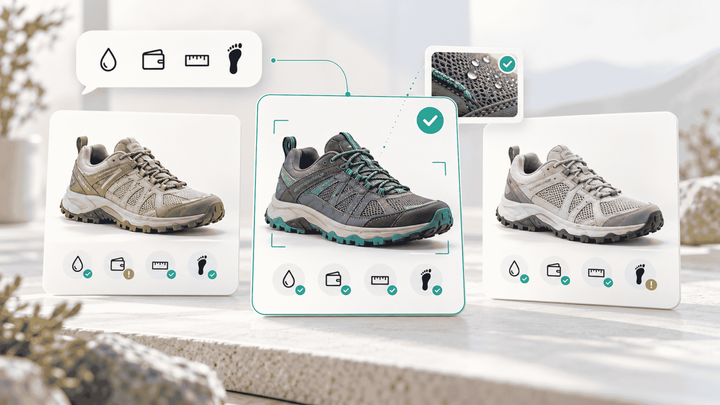
A UK shopper asks about shoe size in UK sizing. A US shopper uses US sizing. A European shopper uses EU sizing. The AI must convert and recommend in the correct local system without the shopper specifying which system they use. Their input language and storefront region tell the AI which sizing standard to apply. Getting this wrong doesn't just confuse shoppers. It drives returns.
Shipping and Delivery Expectations
Delivery timelines, carrier names, customs information, and return shipping processes differ by market. A shopper in Germany expects DHL references and 2 to 3 day delivery windows. A shopper in Australia expects different carriers and longer transit times. The AI must surface the correct regional logistics information rather than defaulting to US shipping details. This is where tools like DeepL and others, basic machine translation services and generic machine translation APIs, and standard customer service tools fail: they translate the words "free shipping" but still show US-specific delivery estimates.
Cultural Communication Norms
Directness varies by market. A German shopper expects precise, factual answers. A Japanese shopper expects formal, respectful phrasing. A Brazilian shopper expects warmth and informality. Multilingual AI adapts communication style by detected language, not just translates the same English script into different words. This is localization at the tone level, and it directly affects customer experience, trust, and conversion rates. A poor customer experience in one language damages your brand globally. Consistent customer experience across languages builds loyalty.
The ROI Comparison: AI Deployment vs. Language-Specific Staffing
Consider an enterprise ecommerce business (or any enterprise) selling into 10 countries. The traditional approach requires roughly 20 language-specific agents (two per language for shift coverage), costing $700,000 to $1.1 million annually in salaries alone. Add hiring costs, training on your product catalog, policy updates per region, and manager overhead, and the true cost climbs higher.
A single deployment of multilingual chatbot deployment (not 20 separate AI agents per language) handling 80% of conversations across those same 10 languages delivers:
- Instant response times versus queue-dependent wait times that vary by language availability
- 24/7 coverage across all time zones without shift scheduling, overtime, or holiday gaps
- Consistent product knowledge across every language because the AI trains from the same catalog, not from separate training sessions per team
- Scalability to add new languages without hiring, training, or onboarding delays. Entering a new market takes days, not months of recruitment. The model is infinitely scalable. Unlike hiring, which hits scalable limits fast, scalable AI chatbots at every new language
The annual cost savings from AI-powered multilingual support and AI-powered ecommerce automation typically run into six figures. Brands redirect that budget into growth channels, expand their customer base, inventory, or marketing for the new regions they can now afford to serve.
The Human Layer That Multilingual AI Doesn't Replace
Not every conversation belongs to AI. Complex escalations, emotionally sensitive interactions, and VIP clienteling still benefit from native-speaking human staff. The split works out to roughly 70 to 80% of conversations handled by AI (order status, product questions, sizing help, shipping inquiries, return requests) and 20 to 30% routed to your human team for interactions that require cultural nuance and human judgment.
The difference is that your multilingual human agents now focus exclusively on high-value conversations instead of answering "Where is my order?" in five languages all day. Their expertise gets applied where it matters most. AI-powered chatbots and agentic AI agents handle the routine multilingual interactions. Natural language processing ensures accuracy across global markets. Human agents focus on conversations where native language fluency and cultural context matter most.
How Alhena AI Powers Multilingual Chatbot Experiences
Alhena AI supports 90+ languages natively across web chat, email, Instagram DMs and WhatsApp, and voice. Language detection is automatic from the first message, with no configuration per language required.
On the ecommerce localization side, Alhena's Product Expert Agent adapts currency context, sizing references, sizing conversions, and shipping context per storefront. The AI models learn from your verified product data on every site, so accuracy is guaranteed. This level of accuracy means every product recommendation, sizing guide, and order update is correct. Accuracy with no hallucinations regardless of language. The Order Management Agent handles post-purchase queries (tracking, returns, exchanges) with the same regional accuracy.
Brand voice stays consistent across every language thanks to built-in capabilities. These capabilities extend across tone, formality, and regional phrasing. The language capabilities of modern AI through configurable tone and personality settings. You define how your brand sounds, and Alhena maintains that voice whether the conversation is in Korean, Arabic, or Portuguese.
When conversations do escalate, Agent Assist provides real-time translation for your human team. If a Spanish-speaking customer gets routed to an English-speaking agent, Agent Assist translates both directions live during the handoff. Your agents don't need to speak the customer's language to deliver a personal, informed response.
Brands using Alhena have seen measurable results across markets. Tatcha achieved a 3x conversion rate and 38% higher average order value. Manawa, serving customers across multiple European markets, cut support workload by 43% and reduced response times from 40 minutes to under 1 minute. Crocus reached an 86% deflection rate while maintaining 84% customer satisfaction.
From Headcount Problem to Deployment Problem
Multilingual chatbot technology used to scale with payroll. Every new language meant new hires, new training cycles, and new scheduling complexity. That model capped how many markets a brand could realistically serve.
Now it scales with deployment, letting you expand into new regions without friction. Brands that use AI and consistently use AI-first support to use AI for every routine conversation instead of hiring per-language across languages redirect six figures of annual staffing cost into growth while delivering faster, more consistent support in every region they enter. The question isn't whether you can afford multilingual AI. It's whether you can afford not to have it.
Ready to replace language-specific hiring with a single AI deployment? Book a demo with Alhena AI or start free with 25 conversations. Use the ROI Calculator to see your projected savings.
Alhena AI
Frequently Asked Questions
How does automatic language detection work in multilingual chatbot?
Alhena AI identifies the shopper's language from their first message using real-time language detection at the message level. There are no dropdown menus or pre-routing steps. The AI responds in the shopper's preferred language with speed that ensures no shopper waits and can handle mid-conversation language switching when bilingual shoppers mix languages.
Can Alhena AI handle languages that nobody on our team speaks?
Yes. Alhena AI is an AI-powered multilingual platform that supports 90+ languages. As one of the leading AI-powered chatbots for ecommerce, Alhena uses natural language processing and real-time translation to break through language barriers in global markets and deliver native language accuracy to every shopper. Unlike generic chatbots, Alhena's AI agents are purpose-built for ecommerce natively, so your team doesn't need to staff speakers for every market you serve. For the 70 to 80% of routine conversations (order status, sizing, shipping, returns), the AI handles them fully in any supported language. When escalation is needed, Agent Assist provides live translation between the customer's language and your agent's language.
How does Alhena AI maintain brand voice across different languages?
Alhena AI uses configurable tone and personality settings that apply across all languages. You define your brand voice once, and the AI adapts phrasing, formality, and communication style to match both your brand standards and the cultural norms of each detected language. A German shopper gets precise, factual responses while a Brazilian shopper gets warmer, more informal phrasing.
Do we still need human agents if we deploy multilingual chatbot?
Yes, but fewer and focused on higher-value work. Alhena AI handles the 70 to 80% of conversations that are routine across all languages. Your multilingual human team members focus on the 20 to 30% that require cultural nuance, emotional sensitivity, or VIP clienteling. The result is a leaner team doing more impactful work rather than answering repetitive questions in five languages.
How does the cost of multilingual chatbot compare to hiring language-specific agents?
Supporting five languages with two agents each costs $350,000 to $550,000 per year in salaries before overhead. Scaling to 10 languages doubles that. A single Alhena AI deployment covers 90+ languages with 24/7 availability, instant response times, and consistent product knowledge at a fraction of that annual cost. Most brands see six-figure savings in the first year.