Black Friday 2025 generated $11.8 billion in U.S. online sales, a 9.1% year-over-year increase according to Adobe Analytics. Mastercard SpendingPulse put total e-commerce growth at 10.4% YoY. Those numbers are already in the rearview mirror, which means BFCM 2026 will be bigger, spikier, and less forgiving for brands that can't answer shopper questions fast enough.
This post breaks down three data points every e-commerce team should plan around, and shows where AI shopping agents fit into the picture.
10.4% YoY Growth and the Question Volume It Creates
Ecommerce isn't just growing in dollars. It's growing in conversations. Every new consumer who lands on your online store during BFCM brings pre-purchase and discovery questions: "Does this run true to size?" "Will it arrive by December 23?" "Can I stack this promo code with the sitewide campaign deal?"
When GMV climbs 10% year over year, the volume of those questions climbs with it. Static FAQ pages and keyword-triggered chatbots don't keep up, because shoppers ask the same question in dozens of different ways. The gap between what a shopper asks and what your knowledge base can answer is where revenue and retention leaks.
Brands with proven results deployed AI shopping agents during BFCM 2025 saw over 10% of their peak-season revenue come from shoppers who engaged with those agents, according to data from Constructor. That's not a support cost saving. That's a new revenue and retention channel.
The 80% Weekend Surge Pattern
BFCM volume doesn't arrive in a smooth curve. Data from Constructor's 2025 analysis showed an 80%+ boost in shopper searches on Saturday, Sunday, and Cyber Monday compared to typical late-October baselines. U.S. search traffic surged 90 to 130% above November averages on Black Friday itself. Some retailers saw 4x spikes in search activity within minutes of a campaign launch.
Support and sales teams are staffed for averages, not peaks. When traffic doubles or triples overnight, wait times balloon, agents get pulled into repetitive pre-sales questions, and complex tickets sit in a queue. The consumer who needs sizing help at 11 PM on Black Friday isn't going to wait until Monday morning.
This is why AI-powered support during peak season has become table stakes. An AI agent that handles product questions, shipping cutoff dates, and promo-code logic at 2 AM works the same as it does at 2 PM, with no overtime budget.
Cart Abandonment: Every Empty Cart Is an Unanswered Question
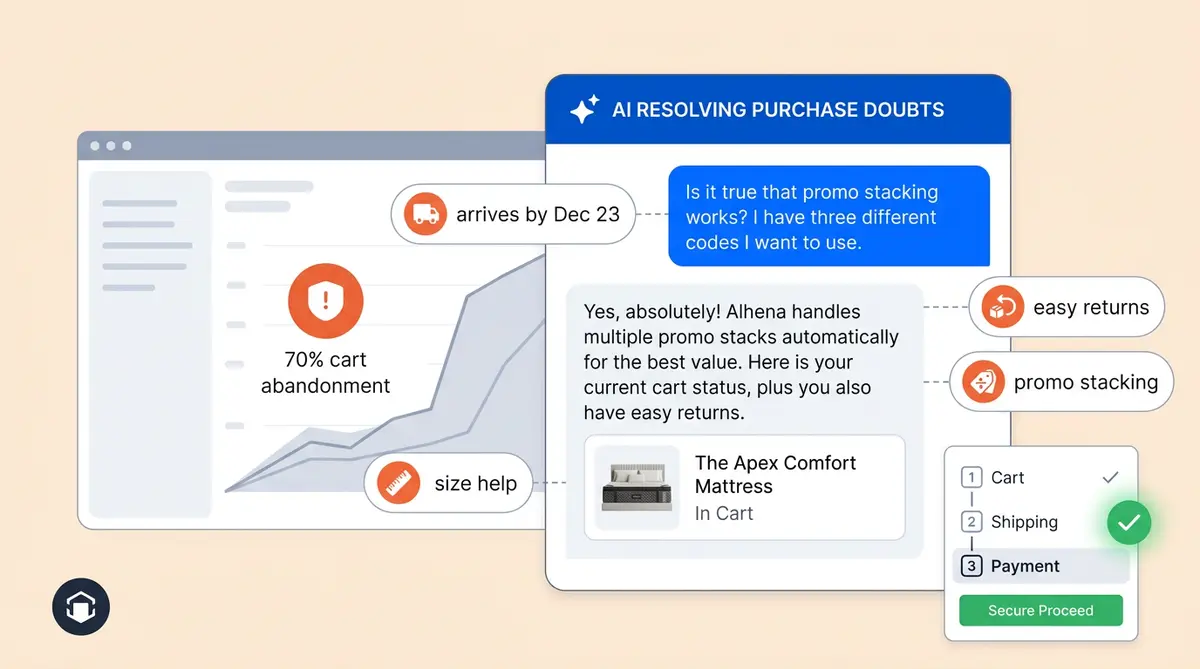
Baymard Institute's aggregated research puts the average online cart abandonment rate at roughly 70%. During BFCM, the causes narrow to a handful of answerable questions: unclear shipping costs, return policy confusion, sizing doubt, and promo-code friction.
Each of those is a question an AI agent can resolve in seconds. When a shopper asks "Will this arrive before Christmas?" and gets a grounded, accurate answer pulled from your real shipping data, hesitation drops. When the agent confirms, "Yes, your 20% code stacks with the sitewide campaign deal," the shopper checks out instead of opening a new tab to comparison-shop.
Alhena AI's Shopping Assistant is built for exactly this kind of pre-purchase guidance. It pulls answers from your catalog, policies, and live inventory, so shoppers get specific answers instead of generic deflections. Brands like Tatcha saw a 3x conversion rate and 38% higher AOV after deploying it, while Crocus achieved an 86% deflection rate with 84% CSAT.
For a deeper look at AI-driven cart recovery tactics, see our complete guide to AI abandoned cart recovery.
What AI Agents Actually Do During BFCM
The value of AI during peak season isn't "scalability" in the infrastructure sense. It's conversation coverage. Here's what that looks like in practice, and these examples show how Alhena AI handles it:
- Pre-sales question handling at volume. The Product Expert Agent answers product, shipping, and policy questions grounded in your verified data, not hallucinated guesses.
- Automatic agent routing. Product questions go to the Product Expert Agent. Order status, returns, and tracking go to the Order Management Agent. No human triage needed.
- Action, not just answers. Alhena's agents can look up orders, check inventory, recommend products, and populate carts. That turns a support interaction into conversions.
- Human handoff with full context. When a shopper needs a person, the conversation transfers without making them repeat themselves.
- Revenue attribution. Every conversation that leads to a cart or checkout event is tracked, so you know exactly what your AI generated during the peak.
If you're planning your BFCM AI setup, our BFCM 2026 AI Playbook covers the full preparation checklist.
A Pre-BFCM Planning Checklist
Start now, not in October. Build your plan early. Six months of preparation to build readiness beats six days of panic.
- Audit last year's campaign and ticket data. Which pre-purchase questions drove the most volume? Those are the ones your AI should handle first.
- Update your knowledge base. Shipping cutoffs, return windows, and promo rules should live in your AI's knowledge base, not just on a marketing landing page.
- Set handoff triggers. Define when conversations should escalate: refund requests above a threshold, VIP customers, complaints that need a human touch.
- Instrument cart and checkout events. Without event tracking, you can't attribute revenue to AI conversations. Use Alhena's ROI Calculator to model the impact before you deploy.
- Plan a post-BFCM review. Feed the top unanswered questions from peak season back into your AI's training loop to improve performance for the next surge.
For broader ROI planning beyond BFCM, our 2026 Ecommerce AI ROI Playbook breaks down the metrics that matter.
The Bottom Line
BFCM 2026 will push more traffic, more questions, and more urgency through your online store than any previous year. The brands that win won't just have fast servers. They'll have AI agents that answer the right question at the right moment, turning hesitation into checkout.
The data is clear: 10.4% growth, 80%+ traffic surges, and billions in abandoned carts. The question is whether your store is ready to handle the conversations that come with it.
Ready to prepare your store for BFCM 2026? Book a demo with Alhena AI or start for free with 25 conversations.
Frequently Asked Questions
How much did Black Friday 2025 generate in online sales?
Adobe Analytics reported $11.8 billion in U.S. online sales on Black Friday 2025, a 9.1% year-over-year increase. Mastercard SpendingPulse measured total e-commerce growth at 10.4% YoY across the full day.
How much does BFCM traffic surge compared to normal levels?
Constructor data from BFCM 2025 showed an 80%+ boost in shopper searches on the Saturday-through-Cyber-Monday stretch compared to late-October baselines. U.S. search traffic surged 90 to 130% above November averages on Black Friday itself.
What is the average cart abandonment rate during BFCM?
Baymard Institute puts the average online cart abandonment rate at roughly 70%. During BFCM, the primary causes narrow to shipping cost confusion, sizing doubt, return policy uncertainty, and promo-code friction, all of which AI agents can address in real time.
How do AI shopping agents help during Black Friday and Cyber Monday?
AI shopping agents handle pre-purchase questions at scale, answering product, shipping, and policy queries 24/7 without wait times. Alhena AI routes questions to specialized agents (Product Expert and Order Management), resolves cart hesitation in real time, and tracks revenue attributed to each conversation.
When should ecommerce brands start preparing their AI for BFCM 2026?
Start at least three to six months before peak season. That gives you time to audit last year's ticket data, update your knowledge base with current shipping cutoffs and promo rules, set handoff triggers, and instrument cart and checkout events for revenue attribution.
How much revenue can AI agents generate during BFCM?
Constructor reported that over 10% of BFCM 2025 revenue came from shoppers who engaged with AI shopping agents. Alhena AI customers like Tatcha have seen 3x conversion rates and 38% higher AOV after deployment, with revenue attribution built into the analytics dashboard.
Does Alhena AI work with Shopify and other ecommerce platforms during peak traffic?
Yes. Alhena AI integrates with Shopify, WooCommerce, Shopify Plus, Magento, and Salesforce Commerce Cloud. It also connects with helpdesks like Zendesk, Gorgias, and Freshdesk. The system handles peak-volume conversations without requiring additional infrastructure setup from your team.