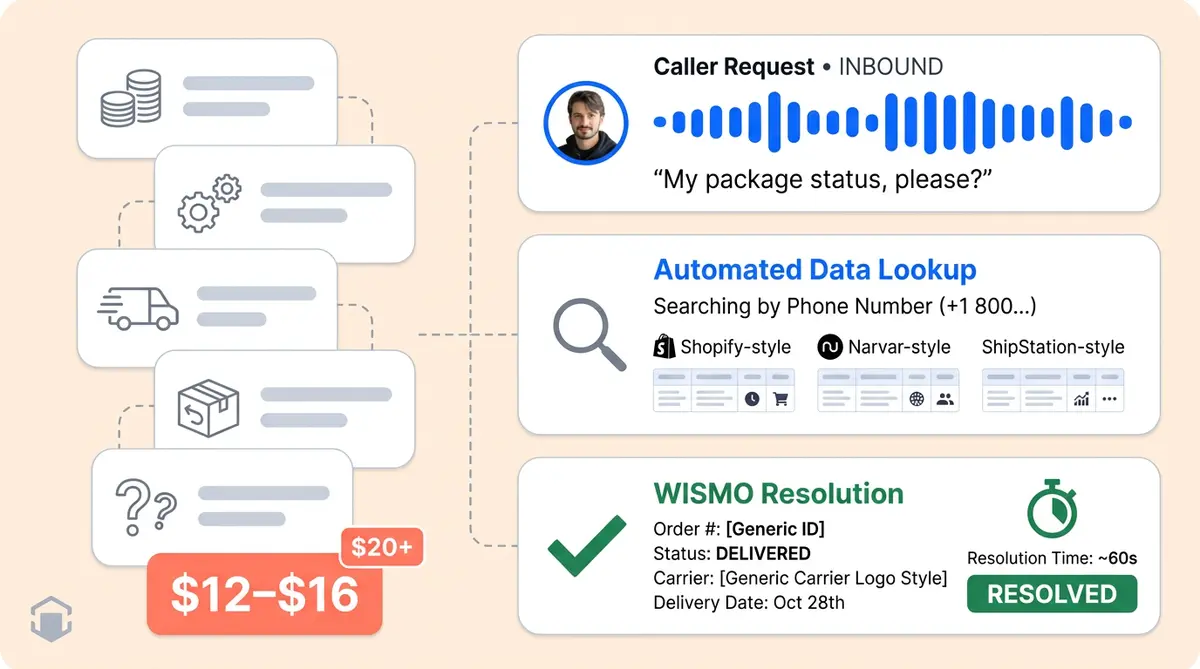
Industry benchmarks for 2026 put e-commerce voice support interactions at $9 to $16 per resolved contact for the average retailer. Chat sits at $3 to $5. Email lands around $4 to $7. Self-service costs under a dollar. That cost gap between voice and every other retail support channel keeps widening as brands automate chat and email with AI, while phone lines still rely on live agents. This post breaks down what a voice commerce call actually costs, line by line, and why voice assistants and voice bots represent the highest ROI automation target left in e-commerce.
Where the Money Goes in a Single Phone Call
The per-call price tag isn't just agent salary divided by calls handled. Five cost layers stack on top of each other.
- Agent labor. An e-commerce customer service call typically runs 4 to 6 minutes. At a loaded hourly wage of $18 to $28 (roughly $0.30 to $0.47 per minute), agent cost alone eats $2 to $4 per call.
- After-call work. Agents spend 1 to 3 minutes logging info, updating tickets, and tagging issues. That's hidden handle time that still costs the payroll.
- Peak-load staffing. Phone queues from online store shoppers demand real-time coverage. You can't batch calls like emails. Scaling for Monday morning spikes or holiday surges means paying agents to sit idle during off-peak windows and still missing calls during unexpected surges. Every missed call is a missed sale.
- Turnover. Call centre attrition typically runs 30% to 45% annually, costing thousands per month in replacement hiring. Each new hire needs weeks of training before handling customer service calls solo.
- Telephony and platform fees. Per-minute carrier charges ($0.02 to $0.08 per minute for inbound), IVR licensing, recording storage, and QA monitoring and AI tools add $0.50 to $1.50 per interaction.
Total: $9 to $16 for a routine service call. High-complexity calls involving returns, checkout errors, or payment disputes push past $20.
The Voice Commerce Cost Gap Is Getting Wider
Chat automation has compressed digital channel costs fast. Crocus hit an 86% deflection rate on chat. Puffy automated 63% of inquiries with 90% CSAT, proving AI improves customer experience. Those results push chat cost-per-contact toward $2 to $3.
Voice hasn't seen the same drop. Most voice AI solutions in the market are still menu-based IVR trees that frustrate callers into pressing zero. The result: your most expensive customer service channel is also your least automated.
If you've already pushed chat to 80% containment, squeezing another 5% saves pennies. Automating even 30% of voice calls at $12 each saves real money. That's the math that makes voice the best commerce channel to tackle next.
What a Voice AI Commerce Assistant Changes
The shift isn't about a smarter IVR menu. It's about putting a voice agent on the line that does what your human support teams do: look up orders, initiate returns, modify shipments, answer product questions, add items to cart, or guide shoppers through checkout.
This voice assistant runs on the same agent architecture that powers chat and social commerce. That creates several cost structure benefits:
- No peak-load staffing. Voice agents handle calls at 2 AM and on Black Friday without overtime or scaling headaches.
- No after-call work. Every conversation is transcribed, tagged by intent for instant retrieval, and logged to your helpdesk. When escalation happens, the human agent receives the full customer info, conversation history, and context via smart escalation, so there is no manual note-taking. This applies to both inbound service calls and outbound calls for delivery updates.
- No training ramp. You don't need to build separate voice scripts. Update a return policy once, and the voice bot pulls from the same knowledge base as chat, email, and the support concierge.
- No language premium. Alhena supports 90+ languages natively, delivering personalized commerce experiences within the same voice assistant. These AI tools handle calls in any language from day one.
Four Voice Commerce Use Cases With the Biggest Cost Payoff
Not every call type fits AI equally. These are the top use cases where ROI is highest, targeting high-volume, structured interactions the voice bot can resolve end-to-end for online store shoppers.
WISMO (Where Is My Order). The most common e-commerce call. The AI bot connects to Shopify, Narvar, or ShipStation, reads tracking info, and provides instant resolution within 60 seconds.
Returns and exchanges. Verify the order, confirm the item, check eligibility, and generate the label. Alhena's Order Management Agent handles the full conversation flow through your existing online store integrations.
Order and checkout modifications. Time-sensitive changes (often triggered by outbound calls about delivery issues) that drive callers to pick up the phone. Voice agents resolve these with personalized responses based on order history.
Subscription changes. Pause, skip, or cancel requests are high-churn moments. Handling them on the call helps convert and retain customers in the funnel.
To learn more about when voice AI makes sense for your brand, see our Voice Readiness Framework. If you're weighing voice AI against outsourced agents, the Outsourcing vs. AI cost framework covers that comparison.
The Bottom Line
Voice is the most expensive support channel in e-commerce and the least automated. That combination makes it the single biggest cost reduction opportunity for support teams that have already improved chat and email. Whether you run a Shopify store, a Magento commerce platform, or a DTC online store, voice AI changes the math. Deploy a voice assistant that resolves issues, not one that just routes calls.
Ready to see what voice AI would save your team? Book a demo with Alhena AI or start a free trial with 25 conversations.
Frequently Asked Questions
How much does a phone call cost in ecommerce support?
Industry benchmarks for 2026 put ecommerce and commerce voice support at $9 to $16 per resolved contact for the average retailer. High-complexity service calls can exceed $20. AI chatbot and voice bot-assisted channels, by comparison, resolve at $2 to $3 per contact.
Why is voice the most expensive customer service channel?
Five cost layers compound: agent labor and handle time, after-call documentation work, peak-load staffing requirements that can add $5,000 to $15,000 per month in excess labor, high turnover (30-45% annually), and telephony platform fees. Phone queues from shoppers demand real-time coverage that can not be batched, leading to missed calls during peaks.
What customer service call types work best for voice AI?
WISMO (where is my order), returns initiation, order and checkout modifications, and subscription changes. These are high-volume, structured use cases where the voice bot can resolve end-to-end for online store shoppers using existing order, cart, and commerce system integrations like cart data, tracking info, and store records.
Does Alhena Voice AI replace the call center?
No. Alhena uses a hybrid model: the voice assistant resolves routine calls autonomously and escalates complex issues to humans with full transcript and context. The goal is cost reduction on repetitive inquiries while maintaining personalized, instant customer service for every commerce shopper, not total replacement.
How does Alhena Voice AI differ from traditional IVR?
Traditional IVR and legacy voice assistants route calls through menu trees. Alhena Voice AI is a smart, conversational voice assistant, virtual agent, and commerce bot that can look up orders, initiate returns, modify shipments, and answer product questions using NLP and natural language processing for personalized, smart interactions. It runs on the same voice assistant and agent architecture as Alhena chat and email, so there is no separate knowledge base to maintain, which cuts ongoing maintenance to near zero.
How quickly can voice AI show positive ROI?
Brands with high WISMO and returns call volume typically see ROI within weeks. If 30% of your voice contacts cost $12 each and the AI resolves them at a fraction of that, the monthly savings compound fast compared to hiring and training new agents against the flat platform fee. Any retailer or retail brand with high call volume benefits.